VIP stands for "very important person," a label for someone given special treatment because of rank, influence, or importance, and in business it means preferential access for selected customers. The English initialism dates to 1933.
If the only change is a slightly larger points multiplier, why call anyone a VIP at all?
Most owners treat the letters like a sticker on a loyalty tier. They add a small discount and hope regulars feel chosen. Customers notice when the visit stays the same: same queue, same booking window, same drink.
A clearer way to think about what is VIP is as a design choice. You pick who qualifies, what they can reach that others cannot, and how you explain that without treating lighter spenders as lesser. Access and recognition usually beat a permanent price cut, especially when the margin on a coffee or a cut and color is already thin.
The practical questions are which benefits a small budget can support, and how a program stays fair when it uses customer data.
Table of Contents
- What VIP Stands For and Where the Term Comes From
- How VIP Status Works in Loyalty Programs
- Benefits That Make VIP Feel Exclusive
- VIP Examples From Travel, Events and Local Shops
- How to Set Up a Small Business VIP Tier
- Common VIP Mistakes and Privacy Limits
What VIP Stands For and Where the Term Comes From
Say you're at an airport. One traveler walks past a long queue because their name sits on a list. Everyone else can see why. That person isn't holding a government rank for the afternoon. The airline decided they matter enough, on this trip, for reserved access, a quieter space, or a staff member who already knows the booking.
VIP is an abbreviation for "very important person." It describes someone granted special treatment because of social rank, influence, public prominence, or importance in a particular setting. The Etymonline record drawn from the Oxford English Dictionary places the earliest documented English usage in 1933, when "VIP" or "V.I.P." appeared as an initialism for "very important person" or "personage."
The expression didn't catch on overnight. Broader popularity grew after World War II, especially through military and aviation use. Selected people were separated from the general public and given advantages such as reserved access, extra comfort, security, or dedicated services. By the second half of the 20th century the label had moved past high-ranking passengers and military figures. It covered heads of state, senior politicians, celebrities, religious leaders, wealthy individuals, and other notable guests.
A label, not a legal rank
In commercial use today, the label generally signals preferential access rather than a legally defined status. What counts as VIP depends on the organization, the event, the venue, or the service provider. A festival can sell a separate entrance. A neighborhood bakery can offer first pick of a seasonal loaf. Neither version is a universal rank or a formal title.
That flexibility is what a merchant needs. You can define your own version, as long as customers can tell what the status changes about the visit.
VIP is a flexible customer-service category: preferential access an organization chooses to grant, not a legal title anyone can claim.
How VIP Status Works in Loyalty Programs
A restaurant VIP room uses the same kitchen as the main floor. The food isn't a secret menu invented for one table. What changes is a reserved table and a host who knows your name. Loyalty programs work the same way. VIP status sits above base membership. The till, the product, and the staff stay shared. The tier adds treatment the base card doesn't include.
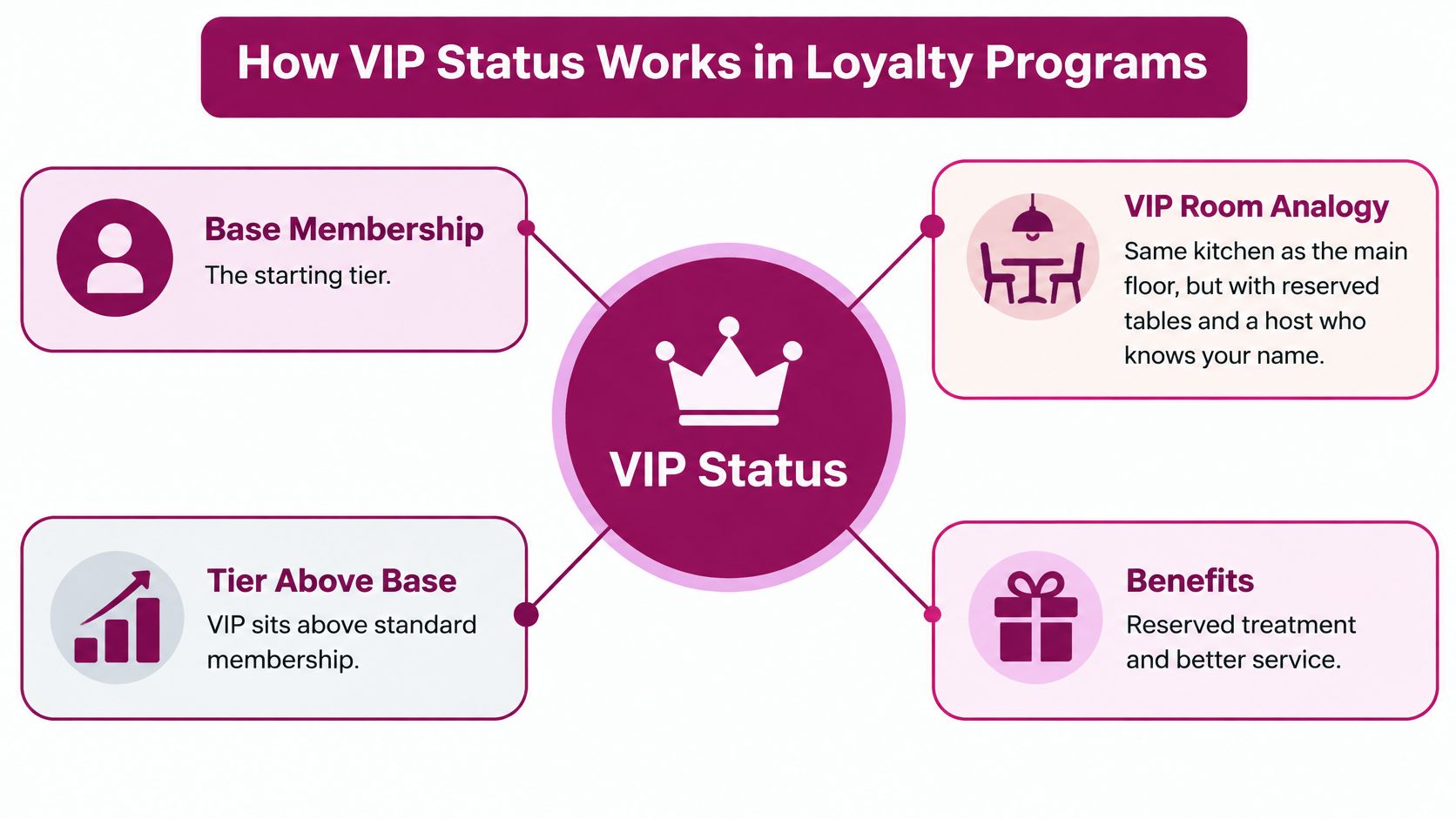
Three parts have to exist or the tier is only a name.
- An entry rule the customer can understand: Spend, visits, time as a regular, or a staff invitation, written in plain words.
- Benefits the base program doesn't offer: Reserved slots, earlier access, or a named perk, not a copy of the starter reward.
- Recognition people can see: A pass, a greeting, or a booking window that shows the status without announcing someone's spend to the room.
Four structures side by side
| Tier | Entry rule | What it adds | Main risk |
|---|---|---|---|
| Base member | Joins free and earns on every purchase | Standard points or stamp rewards | Little visible difference from other customers |
| Spend-based VIP tier | Reaches a set spend or visit count | Faster earning or a choice of rewards | Costs rise if the threshold is too low |
| Invitation-only VIP | Chosen or invited by staff | Early access and reserved slots | Feels unfair if criteria are unclear |
| Recognition VIP | Earned through loyalty over time | Named status and priority booking | Needs consistent communication to be felt |
A base member is the starting point. They join free and earn on ordinary purchases. A spend-based VIP tier uses a threshold you can explain at the counter, which is easy to audit and easy to cheapen if too many people cross it in the first month. An invitation-only group feels personal, and it also feels arbitrary when nobody can say why one regular was asked and another wasn't. A recognition VIP builds more slowly. Status is the point, so staff have to say it out loud and apply it the same way on a busy Saturday.
A test for a real tier
Can a customer see how to qualify? Does the status bring something beyond a slightly larger points multiplier? If both answers are yes, the tier is doing design work. If either answer is no, you've renamed the base program.
Benefits That Make VIP Feel Exclusive
Exclusive perks are restricted, hard to copy by spending a bit more, and built on access or recognition. A higher points multiplier fails that test. Anyone who buys more already earns more. Calling the extra rate "VIP" doesn't create scarcity.
| Benefit | Cost to merchant | Perceived exclusivity | Best fit |
|---|---|---|---|
| Preferred appointment window | Low | High | Salons, spas, gyms |
| Early access to limited products | Low to medium | High | Independent retail, bakeries |
| Free add-on with a visit | Low to medium | Medium | Cafés, restaurants |
| Birthday upgrade | Low | Medium | Cafés, tea shops, salons |
| Points multiplier | Medium | Low | Points-based programs |
| Percentage discount on everything | High | Low | Avoid as the core VIP benefit |
Preferred appointment windows cost almost nothing if you hold two morning slots that were already hard to fill. They feel scarce because time doesn't reprint. Early access to a limited loaf, a small-batch serum, or a restock works the same way. You aren't cutting the price. You're changing who sees the item first. A free add-on, such as an extra shot or a sample size, has a real unit cost, so cap it to the visit rather than the whole month. A birthday upgrade is personal and easy to remember, and it doesn't train people to expect a lower price every week.
A points multiplier is the weakest exclusive signal. It raises your liability whenever someone already spends a lot. A percentage discount on everything is worse as the core perk. It hits margin on items the customer would have bought anyway.
Choice matters as much as the perk itself. In the Antavo Global Customer Loyalty Report, 81.2% of surveyed members preferred brands that let them customize rewards, while only 49.2% of program owners currently offered that capability. A simple version is a choice between points and one concrete reward, not a menu of twenty options. Strong customer satisfaction and loyalty usually follows a perk the person wanted.
Calling many customers VIP dilutes scarcity and leaves little perceived difference from the base program.
Pick two or three benefits you can absorb, such as a booking window, first pick of new stock, or a birthday treat. Skip the blanket percentage off.
VIP Examples From Travel, Events and Local Shops
A regular at a neighborhood bakery gets a text each autumn before the seasonal loaves go on the counter. She chooses two loaves before the door opens. The bread costs the same. What she buys is certainty that the one she likes won't be gone.
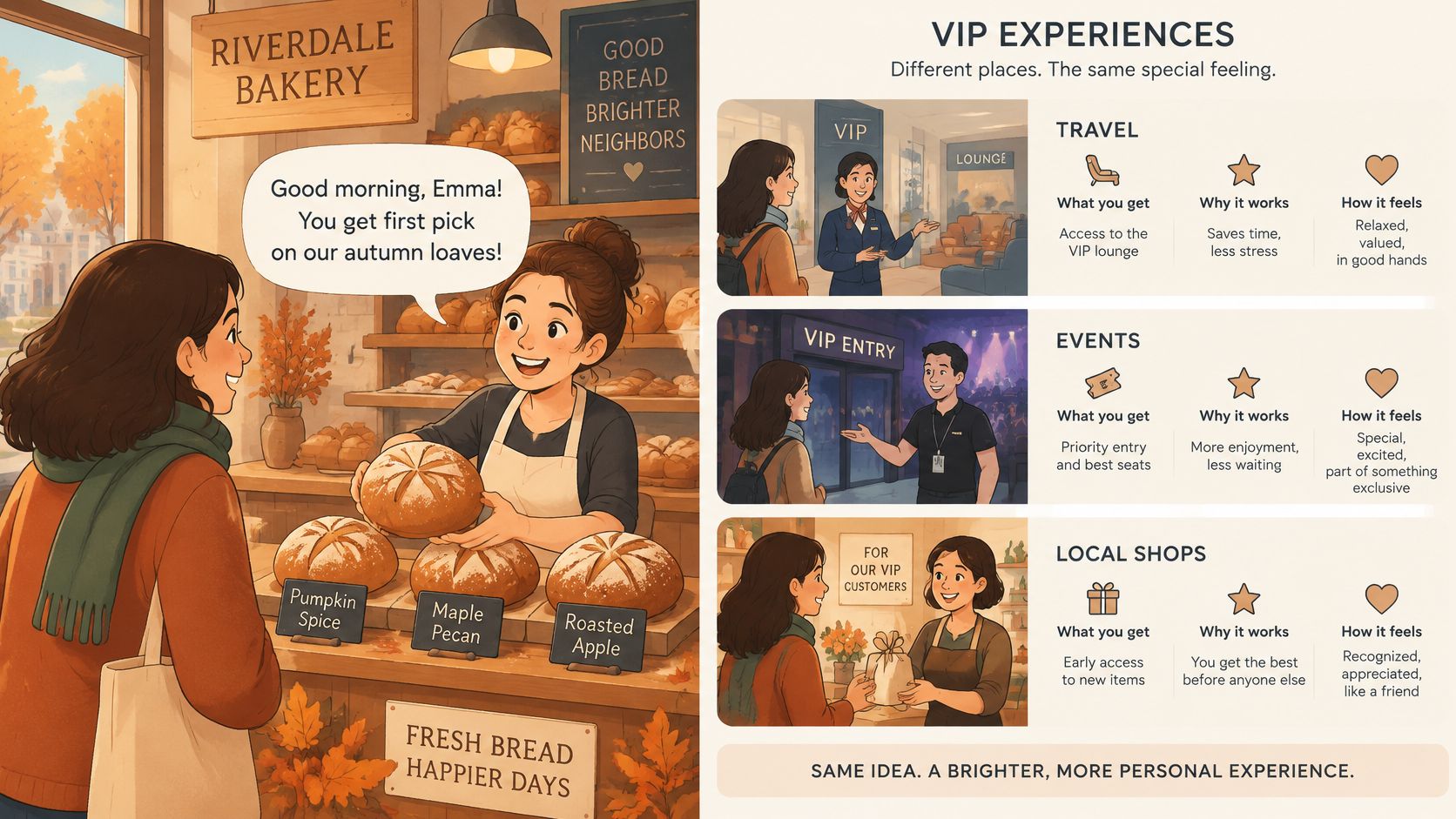
Airline programs are the public version of that queue skip. Priority boarding and lounge access are easy to see, which is why they feel real. The airline spends on space and staffing, not on cutting every fare.
Concerts and festivals sell the upgrade in the open. Reserved seats, a separate entrance, and a packaged add-on make the step from a standard ticket obvious. The cost to the promoter is high because capacity near the stage is limited, and that limit is exactly why the package holds its meaning. These customer loyalty examples share that pattern even when the ticket price is the product.
Closer to a local counter
Hotels often move repeat guests into a better room when one is empty. The suite is rare, so the gesture lands, and the hotel only gives it when the room would otherwise sit unused.
A salon that lets top clients book a preferred stylist before the public diary opens is selling time, not a cheaper color. A gym founders' tier with one reserved class slot works for the same reason. Capacity is the scarce thing. A café that gives a birthday drink to members who visit every week spends little and repeats the gesture once a year.
| Business | What the VIP receives | Why it works | Cost to business |
|---|---|---|---|
| Airline loyalty program | Priority boarding and lounge access | Visible queue skip and comfort | Medium |
| Concert or festival | Reserved seating and VIP packages | Tiered pricing makes the upgrade clear | High |
| Hotel | Suite upgrade for repeat guests | Rare, high-value room | Medium |
| Salon | Preferred stylist booking before the public | Access to scarce time | Low |
| Gym | Founders' tier with a reserved class slot | Scarce capacity signals status | Low |
| Cafe | Birthday drink for weekly visitors | Small, personal and repeatable | Low |
| Bakery | First pick of seasonal loaves each autumn | Scarcity tied to a seasonal product | Low |
A short look at how packaged access is sold on a big stage makes the local version easier to judge. The mechanism is the same. Something limited is held back for a named group.
Across these settings, status works when the benefit matches what the customer values most. The biggest discount is rarely that thing.
How to Set Up a Small Business VIP Tier
One tier cannot chase two goals. More repeat visits and a higher spend per visit pull the offer in different directions. Pick one before you name anything.
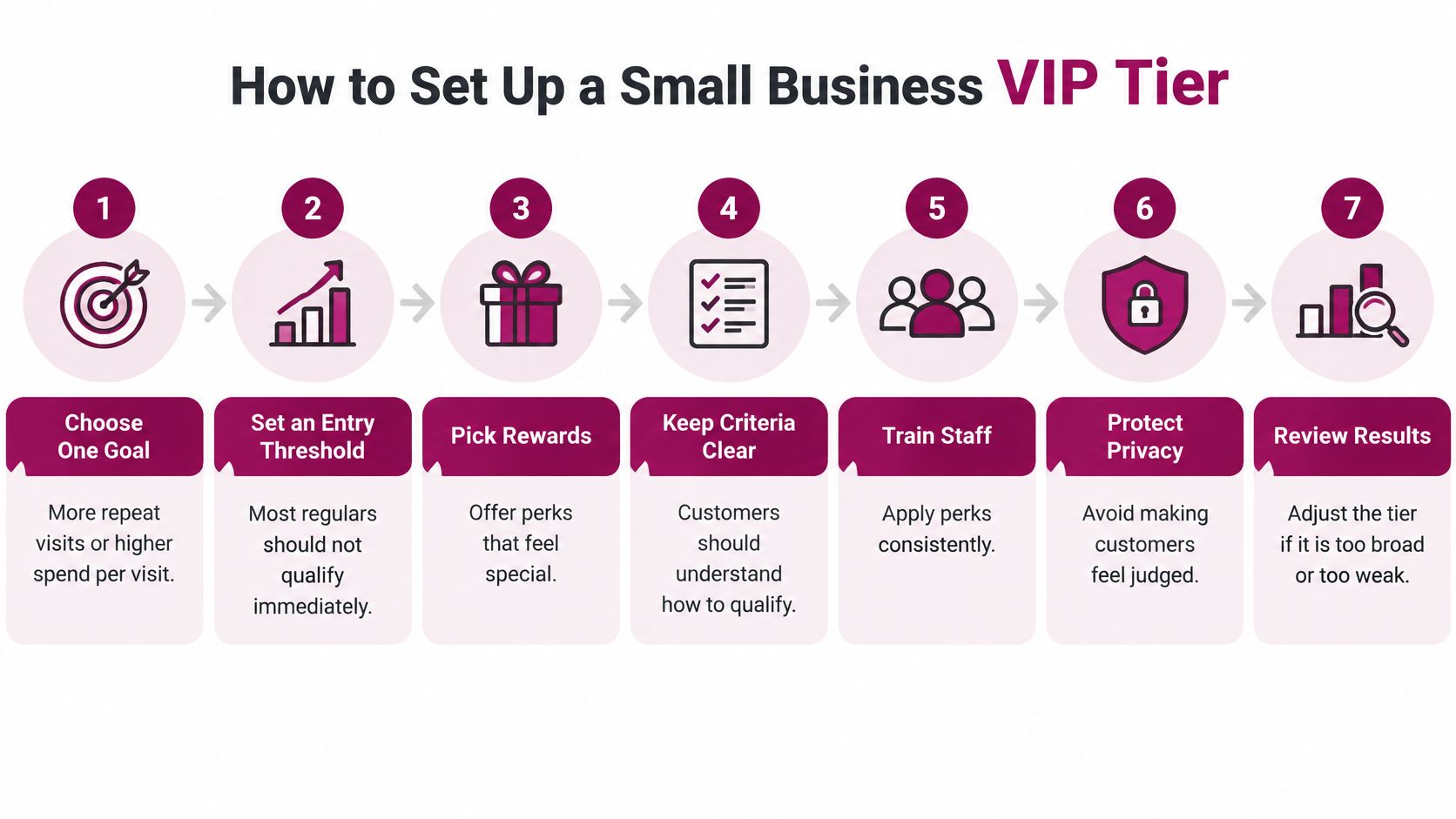
Seven steps
- Choose one goal. Write "more repeat visits" or "higher spend per visit" at the top of the page. If you want both, you're designing two programs.
- Set an entry threshold most regulars reach in about three months. Open the customer list and count how many people already qualify. We keep every customer in one list, with points balance or stamp progress, full transaction history, and last visit, so that count is a lookup rather than a guess. If half the file already qualifies, raise the bar.
- Pick two or three benefits with a fixed monthly cost you can absorb. Use the low-cost, high-exclusivity options, such as a booking window or early access, before any percentage off. Points rewards can be a free item, a fixed-amount discount, or a percentage discount earned at a set point threshold. Keep the percentage version off the VIP core.
- Name the tier in customer language. "Regular" or "Inner Circle" beats a code like Tier B. People repeat a name they would say out loud.
- Write the rules in one short paragraph. Cover how someone qualifies, when you check status, and whether it resets. If you can't read it aloud in under thirty seconds, it's too long.
- Brief staff on the rule and the reason. Inconsistent perks are the usual slip. A host who comps a drink "because they seemed nice" teaches everyone else that the written rule is optional.
- Run it for 90 days, then review. Look at who qualified, which benefit was used, and whether repeat visits moved in the direction you chose.
Which entry rule to start with
A spend-based rule gives a clear threshold you can explain at the till. Recognition builds more slowly and needs the same greeting every time. For a first tier, spend or visit count is easier to staff. Move toward recognition once the habit is steady.
A short guided setup can recommend points or stamps and show a preview of the Wallet pass before you go live, which is useful when you want the status visible on a phone people already carry. Broader choices for customer loyalty programs for small business still come down to the same entry rule and the same two or three perks.
This week, write the chosen benefit and the entry rule on one page and tell staff before anyone hears the name.
Common VIP Mistakes and Privacy Limits
The most common failure is letting too many people qualify. Status then means little, because the line, the booking book, and the greeting look the same as before. A velvet rope only works when it holds back a crowd.
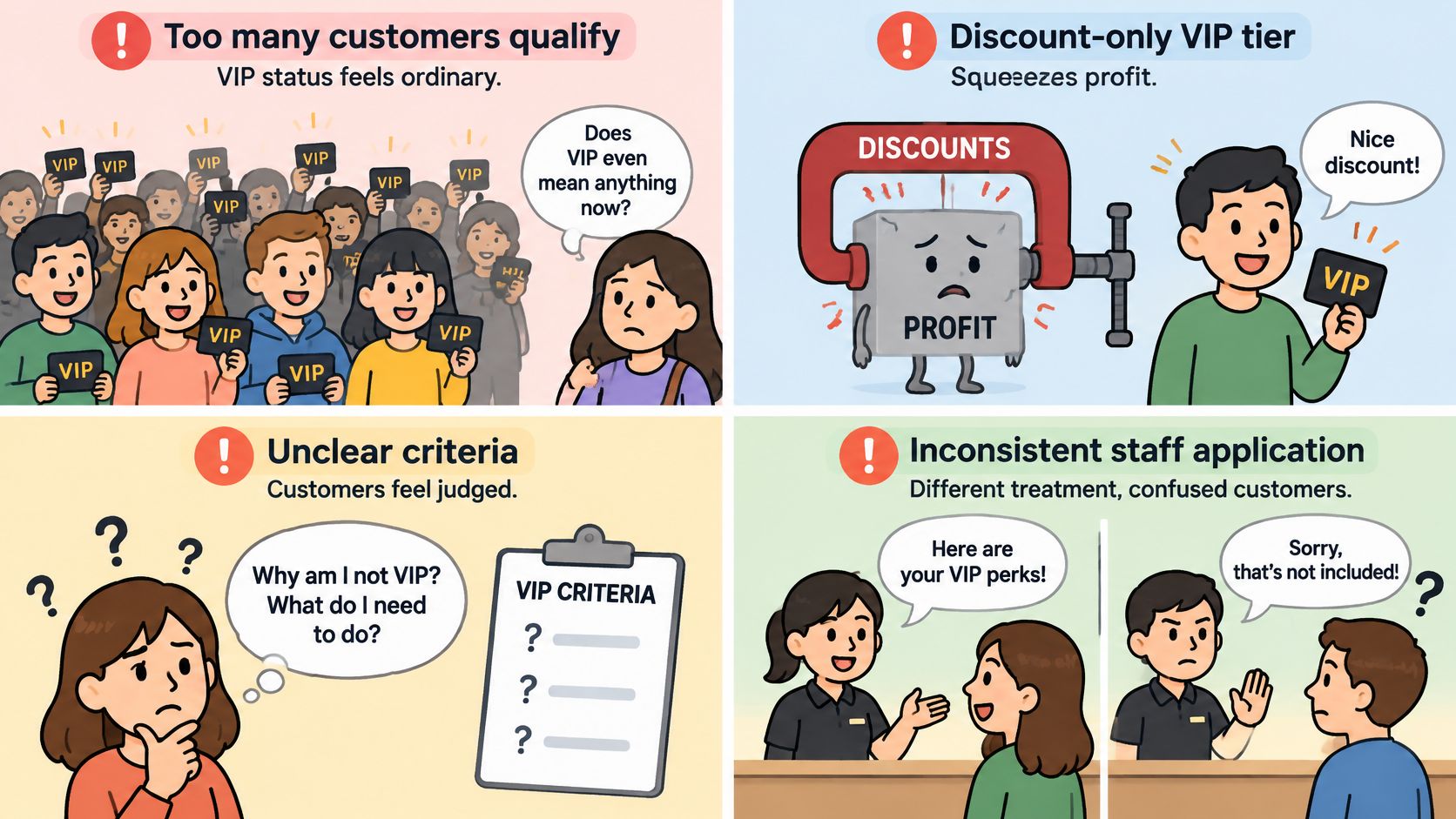
Four slips show up again and again.
- Too wide a tier: If most of your customer list qualifies, you've built a second base program.
- Discount-only status: A standing percentage erodes margin on purchases that would have happened anyway.
- Unclear criteria: Customers feel judged when they can't see the rule, even if your intent was generous.
- Inconsistent staff: One barista honors the window and another doesn't, so the perk becomes a rumor.
The privacy trade-off
Spend-based status sounds harmless until you ask what you stored to award it. In the PwC 2025 customer experience survey, 53% of consumers said sharing personal information can be worthwhile when it makes interactions smoother, yet 93% said mishandling that data would cause them to lose trust. The design question is therefore narrow: what is the smallest amount of information that still tells you who earned the perk?
VIP without surveillance
Use low-intrusion signals: purchase history, stated preferences, or visit frequency. Say why you need each one, and apply a simple test: if a signal would embarrass the customer when read aloud, leave it out. Show the benefit on the next visit, not after a long silent period, so the exchange feels immediate and fair. Never imply that people who spend less are valued less. A wallet pass can show status without a separate app, and it shouldn't display sensitive purchase patterns to anyone standing nearby.
Can a VIP program be personalized, transparent, and inclusive at the same time?
Yes, when the rule is public, the perk is access rather than judgment, and lighter spenders still get a fair base reward.
Loyal Customer helps cafés, salons, gyms, and independent shops run a points program or digital stamp card from a phone, with Apple Wallet and Google Wallet passes and no app for customers. A points reward can be a free item, a fixed-amount discount, or a percentage discount, each available at a set point threshold, and one customer list shows every member's points balance or stamp progress, transaction history, and last visit. Visit Loyal Customer to set up a tier your staff can explain in one sentence.