The Tuesday rush is over, the paper stamp cards are in a drawer or in someone's coat, and a regular just paid full price because they forgot the card again. You already know who comes back. What you don't have is a simple reason for them to pick you on an ordinary Wednesday, not a feelings campaign and not a catalog of perks nobody will read.
Customer loyalty programs for small business work when they change the next visit. They fail when the first free item creates a short spike and then the offer is too far away, too fuzzy, or too nosy to keep. Pick one mechanic, put it where the phone already lives, and judge it after people redeem, not when they sign up.
Table of Contents
- Points, Stamps, and Wallet Passes Compared
- Why a Small Customer Base Is Enough
- How Rewards Pull the Next Visit
- Match the Model to Ticket and Rhythm
- Offers That Stay Simple and Trustworthy
- How to Launch From a Phone
- Start With One Offer and Measure Returns
Points, Stamps, and Wallet Passes Compared
The counter choice is points, a digital stamp card, or a wallet pass that carries one of those two. Points are spend-based credit. A café might award 1 point per dollar and a free drink at 80 points, so a $4 coffee climbs slowly while a $16 brunch moves faster. A digital stamp is one mark per visit or qualifying item, classically 8 or 10 stamps for a free item. It works when tickets look alike and fails when a large order earns the same stamp as a snack.
A wallet pass is not a third reward formula. It is an Apple Wallet or Google Wallet card that stores points or stamps, so customers skip a new app and don't lose a paper card. It also removes the staff over-stamping and forged-card problems of paper.
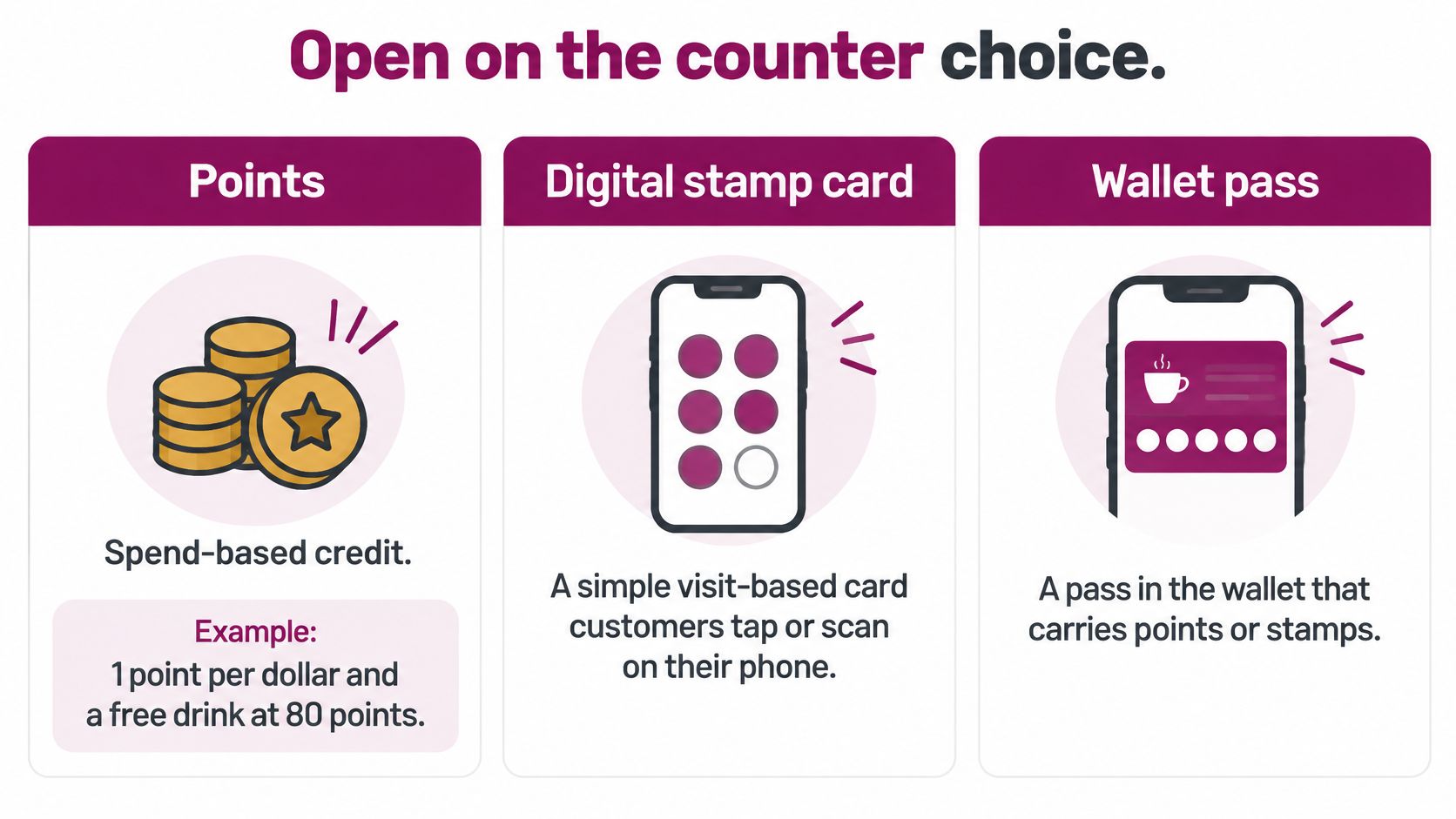
Similar visits favor stamps, uneven baskets favor points, and almost every small shop should deliver the chosen program as a wallet pass.
| Format | Reward logic | Main strength | Main weakness | Sample offer |
|---|---|---|---|---|
| Points | Points per dollar or per paid item, redeemed at a set balance | Bigger spend earns a bigger reward | Customers ignore it if the math is unclear | 1 point per dollar, $5 off at 100 points |
| Digital stamp card | One stamp per visit or qualifying purchase | Instantly understood, no math | A large order earns the same stamp as a small one | Free drink after 10 stamps |
| Wallet pass | Stores either points or stamps in Apple Wallet or Google Wallet | No extra app and the card is hard to lose | Still needs a simple reward rule underneath | Same stamp or points offer, added once to the phone wallet |
In 2024, 86% of consumers rated financial rewards, simplicity, and ease of use as important or very important loyalty-program attributes, according to Deloitte's 2024 Consumer Loyalty Survey. That is the reason not to add tiers on day one. Circle one row before you set anything up.
Why a Small Customer Base Is Enough
The objection I hear most is simple. "We don't have enough customers for a program."
A 2025 survey of 617 U.S. micro and small-business owners found that 73.2% operated without a formal loyalty program, so only 26.8% had one. Among businesses that had invested in retention, 69.1% reported a major or moderate increase in sales. Many owners thought their base was too small to justify a program, and 26.8% of service providers said loyalty programs felt irrelevant to their model.
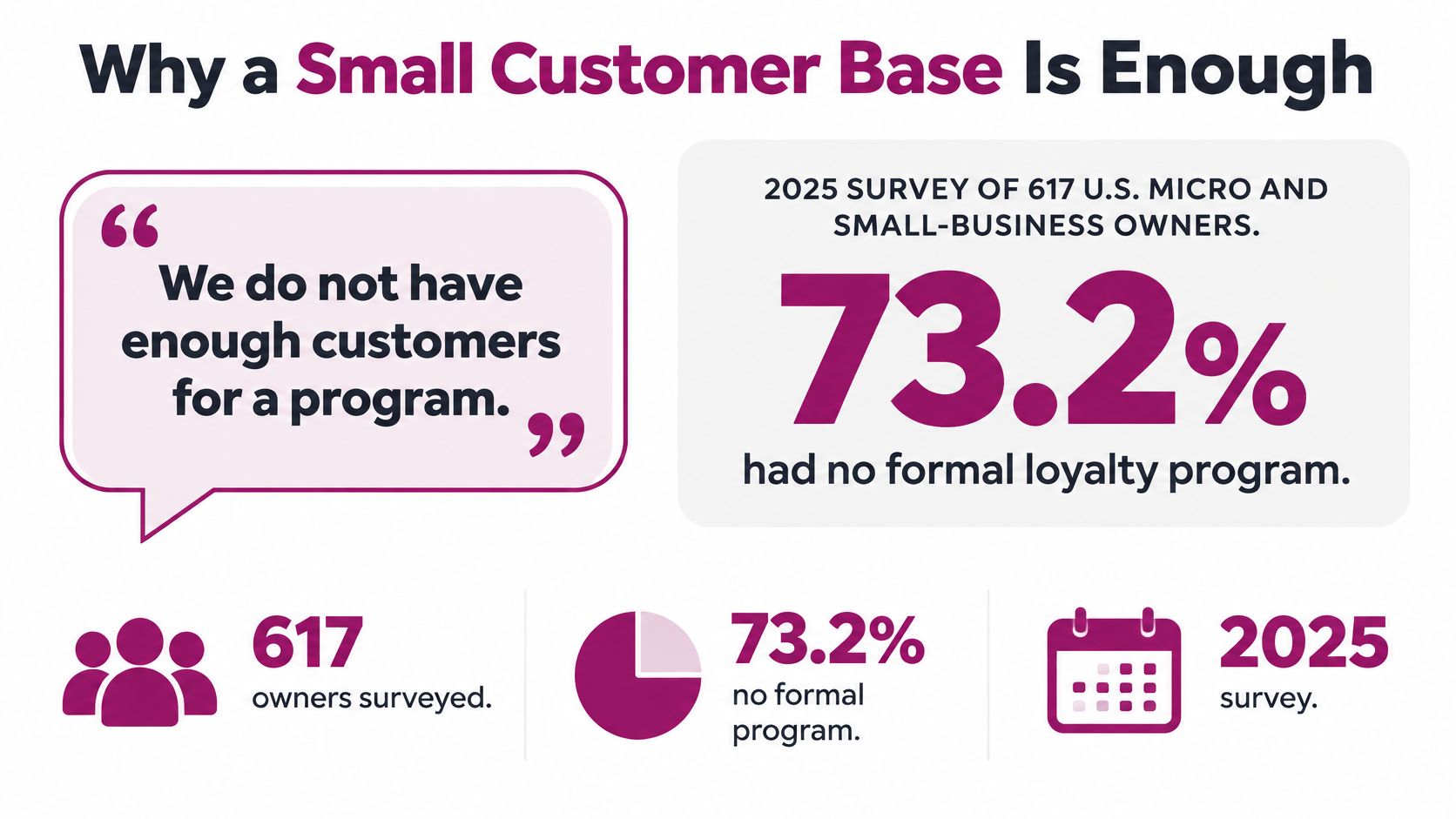
That objection shows up in cafés, bakeries, salons, gyms, takeaways, independent shops, and Instagram sellers alike. A modest set of regulars is enough to test one offer. The program needs repeat purchases, not a national database. A phone-configured pass, issued into the wallet the customer already has, keeps the test from turning into an IT project.
Owners who want a plain walk-through of why repeat visits beat a bigger ad budget can start with this short explainer.
The survey is U.S.-focused and reflects owners' self-reported outcomes, so it does not prove every program caused the sales rise. Treat it as a benchmark. Most small businesses still have no formal program, while roughly seven in ten adopters reported a meaningful sales improvement.
Practical rule: If you can name 30 people who already come back, you have enough frequency to test one offer for 30 to 90 days.
Don't widen the offer while you wait for a bigger list. Run the one card, then look at whether those regulars returned. The next part is how to read that return, not how to collect a bigger file.
How Rewards Pull the Next Visit
Say a regular has 8 of 10 stamps. They will cross the street to finish the card rather than start over somewhere else. The program is a reason to choose you on the next ordinary visit, not a campaign about how they feel.
Three plain forces do the work.
- Progress motivation: The remaining stamps feel close, so the unfinished card pulls harder than a blank one.
- Loss aversion: Earned points feel costly to abandon, even when the cash value is small.
- Reciprocity: When the free item arrives, many people feel a small pull to come back once more.
A meta-analysis of 429 effect sizes from loyalty-program studies published between 1990 and 2020 found strong evidence that programs increase customer loyalty, with the largest effects in behavioral loyalty such as repeat purchasing, rather than emotional commitment to the brand. A clear reward gives a cognitive reason to return. Affection, if it shows up at all, comes later from repeated good visits.
Design for one action
Pick one measurable action: a return visit, a repeat order, or a threshold purchase. Enrollment is not the success metric. If you want a wider menu of incentives for customers, keep this program to a single next-visit hook.
Track four numbers, members against non-members:
- Visit frequency
- Average transaction value
- Redemption rate
- Days between purchases
Compare newly enrolled customers with a similar group over 30 to 90 days. Results change with structure, reward, delivery, and industry. A low-ticket, high-frequency café should prefer a visit stamp over a complicated catalog. A shop with uneven baskets should not pretend every visit is equal.
The card is working when the gap between visits shrinks, not when the signup list gets longer.
Match the Model to Ticket and Rhythm
Judge the shop by ticket size and visit rhythm, then take the closest row. Don't import a model because a national chain uses it.
| Business | Ticket pattern | Visit rhythm | Better model | Sample reward |
|---|---|---|---|---|
| Cafe, bakery, or tea shop | Low and similar | Several times a week | Digital stamps on a wallet pass | Free coffee after 9 stamps |
| Restaurant or takeaway | Low to mid, sometimes a large order | About weekly | Stamps, or points if baskets vary | Free side after 10 stamps |
| Hair, beauty, or spa | Higher, with add-ons | Every 4 to 8 weeks | Points | Points back toward a treatment |
| Independent retail or grocery | Uneven baskets | About monthly | Points | $5 off at 100 points |
| Gym or fitness studio | Class or membership | Weekly sessions | Stamps per class | Guest pass after 10 classes |
| Instagram or WhatsApp seller | Irregular order value | When new stock drops | Points on paid orders | Free add-on after a set spend |
A café with similar $4 to $6 tickets can stamp every paid visit. A takeaway that sometimes rings a family order should switch to points once a snack and a $40 bag would earn the same mark. A salon should not stamp a fringe trim the same as a color. Retail and grocery baskets wander, so a posted points balance is clearer than a punch. A gym can stamp the class itself. A seller on Instagram or WhatsApp should not treat a message as a visit. Points belong on paid orders only. If you want the math behind a spend rule, a points-based loyalty program is the place to pressure-test the threshold before you print it on a pass.
Three checks the table doesn't cover
- Ten-second award: Staff must add the stamp or points in about 10 seconds, or they will skip it when the line is long.
- First reward in reach: A regular should hit the first reward in roughly 4 to 8 weeks. Farther than that, the card goes quiet.
- Repeatable category: Coffee, classes, cuts, and weekly meals fit. A one-off purchase, or something people can stockpile, does not.
Ignore a fancier model until that first offer has been redeemed.
Offers That Stay Simple and Trustworthy
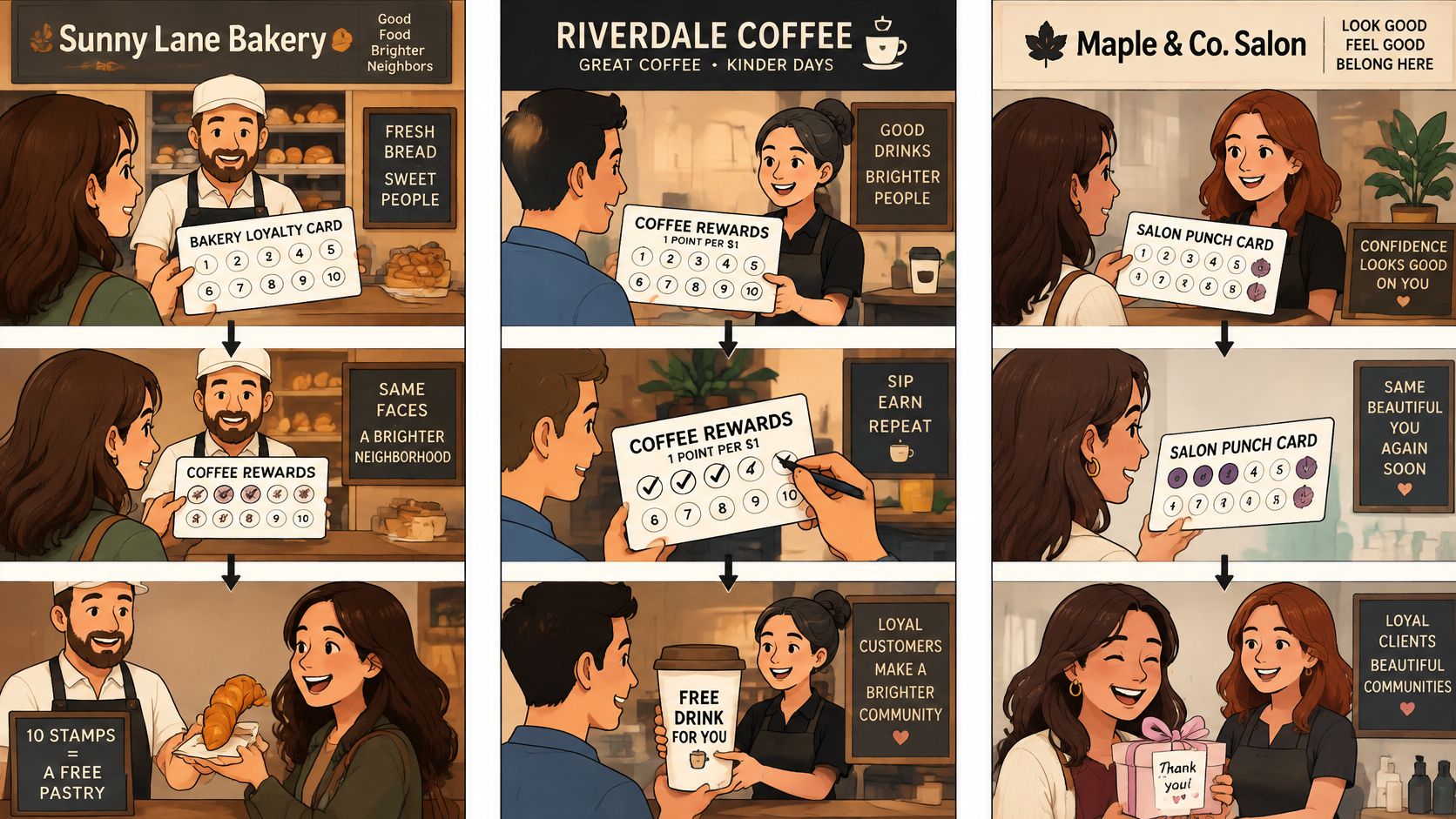
A neighborhood bakery's 10-stamp wallet card gives regulars a reason to return before they have earned a free loaf. The owner should watch whether visits hold after the reward, not just during the early sales bump. That is when a loyalty offer proves its value as a repeat-visit mechanic.
A six-chair salon can use points when color and cuts have different prices: 1 point per dollar, with 500 points toward a treatment. Staff state the balance at checkout; extra tiers would add rules without making the offer clearer.
A home baker selling on WhatsApp can award points after payment, not after a message, and offer a free add-on once spend reaches a posted threshold.
What those shops refuse to add
- One live offer: A second promotion on the same pass makes the first harder to explain. Keep the checkout explanation focused on one clear way to earn and redeem.
- A reward the margin can support: A $4 free drink on a 10-stamp card costs about $4 per completed card. Fund that cost from margin, then check at the 30- and 90-day reviews whether returning regulars justify it.
- Rules staff can repeat: If a new hire cannot explain the offer in one sentence, simplify it before adding another condition.
- A check after redemption: Sign-ups show interest; the week after the free item shows whether customers return without another immediate reward.
Personalize with behavior, not a dossier
PwC's 2025 Customer Experience Survey found that 53% of consumers consider sharing personal information worthwhile when it makes interactions smoother, while 93% say a brand will lose their trust if it mishandles that data. Make the reward feel relevant through visit behavior, not a growing profile of sensitive details.
Collect only what the offer needs: a stamp or points balance, and a name or phone number only if you will use it to message customers. Skip birth dates, demographics, and precise location. Keep the balance while the pass is active, and delete contact details if someone leaves. A bonus stamp after three quiet weeks or extra points on a category someone already buys can make the offer timely without asking for more personal information.
How to Launch From a Phone
A regular orders coffee every weekday; another visits the salon every six weeks. Set up the program around the actual visit rhythm, then make the first reward reachable before that habit cools.
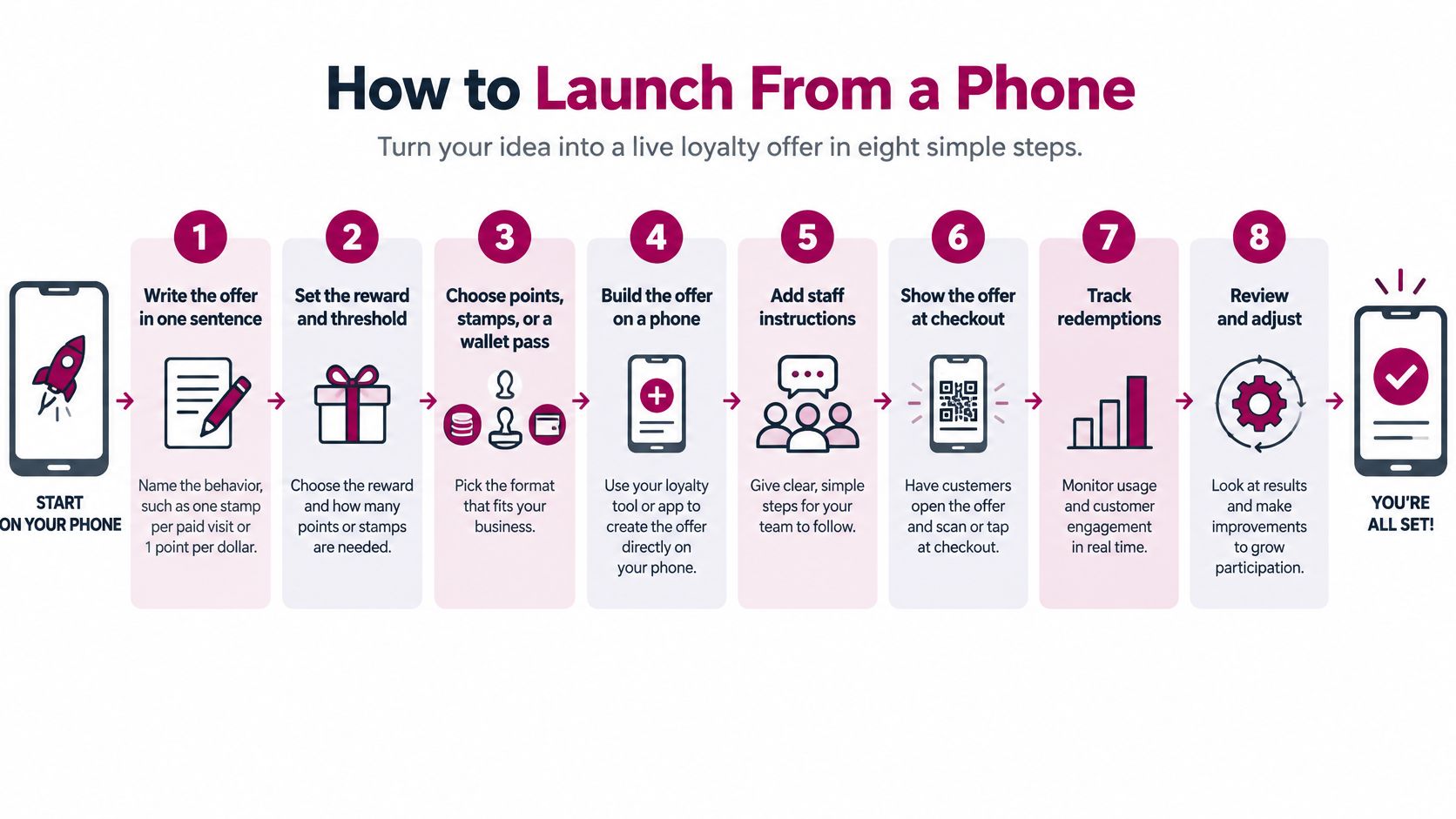
- Write the offer in one sentence, such as one stamp per paid visit or one point per dollar.
- Set the first reward within the customer's usual return window, often 8 to 10 stamps for a frequent-visit business.
- Configure the points or stamp rules on a phone. A basic program can run without a dedicated scanner.
- Create an Apple Wallet pass and a Google Wallet pass so customers can save the card in the wallet app they already use.
- Give staff a checkout prompt they can say in under 10 seconds, and show them how to add stamps or points.
- Invite current regulars in person or through a channel you already use before spending on ads.
- Redeem the first rewards without adding extra conditions and record when they are used.
- Compare visit frequency and spend for enrolled and non-enrolled customers at 30 days and again at 90 days.
Why the last check exists
A review of store-level results found that loyalty-program introductions generally produced immediate increases in category sales and profits, but the effect was often short-lived and stronger where purchase frequency was already high, according to a CEIBS review of store results. That is why the first-week lift is not enough: check whether customers return after redeeming the first reward.
A wallet pass saves customers from installing a separate app. Focus the offer on routines where another visit is plausible, such as coffee, bakery purchases, salon appointments, fitness sessions, or takeaway meals. The early bump can fade once the free item is gone, so track what happens after redemption.
Loyal Customer lets a business set up points or stamps from a phone, issue Apple Wallet and Google Wallet passes, and test the steps with a free trial. Start with the rules and checkout routine; polish the pass after staff can explain and run the offer.
Start With One Offer and Measure Returns
A steady stream of first redemptions does not prove the offer is working. Check whether members return and spend after the free item, then compare those results with customers who did not join. If the numbers do not move, shorten the reward distance or clarify the rule before collecting more customer data.
Keep the first version small. Set up one offer, let regulars use it, and record who redeems. Once you know the reward cost and whether extra visits follow, use a loyalty program ROI calculator to assess whether the offer pays for itself. Add a second offer only if customers keep coming back after the first reward.
If they do not, the reward may be too far away or the rule may be unclear. Fix that before adding tiers, a points catalog, or a birthday offer. Loyal Customer lets a café, salon, takeaway, gym, or independent shop run points or a digital stamp card from a phone and issue Apple Wallet and Google Wallet passes. A free trial gives you a way to test one offer before committing.