A typical U.S. consumer belongs to more than 15 loyalty programs, yet more than 35% of consumers surveyed planned to cancel some memberships the following year, with cancellation intent above 50% among people aged 18 to 34, according to Boston Consulting Group's 2024 loyalty research. For a small retailer, that gap is the software problem: getting a customer to sign up is easy compared with giving them a reason to remember and use the program at the till.
The practical test isn't how many names appear in your member list. It's whether customers can join without friction, understand how rewards work, and see an accurate balance when they're ready to pay. That means choosing a program mechanic that fits your business, making wallet passes reliable, and measuring use rather than enrollment alone.
Table of Contents
- Why Most Loyalty Programs Get Signed Up For and Then Ignored
- Points vs Stamps and How Each Model Behaves at the Till
- How Wallet Passes Keep Balances Honest
- What to Look For When Comparing Loyalty Platforms
- Data, Trust, and the Minimum Viable Privacy Policy
- Measuring ROI When Your Customer Base Is Small
- Your Pre-Launch Checklist and First-30-Days Measurement Plan
Why Most Loyalty Programs Get Signed Up For and Then Ignored
Membership numbers can look healthy while the program sits idle. In complementary U.S. research reported by EMARKETER, the average consumer belonged to 19 loyalty programs but had only 9.3 active memberships. The exact averages differ across studies, but the underlying issue is clear: membership isn't the same as engagement.
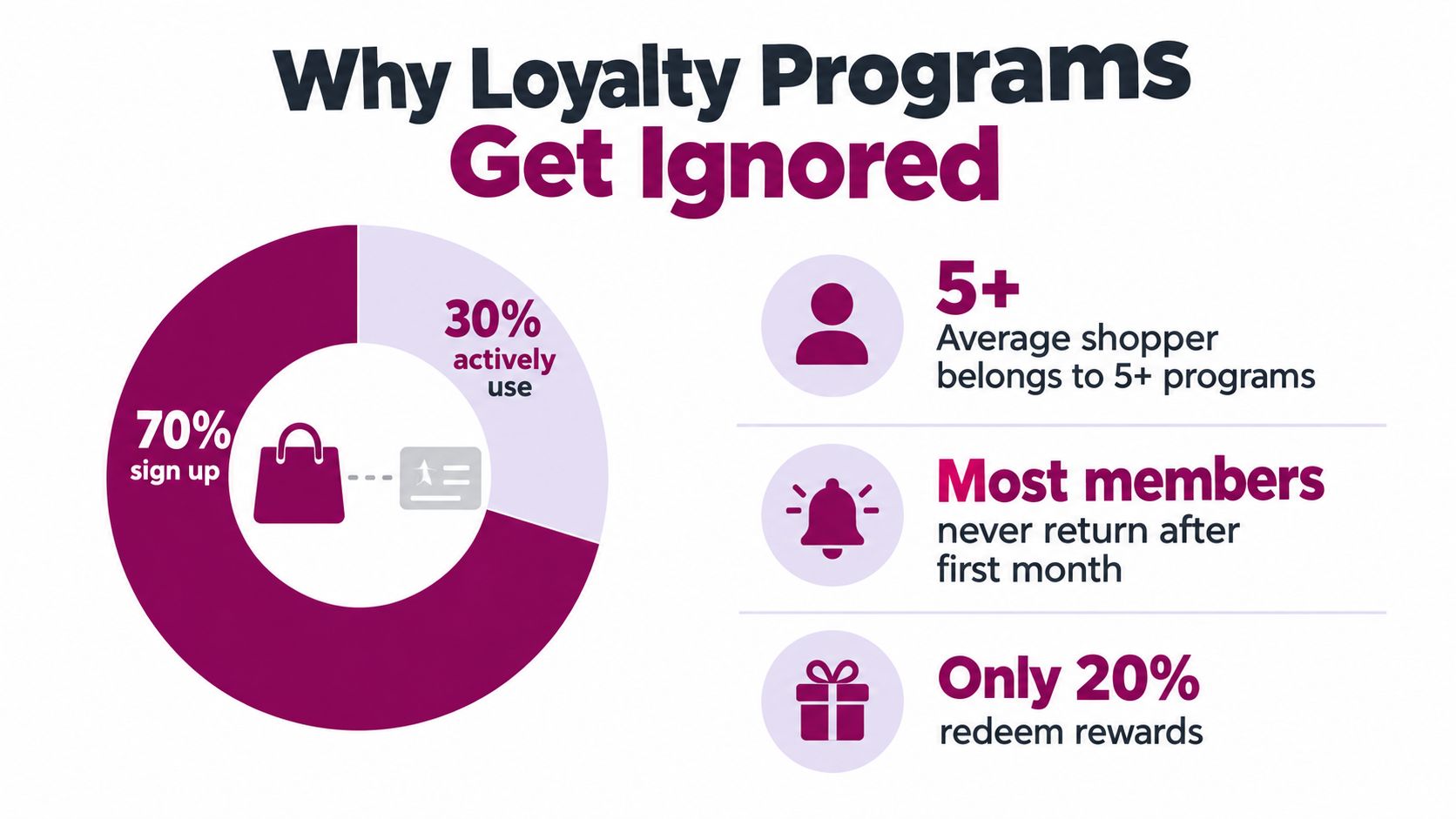
A membership gets ignored for ordinary reasons. Customers forget they joined, don't remember their balance, or can't work out what the reward is worth. If claiming points requires finding a paper card, downloading an unfamiliar app, or explaining a complicated rule while a queue forms, the program adds work to checkout instead of making a return visit more appealing.
This is why retail loyalty program software should be judged by what happens during an ordinary transaction, not just by its marketing features. A wallet-resident pass can make the balance easier to find than a card buried in a wallet or an app the customer rarely opens. A simple phone-based enrollment flow also removes a common barrier: asking someone to install another standalone app just to collect a reward.
Practical rule: Treat an enrollment as the start of the job, not the result. The program has to earn a place in the customer's routine.
Design for repeat use, not an impressive member count
The BCG findings also point to a group that may be especially willing to prune programs: consumers aged 18 to 34. That doesn't mean every young customer behaves alike. It does mean that a retailer shouldn't assume a sign-up will turn into lasting participation without a useful, low-effort experience.
For a café, salon, bakery, or independent shop, the winning experience is usually straightforward: customers can see what they've earned, staff can apply the reward without slowing payment, and the rule makes sense before anyone joins. The sections that follow examine those choices in practical terms, from points versus stamps to wallet synchronization, platform selection, privacy, and small-scale ROI.
Points vs Stamps and How Each Model Behaves at the Till
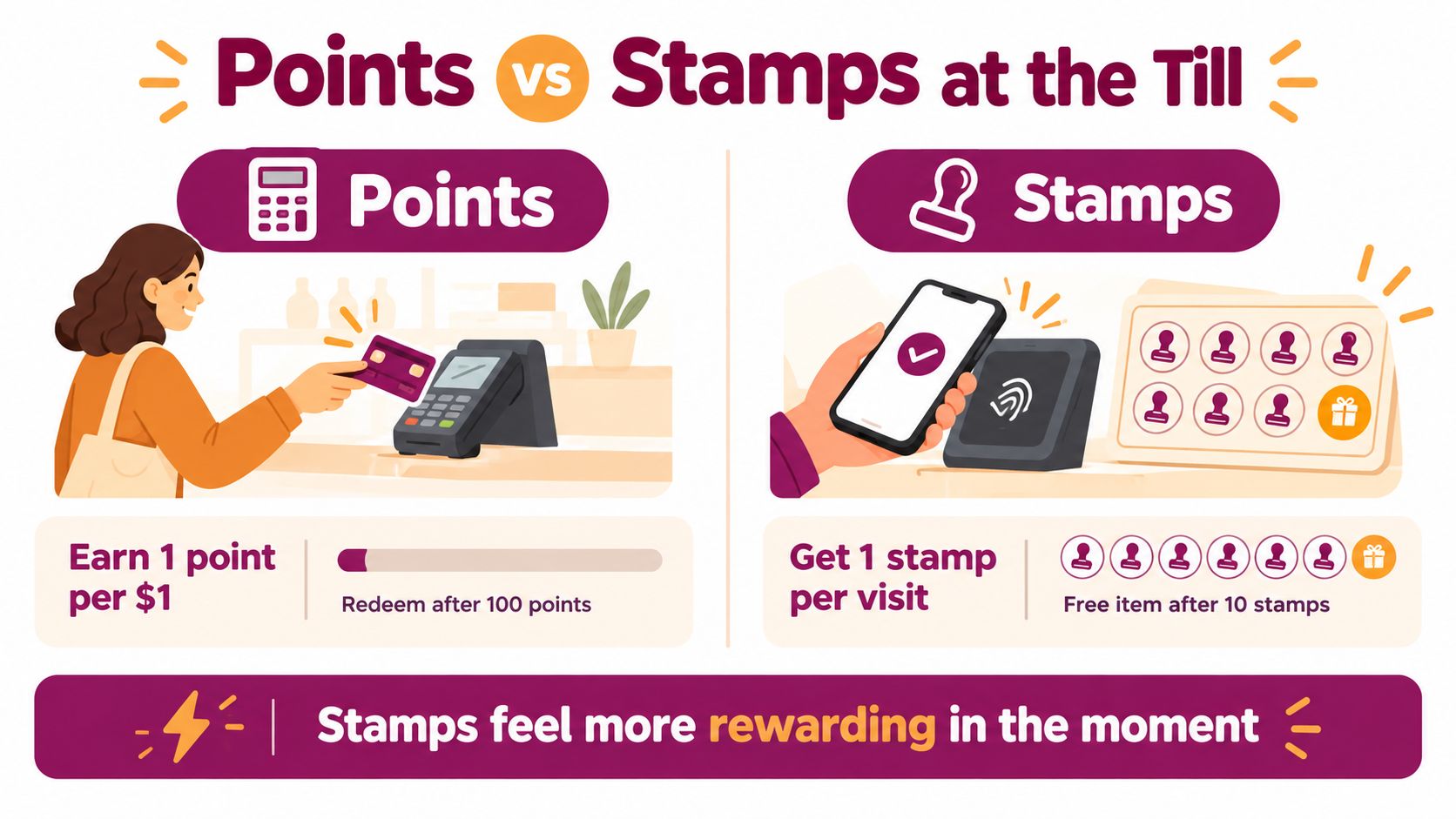
A loyalty mechanic should be easy to explain while the customer is paying. Stamps tend to suit frequent purchases that are similar in value; points can handle a wider range of spending and rewards but ask customers to understand more rules.
Pick the mechanic customers can calculate
A stamp card makes progress visible. At a coffee shop, a customer might earn a stamp per visit and work toward a free drink. A bakery can reward a regular purchase with a stamp, and a salon can use a visit-based offer that customers can explain to a friend without doing mental arithmetic. The drawback is that a visit-based rule may not reflect differences in basket size. If one customer spends much more than another, the same stamp per visit may not match the economics of the offer.
Points suit businesses with varied baskets or rewards linked to spending. A small retailer might award points based on spend and let customers redeem them for a discount or an item. That flexibility comes at a cost: customers have to understand the earning rate, the reward threshold, and what their accumulated balance is worth. When those rules are hard to explain, points can feel abstract and progress can seem slow.
Deloitte's 2024 survey of more than 9,800 consumers in the United Kingdom, India, and Brazil found that 86% considered financial rewards, simplicity, and ease of use important or very important features of loyalty programs, while only 60% were satisfied with personalization. The practical lesson is not that every program needs personalization. It's that customers should be able to understand the value and use the program easily.
| Model | Works well when | Watch for |
|---|---|---|
| Stamps | Visits or purchases are frequent and similar, such as coffee, baked goods, or routine services | A flat reward may not account for different basket values |
| Points | Spending varies, or customers have meaningful choices among rewards | Earning rates and redemption rules can be harder to explain |
A gym or salon could choose either model, depending on how customers buy. A simple visit reward may fit regular appointments; points may fit a broader mix of services and retail products. For more detail on the trade-offs, see this guide to a points-based loyalty program.
Before choosing, ask a staff member to explain the offer in one short sentence. If the customer needs a longer explanation to understand how progress works, simplify the mechanic or make the reward easier to see.
How Wallet Passes Keep Balances Honest
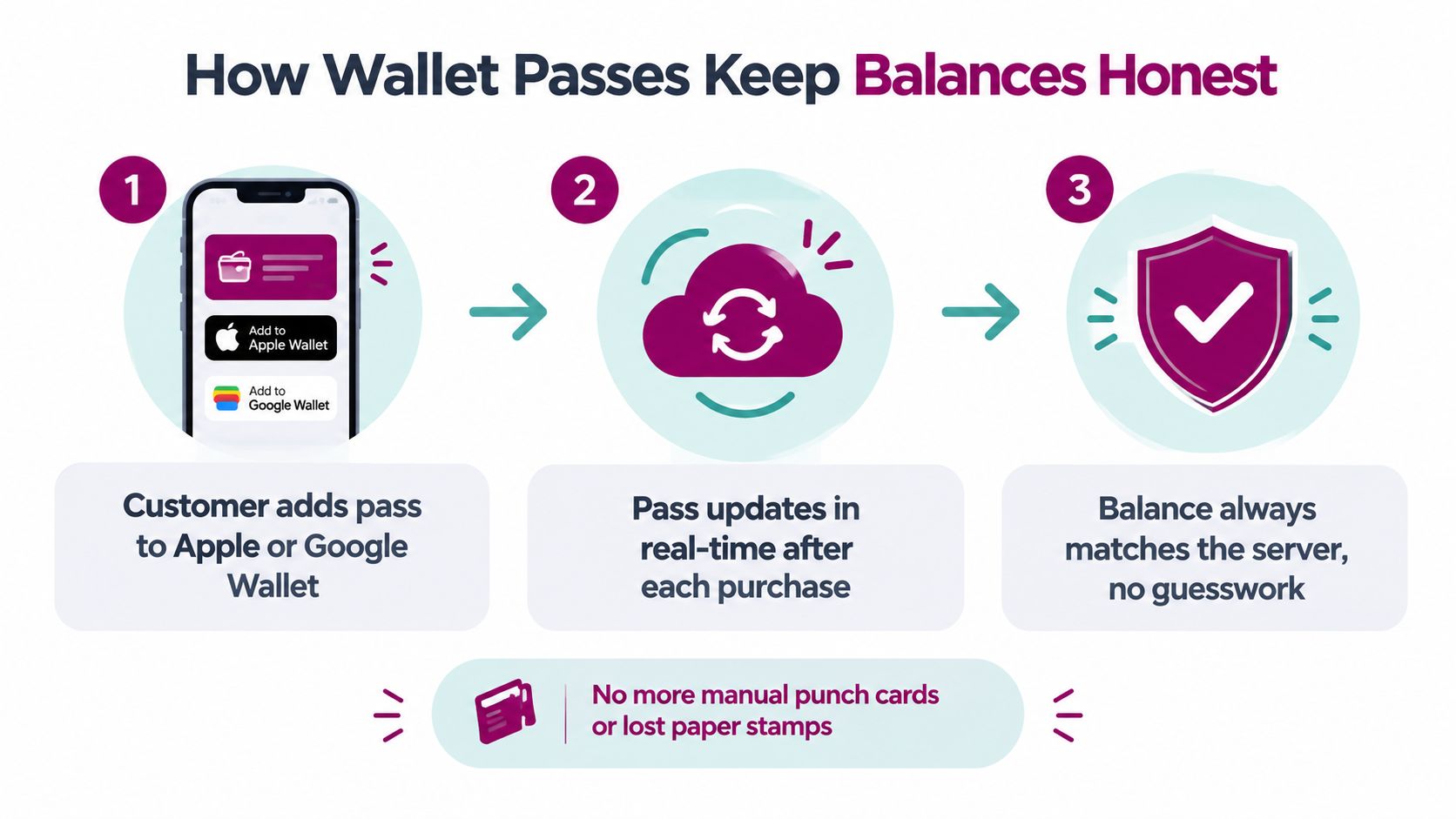
A wallet pass isn't just a digital card you issue once. To display a current balance, the pass has to stay synchronized with the loyalty system that records the customer's transactions.
Keep the ledger authoritative
The first design decision is where the balance lives. The loyalty backend should record the rules, accruals, redemptions, and current balance. The wallet pass is a customer-facing display of that information, not the authoritative record. If a customer's phone shows an old balance, staff should be able to check the backend rather than treating the displayed pass as the final word.
Google Wallet separates a reusable Passes Class, which defines the shared pass setup, from a customer-specific Passes Object. A pass object is issued through a signed JSON Web Token, and Google documents both REST API and Android SDK routes for creating and managing passes in its Google Wallet loyalty-card documentation. Reusing the class avoids creating a separate pass structure for every customer. For routine changes, partial updates can change selected fields without replacing the whole pass.
Treat Apple Wallet as an update service
Apple Wallet uses a different update flow. A device registers an installed pass with the merchant's web service. When pass data changes, the service sends a notification, and the device requests updated pass information over HTTPS. That means pass creation is only one part of the work. The service also needs reliable registration, authorization, notifications, and update handling.
A purchase can update the backend immediately while the phone's display refreshes later. That's eventual consistency, and staff should know how to handle it at checkout. If a customer says a balance hasn't changed, check the ledger first and avoid awarding the same transaction twice just because the pass display appears stale.
Wallet visibility helps customers find a program, but it doesn't replace a reliable transaction record or an update process.
For a small operator, the vendor needs to manage the unglamorous parts: stable customer and pass identifiers, safe handling of authentication credentials, retryable updates, and checks that identify mismatches between ledger and displayed balance. For more on Apple-specific pass considerations, see this explanation of an Apple Wallet loyalty card.
What to Look For When Comparing Loyalty Platforms
Forrester's 2024 Consumer Benchmark Survey found that 85% of U.S. online adults belonged to at least one retail loyalty program, with grocery, credit-card, and pharmacy programs among the most popular categories, according to Forrester's report on retail loyalty. Participation is common, but a small retailer still has to choose software that fits its checkout, team, and customers rather than assuming a long feature list will create active use.
Evaluate the day-to-day workflow
Start with the way the program will run during service. A phone-based system may be enough for a café or salon where staff can identify a customer, add a stamp, or redeem a reward from a mobile device. If you need rewards to apply automatically at a busy till or sync with existing sales records, check whether the platform supports the integration you rely on. A feature that isn't used because it complicates checkout isn't an advantage.
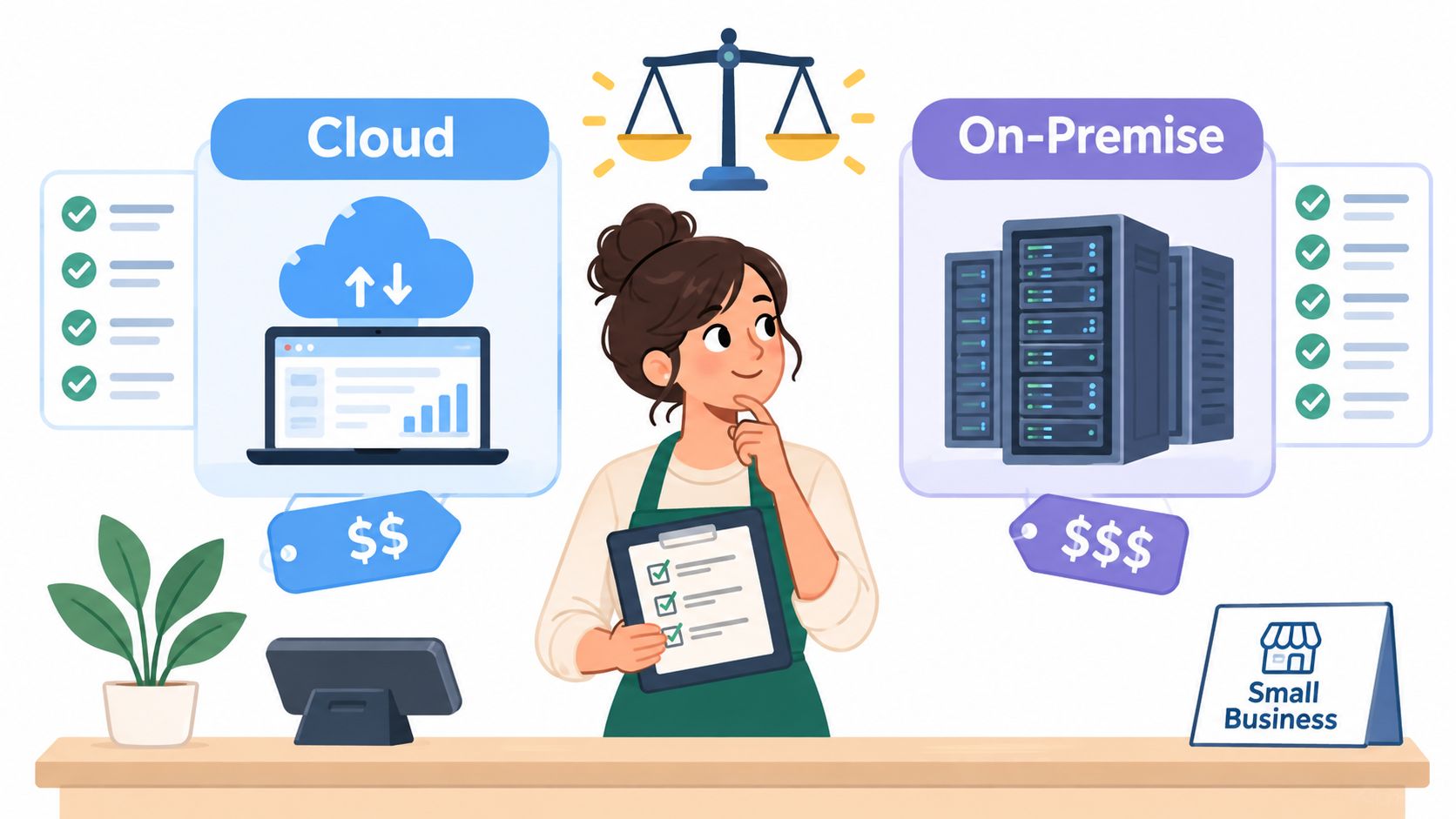
Deployment model matters, too. A cloud service can reduce the need to maintain local software, while an on-premise setup may appeal to a business with specific infrastructure or control requirements. Neither is automatically better. Ask who handles updates, what staff do if the service is unavailable, and whether your team can export its transaction and customer data if you leave.
Count the real cost, not just the subscription
The software fee is only part of the cost. Include reward expense, staff time, any integration or setup work, and the effort required to keep program rules and wallet passes current. Ask a vendor to demonstrate your actual checkout flow, including enrollment, an earning transaction, and a redemption. That will reveal more than a generic feature presentation.
| Evaluation question | What to verify |
|---|---|
| Can staff use it at checkout? | The steps to find a customer, update a balance, and apply a reward |
| Will it fit your setup? | Whether it needs POS integration, a scanner, or only a phone |
| Are wallet passes built in? | How the vendor issues and updates Apple and Google Wallet passes |
| Can you measure activity? | Whether reports show redemption and repeat behavior, not only sign-ups |
| What happens to your data? | Access, export, retention, and deletion options |
Also ask whether wallet support is part of the core product or depends on a separate integration. A wallet pass can reduce friction for customers, but only if the software keeps the displayed balance aligned with the system of record and gives staff a clear way to resolve errors.
Data, Trust, and the Minimum Viable Privacy Policy
Personalization isn't automatically worth collecting more data. For a small shop, a useful program often needs less information than its software makes available to gather. A stamp card may only require a customer identifier and the stamp balance. Collecting extra details without a clear purpose adds work and can make enrollment feel intrusive.
PwC research found that 93% of consumers say a brand will lose their trust if it mishandles personal data, while 53% consider data sharing worthwhile when it makes interactions smoother, according to its 2025 customer experience survey. Customers can accept a data exchange when they understand the benefit. They're less likely to welcome vague requests for information that doesn't appear to improve the reward or service.
Set a small, clear data boundary
Before launch, write down what the program needs to work. For a basic digital stamp card, that might mean a pass identifier and the customer's stamp balance. If you need a contact method to recover an account or send a requested update, explain why and make clear whether marketing messages are optional.
Avoid collecting sensitive personal details that aren't required to award or redeem the offer. Don't turn a simple rewards program into a general-purpose customer profile just because the platform has extra fields. Decide how long you'll keep records, who on the team can access them, and how a customer can opt out or request deletion. The details of privacy law vary, but data minimization is a sensible operating practice everywhere.
Wallet passes add one consideration: the loyalty credential stays on a personal device until the customer removes it. Tell customers what the pass displays, what information your business keeps, and how they can stop participating. That plain-language explanation is part of the enrollment experience, not a legal notice to hide in small print.
Measuring ROI When Your Customer Base Is Small
A small customer base doesn't automatically make loyalty software a poor investment, but it does make measurement more important. U.S. research cited by SumUp found that 73.2% of small businesses operate without a formal loyalty program, with the leading barrier being the belief that the customer base is too small to justify one. The useful response isn't to assume a program will pay off. It's to test whether it changes customer behavior enough to cover its costs.
Measure behavior, not enrollment
Before launch, establish a baseline using records you already have. Track repeat-purchase rate, visits per customer, reward cost, redemption, and contribution margin. Then compare those measures after the program starts, keeping the same definitions so the comparison means something.
A customer who joins and returns may have come back anyway. To avoid counting every redemption as incremental growth, compare behavior among members with the business's existing pattern, and look for changes in visit frequency or spending that coincide with the program. This won't prove causation on its own, but it's more informative than reporting a large enrollment count.
| Measure | What it helps you understand |
|---|---|
| Repeat-purchase rate | Whether customers return after joining |
| Visits per customer | Whether visit frequency appears to change |
| Redemption rate | Whether customers use rewards, and whether the offer feels reachable |
| Reward cost | What the business gives up to deliver the incentive |
| Contribution margin | Whether the relevant purchases leave enough margin to support the offer |
Keep the test small enough to manage
Set a minimum enrollment or transaction threshold before you start judging results. If only a few customers have had time to earn a reward, redemption data won't tell you much. A clear review point helps you avoid either abandoning a workable idea too early or keeping a weak offer because you've already launched it.
Match the mechanic to the buying pattern. For a café with frequent, similar purchases, a digital stamp card may be easier to understand than a points system. For a shop with varied basket sizes, points may offer more flexibility, but the earning and reward rules need to remain transparent. A loyalty program ROI calculator can help structure the economics, but use your own reward costs and transaction records rather than relying on a generic promise of higher retention.
Your Pre-Launch Checklist and First-30-Days Measurement Plan
A workable launch starts with a short, repeatable checkout routine. Choose a mechanic, set the reward rule, configure the pass, and train staff to explain the offer in plain language. If the customer can't join or understand the reward without holding up the line, simplify the flow before inviting people in.
Prepare the program for real transactions
Before you launch, walk through the entire experience as a customer and as a staff member. Test earning, redemption, and what happens when a pass doesn't display the latest balance.
- Choose the model: Use stamps when purchases are frequent and similar; consider points when spending varies and customers benefit from flexible rewards.
- Write the rule plainly: Explain what earns progress, what the customer can redeem, and any relevant limits.
- Configure wallet passes: Confirm that the customer can save the pass and that routine balance updates work.
- Set a staff script: A simple invitation such as, “Would you like a digital card for this reward?” gives the customer a clear choice without a long pitch.
- Check the fallback: Decide how staff will verify the ledger when a pass appears out of date.
- Explain data use: Tell customers what information the program needs and how they can opt out.
Measure the launch, then adjust
During the first month, record sign-ups and transactions, but don't treat either as a win by itself. Review repeat purchases, redemptions, reward cost, and whether customers can use the pass smoothly at checkout. Check whether the displayed wallet balance matches the backend ledger, and note any failed registrations or update delays so you can distinguish an offer problem from a technical one.
Keep changes focused. If customers join but rarely redeem, check whether the reward feels attainable and valuable. If staff forget to offer the program during busy periods, simplify the till routine and practice the invitation again. If customers ask the same question repeatedly, rewrite the rule rather than asking staff to explain around confusing wording.
The early failures are usually preventable: earning rules that are too complicated, rewards that are hard to understand, staff who haven't tried the process themselves, and no clear way to resolve a stale wallet display. Fix those issues before adding tiers, campaigns, or more data collection.
Loyal Customer provides phone-operated points programs and digital stamp cards, with loyalty cards designed for Apple Wallet and Google Wallet. If you're choosing a practical way to run rewards at the till, visit Loyal Customer to review the setup and try a basic program.