A regular walks into your café, orders the usual drink, and reaches for a paper loyalty card that has disappeared somewhere between their wallet and yesterday's shopping. Another customer asks whether they need to download an app, then decides the free coffee isn't worth the effort. At the salon next door, the owner faces the opposite problem: a points idea sounds flexible, but staff need a system they can explain and operate while serving clients.
A digital loyalty card app can solve those problems, but only if it fits the customer's routine. The important choice isn't paper versus phone. It's whether your program uses stamps or points, where the reward appears at checkout, how much information you collect, and whether your team can run the process without slowing down service.
Table of Contents
- What a Digital Loyalty Card App Actually Does
- Points and Stamp Cards Explained
- Choosing Between Points and Stamps
- Why Wallet-Native Passes Reduce Friction
- Setting Up Your Program From Your Phone
- Metrics That Actually Predict Retention
- Common Pitfalls and How to Avoid Them
- Real Use Cases for Cafes, Salons, Bakeries, Gyms, and Micro-Merchants
What a Digital Loyalty Card App Actually Does
A digital loyalty card app turns a repeat-purchase reward into a mobile credential. Instead of handing over a paper card, the customer presents a pass on their phone, usually through Apple Wallet or Google Wallet. The merchant adds a stamp or points after the purchase, and the customer can see progress toward the next reward.
For a café, the workflow might be simple. The barista asks whether the customer wants to join, the customer scans a QR code or opens a shared link, and the pass is added to the phone. On the next visit, the customer shows the pass, the barista scans it, and the system records the visit. The customer doesn't need to remember a paper card or install a separate customer app.

The same pattern works in a salon. A client can earn points when buying eligible services or products, then check their balance from the pass before booking again. The receptionist sees the same reward status and applies the benefit when the client is ready to redeem it.
The two operating models
Most small businesses start with one of two mechanics:
- Stamp cards: Each qualifying visit adds one stamp toward a defined reward.
- Points programs: Purchases add points to a balance, with rewards earned at selected thresholds.
The right choice depends on how predictable your transactions are and how much explanation customers need. A coffee shop with similar orders may benefit from a visible visit counter. A salon with different services and retail purchases may need points that reflect varied spending.
Your first task is to map the moment of use, not compare feature lists. Ask what the customer shows, what the employee taps or scans, and whether the reward can be explained while the queue keeps moving. You can review a typical wallet-based customer journey in how Loyal Customer works, then test whether that journey matches your own counter or reception desk.
Points and Stamp Cards Explained
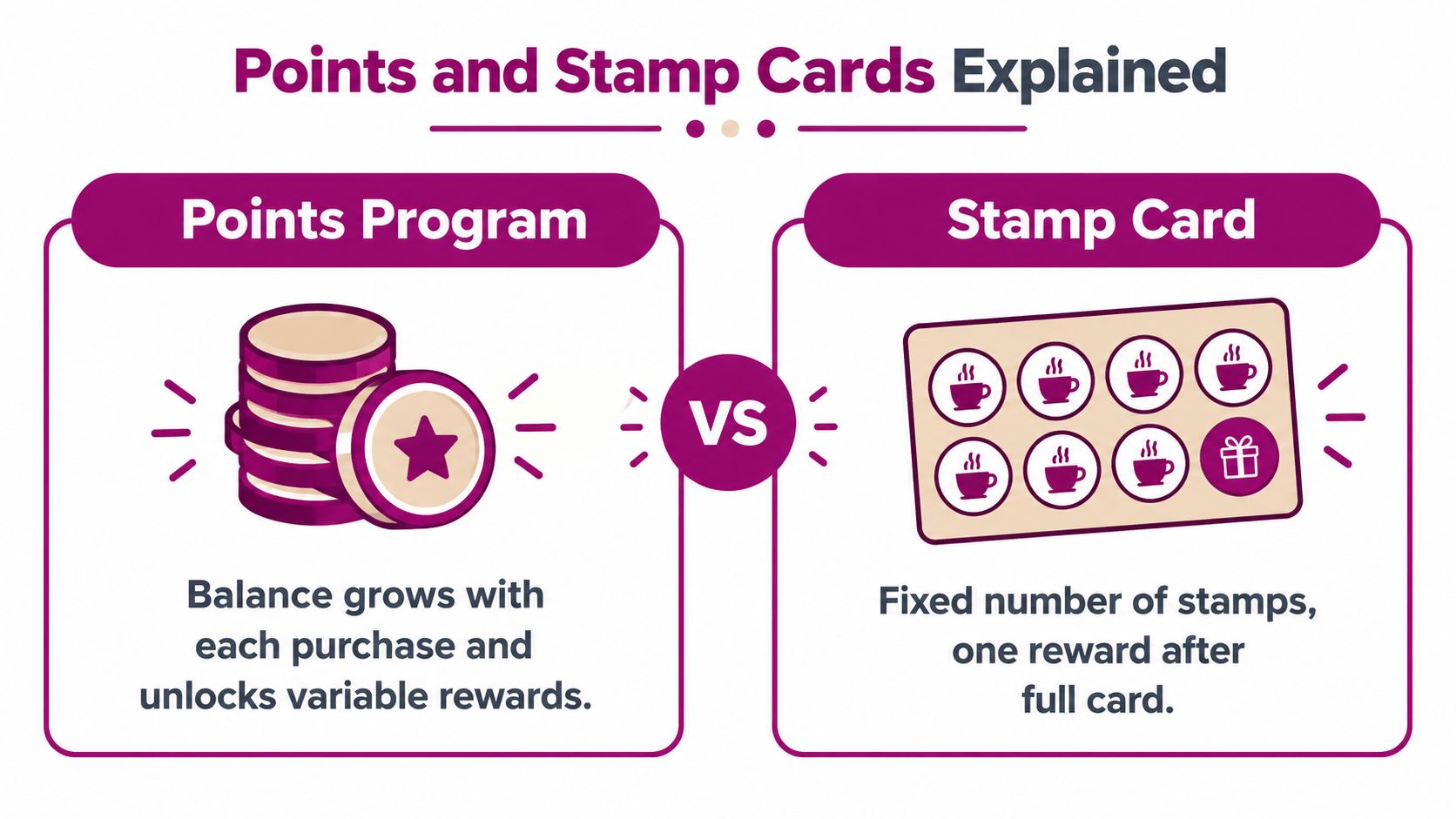
A stamp card is the digital version of the familiar paper card. The customer earns one mark for a qualifying visit, and the card shows progress toward a fixed reward. A café might offer one free drink after a completed series of visits. The customer understands the arrangement immediately because the card answers one question: how many visits remain?
A points program works more like a running account. Each qualifying purchase adds points, and the customer exchanges a balance for one or more rewards. A salon could award points for hair services, skincare products, or selected add-ons. The business can then make rewards proportional to different purchase values instead of treating every transaction as identical.
How stamps work in practice
Suppose a café wants to encourage regular morning visits. The owner creates a stamp rule for one qualifying drink purchase. The customer presents the wallet pass, the barista confirms the purchase, and one stamp appears on the card. When the customer reaches the reward threshold, the pass displays that a drink is ready to redeem.
Stamps suit businesses where the visit itself carries most of the value. They're easy to explain, easy to check, and usually easy for staff to apply. They can become confusing when customers buy very different products or when several conditions apply, such as different stamp values for weekdays, food, and drinks.
How points work in practice
Points give the merchant more room to design earning and redemption rules. A salon might award points for an appointment and separate points for eligible retail purchases. A customer with a larger basket can earn more than someone buying a single low-value item, provided the rules are clear.
The tradeoff is visibility. Customers need to understand how points accrue, what they're worth, and when they can redeem them. A pass should show the current balance and the next available reward without forcing the customer to remember a complicated formula.
Practical rule: If a customer can't explain how to earn and redeem after hearing it once, simplify the program before launch.
Both models can appear on a wallet pass. A stamp card displays progress through the card, while a points program displays a balance and reward status. The technology changes the delivery method, but the customer still needs a reward logic they can understand at the till.
Choosing Between Points and Stamps
A better way to choose is to start with the customer moment at checkout. If the rule can be understood in a glance, used on an older phone without extra setup, and tracked by staff without a long explanation, you are close to the right model. If the reward logic needs too much interpretation, the program is asking the customer to do work the pass should be doing.
| Dimension | Stamp cards | Points programs |
|---|---|---|
| Customer explanation | Very simple, one visit adds one stamp | Requires an explanation of earning and redemption |
| Best fit | Similar, frequent transactions | Varied spending or several eligible categories |
| Reward design | Fixed reward after a defined number of stamps | Flexible rewards at different balance thresholds |
| Staff workload | Usually quick to apply and verify | Needs clear rules for accrual and redemption |
| Customer visibility | Progress toward a single reward | Current balance and available reward status |
| Promotion flexibility | Limited unless special stamp rules are added | More adaptable for campaigns and product groups |
| Common risk | Customers may question qualifying visits | Customers may not understand point value |
The table matters because it shifts the decision away from preference and toward operating reality. A stamp system usually wins when speed and clarity matter more than flexibility. A points system usually wins when you need to reflect different purchase values or several earning categories. Neither is better on its own. The better choice is the one customers can follow without stopping the line and the one staff can apply correctly on a busy day.
Choose stamps when repetition is the main goal
Stamps work best when the target behavior is simple and repeated. The customer does the qualifying action, sees progress on the pass, and knows how close the reward is. That short feedback loop matters. The reward should feel near enough to pull the next visit forward, without forcing the customer to calculate what today's purchase means in a larger formula.
This is also where digital wallet passes become a deliberate UX choice rather than just a tech replacement. A visible stamp count inside the phone wallet reduces friction at the till, keeps the interaction quick, and asks for very little customer data. For merchants who want a lighter privacy footprint, that simplicity is useful.
Choose points when value varies
Points are stronger when the business needs more than one earning rule, but they only work if the math stays visible. A customer should be able to answer two plain questions without help: how do I earn, and what can I get? If either answer sounds like staff training material, the setup is too complex.
Write the earning rule and the redemption rule in plain language before launch. Then test them out loud. If a cashier or receptionist cannot explain both in one short sentence each, simplify the program.
For a closer comparison, see this guide to points versus stamps loyalty programs. After launch, judge the choice by more than enrollments. Look at repeat visits, reward redemption, and whether staff can apply the rule consistently without extra explanation.
Why Wallet-Native Passes Reduce Friction
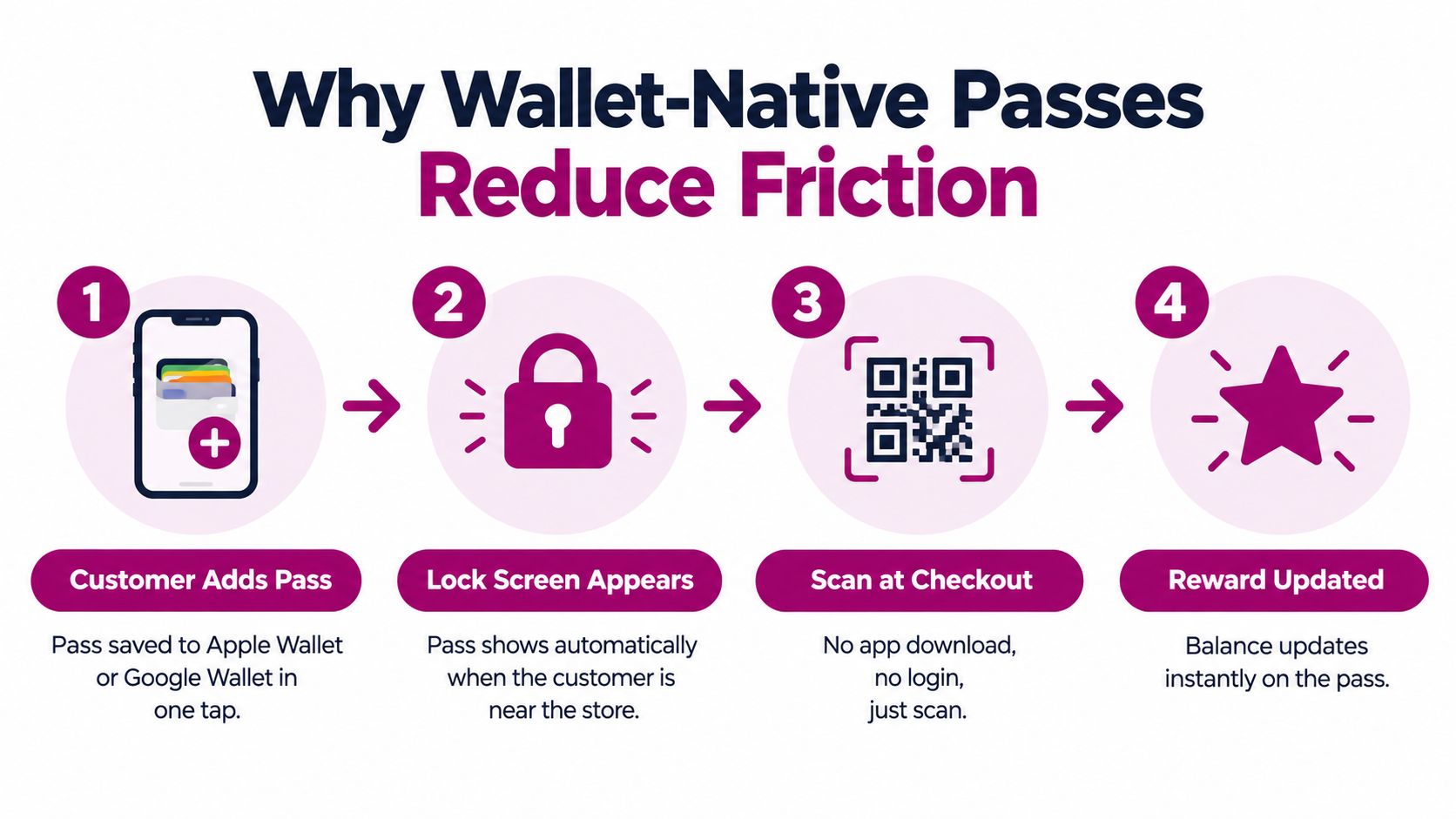
A wallet pass is a deliberate user-experience decision, not just a newer format for the same card. The customer already carries a phone to the café, salon, bakery, or gym. Putting the loyalty credential in that phone's wallet makes the reward available where the customer is already looking.
A standalone app asks the customer to find, open, and sometimes sign into another application. A paper card asks the customer to remember where they placed it. A wallet pass reduces those separate tasks by keeping the card in Apple Wallet or Google Wallet, where it can be opened during checkout.
The Boston Federal Reserve analysis of loyalty and mobile payments found that only 13% of consumers used mobile wallets for in-store payments, while 94% said they would use mobile wallets more frequently if they could earn and redeem loyalty rewards. The implication for a small merchant is practical: loyalty should be visible inside the wallet experience instead of being separated from it.
Put the useful information on the pass
A customer shouldn't have to search for their balance. The pass should make the important state readable at a glance:
- Current progress: Show stamps earned or points available.
- Reward status: Make an available reward obvious.
- Redemption instruction: State what the customer needs to show or ask for.
- Business identity: Include the merchant name and recognizable branding.
Server-side updates matter because the merchant changes the underlying balance after a purchase or redemption. The pass should receive the new status without requiring the customer to reopen a separate loyalty application or wait for a manual refresh.
Wallet availability doesn't mean the experience is automatically frictionless. A customer still needs to add the pass, find it, and present it. That's why the pass should be paired with a short link, a QR code, and staff guidance at the point where enrollment happens. The technology works best when it removes repeated effort after the first setup.
Setting Up Your Program From Your Phone
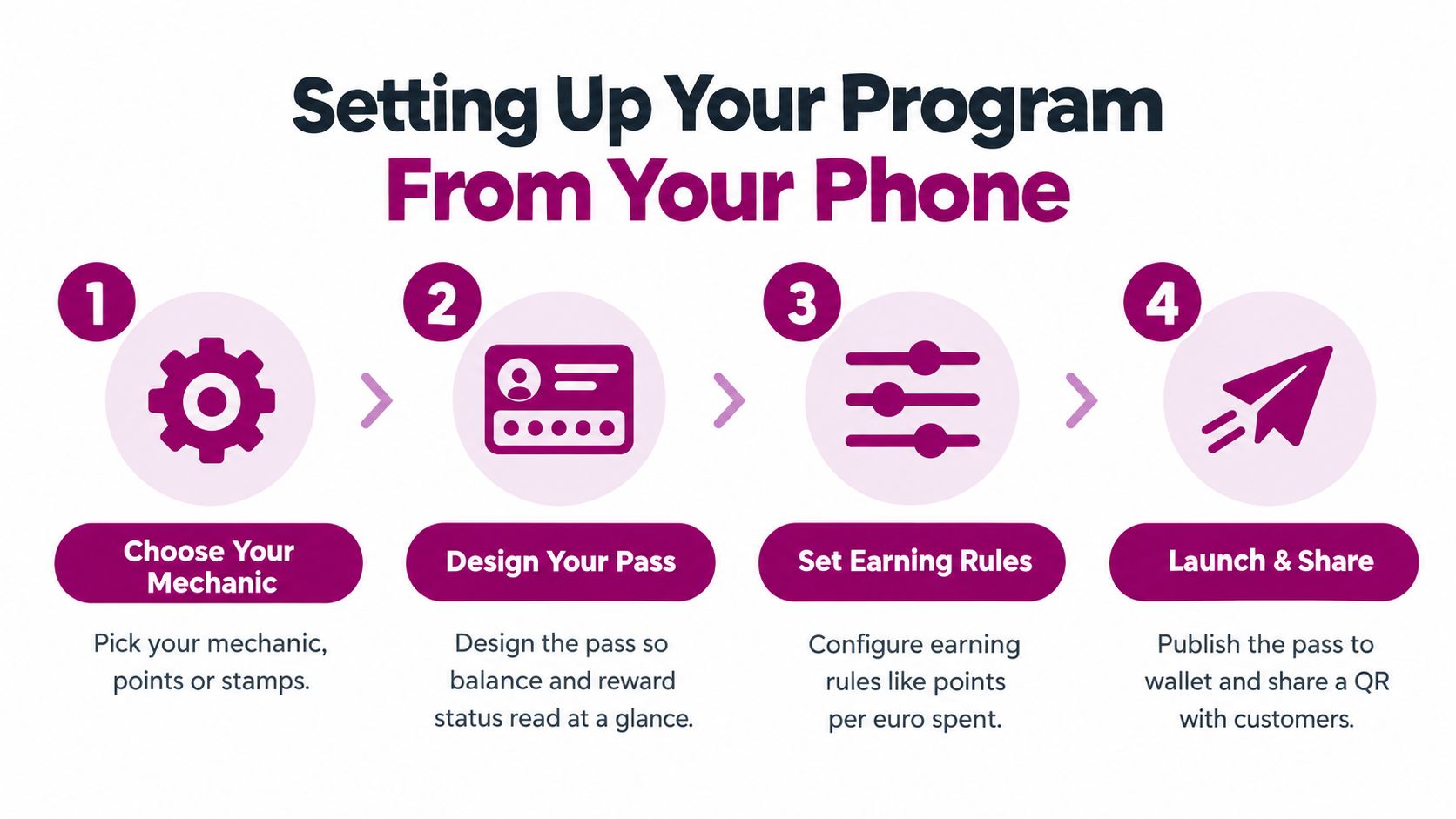
A small merchant can launch a useful program without starting with a large technical project. Begin with the behavior you want to encourage, then select the mechanic and write the rule before designing the pass.
Start with the earning rule
Choose one primary action. For a café, that might be a qualifying drink purchase. For a salon, it could be a completed appointment, an eligible product purchase, or both with separate rules. Avoid rewarding every possible action at launch because staff and customers need a clear first version.
Then decide what happens when the customer qualifies. A stamp card may provide one defined reward. A points program may provide a reward when the balance reaches a threshold. Record exceptions before opening the program, including refunds, duplicate scans, ineligible items, and rewards that have already been redeemed.
Design for the checkout glance
The pass should answer the customer's immediate question. A café customer wants to know how close they are to the next drink. A salon client wants to know whether their balance can be used today.
Use a short program name, clear reward wording, and a visible balance. Don't hide the redemption instruction in a long description. Your staff should be able to verify the status without turning the checkout interaction into a support conversation.
Make enrollment part of service
Give customers a QR code or short link at the counter, on a receipt, in the booking confirmation, or in an Instagram message. Staff can use a single sentence: “Scan this to save your loyalty pass, and we'll add your visit today.”
Run the first test with your own phone and another device. Check the add-to-wallet journey, scan the pass, add a reward, redeem it, and confirm that the displayed status changes. A phone-based tool such as Loyal Customer can support points or digital stamps, wallet-ready passes, and mobile administration, while a free trial gives a merchant a way to test the workflow before making a longer commitment.
Use this getting started guide for a digital loyalty program as a practical reference, then write down these launch decisions:
- Mechanic: Points or stamps?
- Qualifying action: What exactly earns credit?
- Reward: What can the customer redeem?
- Staff action: What must the employee scan or tap?
- Fallback: What happens if the customer can't show the pass?
- Review point: When will you inspect participation and redemptions?
A phone-first setup is valuable because owners and managers can adjust basic rules while working in the business. That convenience still needs discipline. Keep the first version narrow, observe how people use it, and only add complexity when a real customer behavior justifies it.
Metrics That Actually Predict Retention
Enrollment is the easiest number to celebrate and one of the weakest numbers to trust on its own. A customer can register once, never open the pass again, and still remain in the member count. The Boston Consulting Group research on loyalty programs found that U.S. consumers held an average of 19 loyalty memberships per person in 2024, but only 9.3 were active on average. That gap shows why a large database doesn't prove that customers are using your program.
Track behavior after enrollment instead.
The useful monthly view
Active participation rate tells you how many enrolled customers earn or redeem during the period. It separates people who joined from people who returned and used the program.
Redemptions per active member shows whether rewards are part of the customer journey or merely accumulating in the background. A low figure can mean the reward is too distant, unclear, or unattractive.
Average time between visits connects loyalty activity to the behavior you want. A café can compare the interval between qualifying visits. A salon can observe whether clients return within the intended booking rhythm.
Reward-eligibility-to-redemption conversion identifies what happens after a customer becomes eligible. If many customers claim rewards but few use them, review the redemption instructions, expiry rules, or reward relevance.
A membership count tells you who entered the program. A retention metric tells you who changed behavior.
Review two or three of these measures each month or quarter, depending on your transaction volume. Then make one controlled adjustment, such as simplifying the rule, changing the reward threshold, or improving the pass wording. Don't change earning rates, rewards, and enrollment messaging at the same time, or you won't know which change affected behavior.
The broader context supports this approach. The same BCG research reports that nearly 73% of U.S. consumers change their spending to maximize loyalty benefits, while 85% say loyalty programs make them more likely to continue doing business with brands. Those figures come with an operational warning: customers respond when the benefit is clear enough to influence a purchase, not when a program merely records their name.
Common Pitfalls and How to Avoid Them
A wallet pass removes some friction, but it doesn't remove every barrier. Small businesses often launch a technically sound program that fails at the exact moment a customer needs to use it.
Treating wallet access as universal
Some customers use older phones, have limited storage, lack reliable connectivity, or don't know how to add a pass. In a U.S. survey, 53% of consumers who didn't use digital wallets said they hadn't set one up, according to the Fiserv 2025 consumer survey facts.
Offer a fallback journey:
- Browser or SMS enrollment: Let customers begin without downloading a dedicated app.
- Staff-assisted setup: Train employees to help add the pass without holding the customer's phone longer than necessary.
- Manual lookup: Define how staff can find the customer or apply a reward when the pass can't be displayed.
- Recovery guidance: Explain what happens after a lost or replaced phone.
Test the complete flow on both iPhone and Android devices. Also state whether customers can present the pass without a live connection, rather than leaving them to discover the limitation at checkout.
Collecting more data than the reward needs
A simple stamp card may not need a detailed customer profile. Asking for a name, birthday, address, and extensive preferences before the first reward can make a small benefit feel intrusive.
The privacy concern is real even among active loyalty members. A KPMG Canadian retail survey reports that 49% of respondents were very concerned about personal information being shared with retailers, while 90% belonged to a loyalty program. Participation and concern can coexist when customers understand the exchange and receive visible value.
Collect only what redemption, account recovery, and customer support require. Keep marketing consent separate from reward eligibility, explain the purpose of each field, and provide a clear route for deleting or correcting information. A second 2025 study cited by KPMG found that only 58% of loyalty members believed brands used their shared data responsibly, and only 61% felt they received a more personalized experience. For a small merchant, a transparent, low-data program may build more trust than elaborate personalization that customers can't see.
Writing rules staff can't apply quickly
If an employee must calculate several exceptions during a busy shift, customers will receive inconsistent answers. Use deterministic rules, record each earning or redemption event, and define what happens when a transaction is reversed or scanned twice.
The backend should preserve an event history instead of overwriting the displayed balance without a trace. That record makes it easier to correct duplicate credits, refunds, expired rewards, and rule changes while keeping staff explanations consistent.
Finally, schedule a review. A loyalty program isn't finished when the pass is published. Check active participation, redemption behavior, customer questions, and staff errors. Then make small changes based on what people do.
Real Use Cases for Cafes, Salons, Bakeries, Gyms, and Micro-Merchants
A café can keep the model deliberately simple. The owner creates a stamp pass for qualifying drinks, places a QR code beside the till, and asks baristas to scan the pass before completing the order. The main metric is active participation, supported by the number of customers who redeem after reaching the reward.
A salon needs more flexibility. One client may book a basic service, while another adds treatment products or a premium appointment. A points pass can recognize those differences, show the balance before the next booking, and encourage relevant retail add-ons without forcing staff to treat every visit as identical. The salon should watch the interval between visits and the conversion from eligible rewards to actual redemption.
A bakery can use stamps to build a morning habit. The pass might reward qualifying visits, while the counter sign explains the program in one sentence. The owner can review whether enrolled customers return often enough to earn the reward and whether redemption creates confusion during busy periods.
A small gym can turn attendance into milestones. Stamps suit a straightforward visit-based model, while points may work if the gym wants to include classes, personal training, or selected merchandise. The pass should make the next milestone visible, and the manager should watch active participation rather than count every person who scanned a promotional QR code.
An Instagram-only seller has a different workflow because there may be no storefront or conventional checkout. The seller can share a loyalty link in direct messages, include a QR code in packaging, and use a digital pass for repeat orders. A simple points rule may fit varied baskets, while the most useful metric is whether enrolled buyers return for another purchase.
Deloitte's 2024 Global Consumer Loyalty Survey covered more than 9,800 consumers and found that 86% rated financial rewards, simplicity, and ease of use as important or very important. Four out of five valued flexibility in earning and redeeming rewards, and three-quarters of Gen Z and millennial respondents said a high-quality digital experience was essential to loyalty programs. Those findings reinforce the same lesson across each example: make the benefit easy to understand and easy to reach.
The technology supports the routine, but it doesn't create the routine by itself. A digital loyalty card app works when the customer knows what to do, the employee can complete the action quickly, and the reward remains visible after the visit.
Start by choosing one customer behavior, then build a simple points or stamp rule around it and test the wallet journey with your staff. Loyal Customer provides phone-managed points programs, digital stamp cards, and wallet-ready passes for Apple Wallet and Google Wallet, so visit Loyal Customer to test a practical setup for your café, salon, bakery, gym, or micro-business.