
A customer reaches the counter, orders their usual coffee, and you offer a loyalty card. They nod, take it, and put it somewhere in a wallet, coat pocket, or car. The next time they visit, the card is missing. A different customer says they'd join, but they don't want another app. Your team moves on because the queue is growing.
That friction is where many loyalty programs lose participation. Learning how to start a loyalty program isn't mainly a software decision. It's an exercise in making the next visit easier, the reward understandable, and the enrollment process almost invisible. For a cafe, salon, bakery, or independent shop, a simple digital stamp or points program stored in Apple Wallet or Google Wallet can often fit the customer's existing habits better than a printed card or standalone app.
Table of Contents
- Defining Your Retention Goal Before Building
- Choosing Between Points and Digital Stamps
- Designing Rewards That Drive Repeat Visits
- Issuing Wallet Passes for Frictionless Enrollment
- Launching the Program and Training Your Staff
- Measuring Success and Avoiding Common Pitfalls
Defining Your Retention Goal Before Building
The first mistake usually happens before anyone chooses a platform. An owner prints cards or compares software features without deciding what customer behavior needs to change. A loyalty program then collects members but gives the business no clear answer about whether visits are increasing, lapsed customers are returning, or transaction values are improving.
Start with one primary goal. Choose the problem that matters most to your current operation:
- Increase visit frequency: Useful for coffee shops, takeaway counters, bakeries, and other businesses where customers can reasonably return often. Track repeat visits per enrolled customer.
- Increase average transaction value: Relevant when customers can add services, upgrades, products, or higher-value items. Track average receipt value for participating customers.
- Reactivate lapsed customers: Appropriate for salons, spas, gyms, and businesses with longer gaps between purchases. Track whether inactive customers return after a targeted incentive.
Don't select all three as equal priorities. A program designed to increase frequency will usually need a simple visit-based mechanic. A program intended to lift transaction value may need points linked to spend or rewards tied to add-ons. A reactivation program may need a time-limited message or return offer rather than a permanent discount.
Match the metric to the business
A coffee shop might define success as more enrolled customers returning for another purchase. A salon may care more about the time between appointments. An independent retailer may want members to choose a larger basket or try a profitable category.
Write the goal in one sentence:
“We want existing customers to return more often, and we'll judge the program by repeat purchase rate.”
Then select three KPIs that connect directly to that goal: enrollment, active participation, and repeat purchase rate are a practical starting set. Don't make total sign-ups the main measure. A customer who joins but never presents the pass has created an administrative record, not retention.
Deloitte's loyalty research reports that the average consumer belongs to 8 loyalty programs but actively participates in only 5, while 51% engage with just one program in their category. The findings are summarized in Deloitte loyalty program statistics. Your program therefore has to earn attention quickly. Clear rules, visible value, and a memorable customer experience matter more than a long feature list.
Choosing Between Points and Digital Stamps
Points and stamps solve different operational problems. A digital stamp records a qualifying visit or purchase, while a points program gives you more room to vary rewards according to spend, product type, or promotional rules.
For a cafe selling broadly similar orders, stamps are usually easier to explain. “Collect a stamp with each qualifying visit and redeem a reward after the target is reached” takes little staff training and little customer effort. The customer can see progress toward a specific outcome instead of interpreting a points balance.
Salons may also benefit from stamps when the desired behavior is appointment frequency. A stamp can represent a completed service, although the business should define clearly which services qualify. A points model becomes more useful when customers buy different combinations of services, products, or upgrades and the business wants the reward to reflect value rather than mere attendance.
Use points when value varies
Points can support rules such as earning based on spend, awarding extra points for selected categories, or creating different redemption options. That flexibility has a cost. Staff must understand the earning logic, customers must understand the balance, and the business must prevent exceptions from becoming checkout debates.
A points program makes sense for an independent retailer with a wide price range or a salon selling both appointments and products. It can also work for a restaurant where a customer's order size varies substantially. It's unnecessary complexity for a coffee shop where most visits follow a familiar pattern.
A 2026 loyalty benchmark reported that stamp cards produced stronger activation and repeat behavior than points cards in its measured sample. It recorded 78.9% of stamp-card holders scanned at least once, compared with 68.5% of points-card holders, while 20.5% of stamp-card holders reached three or more visits, compared with 11.4% for points cards. The same benchmark reported that only 4.9% of all cards redeemed at least one reward, which reinforces the need for achievable rewards and active redemption tracking. See the 2026 loyalty benchmark for the full context.
| Business Type | Transaction Pattern | Recommended Model |
|---|---|---|
| Coffee shop | Frequent, similar purchases | Digital stamps |
| Salon | Repeated services with defined visits | Digital stamps |
| Independent retail | Variable basket sizes and categories | Points |
| Restaurant or takeaway | Mixed order values and promotional items | Points or simple stamps |
| Bakery | Regular visits with familiar purchase occasions | Digital stamps |
For a broader comparison of the mechanics, review this guide to points versus stamps loyalty programs. Choose the model your staff can apply consistently during the busiest period, not the model with the most configuration options.
Designing Rewards That Drive Repeat Visits
A reward has to feel reachable before it can change behavior. If a customer can't understand how to earn, what they'll receive, and how close they are within about 30 seconds, the program creates work without creating momentum. An implementation guide on why loyalty programs fail identifies unclear rules and thresholds that are too high as recurring failure points.
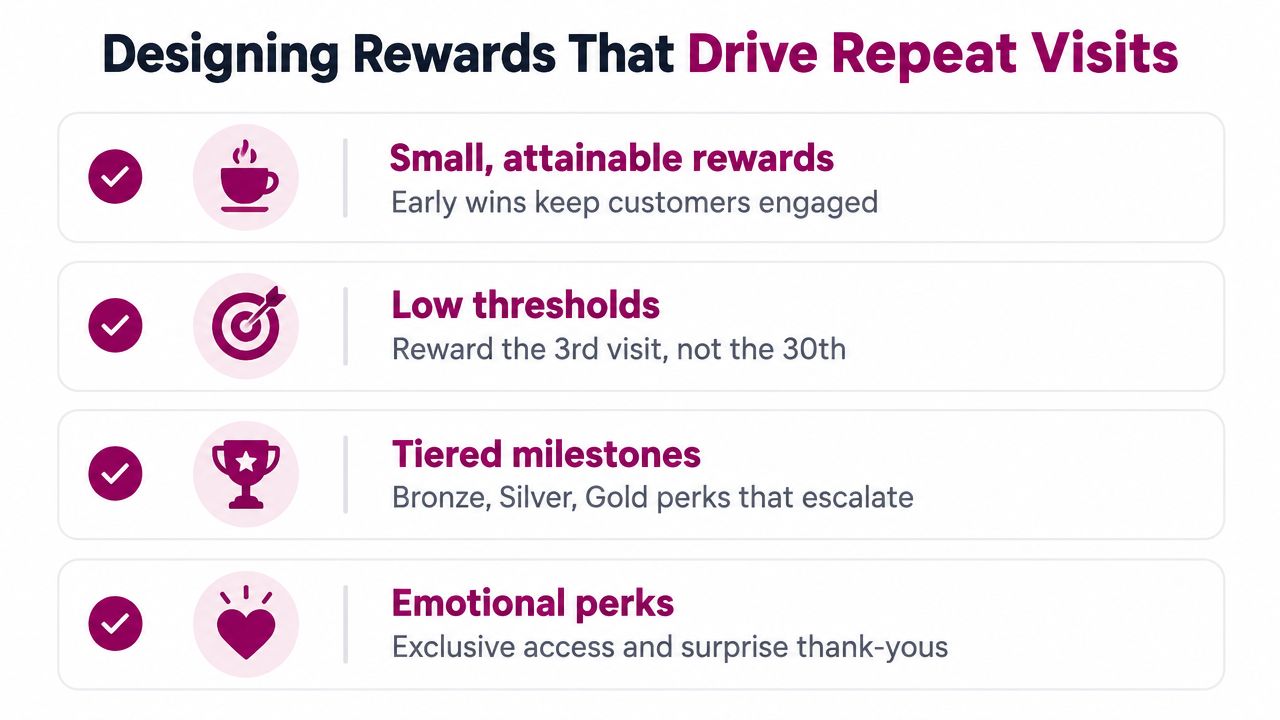
The first reward should arrive early enough to establish trust. That doesn't mean giving away a costly product. A complimentary add-on, size upgrade, service enhancement, or access to a member-only item may create more perceived value than a broad discount that trains customers to wait for a deal.
Build the reward around the next visit
Use a short rule set:
- Define the qualifying action. State whether the customer earns for each visit, service, purchase, or qualifying product.
- Show progress clearly. The pass should display the current stamp count or points balance without forcing the customer to search.
- Offer an immediate welcome benefit. Give new members a small reason to use the program on their next visit.
- Make redemption simple. Staff should know exactly how to verify and apply the reward.
- Review the margin. Calculate the cost of the reward, the qualifying purchase requirement, and any likely effect on the average receipt value.
Thresholds deserve particular attention. A reward that arrives after a customer has already lost interest won't create a return visit. For a coffee shop, the first meaningful milestone should support habitual purchasing. For a salon, it might be a treatment upgrade or product benefit that complements a scheduled appointment rather than cutting the service price.
Prefer value over constant discounting
A good reward strengthens the reason to return. A free flavor addition can encourage a customer to choose the same cafe again. Early access to a seasonal service can make a salon member feel recognized. A surprise thank-you can add emotional value without turning every purchase into a price negotiation.
Examples and practical ideas are collected in these customer loyalty examples. Use them as prompts, then adapt the reward to your actual margin, stock, staffing, and customer expectations. A complicated tier system can wait until the basic program proves that customers participate and redeem.
The Antavo Global Customer Loyalty Report for 2026 reports that 83.0% of loyalty program owners are satisfied, 9 out of 10 owners who measure performance report positive ROI, and the average ROI among those reporting a positive return is 5.3x. Those figures don't guarantee results for a small business. They support a more useful conclusion: measure the program as a retention channel, and keep changing the design when customer behavior says it isn't working.
Issuing Wallet Passes for Frictionless Enrollment
A standalone app asks customers to make a commitment before they've experienced any value. They need to find the app, download it, create or remember credentials, and open it at the counter. During a busy morning rush, that sequence is too much to ask for a simple reward.
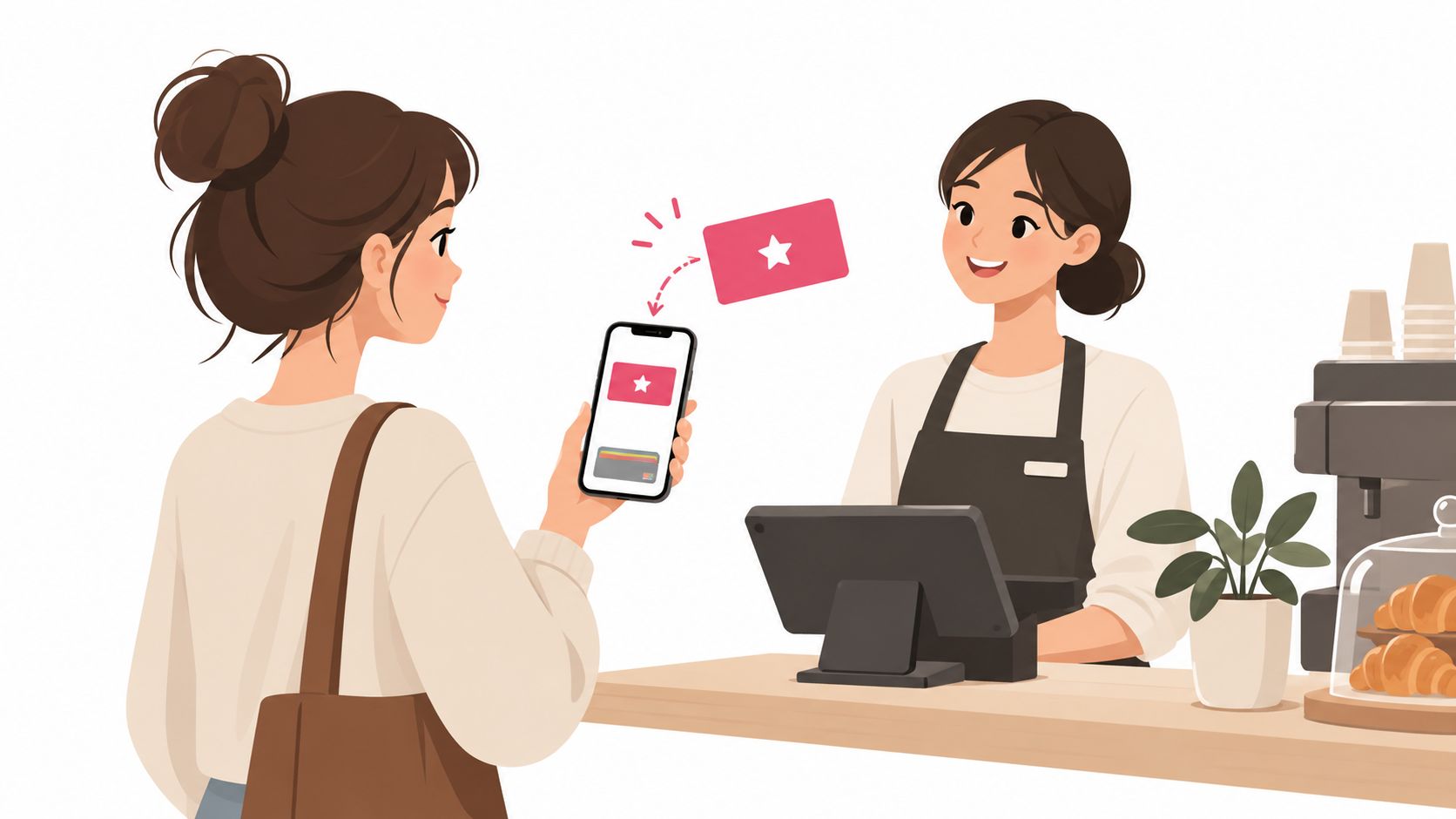
A wallet pass removes several of those steps. Customers can save a loyalty credential to Apple Wallet or Google Wallet, then present it from a familiar place on their phone. The pass can show the current stamp or points balance, your branding, and the information staff need to identify the member.
Set up the pass around the checkout moment
Configure the customer journey in this order:
- Create the program rules. Select stamps or points, define the qualifying purchase, and add the first reward.
- Design the digital card. Use recognizable branding and place the balance where customers can find it quickly.
- Publish one join route. A QR code at the counter, a link in your Instagram profile, and a link in appointment confirmations should all lead to the same enrollment page.
- Let the customer save the pass. The customer chooses Apple Wallet or Google Wallet, depending on their device.
- Test the full exchange. Join as a customer, save the pass, present it at checkout, add progress, and redeem a reward.
The pass should be the primary interface, not an advertisement for an app download. If customers need a separate application to see their balance or claim a reward, you've reintroduced the friction you were trying to remove.
Give staff a single operational action
Your team needs one repeatable instruction, such as “scan the pass before completing the payment” or “open the member page and add one stamp.” Avoid asking staff to move between several screens while a queue waits. For salons, receptionists can issue or update the pass during check-in. For cafes, the barista can point to the QR code and finish enrollment between orders.
Businesses comparing wallet workflows can review loyalty passes for Apple Wallet. The important design choice isn't merely whether the pass looks polished. It's whether the customer can find it, whether the employee can process it quickly, and whether the balance remains understandable after several visits.
Launching the Program and Training Your Staff
At 8:30 in the morning, a cafe counter leaves no room for a five-minute explanation. One employee is taking orders, another is preparing drinks, and customers are already waiting. A loyalty program succeeds when enrollment fits into that choreography instead of interrupting it.
Give staff a short script and a clear fallback. For example:
- Barista: “Would you like a digital reward card? Scan this code, save it to your phone, and I'll add today's stamp.”
- Receptionist: “We have a digital rewards card for returning clients. I can send it to your phone now, then we'll update it after your appointment.”
- Retail clerk: “Would you like points on this purchase? Scan here to join, and your balance will be available from your phone.”
The script should explain the immediate benefit, identify the next action, and stop. Staff don't need to describe every future promotion at the register.
Pilot the physical workflow
Run the first version as a controlled pilot. One implementation guide recommends a two-week experiment focused on the welcome bonus, while monitoring redemption, engagement, and support tickets. Use that period to identify operational friction, not to declare a permanent winner.
During the pilot, record what happens:
- Enrollment interruptions: Note where customers abandon the process.
- Staff hesitation: Write down questions employees can't answer immediately.
- Scanning failures: Check whether the QR code is visible, well lit, and placed at the natural payment point.
- Reward disputes: Look for ambiguous qualifying purchases or inconsistent exceptions.
- Customer language: Capture the words people use when they ask what the program does.
Keep the counter materials simple. Place one sign where customers wait, not several competing signs around the store. Add the join link to digital receipts, booking confirmations, and social profiles only after the in-person flow works.
Train for exceptions before launch
Decide what happens when a customer forgets their phone, loses access to a pass, or asks for a missed stamp. Decide who can reverse a redemption and how staff handle refunds. Clear rules protect both the customer relationship and the program's margin.
A soft launch also gives employees permission to report problems. If staff find the program awkward, customers will experience that awkwardness at every visit. Fix the workflow before adding more rewards, tiers, or promotional campaigns.
Measuring Success and Avoiding Common Pitfalls
A loyalty program can't compensate for a disappointing coffee, an unreliable appointment, poor service, or an uncompetitive offer. Deloitte's survey of 5,564 U.S. adults who were loyalty-program members found that price, value, and quality remain top drivers of repeat behavior, with loyalty programs acting as only one part of the equation. The finding appears in Deloitte's research on reshaping customer loyalty programs.
Track behavior, not just membership. A useful dashboard includes:
- Active-member rate: How many enrolled customers present or use the program?
- Redemption rate: Do customers reach and claim rewards?
- Redemption velocity: How long does it take members to move from earning to redemption?
- Repeat purchase rate: Are participating customers returning more often?
- Average receipt value: Does the program preserve or improve transaction value?
The benchmark cited earlier flags redemption below 20% and active-member rates below 30%, alongside no measurable improvement in repurchase rate or average receipt value, as warning signs. Treat those thresholds as diagnostic signals, not universal guarantees. A low redemption rate may mean the reward is too distant, the rules are unclear, or customers don't value the reward.
Practical rule: If enrollment rises but active use and repeat purchases stay flat, change the experience or reward cadence before adding more features.
Review the program regularly. Lower an unreachable threshold, replace a weak reward, improve the pass display, or change the staff script. Keep the core product, convenience, and service strong, because the loyalty program should support a good customer experience, not conceal a poor one.
Loyal Customer lets cafes, salons, retailers, and other consumer-facing businesses run either a points program or digital stamp card from a phone, with loyalty cards available for Apple Wallet and Google Wallet. Visit Loyal Customer to test a simple wallet-ready program, publish a join link or QR code, and see whether customers use it before investing in a more complex setup.



