Your stamp card isn't failing because customers dislike free rewards. It fails because the finish line feels too far away, the card is buried when they reach the counter, and no one reminds them they're getting close. A 2026 compilation citing Deloitte research reports that the average U.S. consumer is enrolled in eight loyalty programs but actively participates in only five. That gap explains most unused cards. People enroll when the offer sounds easy, then drop the programs that demand effort, memory, or another app.
Good stamp cards ideas fix those three problems before they try to be clever. The reward is specific, progress is visible in two seconds, and the first win arrives while the customer still cares. A regular coffee buyer shouldn't need three months to earn a free drink. A salon client who visits six times a year shouldn't chase a target designed for a weekly cafe regular.
The eight ideas below each include a concrete threshold, ready-to-use wording, and an honest note on when the idea backfires. Pick the one that matches your visit frequency and margins, not the one that looks busiest on a poster. Test it small, watch who redeems, and remove friction before you add more rules.
Table of Contents
- 1. Classic Buy-10-Get-1-Free Stamp Card
- 2. Tiered Milestone Stamp Card
- 3. Bonus Stamp Days and Double-Stamp Promotions
- 4. Mystery Reward Stamp Card
- 5. Referral Stamp Card
- 6. Spend-Based Stamp Card
- 7. Attendance Challenge Stamp Card
- 8. Collect-the-Set Themed Stamp Card
- Stamp Card Ideas at a Glance
- Pick One Card and Launch It This Week
1. Classic Buy-10-Get-1-Free Stamp Card
Say an independent coffee shop sets this rule. Buy 10 drinks, get the 11th free. Every visit earns one stamp, the pass shows 6 of 10 visits completed, and the reward never needs explaining. Bakeries can run the same shape with a free pastry, and tea shops can offer a free bag of loose-leaf tea after a set number of visits.
The mechanic works because it rewards frequency, not spend, and the goal stays visible. A digital version matters here. Fiserv's 2025 Annual Prepaid Consumer Insights Survey reports that 90% of surveyed consumers use a digital wallet. That makes an Apple Wallet or Google Wallet pass a better default than paper for most buyers, provided you keep an SMS, email, or browser fallback for customers who don't use a wallet.
How I'd set it
Aim for the first reward within four to six weeks for a typical customer. If regulars come twice a week, ten stamps works. If they come weekly, try five or six stamps instead. Choose a reward with high perceived value and low marginal cost, such as a standard drink rather than your most expensive seasonal special. I explain the cost logic for choosing stamp counts and rewards in more depth, but the short version is simple. Don't let the free item eat the margin from the paid visits.
Use this wording at the counter. "You're on stamp 9 of 10. Your next regular latte is free." Send a wallet notification at nine stamps, not at three, because the reminder should create a reason to return soon.
Practical rule: Keep the same stamp count across locations. If staff in one shop say eight and staff in another say ten, trust disappears faster than stamps accumulate.
When it backfires: The target is too distant, the free item is heavily restricted, or staff forget to stamp. Customers don't quit loudly. They just stop bringing the card.
2. Tiered Milestone Stamp Card
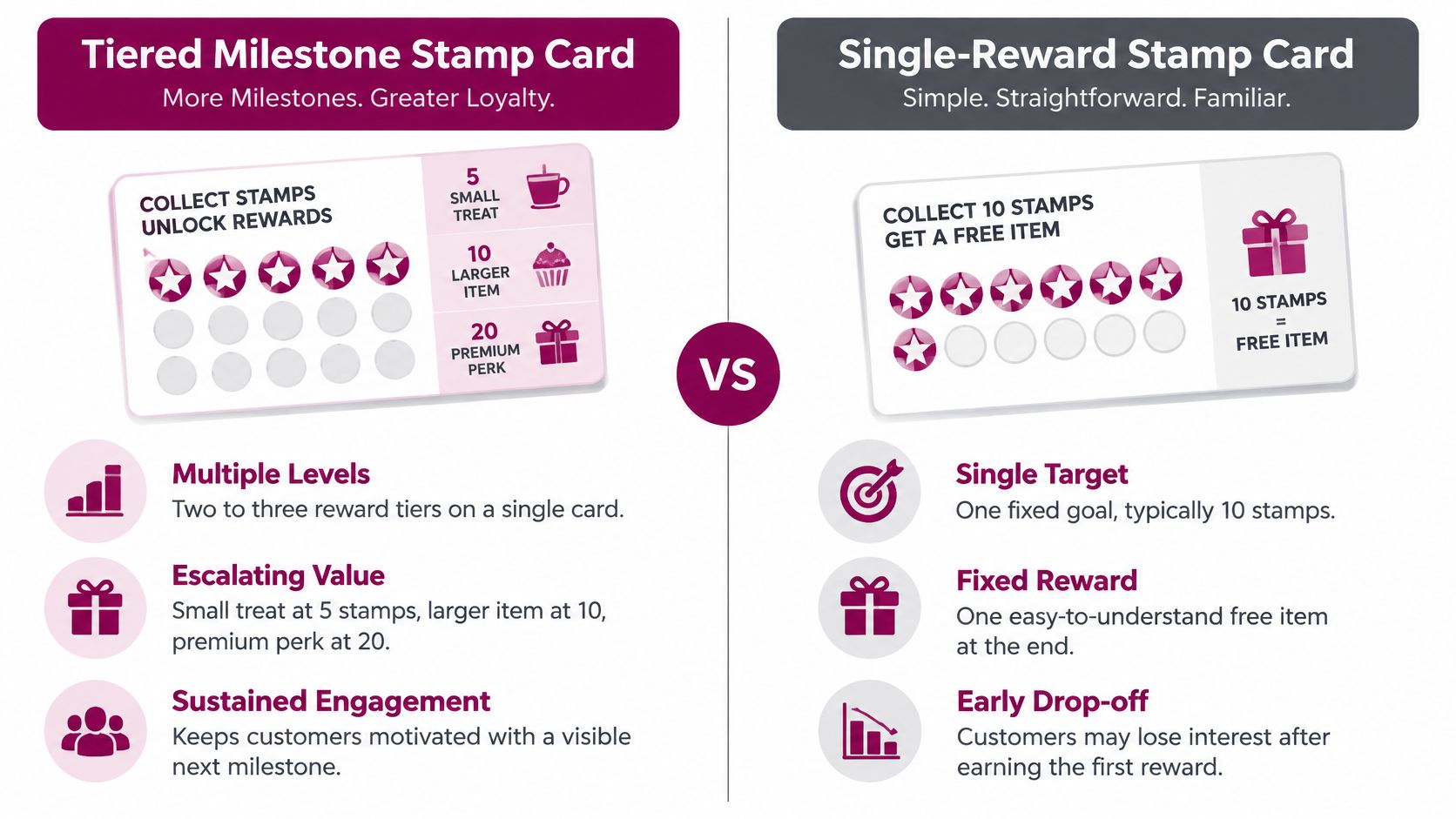
A tiered card gives customers a reason to continue after the first reward. A salon might offer a free conditioning treatment at 5 visits, a product gift at 10, and a larger service upgrade at 15. A gym could give a guest pass first, then a personal-training taster, then a premium perk at the top tier.
Digital progress display is essential because three rewards are harder to track on paper. The National Restaurant Association reported that in 2024, 60% of current restaurant loyalty-program members preferred accessing the program through a smartphone app rather than a physical card. A wallet pass can meet that preference without forcing a separate download, as long as the next milestone stays on the front of the pass.
The comparison below shows why tiered and single-reward cards produce different behavior.
Keep the ladder readable
- Use three tiers at most: More levels look generous in a planning meeting and confusing at checkout.
- Grow the gaps gradually: Five, ten, and fifteen is easy to understand. Five, seven, and twenty feels rigged.
- Display only the next reward: Customers need one goal, not a spreadsheet of future prizes.
- Set a fair expiry window: Make the top tier achievable at normal visit frequency, and state the deadline plainly.
Send this message after the first milestone. "Your free treatment is ready. You're also 4 visits from your next reward." That wording celebrates the win first, then gives the customer a fresh reason to continue.
When it backfires: The early reward is so weak that customers treat it as a token, or the top reward is so expensive that staff discourage redemption. Price every tier before you launch, and track completion, redemption, and post-redemption return separately.
3. Bonus Stamp Days and Double-Stamp Promotions
Double stamps solve a timing problem, not a loyalty problem. A cafe that's quiet before 9 a.m. can offer two stamps on weekday mornings. A restaurant with empty tables on Tuesdays can give a bonus stamp that night while keeping the normal card unchanged. Customers move a visit they'd probably make anyway into the hour you need covered.
This image shows the simple counter moment that makes the promotion work.
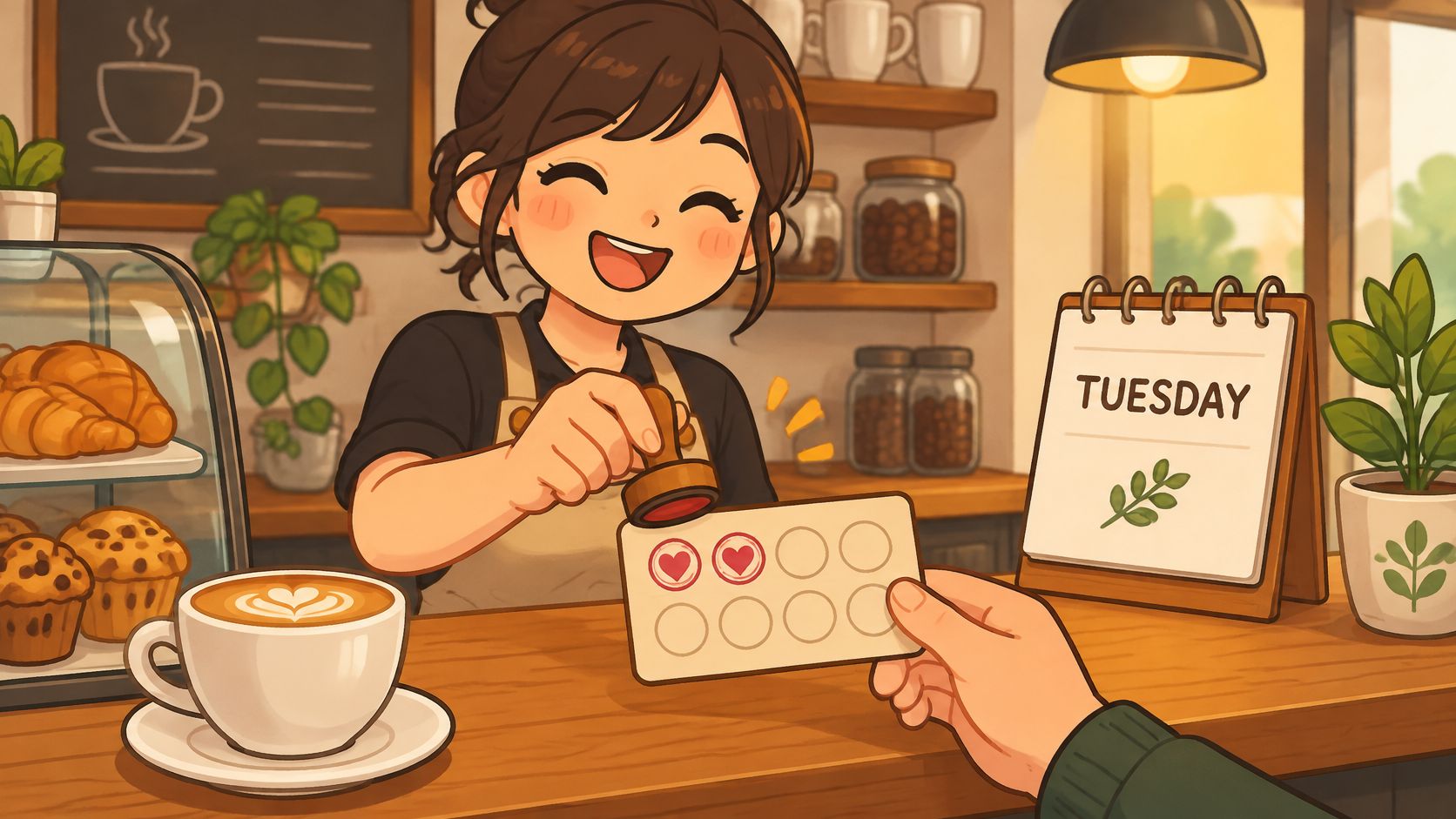
Keep the offer narrow. One or two bonus periods a week is enough, tied to one daypart and one clear qualifying purchase. Message wallet holders that morning with wording such as, "Double stamps until 10 a.m. today. Buy your usual coffee and get 2 of 10." Don't announce it so early that customers delay yesterday's full-price visit just to chase the bonus.
Measure whether the promotion influenced behavior or just discounted regulars. Recent restaurant research summarized by PassKit reports that 83% of restaurant leaders with loyalty programs reported larger orders and repeat visits. Those are operator-reported results, not proof that your promotion caused the lift. Compare bonus periods with normal periods, then check visit frequency, average transaction value, reward cost, and margin per member.
A quick operating check
Run the promotion for several weeks, compare the same hours before and after, and stop if redemption costs rise without extra visits. Bonus stamps should pull demand into empty capacity. They shouldn't train your busiest customers to wait for double value.
When it backfires: Bonus days happen so often that one stamp feels like a penalty. Scarcity is the point. Protect it.
4. Mystery Reward Stamp Card
The customer completes a set card, then reveals which reward they've won from a published pool. That pool might include a free pastry, a drink upgrade, or a small seasonal gift. Tim Hortons Roll Up the Rim uses a related prize-reveal mechanic on cups, while a bakery can create the same anticipation with a surprise treat after a completed card.
The reward reveal deserves a visible moment, as shown here.

Uncertainty only helps when every outcome feels fair. Publish the reward options and approximate odds in the card terms, give every result a minimum useful value, and check local prize-promotion regulations before launch. I take the same position in this guide to using surprise rewards without disappointing customers. A tiny discount after ten full-price purchases isn't a mystery. It's an insult with confetti on it.
Try this wording on the pass. "Card complete. Reveal your reward. Every prize includes at least a free pastry." The guaranteed floor matters as much as the top prize because it removes the fear of wasting ten visits.
Make the reveal easy
This video is worth watching for ideas on presenting the completion moment clearly.
Use a reveal animation if your pass supports it, but keep redemption to one tap at checkout. Don't make customers screenshot a code, open another page, or explain the prize to a staff member who hasn't been trained.
When it backfires: The odds are hidden, the weakest prize is embarrassing, or customers feel pushed to buy one more item just to finish. Mystery should decorate a fair reward, never disguise a weak one.
5. Referral Stamp Card
A referral stamp turns a satisfied regular into your acquisition channel. The rule is straightforward. Your friend completes a first qualifying visit, you each earn one stamp. Salons can award it after a friend's first appointment. Gyms can award it after a friend attends a first class or joins. Dropbox used the same both-sides logic by rewarding the referrer and the new user, which makes sharing feel generous rather than self-serving.
Award the stamp only after the friend's first paid or attended visit. Paying for a sign-up alone invites duplicate accounts and people referring a second email address they control. Block duplicate phone numbers or emails where your system allows it, and cap how many referral stamps one customer can earn on a single card if abuse becomes a concern.
Give customers words they can copy
Customers won't write your marketing copy for you. Give them a message ready for WhatsApp or Instagram.
"I go to this salon and have a stamp card you can use too. Book your first appointment through my link and we both get a stamp toward a free treatment."
That message names the benefit for both people and doesn't oversell. Your staff should use the same structure in person. "If a friend books after you, you'll both get a stamp." Short beats enthusiastic.
Place the share prompt after a good experience, such as a completed appointment or a finished coffee, not during enrollment when the customer hasn't decided whether they like you yet. For the broader mechanics, this breakdown of building customer referral programs that reward both sides covers the tracking choices.
When it backfires: Your regulars feel turned into sales staff, or low-quality referrals arrive only for the freebie and never return. Track the friend's second visit, not just the referral count.
6. Spend-Based Stamp Card
Visit-based stamps punish businesses where basket sizes vary. A customer buying one coffee and a customer buying lunch for four shouldn't always make identical progress. A spend-based card fixes that by awarding one stamp for each set amount spent, such as one stamp per 10 spent before discounts.
Independent grocers can use this design across mixed baskets. Takeaways can award one stamp per order over a minimum value, or extra stamps when a family order crosses higher bands. The starting threshold should be calibrated so an average order earns one stamp. Set it too low and you give away margin on every transaction. Set it too high and ordinary customers never move.
State the rule before customers test it
- Define qualifying spend: Say whether the amount is before or after discounts, taxes, and tips.
- Handle refunds explicitly: Remove stamps when the qualifying purchase is refunded.
- Protect low-margin categories: Exclude gift cards or heavily discounted items if necessary, and disclose the exclusion.
- Show progress in money and stamps: "You've earned 4 stamps" is clearer than making customers calculate their own total.
Use wording like this on the card. "Earn 1 stamp for every 10 spent. Collect 8 stamps for a free main under 12." A category or value limit keeps the reward predictable without hiding it in tiny terms.
I recommend favoring incremental visits and profitable categories over the highest possible completion rate. A card everyone completes may discount purchases they'd have made anyway. Compare member and non-member behavior where you can, and watch gross margin per member alongside completions.
When it backfires: Customers split or combine orders to game thresholds, or staff argue about whether a discounted item counts. Write the edge cases down before launch.
7. Attendance Challenge Stamp Card
An attendance challenge adds a deadline to the familiar stamp structure. A gym might set 12 classes in 30 days. A yoga studio might offer a free session after eight attended classes in a month. Wellness spas and recurring service providers can use a softer version where completing the challenge earns a discount on the next package.
The deadline works when the goal stretches active members without punishing normal life. Set a target most active members can realistically reach with modest extra effort. If your typical member attends twice a week, a twelve-class month asks for one extra class most weeks. That's demanding but plausible. A twenty-class target mostly rewards people who already live at your studio.
Run the challenge from check-in
Stamp attendance at the front desk or through the wallet pass as the customer arrives. Don't rely on members remembering to request credit afterward. Midway through the period, message only the people who are behind and still have a realistic path. "You're at 5 of 12 with 16 days left. Two classes this week keeps you on track."
That message is useful because it turns the remaining target into a weekly action. A generic blast to everyone teaches members to ignore you. A congratulatory message to finishers should point straight to the next booking, such as, "Challenge complete. Your free class is ready. Book it before Sunday."
When it backfires: The deadline creates guilt, members attend while injured, or customers who miss the target by one class feel cheated. Consider a small partial-completion perk or a paid extension where it fits your model. The reward should encourage the next healthy visit, not reward exhaustion.
8. Collect-the-Set Themed Stamp Card
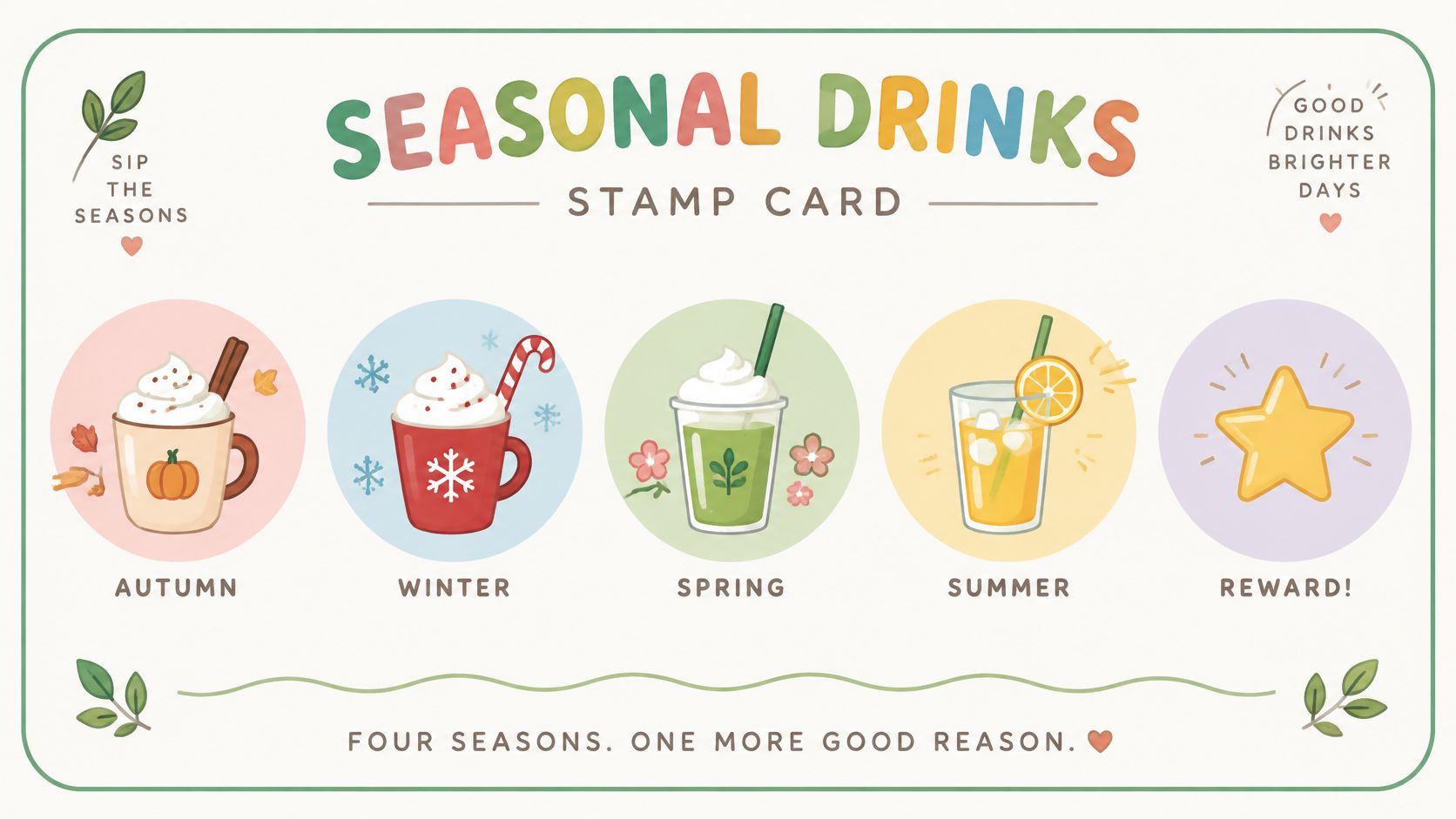
Collect-the-set cards turn variety into the goal. Each stamp represents a different drink, product, or season, and collecting them all earns the reward. A cafe can issue one stamp for each drink on a holiday menu. A tea shop can create a monthly tea-of-the-month set that encourages sampling. A bakery can use different stamps for seasonal bakes rather than counting anonymous visits.
This seasonal example shows how visual variety makes missing items obvious.
Collecting has deep retail roots. Gallup's account of the trading-stamp era reports that in August 1957, 68% of U.S. adults were saving or collecting trading stamps. The format has changed, but the pleasure of filling visible gaps hasn't. Among collectors in that report, approximately two-thirds said they'd already obtained something in exchange for their stamps, which underlines why the reward still needs to be tangible.
Keep sets to four to six stamps so customers can finish within the season. Rotate the theme without rebuilding the whole program, and display the set in-store so non-members understand what they're joining. The final reward should match the theme, such as a limited-edition drink, a seasonal gift box, or first access to the next menu.
Use this message when one item remains. "Only the Winter Spiced Latte is missing. Collect it to earn your free holiday drink."
When it backfires: One item sells out, a customer dislikes the only remaining flavor, or the season ends before regulars can finish. Build in a substitute stamp for sold-out items and announce the end date early.
Stamp Card Ideas at a Glance
| Idea | Best For | Reward Structure | Main Risk |
|---|---|---|---|
| Classic Buy-10-Get-1-Free Stamp Card | Businesses seeking simple, frequent repeat visits | One free item after a fixed number of stamps | Rare visitors may not finish the card |
| Tiered Milestone Stamp Card | Businesses aiming to sustain engagement over time | Increasing rewards at multiple stamp milestones | Higher-tier rewards can become costly |
| Bonus Stamp Days and Double-Stamp Promotions | Businesses looking to boost traffic during quiet periods | Extra stamps on selected days or times | Customers may wait for promotions |
| Mystery Reward Stamp Card | Seasonal campaigns, launches, or businesses seeking excitement | A surprise reward revealed when the card is complete | Unclear reward odds can disappoint customers |
| Referral Stamp Card | Businesses seeking new customers through word of mouth | Stamps for verified referrals, sometimes rewarding both people | Referral abuse or low-quality leads |
| Spend-Based Stamp Card | Retail, grocery, or takeaway businesses with varied order sizes | Stamps earned for each set amount spent | Rules may feel complicated or make progress seem slow |
| Attendance Challenge Stamp Card | Fitness, wellness, and recurring-session businesses | A reward for reaching an attendance goal within a set period | Ambitious targets can discourage customers |
| Collect-the-Set Themed Stamp Card | Businesses promoting varied, seasonal, or new products | A reward for collecting a complete set of themed stamps | Limited availability can make the set hard to complete |
Pick One Card and Launch It This Week
Don't launch three mechanics and hope customers sort them out. Choose the card that matches your visit frequency, order pattern, and margin. A cafe with fast repeat visits fits buy-10-get-1-free or double-stamp mornings. A salon with longer gaps fits tiered milestones or referrals. A grocer with uneven baskets fits spend-based stamps. A fitness studio fits an attendance challenge because attendance is already the behavior you're selling.
Define four things before you design anything. Write down the qualifying action, the target, the exact reward, and the date you'll review results. Then decide what counts as success. I wouldn't judge a card by registrations alone. Track enrollment to first stamp, second use, completion, redemption, and whether the customer returns after redemption. Segment by new and regular customers if you can, because a card that only rewards people who'd visit anyway may look busy while contributing very little.
Build an inclusive fallback into the launch, not after complaints arrive. Some customers don't use Apple Wallet or Google Wallet, have older phones, need accessible enrollment pages, or do not want another digital account. Square's restaurant trends material highlights the operational reality that merchants still need visible sign-up routes and staff who can explain and support participation. Offer a wallet pass first, then SMS or email lookup, plus a staff-assisted or paper backup. Train staff to merge or recover progress when a customer switches channels. Removing an app download helps many people, but a wallet-only rule can create a new barrier.
Test with customers before you print posters or promise an expensive top reward. Loyal Customer lets you run a digital stamp card from a phone, set a target of 3 to 10 stamps, give one stamp per checkout, and issue wallet-ready passes for Apple Wallet and Google Wallet that update automatically. You can preview the wallet card before launch and use the free trial to test whether customers understand the earning rule at the counter.
Start smaller than your ambition. If your normal customer can earn the first reward soon, staff can explain the rule in one sentence, and the reward costs less than the repeat visits are worth, you've built a card people will keep. That's the standard. Everything else is decoration.
Choose one threshold, write the exact reward, and test it with a wallet-ready card that gives one stamp per checkout and updates automatically in Apple Wallet or Google Wallet. Start your free trial with Loyal Customer, preview the pass before launch, and launch your first stamp card this week.