
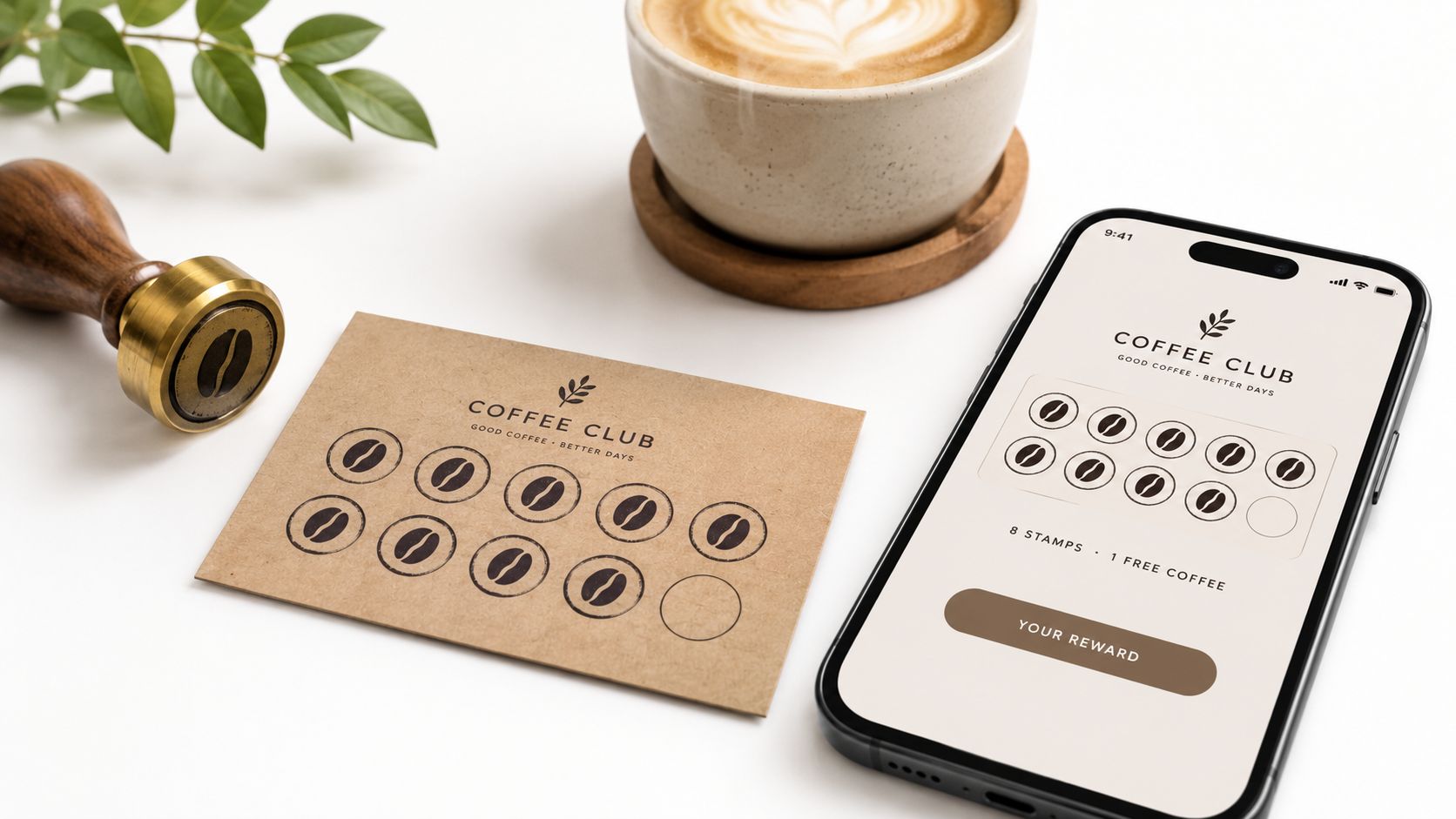
You're at the till, a regular customer orders the same flat white they get every Tuesday, and the paper stamp card still isn't in their wallet. The drink goes through, the customer smiles, and the loyalty moment disappears. A week later they find the card crushed in a coat pocket, then the next time it's gone for good.
That's the problem loyalty card stamps have always had. The reward can be good, the offer can be fair, but if the card is missing at checkout, the habit breaks. Digital stamps fix the part that matters most, the card stays on the phone, ready when the customer already has their wallet out.
Table of Contents
- The Moment a Paper Stamp Card Disappears
- How Loyalty Card Stamps Actually Work
- Paper Cards, Apps, and Wallet Stamps Compared
- Customising a Digital Stamp Card for Your Shop
- How Many Stamps Before a Free Reward
- Redeeming Stamps at the Till Without Slowing the Queue
- A Simple Checklist Before You Launch
The Moment a Paper Stamp Card Disappears
The loss usually doesn't happen in some dramatic way. It happens at a counter, in a rush, with someone holding a takeaway cup and asking if they've got their card with them. In a cafe, that's the exact second paper loyalty falls apart, because no one wants to slow the line while a customer digs through pockets.

A lot of owners think the reward size is the main decision. In practice, the bigger issue is whether the card is present when the sale happens. If the customer only remembers it on the second visit, the program is already leaking value. If the card is lost by the third, the routine is gone.
What I saw behind the counter
In a cafe, the forgotten card usually means the owner absorbs the visit and stamps nothing. In a salon, the same thing happens when a client is booked in, pays, and only later remembers the card in a different bag or jacket. That isn't a reward problem, it's a presence problem.
Practical rule: if the card isn't easy to present in five seconds, the program won't survive busy service.
Digital loyalty card stamps solve that by moving the card into the device customers already carry for payments. The logic is simple, the visit gets counted when the customer is at the counter, not when they remember a piece of cardboard. For small businesses, that matters more than fancy branding or a bigger freebie.
How Loyalty Card Stamps Actually Work
A loyalty card stamp program has three parts, and they're all straightforward. First is the qualifying action, such as buying a coffee or paying for a salon service. Second is accumulation, where one visit adds one stamp. Third is the redemption rule, where a full card earns the reward.
Coffee and salon versions
In a cafe, the pattern is easy to explain to staff. A customer buys a coffee, the shop adds one stamp, and when the card reaches the set total, the next drink is free. In a salon, it works the same way, but the qualifying service might be a cut, a colour, or another tracked appointment, and the reward could be a free treatment or add-on.
The important part is that the customer understands the game in one sentence. They buy, they collect, they redeem. That clarity is why stamp cards feel friendlier than more complex loyalty systems.
The simplest way to train staff
If I had to teach a new team member in under a minute, I'd say this:
- Check the purchase qualifies. If it does, add one stamp.
- Watch the count. When the card fills, the reward becomes available.
- Redeem once. Mark it immediately so it can't be used again.
That's enough for a cafe counter or a salon desk. The nicer design details matter later, but the mechanic itself has to be boringly clear.
A good stamp program should be easy enough to explain while making change.
The customer-facing version also helps when the card lives in a wallet instead of on paper. A scan, a saved pass, and a visible stamp count make the whole thing feel present without adding extra steps. If you want a plain guide to the broader digital version of this setup, the logic lines up with the approach in digital punch cards.
Paper Cards, Apps, and Wallet Stamps Compared
The trade-off between paper, apps, and wallet-based loyalty is mostly felt at the till. Paper is cheap but forgettable. Apps can be powerful, but they ask for a download and a second habit. Wallet stamps sit in the middle, they're simple for the customer and easier for a small team to run.
| Paper, App, and Wallet Stamps at a Glance | Setup cost | Install needed | Stamp at till | Customer friction | Data captured |
|---|---|---|---|---|---|
| Paper cards | Low | No | Manual stamp or punch | High when forgotten | Minimal |
| Standalone apps | Higher | Yes | Usually app-based | Higher because of install and sign-up | Richer |
| Wallet-based stamps | Moderate | No separate app | Scan, tap, or lookup | Lower because the card lives on the phone | Useful day-to-day tracking |
Wallet stamps make sense because they live in Apple Wallet or Google Wallet, not in a separate app people need to remember. That removes one extra decision before the first visit and one extra excuse on the second. For a cafe or salon with a small team, that reduction in friction matters more than feature depth.
What the counter feels like
Paper cards are easy to start, but the staff ends up chasing cards that are in the car, the coat pocket, or the wrong bag. Apps can collect more customer detail, but they also create more no-shows on the loyalty side because some regulars never bother to install them. Wallet-based stamps keep the behavior close to the payment habit customers already have.
If you're weighing setup and adoption for a local business, the practical decision usually comes down to checkout speed and whether customers need to install anything. Those two things decide more loyalty programs than fancy dashboards do. A simple comparison of wallet-first thinking is also covered in digital loyalty cards for business.
Customising a Digital Stamp Card for Your Shop
A digital stamp card works only if it matches how your shop sells. A cafe and a salon need different thresholds, different wording, and different reward labels, even if the software can reuse the same layout. Start with repeat visit patterns, then shape the card around them.
Customising a digital stamp card starts with the threshold. If the reward sits too far away, customers forget about it. If it lands too quickly, you give away margin before the program has paid for itself.
The reward name matters just as much. “Free drink” and “free regular coffee” do not feel the same, and “free treatment” is clearer than a vague discount line. Clear wording also saves staff from explaining the offer differently at the counter.
Branding and live edits
The rest is presentation. Set the stamp icon, choose the card colours, add your logo, and adjust the card art so it looks like your shop instead of a template. You can also change the copy later, which helps when you spot wording that confuses customers or slows staff down.
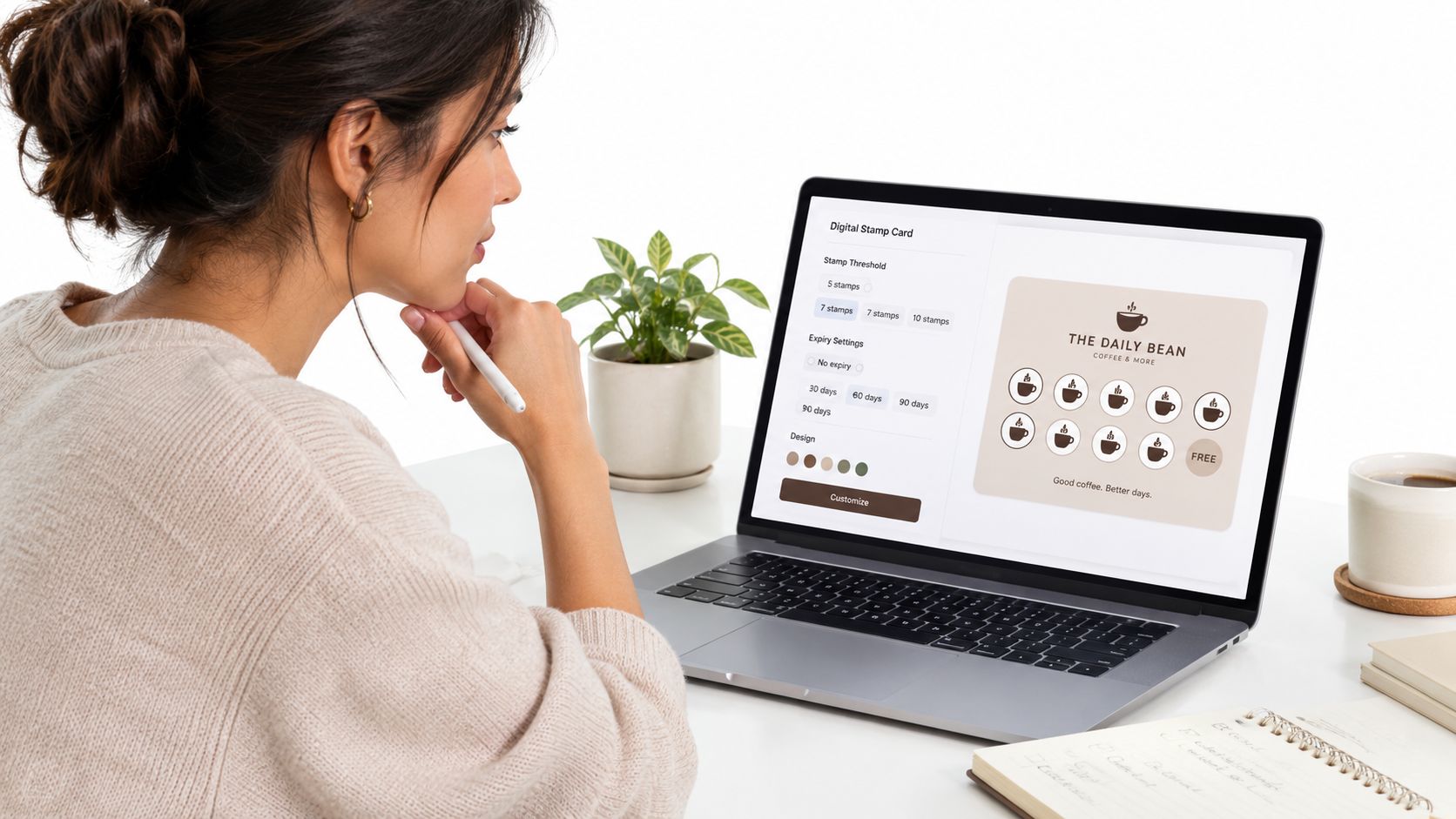
For cafes, keep the stamp tied to a coffee purchase and make the reward obvious at a glance. For salons, tie it to the service visit and use wording that fits appointments, not takeaway sales. The aim is to remove questions at the till.
Simple test: if a part-time employee cannot explain the card in one breath, the copy is too clever.
Wallet-based cards also save time after launch. Once the setup is right, you are not reprinting cards or rebuilding the offer every week. You make the offer once, then only touch it when the business changes. That suits solo operators and small teams who already have enough admin to handle.
How Many Stamps Before a Free Reward
The right threshold depends on how often people come back. A coffee customer can hit a target much faster than a salon client, so the numbers should reflect that reality instead of trying to force every business into the same shape. The best programs feel earned, not distant.
What usually fits each business type
Coffee shops often land at 8 to 10 stamps for a free regular drink. Salons usually sit closer to 5 stamps for a free add-on or treatment. Those ranges are practical because they fit how often the customer already visits.
| Common stamp thresholds by small business type | Stamps Required | Reward Given | Approx. Completion Time |
|---|---|---|---|
| Coffee shop | 8 to 10 | Free regular drink | Frequent visitors can reach it in a short cycle |
| Salon | 5 | Free add-on service or treatment | Repeat clients can reach it over several appointments |
| Bakery | 6 to 8 | Free pastry | Works for customers who come in regularly but not daily |
| Independent retail | 5 to 7 | Discount or free item | Suits less frequent repeat purchases |
The reason these ranges work is simple. A reward needs to feel within reach, but not immediate. If customers can see the finish line, they keep coming back. If they can't, they stop thinking about the card at all.
Why the waiting time matters
For frequent visitors, the reward should feel close enough to stay memorable. For occasional visitors, the program can't drag on so long that the card gets forgotten between trips. That's why thresholds above 12 usually feel too stretched for a small business, especially when the repeat cycle isn't daily.
I've found that the cleanest programs are the ones customers can remember without checking the card every time. A coffee regular understands that the next free drink is not a distant promise. A salon client understands that a reward is coming after a handful of booked visits, not a year later.
Redeeming Stamps at the Till Without Slowing the Queue
Redemption has to fit the pace of the shop. In a cafe rush, the wrong process can back up the line. In a salon on a Saturday afternoon, one clunky lookup can make the desk feel disorganised fast.
Three ways to redeem
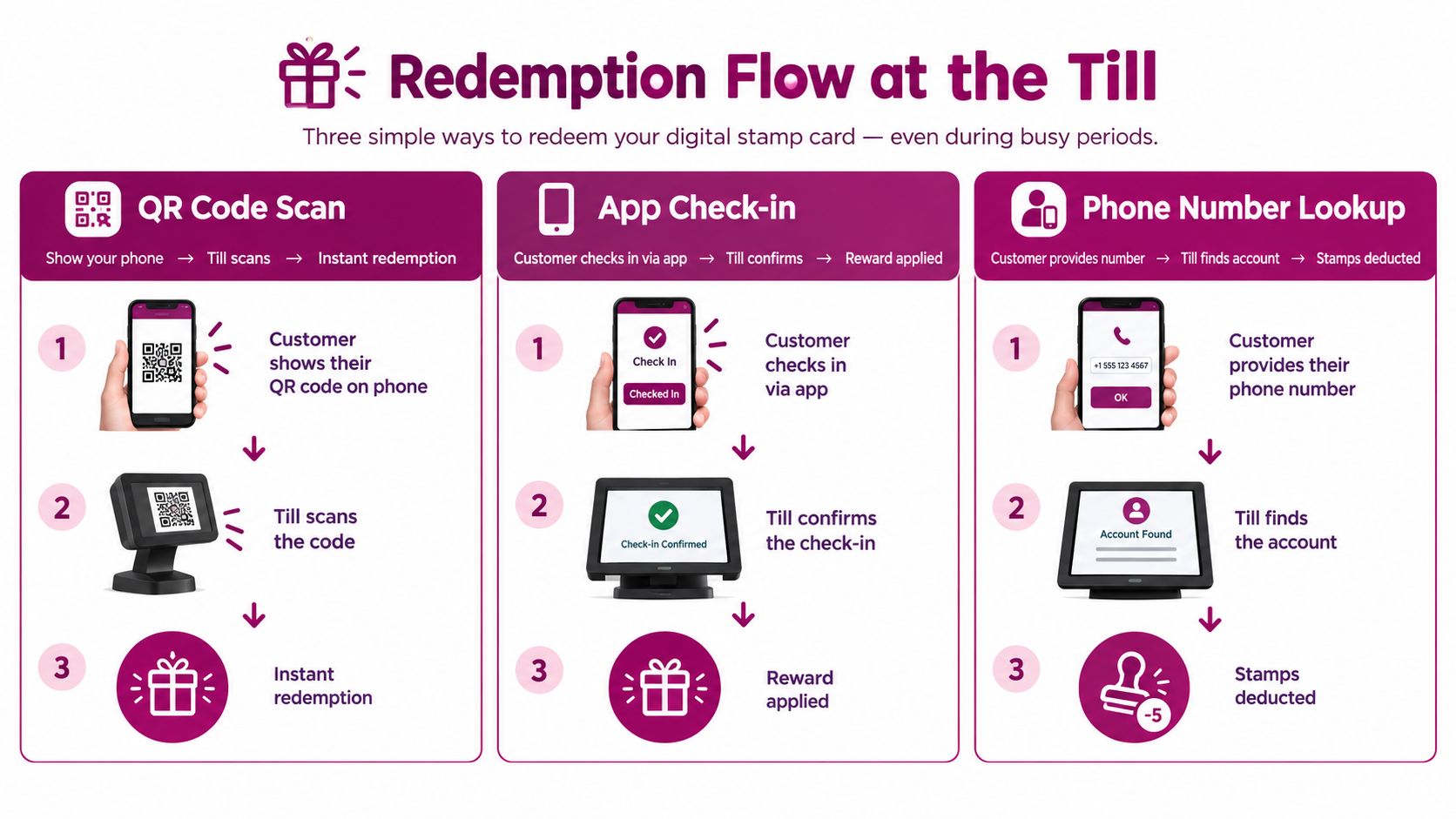
A QR code scan from the customer's wallet is the cleanest flow. The customer shows the pass, the cashier scans it, and the reward is applied. A phone-number lookup works when the customer can't open the card quickly, and an NFC tap can be the fastest option where the hardware supports it.
Practical rule: pick one redemption method and train everybody on it. Mixed habits cause more delays than the software does.
The time difference is small but real. A QR scan is usually quick enough that the customer barely notices the process. A phone-number lookup takes longer because someone has to search and confirm the account. NFC tap is fastest, but only if your setup supports it and your staff remember to use it consistently.
What the cashier should see
When the card has the right stamp count, the till should show the reward clearly and log the redemption straight away. That matters because a free item should not be open to a second use. If the reward is recorded at the moment it's redeemed, the staff don't have to argue about whether the card was already used.
The slowest part of redemption is usually not the system, it's uncertainty. If part-time staff have to guess how to search for the customer or whether a card can be used twice, the line stalls. If they know the one method to follow, the whole process stays calmer.
The same logic is what makes wallet-based cards useful at checkout. The card lives where the customer already looks for payment, so the reward sits beside the buying habit instead of outside it. That's why a simple wallet-based system can feel faster than a paper stamp card even when the reward is identical.
A Simple Checklist Before You Launch
The launch should be judged by fit, not by how many settings you've touched. A good stamp card lines up with how often people visit, what they buy, and how quickly staff can handle redemption. If one of those pieces is off, the program feels awkward from day one.
What to confirm before you go live
- Match the threshold to the visit rhythm. Use 5 for many salons and 8 to 10 for many coffee shops, because those levels fit repeat behaviour better than a one-size-fits-all target.
- Protect your margin with the reward itself. A free coffee is not the same as a free treatment, so the reward has to suit the average sale.
- Choose how stamps accrue. Decide whether they add per visit, per spend, or both, then keep that rule simple enough for staff to remember.
- Test the redemption flow in a real transaction. Run a QR scan or phone lookup during an actual sale, not just in the office.
- Brief every staff member on no-card situations. The answer should be the same every time, so customers don't hear different stories from different people.
A first month review matters because habits shift. Some customers redeem fast, others drift, and a threshold that looked right at launch can feel too easy or too slow once real behaviour shows up. Track what gets redeemed, then adjust the card before it starts costing more than it returns.
For a small business, the point of loyalty card stamps is not complexity, it's repeat business that staff can run without drama. If you want a setup that can issue digital stamp cards or points-based cards, live in Apple Wallet or Google Wallet, and stay simple at the counter, take a look at Loyal Customer and see how it fits your shop.



