
Independent cafes don't win because they hand out freebies, they win when they make the next visit feel easy. That matters because independent coffee shops typically retain only 40% to 50% of first-time customers within the first 30 days, while top performers reach 70% or higher. The gap is why Cafe Loyalty apps and why loyalty is important is a practical business topic, not a branding exercise. If a guest comes back fast, the program has a job. If they don't, the app is just another icon on the phone.
A lot of loyalty advice still treats rewards like a rescue plan for weak sales. That's backward. Loyalty works best as a retention amplifier, one that helps good coffee, fair pricing, and decent service stick in the customer's mind long enough to become habit. The modern version also has to respect friction, because branded coffee shop app downloads can be under 20%, and 60% to 75% of those who do download may delete the app within 60 days regulr.ai. That's why wallet-native passes matter so much for small cafes. They live where customers already pay, not in another app drawer they forget to open.
Table of Contents
- Why Loyalty Is Important for Cafes Today
- The Economics of Loyalty Explained Simply
- Points vs Stamps in a Cafe Setting
- Why Wallet Passes Beat Standalone Cafe Apps
- How a Cafe Loyalty Program Changes Daily Behavior
- Common Misconceptions That Undercut Cafe Loyalty
- Launching a Loyalty Program That Actually Works
Why Loyalty Is Important for Cafes Today
Loyalty matters early, not just eventually. The first month is when a cafe either turns a one-time visitor into a regular or loses them to habit somewhere else. Independent shops feel that pressure harder than chains because every repeat order carries more weight in a smaller sales base.
Customer loyalty also fits coffee behavior better than it fits many other retail categories. People buy coffee frequently, often on a routine, and that creates repeated chances to earn, redeem, and reinforce the habit. When a guest sees progress after every visit, the reward starts to feel tied to their day, not just to a transaction.
A cafe owner should think of loyalty as a revenue lever. Raising retention is usually cleaner than pushing higher prices, because price changes can create sticker shock while a loyalty reward feels earned. That difference is especially useful in a neighborhood cafe where customers notice value fast and talk about it even faster.

Practical rule: loyalty should make a regular feel recognized, not hunted for another signup.
The catch is that the format has changed. Older punch cards worked when people tolerated paper, but today customers expect something they can keep in their phone. Wallet-based loyalty passes fit that expectation because they reduce the steps between “I'll come back” and “I'm redeeming it.” For a small cafe, fewer steps usually means more repeat behavior.
The Economics of Loyalty Explained Simply
The money side of loyalty is easier than most owners expect. There are only a few levers, and they show up in ordinary cafe behavior. If you can explain them to a barista, you can run them in a real store.
Retention, spend, and frequency work together
Retention is the first lever. It's the share of customers who come back, and that matters because each return visit is cheaper than reacquiring a fresh customer. Loyalty research says members generate 12% to 18% more annual revenue than non-members, and some benchmarks put program return at about 5.2x revenue relative to cost Loyaltypass.
Average transaction value is the second lever. A regular who is close to a reward often adds the pastry or drinks upgrade they might skip elsewhere. That's not magic, it's momentum, and it's one reason loyalty programs can improve both visit count and ticket size.
Purchase frequency is the third lever. If a customer visits one more time a week, the effect compounds across the month and the year. The business doesn't need every guest to behave differently, it needs enough of them to move a little more often.
Loyalty doesn't need to create new demand from scratch. It needs to make the next purchase easier to choose.
The key is that these levers don't sit still. When retention improves, frequency rises. When frequency rises, spend per visit has more chances to rise too. That's why loyalty should be measured as a system, not as a coupon with a prettier design.

Points vs Stamps in a Cafe Setting
The best format depends on how the cafe sells. A simple espresso bar with a tight menu usually benefits from stamps because the customer understands the reward in one glance. A broader menu with pastries, beans, and retail items usually benefits from points because spend can be tracked more flexibly.
Here's the simplest way to think about it. Stamps are built around visits, while points are built around value. If your regulars almost always buy one drink and leave, stamps are clean and intuitive. If one customer buys a latte and another buys beans, breakfast, and a drink upgrade, points create a fairer system.
| Factor | Stamp Cards | Points Programs |
|---|---|---|
| Best for | Repeated drink visits | Mixed baskets and larger orders |
| Customer understanding | Instant, no math | Slightly more flexible |
| Redemption feel | Fast and emotional | More adaptable to menu variety |
| Staff effort | Very low | Low to moderate |
| Menu fit | Tight, focused drink menus | Cafes with food, retail, or add-ons |
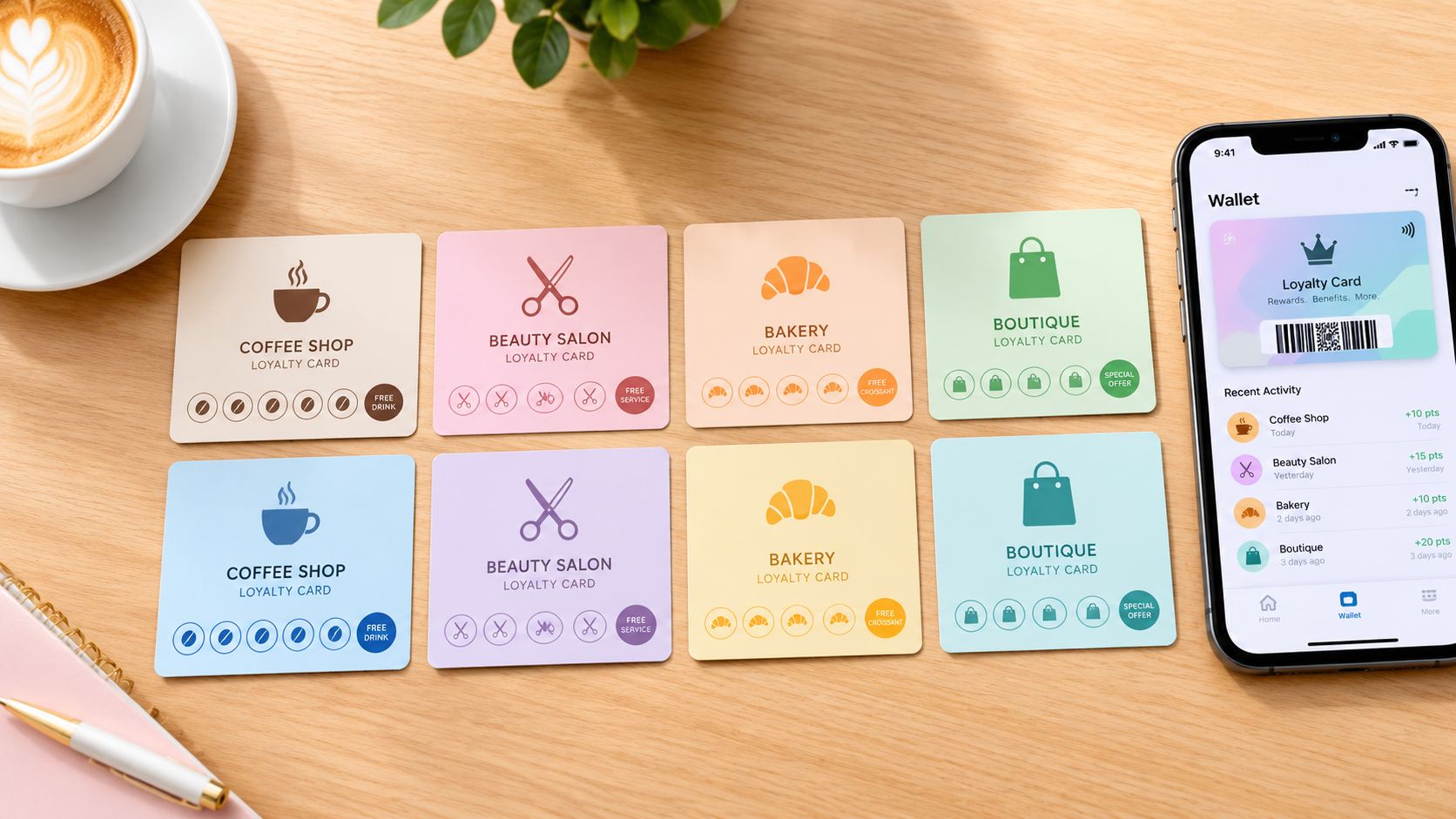
A hybrid usually works better than a purity test. A cafe can use stamps for the core drink habit and points for higher-value spending, or keep both inside one wallet pass so customers see one clear balance. The point is to match the mechanic to the behavior you want, not the other way around.
For a deeper format comparison, the breakdown at points vs stamps loyalty is worth a look if you're deciding how much complexity your team can handle.
Why Wallet Passes Beat Standalone Cafe Apps
Standalone apps look impressive in a launch deck and then fade in real life. The problem is simple, customers don't want another app unless it gives them a strong reason to keep it. That friction is exactly why wallet-native passes often work better in cafes.
Wallet-based loyalty lives inside Apple Wallet or Google Wallet, so there's no separate install, no extra login, and no brand-new icon to ignore. The pass stays on the device customers already use for payment and tickets, which makes it easier to remember at the counter. Industry guidance also describes wallet passes as a practical replacement for the brand app for many small merchants because they're persistent, centrally updated, and always available on the phone Enactor.
The convenience angle matters more than the tech stack. In 2026, 43% of consumers said they prefer managing points and rewards in a digital loyalty card rather than downloading another brand app, and 32% said wallet-based cards are more convenient and accessible 360 Magazine. That lines up with what small operators see at the counter, people will accept something simple in a wallet far more readily than they'll install a branded app for one coffee shop.
If you want a side-by-side view of the trade-offs, the contrast in digital vs paper loyalty cards is useful because the core competition isn't “digital versus analog,” it's “low-friction versus forgotten.”
How a Cafe Loyalty Program Changes Daily Behavior
On a normal Tuesday, the change is small enough to miss if you're not watching the register. The owner has set a simple rule, buy nine coffees, get the tenth free, and the reward lives in a wallet pass that the barista updates at checkout. Nobody needs to explain the system twice, and the customer sees progress without digging through an app.
Maya, who already visits a few times a week, starts timing one extra stop because she's close to the reward. Devon stops splitting his spend between the cafe and a chain, because the halfway point makes switching feel wasteful. Priya, who mainly came in for meetings, begins adding a pastry on Fridays because the program gives her a reason to extend the visit.
Those are classic behavioral effects at work. A half-finished reward creates a sense of progress, and progress changes decisions. The customer doesn't just remember the cafe, they remember their standing inside the program.
A good loyalty pass doesn't beg for attention. It quietly keeps the reward visible until the customer is ready to act.
The useful part for the owner is that these shifts show up in routine patterns, not marketing slogans. Loyalty members cluster visits more predictably, and once a reward is near, the next order becomes easier to nudge upward. That's the kind of behavior a small team can staff around, because it shows up in the same mornings and the same lunch windows that already drive the store.
Common Misconceptions That Undercut Cafe Loyalty
The first bad assumption is that loyalty can rescue poor product quality. It can't. If the espresso is inconsistent, the milk is overheated, or the price feels off for what's in the cup, a loyalty program just makes the problem more visible. Research on coffee shops points to service quality, price fairness, and satisfaction as core drivers of loyalty behavior, which is exactly why points and stamps should support a strong operation rather than hide a weak one Seaninstitute eJournal.
The second bad assumption is that signups equal success. They don't. A customer can join a program and never change their behavior, which is why the important number is activation, not enrollment. If the member doesn't come back soon enough to build a habit, the program is collecting names instead of revenue.
The third bad assumption is that generosity is the same thing as effectiveness. It isn't. A reward should feel reachable and still protect margin. Independent cafes can win on familiarity and community, not by trying to out-discount every chain around them.
| Misconception | Reality | Correct Action |
|---|---|---|
| Loyalty fixes weak coffee or bad service | It only amplifies what customers already like | Audit product quality before launch |
| Signups prove the program works | Only activated members change revenue | Track first return behavior, not just enrollment |
| Bigger rewards always compete better | Margin still matters | Set rewards to fit your actual basket economics |
If a cafe wants the program to last, it has to be honest about what loyalty can and can't do. Loyalty can sharpen retention. It can't replace a good cup, fair value, or a team that treats regulars well.
Launching a Loyalty Program That Actually Works
The first month should be boring on purpose. Pick one mechanic, points or stamps, and keep the reward close enough that a normal customer can see it as reachable, not theoretical. If staff members need a script to explain it, the program is already too complicated.
A simple 30-day rollout
- Choose one core mechanic. Stamps are easier if the cafe mostly sells drinks. Points make more sense if baskets vary a lot.
- Set the reward before launch. Decide what gets redeemed, how it's earned, and what the threshold is before customers start joining.
- Train the counter ask. Baristas should use the same short phrase every time, so enrollment doesn't depend on who's working.
- Place the pass where it's hard to miss. A QR code or tap point at the till works better than a poster on the wall.
- Check behavior early. Look at enrollment in week one, redemption frequency in the middle of the month, and whether the reward level is realistic by day 30.
The software matters less than the counter habit in the first month. Personal prompts beat passive reminders when the customer base is small and the staff already knows regulars by name. If you want a phone-based system that can run points, stamps, and wallet-ready passes from one place, Loyal Customer is one option to look at.
The key question after launch is whether loyalty is changing visit patterns. If customers are signing up but not returning, the offer is too slow, the ask is too soft, or the cafe still hasn't earned the repeat visit on product alone. A program that works is visible in the register, not just in the dashboard.
If you want to stop guessing about loyalty and start running it from a phone, visit Loyal Customer and see how a wallet-ready stamp or points program can fit a cafe counter without adding app-store friction. It's a practical way to keep regulars visible, rewards simple, and the next visit easier to earn.