
Loyalty mechanics don't automatically beat simple ones. A small café, salon, bakery, gym, or independent retailer usually needs a program customers can understand at checkout, access from a phone, and redeem without asking staff to decode complicated rules. The best loyalty program ideas start with a reward people will use, then protect the merchant's margins.
This list covers ten practical options, from a mobile-first setup and a digital stamp card to wallet passes, referral bonuses, personalized birthday rewards, VIP tiers, and category-specific point multipliers. It includes a concrete 10-visit buy-one-get-one-free offer, a 1,000-point reward for a 15% discount, and weekend promotions that encourage customers to buy more for the coming week.
Loyal Customer fits merchants that want to create a points program or digital stamp card, manage it from a phone, and issue Apple Wallet or Google Wallet passes. That matters because customers already carry their phones, while paper cards and standalone app downloads create unnecessary friction. The practical question isn't which program looks most advanced. It's which mechanic your team can operate consistently and your customers can use quickly.
Table of Contents
- 1. Mobile-First Setup with Complete Customization
- 2. Simple Stamp Card with Clear Visit Milestones
- 3. Weekend and Limited-Time Flash Promotions and Redemptions
- 4. Points-Based System with Tiered Redemption Thresholds
- 5. Apple Wallet and Google Wallet Native Pass Integration
- 6. Referral Bonus Points for Customer Advocacy
- 7. Surprise and Delight Random Reward Drops
- 8. Tiered VIP Membership Levels with Escalating Benefits
- 9. Category-Specific Bonus Points for High-Margin Items
- 10. Birthday and Anniversary Bonus Rewards
- 10 Loyalty Program Ideas Comparison
- Choose the Simplest Idea That Fits Your Business
1. Mobile-First Setup with Complete Customization
Small businesses can launch and manage a loyalty program from the phone already used during daily operations. A mobile-first workflow lets the owner register a profile, set an earning rule, customize a reward, and scan customers without desktop software, specialist support, dedicated hardware, or a desktop POS. A documented workflow covers setting a points-per-spend ratio, creating a reward, and scanning at checkout on iOS or Android in this mobile loyalty setup guide.
Differentiator is removing the setup bottleneck that keeps many small businesses from launching. An independent coffee shop can start a stamp card, a salon owner can update offers between appointments, and an Instagram or WhatsApp merchant can create a wallet pass without technical help. Each example keeps configuration close to the workday, where staff can test the process before customers use it.

Launch with one rule
Start with a free trial, configure one clear reward, and scan your own pass before inviting customers. A coffee shop might begin with 10 visits for one free item, while a salon could reward completed appointments instead of spending.
Review earning and redemption activity during a short weekly check. Change one variable at a time, such as the reward, message, or eligible product, so the team can identify what affected engagement.
Practical rule: If staff can't explain the program in one sentence, simplify it before launch.
A lean launch means accepting less sophistication early on, which suits a small team better than a feature-rich system nobody has time to manage.
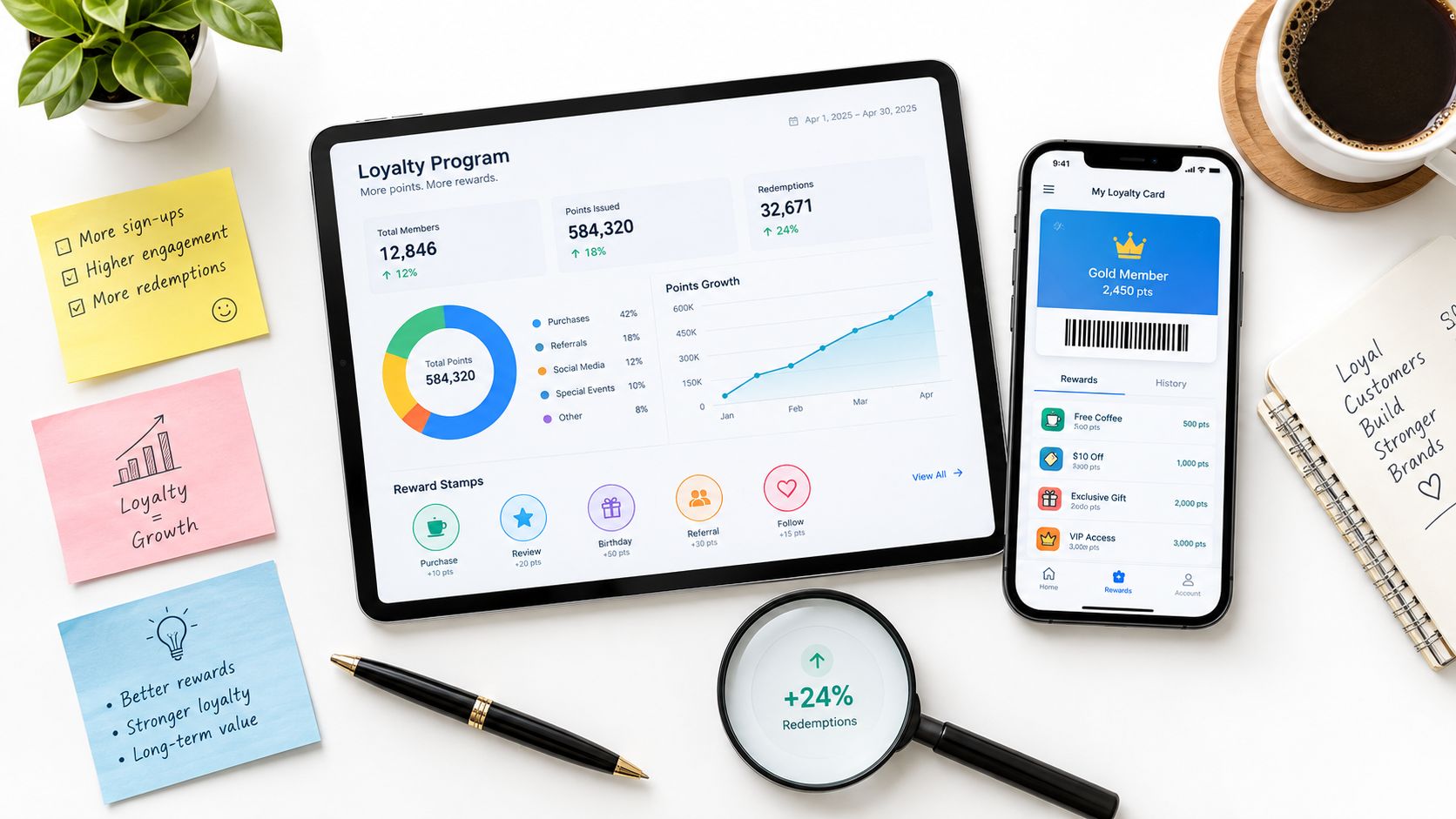
Loyal Customer supports this operating model with phone-based points and stamp workflows, plus wallet-ready cards for customers who want access without another standalone app. The walkthrough below shows the full setup flow on a phone, including the steps a merchant can test before going live.
2. Simple Stamp Card with Clear Visit Milestones
Stamp cards work because customers don't need to calculate the value of every purchase. They see progress toward a defined visit milestone, then receive a reward that feels connected to their routine. A café example awards a free coffee after 10 stamps, and another program grants a free entrée after 10 stamps, documented in these published stamp-card examples.
The supplied merchant model is especially clear: 10 visits earn a buy-one-get-one-free offer. That works well for coffee shops, bakeries, and takeaway businesses where customers make similar, frequent purchases. A salon can instead count completed appointments, while a gym might count check-ins if visits are the behavior it wants to reinforce.

Match the milestone to the routine
A threshold that takes too long to reach loses motivational power. One that arrives too quickly may give away margin without changing behavior. Set the milestone around a realistic customer rhythm, then show visual progress on the digital pass.
Consider these adaptations:
- Coffee shops: Count visits toward a free drink or a buy-one-get-one offer.
- Bakeries: Count qualifying purchases toward a pastry of the customer's choice.
- Hair salons: Count appointments toward a styling service or treatment.
- Fitness studios: Count attendance toward a class or personal-training reward.
A digital version preserves the familiar punch-card experience while reducing the risk of lost paper cards. Customers can present the pass from their phone, and the business can update progress without manually replacing cards. This comparison of digital and paper loyalty cards explains why the format matters as much as the reward.
Give customers an immediate confirmation after each stamp. The visible progress is part of the product. If customers can't tell whether a visit counted, they'll stop trusting the program.
3. Weekend and Limited-Time Flash Promotions and Redemptions
Weekend promotions give customers a clear reason to return within a defined window. A coffee shop might run a Friday-to-Sunday buy-two-get-one-free offer on specialty drinks. A bakery could reduce prices on selected pastries during a Friday afternoon period, while a restaurant could promote larger family packs for weekend planning.
The supplied seasonal example centers on discounted weekend prices that encourage customers to buy more and stock up for the coming week. These promotions can speed up purchasing and shift demand toward planned, higher-volume orders, as shown in these weekend punch-card promotion examples.
Set the offer, window, and audience
Tell customers about the promotion before the weekend, when they are making plans. A Thursday message can introduce the offer, followed by a reminder shortly before redemption opens. State the deadline plainly, such as “redeem by Sunday evening,” and change the featured products over time. Otherwise, customers may delay purchases until a discount appears.
Choose the mechanic according to your stock and demand pattern:
- Coffee shops: Add a weekend bonus to specialty drinks or pair a digital stamp with a selected offer.
- Bakeries: Discount products that sell best during the Friday window or need to move before closing.
- Restaurants: Promote family packs that suit weekend planning and increase the value of each order.
- Gyms: Award extra points during quieter weekend sessions to shift attendance without discounting every visit.
Review the results after each promotion:
- Basket size: Did customers add more items?
- Product mix: Did demand move toward the promoted category?
- Redemption timing: Did customers use the reward during the intended window?
- Repeat behavior: Did participants return afterward?
A broad discount can fill the weekend with low-margin traffic. A narrower offer shifts demand toward selected products, encourages add-ons, or helps move slower inventory instead. Rotate the promotion only when the results justify the operational effort, and avoid copying another merchant's timing without checking your own demand pattern.
4. Points-Based System with Tiered Redemption Thresholds
Points make more sense than stamps when customer spending varies. A restaurant may serve inexpensive lunches and larger family orders, while a salon may sell haircuts, treatments, and products at different prices. A points system can recognize that difference, provided the customer understands what the balance is worth.
One published feature example uses defined conversions such as Buy 2 Get 1 Free for 500 points and a 5% discount for 400 points, demonstrating why fixed redemption thresholds are more useful than vague promises. The same principle appears in the supplied merchant example, where 1,000 points provide a 15% discount.
Make the exchange rate visible
Customers should see how they earn, what they're moving toward, and what happens at redemption. A restaurant might award points for eligible spending and offer a defined discount at the 1,000-point threshold. A salon could connect points to service credit, while a coffee shop could let customers exchange a balance for a bundle or free item.
Use more than one threshold only when the choices are easy to compare. A lower reward gives occasional customers a reachable option, while a higher reward can encourage regulars to keep earning. The danger is creating a catalogue that requires staff to explain every option.
Points also let merchants direct attention toward selected products. A café can offer a temporary multiplier on specialty drinks, and a bakery can promote a category with excess stock. Those tactics work best after the base earn-and-redeem rule is stable.
For a deeper comparison of the two core mechanics, use this guide to points versus stamps for loyalty programs. The right choice depends on whether the business wants to reward visits, value, or a combination of both.
5. Apple Wallet and Google Wallet Native Pass Integration
Wallet access removes a common adoption hurdle: customers do not need another app, password, or account location to remember. A digital loyalty card sits in Apple Wallet or Google Wallet, alongside the credentials they already use.
This setup suits local grocery stores, cafés, beauty salons, restaurants, and micro-merchants selling through social channels. A salon can combine an appointment pass with loyalty access. An independent restaurant can issue a digital punch card, while a café can display a barcode or QR code at checkout.
Start with the checkout moment. Customers should see:
- Balance or stamp progress: Show what they have earned.
- Barcode or QR code: Make scanning quick and reliable.
- Business identity: Use the logo and clear name for easy recognition.
- Reward rule: State the threshold and redemption condition plainly.
The add-to-wallet action belongs in email, SMS, receipts, and social messages. A QR code can support setup, but the nearby instruction should explain exactly what happens after scanning. Test the pass on both mobile ecosystems, then scan it under the lighting and distance used at the counter.
Keep the pass deliberately lightweight. Merchants that need full commerce functions should pair it with their existing checkout tools. Loyal Customer documents its points, stamp, and wallet-card features, supporting a phone-managed program without requiring every customer to install a separate application.
Notifications need restraint. A balance update or relevant reward reminder can bring customers back to the pass. Frequent messages make those alerts easier to ignore. For small merchants, the practical goal is simple access at the moment of purchase, not another channel that staff must manage.
6. Referral Bonus Points for Customer Advocacy
Referrals work when the reward follows a real customer action, not merely an invitation. Connect the benefit to a new customer's sign-up and first completed purchase. That qualification keeps the program focused on transactions rather than unproductive sharing.
A coffee shop can reward both people after the referred customer visits. A gym can credit an existing member when a friend joins, while a salon can attach the referral milestone to an upgrade service. Restaurants and independent retailers can offer account credit or a future discount, protecting the value of the current sale.
Make sharing easy and measurable
A two-sided incentive gives the new customer a reason to try the business and gives the existing customer a reason to recommend it. Use a short code, a clear expiry rule, and a simple entry process. A QR code helps when the recommendation happens at the counter or in person.
Place the referral request after a moment that already signals satisfaction:
- After the first reward: Invite the customer to share with someone who would use the same product.
- After a positive interaction: Make the option visible without pressuring the customer.
- At checkout: Let customers retrieve their referral code from the loyalty pass.
- After redemption: Give them a specific reason to return with a friend.
Cap the referral reward and tie it to a completed first purchase so the incentive cannot outpace the revenue it creates. State whether the reward combines with other offers, and give staff one explanation they can repeat accurately.
A leaderboard may suit a community-driven gym or studio, where members already enjoy visible participation. It can feel intrusive in a small salon or private service business. Use private credits there, and reserve public recognition for brands whose customers welcome competition. Track referred visits separately from ordinary loyalty activity so the merchant can see whether the incentive produces repeat business, not just one discounted purchase.
7. Surprise and Delight Random Reward Drops
Predictable rewards create progress. Unexpected rewards create attention. A surprise drop can be a free item, bonus points, or a temporary discount sent to a selected customer through a wallet notification. The point isn't randomness for its own sake. It's the feeling that a customer's existing relationship can produce an occasional, unplanned benefit.
A café might send one regular a free large drink notification. A salon could add bonus points to a customer's balance, while a restaurant could send a selected customer a discount for a quieter weekday visit. A bakery can use the mechanic to drive traffic during a slow period or promote a particular product.
Keep the surprise valuable
A token reward can feel like a marketing trick. Choose benefits customers will notice, and give them enough time to use the reward without making it irrelevant. A limited redemption window can create urgency, but it should still fit the customer's routine.
Segmenting can improve relevance. High-frequency customers might receive occasional recognition, while less active customers could receive a surprise designed to bring them back. A slow Tuesday is a better time for a traffic-building reward than a busy Saturday when the business is already at capacity.
The main risk is perceived unfairness. Customers may wonder why someone else received a benefit and they didn't, especially if the program presents the drops as a status entitlement. Explain that surprises are occasional, avoid implying that every member will receive the same reward, and protect personal data when selecting recipients.
Use this idea as a layer, not the foundation. Customers still need a clear way to earn and redeem standard rewards. Surprise works best when the core experience is dependable.
8. Tiered VIP Membership Levels with Escalating Benefits
Tiered membership works when customers can see a realistic path to better treatment. A gym might offer higher-engagement members faster point earning or a free class. A salon could provide priority booking to customers who return regularly, while a restaurant might give consistent guests earlier access to reservations.
The names, such as Bronze, Silver, and Gold, matter less than the benefit attached to each level. Customers should understand the difference immediately. Possible benefits include faster earning, selected offers, priority service, or an experience unavailable to standard members.
Build tiers around real customer behavior
Set thresholds from typical visit or spending patterns, not from the habits of your best customer. An unreachable level will not motivate regulars. Display progress toward the next tier in the account or wallet pass, and state clearly whether status resets.
Use the fewest levels your team can explain and apply consistently:
- Entry level: Standard earning and access to the basic reward.
- Middle level: A stronger earning rate or one exclusive offer.
- Top level: A service benefit, priority access, or special experience.
Every additional tier creates another rule staff must apply and another benefit the owner must fund. Start with one core reward. Add levels only after customer behavior shows a meaningful group of frequent visitors who could respond to a clear progression.
A tier should also fit the business's capacity. Priority booking may suit a salon with predictable appointment gaps, but it can create frustration if the schedule is already full. A restaurant should confirm that early reservation access will not disrupt table planning.
Annual resets can keep the program active, yet they may frustrate customers who lose recognition. If status resets, announce the timing early and show members exactly how to regain their level.
9. Category-Specific Bonus Points for High-Margin Items
Category bonuses steer customers toward profitable products without reducing the price of the entire basket. A coffee shop can award extra points on specialty drinks, a restaurant can highlight appetizers or desserts, and a salon can reward treatments or styling add-ons. Choose the category using margin, inventory, seasonality, or a product that needs more attention.
The mechanic works best when the offer supports a specific business goal. A bakery might promote selected items later in the day, while an independent retailer could give a new collection extra visibility. Customers receive a reason to try the item, and the merchant avoids funding a blanket discount.
Set a rule customers and staff can follow
Show the offer at checkout and on the wallet pass. List the eligible products, campaign dates, bonus rate, and normal earning rule in plain language. Rotate categories as priorities change, rather than turning one product into a permanent subsidy.
Keep the setup narrow:
- Select a focused range: Begin with categories the business can track and explain.
- Set a campaign window: State exactly when the bonus starts and ends.
- Train staff: Everyone should apply the same points rule at checkout.
- Review redemption: Confirm that the resulting rewards still fit the item's margin.
This tactic should follow a basic sales review. Rewarding products customers already choose may add cost without changing behavior. A stronger campaign gives extra points to a profitable item that needs a timely nudge, while keeping the eligible range small enough to measure.
If multipliers appear constantly, customers stop understanding the normal value of points, so keep bonuses occasional and clearly dated. A café can run a specialty-drink bonus for a short weekend campaign, then return to standard earning. That preserves the offer's attention value and makes its cost easier to control.
10. Birthday and Anniversary Bonus Rewards
Calendar-based rewards give a loyalty program a personal reason to contact customers. A café can offer a birthday drink, a salon can provide a blow-dry or anniversary service, and a gym can recognize a membership anniversary with a class-related reward. These moments don't need complicated automation. They need accurate dates, a clear message, and a reward that fits the business relationship.
Collect the customer's birthday as an optional detail during sign-up. An incentive can encourage sharing, but customers should understand why the information is requested and how it will be used. Membership anniversaries can be easier to manage because the date comes from the program itself.
Give customers room to redeem
Send the message before the date rather than waiting until the day itself. A customer may be working, traveling, or unable to visit on a specific day, so a defined redemption window makes the reward more usable. A retailer might offer a birthday credit with a longer period, while a salon can require booking within a stated timeframe.
Separate birthday rewards from anniversary rewards so the program has more than one personal engagement moment. Keep the copy warm but restrained. A name and a direct explanation of the benefit usually work better than a long promotional message.
Protect the information you collect. Birthdays are personal data, so explain the purpose, limit access, and follow applicable privacy requirements. Don't collect sensitive details just because the platform allows it.
The trade-off is redemption cost versus emotional value. A free item can be memorable, but a service add-on, early access benefit, or targeted offer may fit the margin structure better. Test whether recipients return, redeem, or engage with the program afterward before expanding the reward.
10 Loyalty Program Ideas Comparison
| Option | Implementation Complexity 🔄 | Resource Requirements 💡 | Expected Outcomes 📊⭐ | Ideal Use Cases | Key Advantages ⚡ |
|---|---|---|---|---|---|
| Mobile-First Setup with Complete Customization | 🔄 Low, phone-first setup, no dev required | 💡 Smartphone, brief merchant training | 📊 Fast time-to-launch; ⭐ High adoption among micro-merchants | Independent cafes, Instagram merchants, solo entrepreneurs | ⚡ Rapid launch & on-the-go management |
| Simple Stamp Card with Clear Visit Milestones | 🔄 Very low, straightforward rules | 💡 Minimal setup, wallet pass support | 📊 Strong engagement from familiarity; ⭐ High clarity | Coffee shops, bakeries, salons | ⚡ Low friction, easy to explain |
| Weekend & Limited-Time Flash Promotions and Redemptions | 🔄 Moderate, scheduling, timers, time-zone handling | 💡 Push notifications, margin controls, campaign planning | 📊 Short-term sales spikes; ⭐ High urgency-driven lift | QSR, restaurants, retail weekend/seasonal promos | ⚡ Drives immediate visits and larger baskets |
| Points-Based System with Tiered Redemption Thresholds | 🔄 High, tracking rates, tiers, conversions | 💡 POS/CRM integration, analytics, ongoing management | 📊 Strong CLV and segmentation insights; ⭐ Long-term engagement | Chains, gyms, salons, larger retailers | ⚡ Flexible targeting and promotional control |
| Apple Wallet and Google Wallet Native Pass Integration | 🔄 Low–Moderate, pass creation & secure hosting | 💡 HTTPS pass distribution, barcode standards, pass updates | 📊 High adoption due to no-app friction; ⭐ Wide reach | Any merchant seeking no-app loyalty solution | ⚡ Eliminates app-download barrier; persistent passes |
| Referral Bonus Points for Customer Advocacy | 🔄 Moderate, referral links/codes, fraud controls | 💡 Referral tracking system, reward calibration | 📊 Lower CAC over time; ⭐ Effective organic growth | Growth-focused merchants, community businesses | ⚡ Cost-efficient customer acquisition via word-of-mouth |
| Surprise and Delight Random Reward Drops | 🔄 Low, selection & notification workflows | 💡 Budget for small rewards, segmentation rules | 📊 Boosts engagement and brand sentiment; ⭐ High perceived value | Brands wanting emotional engagement or to fill slow periods | ⚡ High impact for modest cost |
| Tiered VIP Membership Levels with Escalating Benefits | 🔄 High, automatic tiering, tier-specific offers | 💡 CRM/data, program design, dedicated communications | 📊 Improves retention & CLV; ⭐ Strong aspirational effect | Businesses with frequent repeat customers | ⚡ Encourages increased spend and loyalty |
| Category-Specific Bonus Points for High-Margin Items | 🔄 Moderate, configure multipliers and targeting | 💡 SKU/category mapping, POS support, staff training | 📊 Increases sales of targeted items; ⭐ Protects margins | Retailers, cafes pushing high-margin or seasonal items | ⚡ Drives targeted revenue without blanket discounts |
| Birthday and Anniversary Bonus Rewards | 🔄 Low, date capture + automated triggers | 💡 Customer date collection, privacy compliance | 📊 Predictable engagement spikes; ⭐ High personalization | Salons, restaurants, retailers valuing personalization | ⚡ Automated, emotionally resonant rewards |
Choose the Simplest Idea That Fits Your Business
The right loyalty program depends on the behavior you want to reinforce. Start with the customer's normal purchase pattern, not with the most elaborate feature list.
Choose a digital stamp card when customers buy frequently and the purchase is relatively similar each time. Coffee shops, bakeries, and quick-service businesses can make progress obvious with a visit milestone. The supplied example, 10 visits for a buy-one-get-one-free offer, gives customers a concrete target without requiring them to understand a points exchange rate.
Choose points when transaction values vary or when you want more control over which products and behaviors earn rewards. Restaurants, salons, gyms, and independent retailers may need points because a haircut, treatment, product purchase, or membership visit doesn't fit one uniform stamp value. A defined conversion, such as 1,000 points for a 15% discount, is easier to trust than an unexplained balance.
Add Apple Wallet and Google Wallet passes when access friction is holding the program back. Customers shouldn't need to search through emails or download a separate app just to show progress at checkout. A wallet pass keeps the card close to the moment of purchase and can support either stamps or points.
Use weekend promotions when customers plan purchases in advance or can stock up. Bakeries, grocery retailers, restaurants, and cafés can use timed offers to shift demand and increase the value of a planned visit. Protect margins by selecting products and windows carefully, rather than discounting everything every weekend.
Layer referrals, birthday rewards, surprise drops, tiers, or category multipliers only after the core earning and redemption process works. Each additional mechanic creates another customer message, staff rule, and margin decision. Complexity is justified when it solves a specific problem, such as attracting new customers, recognizing frequent visitors, or moving a selected product category.
A free trial is a sensible starting point for a small business. Use Loyal Customer to configure one points or stamp program, test the pass as a customer would, scan it during a simulated checkout, and confirm that staff can explain the reward without hesitation. Then review activation, redemption, basket size, and repeat-visit signals before adding another mechanic.
Don't judge the program by enrollment alone. Customers can join several programs and still use only a subset actively. One 2022 industry reference found that customers in North America and Western and Northern Europe belonged to an average of 16.6 loyalty programs, while mobile app usage accounted for 68% of loyalty-program interactions, as reported in this loyalty-program statistics overview. Convenience and visible progress matter because inactive members don't create useful repeat behavior.
The broader market also shows why small businesses keep investing in these tools. A 2026 industry summary reported that more than 93% of companies globally had implemented some form of loyalty or rewards program, and valued the loyalty management market at about $15.19 billion in 2025, up from $13.31 billion in 2024, with a projection of $41.21 billion by 2032, according to this customer loyalty statistics summary. Those figures don't mean every merchant needs an enterprise program. They show that loyalty is now a mainstream operating model, which makes simple, mobile-first execution a practical competitive choice.
Start with one reward customers can reach and your team can deliver profitably. Measure behavior, listen to checkout questions, and expand only when the evidence shows that the next layer will improve the customer experience rather than add noise.
Loyal Customer lets small businesses run points programs or digital stamp cards from a phone and issue loyalty passes for Apple Wallet and Google Wallet. Visit Loyal Customer to try a free setup, test the customer pass and redemption flow, and choose the loyalty mechanic that fits your business.
Made with Outrank app