A regular comes into a coffee shop on an ordinary Tuesday, orders the latte they always get, and the barista hands them a pastry on the house. The customer hasn't reached a stamp-card reward or asked for a discount. The extra is unexpected, relevant, and easy to enjoy. That's the kind of moment a small business can use to make loyalty feel personal, as long as the everyday experience is already dependable.
Surprise rewards can turn a routine visit into a story a customer remembers. But the tactic is not about just giving things away. The timing, the reward's value, and the clarity of the rules all matter.
Table of Contents
- What Surprise and Delight Means for Loyalty Programs
- Why Surprise Rewards Build Repeat Visits
- Surprise Rewards That Fit Each Merchant Type
- When Reliability Should Come Before Surprise
- Keeping Surprises Fair Without Tracking Customers Too Closely
- Build and Launch a Surprise Reward in a Wallet Pass
What Surprise and Delight Means for Loyalty Programs
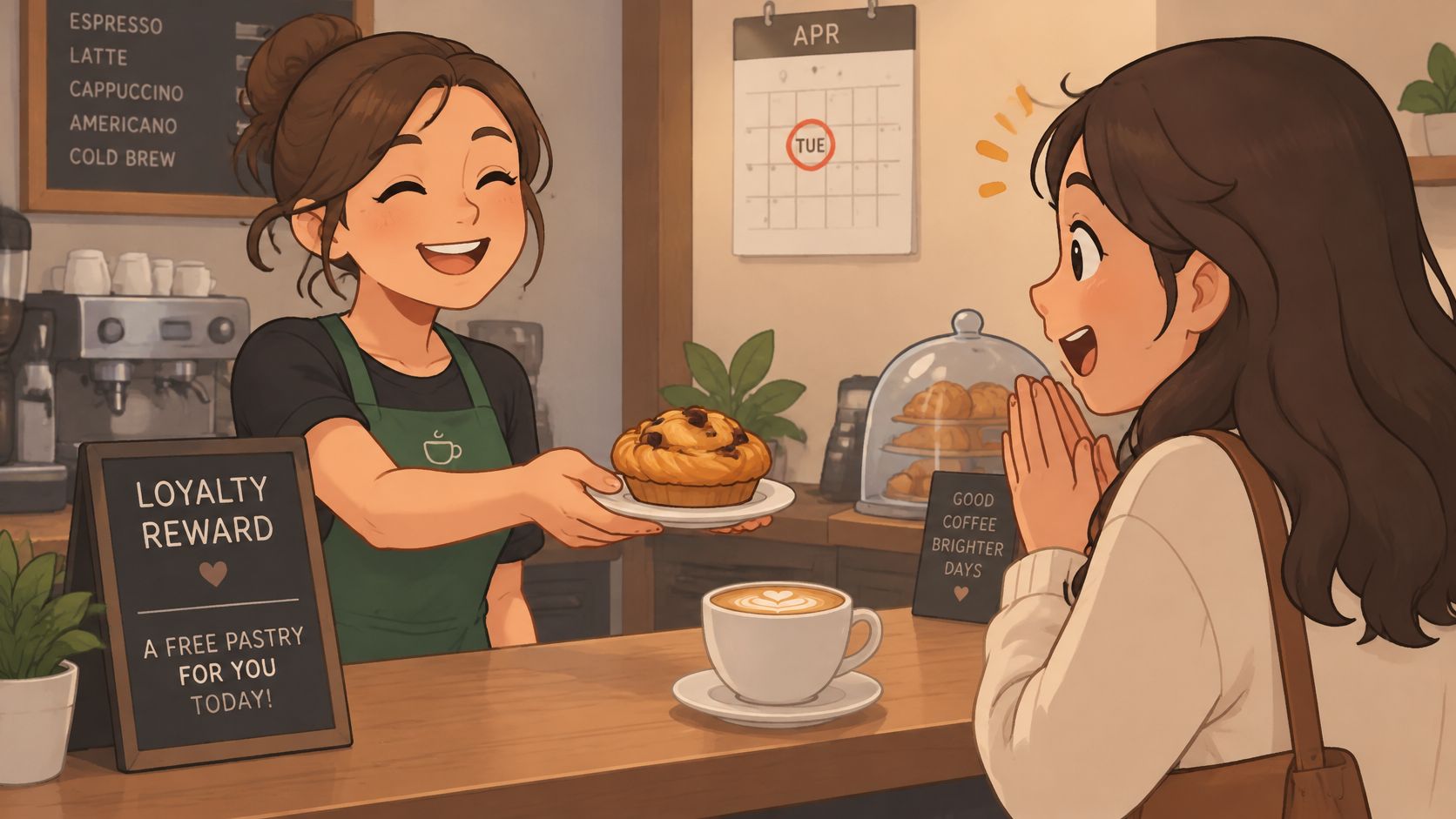
Surprise and delight is an unexpected, relevant benefit that arrives when a customer isn't expecting it and feels more generous than the usual program reward. The pastry with a regular latte fits. A standard “buy ten, get one free” reward doesn't, because the customer knows the rule and expects the reward after completing it.
That distinction matters. Predictable rewards give customers a reason to keep participating. A surprise adds an unannounced benefit, such as an extra stamp, a points top-up, or a free add-on. Delight is the customer's response when the gesture feels thoughtful rather than random or confusing. The same reward can land very differently depending on whether it suits the customer and the moment.
A simple test helps: Would this customer mention the gesture to a friend? If the reward is too small to notice, hard to redeem, or irrelevant to the purchase, it may not create a memorable moment. If it's useful and arrives without adding friction, even a modest extra can feel generous.
Points, digital stamps, and wallet passes can all support surprise rewards. The format doesn't create the delight by itself. What matters is that the business chooses a suitable benefit, makes the terms easy to understand, and delivers it at a moment that feels earned by the customer's relationship with the business, but not mechanically predictable.
Why Surprise Rewards Build Repeat Visits
Delight can affect more than a customer's immediate impression. In research covering 25,000 customers across tourism, insurance, and banking, McKinsey found that delight increased the Net Promoter Score of already-satisfied customers by 28 points in tourism, 18 points in insurance, and 15 points in banking. It also raised stated intentions to reuse a company by 25 percentage points across the analyzed sectors, according to McKinsey's analysis of customer delight.
The practical mechanism is straightforward: a pleasant unexpected moment stands out from the routine. Customers are more likely to remember an experience that exceeds what they expected, and that memory can shape how they talk about the business and whether they choose to return. On a stamp card, the ordinary stamp is the routine. The unexpected bonus stamp is the moment the customer may mention later.
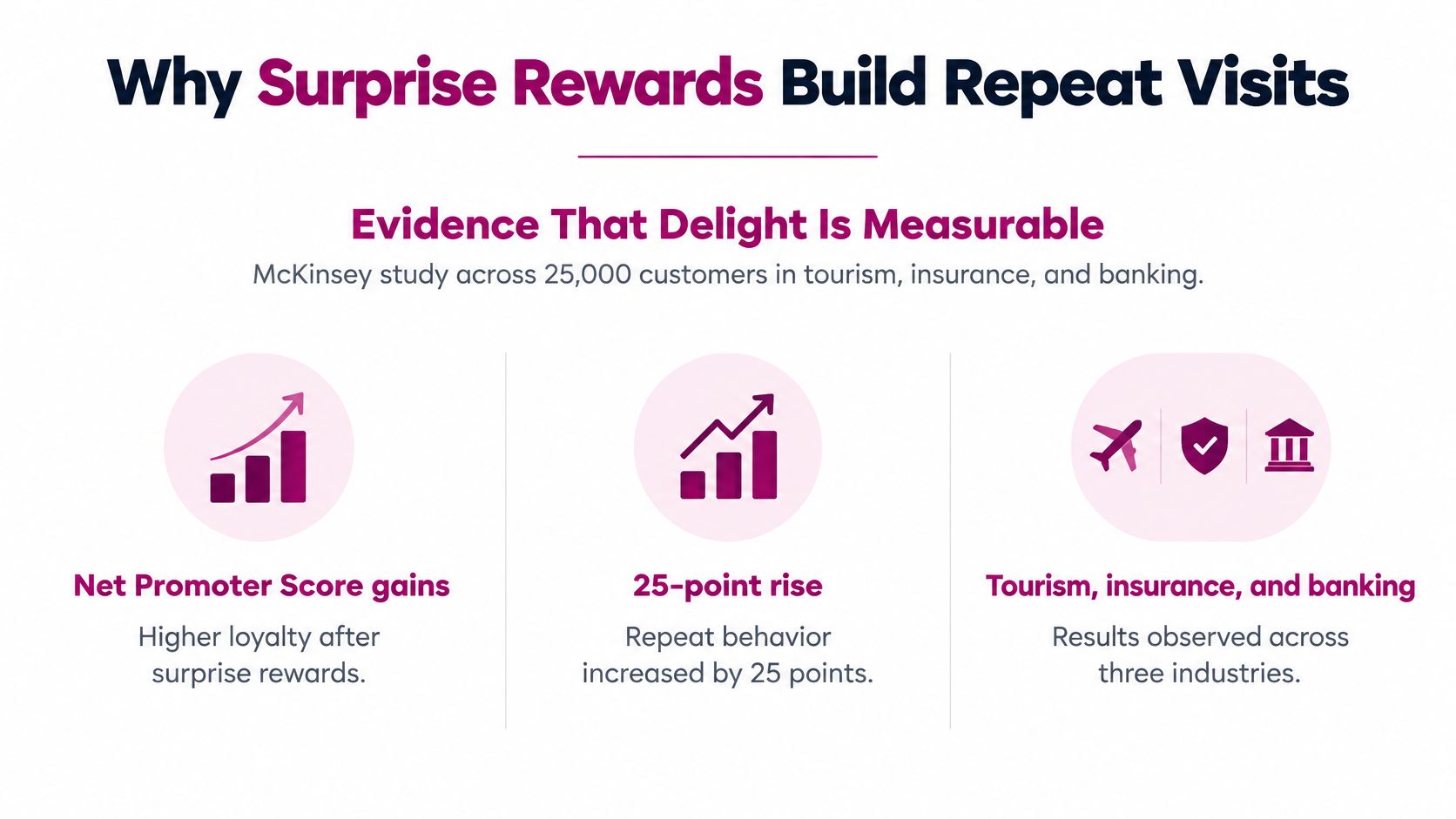
The same McKinsey analysis found that, in tourism, customers who could recall a distinct delightful moment were approximately 19 percentage points more likely to revisit a destination. In insurance, delighting a significant share of customers who were already satisfied was associated with an estimated 8% to 12% in additional revenue, worth several billion euros annually. That estimate signals potential commercial scale, but it isn't a forecast for a cafe or salon.
The findings span several industries and countries, so small merchants should apply them as direction, not as a promise that a free pastry will produce a particular lift. A modest bonus can still give a customer a memorable reason to come back, especially when it fits the visit. The right test isn't how much the reward cost. It's whether customers remember it and return because the experience gave them a reason to.
Surprise Rewards That Fit Each Merchant Type
Use the table as a starting point, then adjust the trigger to match how customers visit and spend. A reward that fits a cafe's frequent visits may feel arbitrary at a salon where appointments are spaced farther apart.
| Merchant type | Surprise trigger | Low-cost surprise reward | Pass format |
|---|---|---|---|
| Cafes and coffee shops | Bonus stamp on a random visit | Free extra shot or small pastry | Digital stamp card |
| Restaurants and takeaways | Bonus points after a spend threshold | Free dessert or side on the next order | Points pass |
| Hair and beauty salons and spas | Return-after-a-gap bonus | Free add-on treatment such as a scalp massage | Points or stamp pass |
| Independent retail and grocery | Points top-up on a large basket | Bonus point balance or small product sample | Points pass |
| Micro-merchants on Instagram or WhatsApp | Referral or birthday-month trigger | Bonus points or free delivery | Wallet pass |
| Gyms and fitness studios | Streak reward after consecutive sessions | Free guest pass or towel service | Stamp or points pass |
| Bakeries and tea shops | Milestone stamp reached early | Free loaf or extra tea refill | Digital stamp card |
Frequent, low-ticket businesses usually have a natural rhythm for milestone stamps or small add-ons. A bonus stamp on an ordinary cafe visit can feel meaningful without requiring the merchant to give away a full order. For restaurants, a spend threshold can tie the surprise to a completed purchase, while the reward for the next order provides a reason to return.
For salons, spas, and other appointment-based services, a return-after-a-gap trigger may suit the customer journey better than rewarding every visit. Retail and grocery businesses can use a points top-up or sample after a qualifying basket. A referral gift can work for a small seller on Instagram or WhatsApp, where a customer's recommendation may help bring in a new buyer.
The timing can vary, but eligibility should stay clear. A customer might not know which visit will earn an extra stamp, but they should know how stamps accumulate and how to redeem the standard reward. Research on surprise rewards links their effect to uncertainty about receiving a similar reward again, so making every visit follow the same bonus pattern can drain away the surprise. For more examples of loyalty mechanics that can be adapted to different businesses, explore these customer loyalty examples.
Set a spending limit before launching. Choose a fixed share of monthly revenue as a planning cap, and include the cost of free products, service time, and any delivery or redemption expense. A reward that brings a customer back but regularly costs more than the margin it supports isn't sustainable.
When Reliability Should Come Before Surprise
An unexpected reward isn't always the best place to invest. In a 2025 study of New Zealand consumers, 58% named consistent, reliable experiences as the most important loyalty driver, while only 8% chose surprise-and-delight moments, according to The Research Agency's analysis of customer loyalty.
Before adding a surprise, check whether the basic experience works consistently:
- Accurate balances: Customers receive the correct points or stamps after a qualifying purchase.
- Clear redemption rules: Staff and customers understand what the reward covers and when it can be used.
- Product availability: The advertised reward or its substitute is available when customers qualify.
- Fast problem resolution: Someone can correct a missed stamp, failed redemption, or other error without sending the customer through a maze.
When customers are complaining about missing points, unclear exclusions, or unavailable products, fix that first. An unexpected reward won't repair a loyalty program that makes it hard to claim an earned benefit. Reliable execution also reduces the chance that a surprise creates another point of confusion at the till.
The Research Agency's article notes that a well-timed delight moment may influence loyalty and spending intent for six to nine months, but that finding doesn't establish that surprise is better than consistent service. Customers and segments can respond differently, and a memorable gesture can't compensate for repeated operational failures.
Decision rule: Make the routine dependable first. Add surprise rewards when the core experience is steady, then track whether they increase repeat visits.
Measure actual customer behavior rather than treating excitement as proof of retention. If repeat visits don't improve, the merchant may need to change the trigger, the reward, or the customer group receiving it.
Keeping Surprises Fair Without Tracking Customers Too Closely
Personalized offers can make a reward feel relevant, but the customer should understand what information the business uses to choose it. In 2024, 73% of consumers wanted personalized loyalty-program rewards, while only 45% of brands offered them, according to Deloitte Digital's research on customer-experience personalization. That gap isn't a reason for a small merchant to build detailed profiles of every customer.
Start with information the customer would expect the business to use. A visit milestone is visible. A birthday-month offer can be based on a date the customer chooses to share. A preference can be selected directly, such as choosing between a sweet or savory reward. Those triggers can feel personal without relying on sensitive details or opaque assumptions.
Use four guardrails when setting up a personalized surprise:
- Ask first: Get consent before collecting information for rewards.
- Make opting out easy: Customers shouldn't have to contact staff repeatedly to stop personalized offers.
- Collect only what's needed: Don't request extra details that don't help deliver the specific reward.
- Match value to information: A small benefit may not justify asking for personal data.
Wallet passes make loyalty convenient by keeping a pass available on a customer's phone, but that convenience also makes the relationship feel continuous. A customer should be able to understand why an offer appeared and what they need to do to redeem it. Merchants comparing wallet-based loyalty options can review this guide to an app for rewards cards.
The simplest fairness test is to explain the trigger in plain language. If the customer might feel uncomfortable hearing how the business selected them, choose a less intrusive trigger.
Build and Launch a Surprise Reward in a Wallet Pass
Set up one reward, one trigger, and a clear way to measure the result. Don't launch a collection of offers at once; if customers respond, you'll want to know which change made the difference.
Set the trigger and limits
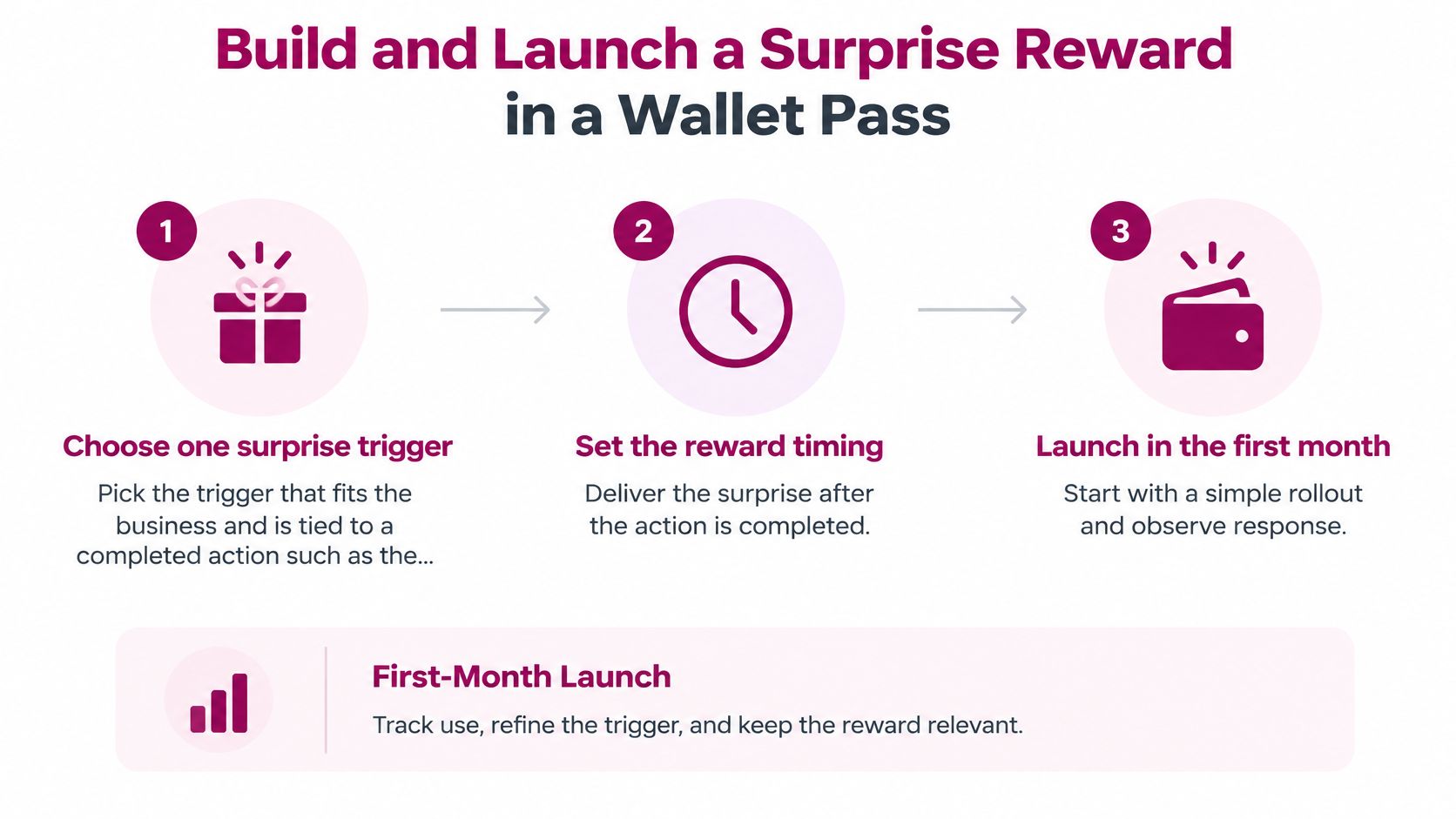
Choose one completed action. Pick a trigger that fits the merchant's visit pattern, such as a finished stamp cycle, a completed redemption, or a qualifying purchase. A surprise can be more memorable when it arrives at the end of the customer's journey, rather than before the customer has completed the action.
Confirm the ordinary experience is reliable. Check balances, redemption instructions, reward availability, and staff readiness before adding the offer. If customers can't depend on the standard program, fix that before introducing an extra reward.
Set the reward and cost cap. Choose a benefit customers will notice, then decide how many surprises the business can issue within a planning share of monthly revenue. Include product cost and service time, and limit frequency so the reward doesn't become an expected entitlement.
Make the reward easy to use
Write the rule in plain language. Configure the points or stamp rule and label the reward so customers can tell what they've earned and how to redeem it. Avoid conditions that staff need to explain from memory, especially exceptions that could turn a pleasant moment into an argument at checkout.
Check the digital pass. Issue the Apple Wallet or Google Wallet pass and verify that the balance and reward information display correctly on each supported platform. If the merchant is still setting up its pass, this guide explains how to create Apple Wallet passes.
Send the notification after the qualifying visit. A message sent in advance makes the benefit expected; a message sent after the visit can confirm the completed action and reveal the extra. Keep the wording concise and include the reward, any relevant redemption condition, and where to use it.
Experience-sequencing research supports placing a positive surprise at the end of the customer journey. In one study, a surprising peak at the end produced the strongest effect on overall perceptions, while remembered surprise peaks improved evaluations compared with anticipated peaks, as described in research on experience sequencing and peak endings.
Test the rollout
Compare a test group with a control group. Run the offer for four weeks, giving the surprise to half of regular customers while the other half receives the standard reward. Compare repeat visits, redemption, and complaints so the decision rests on customer behavior as well as reaction.
Review cost alongside response. Track how much the rewards cost, whether customers redeemed them, and whether staff encountered confusion or failed redemptions. A well-received offer can still be too expensive if the cost rises faster than the visits it generates.
Keep the surprise if repeat visits rise and complaints stay flat. If costs climb faster than visits, reduce the reward, narrow the eligible group, or change the trigger. A successful first month doesn't require every customer to redeem; it should show that the offer was delivered accurately, customers understood it, and the test produced a useful comparison. Loyal Customer provides points programs, digital stamp cards, and Apple Wallet and Google Wallet loyalty passes that merchants can use to set up and run this kind of test.
Set up a points or stamp reward, choose a clear trigger, and test whether a well-timed surprise gives customers a reason to return. Visit Loyal Customer to explore its loyalty tools and try a wallet-ready program for your business.