Your paper stamp cards are in three places at once. A stack sits by the till, regulars keep half finished cards in coat pockets, and someone at the counter is asking if you can combine two cards because they forgot the first one at home.
That's usually the point where a digital punch card for small business use stops sounding like a tech project and starts sounding like relief. The mistake is thinking the reward gets better because it moved to a phone. It doesn't. What changes redemption is whether regulars can finish the card before they forget you, and whether staff can stamp it without slowing the queue.
Table of Contents
- Pick a Format, Threshold and Pilot the Card
- Configure Rewards, Rules and Consent
- Wallet Pass, App or Phone Lookup Compared
- Staff Checkout Routine and Fallback Enrollment
- Common Problems and How to Fix Them
- Launch This Week
Pick a Format, Threshold and Pilot the Card
When I first tested a café stamp card, I printed 15 stamps to protect the margin on free drinks. Regulars rarely finished it, staff stopped mentioning it, and we had too few completions to judge whether the program worked. I cut the threshold to 8 stamps. Customers could see a nearer reward, and staff had an easier reason to bring up the card at checkout.
A vendor blog's analysis of 23,296 stamps across 1,013 small businesses reports that 11.4% of cards were completed when the reward was reachable within 2 to 4 weeks, compared with 0.8% when completion took 32 or more weeks. Those figures show a correlation, not proof that the shorter threshold caused more completions. In my pilot, a closer reward gave regulars a clearer reason to keep using the card. I read the threshold as a prompt customers need to remember, not as a guaranteed way to change behavior.
Stamps suit identical transactions, such as one coffee or one class. Points suit spending that varies, such as a takeaway order or grocery basket. Before choosing software, sketch a card using a punch card template you can adapt by visit rhythm.
Match the Threshold to Visit Rhythm
| Business type | Typical visit rhythm | Format | Stamps or points to reward | Realistic reward window |
|---|---|---|---|---|
| Cafe or coffee shop | 2-5 visits a week | Stamp card | 8-10 stamps | 2-4 weeks |
| Bakery or tea shop | 1-3 visits a week | Stamp card | 8-10 stamps | 3-5 weeks |
| Takeaway or casual restaurant | 1-2 visits a month | Points by spend | Reward at a set spend | 4-8 weeks |
| Hair or beauty salon | Every 4-6 weeks | Points or stamp card | 4 visits, or a smaller first reward | 4-6 months |
| Gym or studio | 2-3 classes a week | Stamp card per class | 10 classes | 4-5 weeks |
| Independent grocery or retail | 2-4 visits a month | Points by spend | Points per dollar spent | 6-8 weeks |
| Micro-merchant taking Instagram or WhatsApp orders | 1-2 orders a month | Stamp card | 5 orders | 2-5 months |
Count how long a typical regular needs to finish the card. Use actual visit patterns, not your most frequent customer's schedule. If customers are likely to forget the reward before they earn it, shorten the threshold or offer a smaller reward earlier.
For cafés and bakeries, a reward within about a month may fit the visit rhythm. Salons cannot shorten a six-week haircut cycle, so consider a smaller first reward after two visits, with the main reward further away. That gives customers an earlier payoff without pretending they visit more often.
Practical rule: If staff have to explain why a reward is still worth chasing in month three, the threshold may be too high.
Run a Pilot You Can Actually Judge
Run a 30 to 60 day pilot at one or two locations. If you can, compare eight stamps against ten while holding the reward and staff script steady. Change one variable at a time. If you change the reward, script, and threshold together, you will not know which change affected results.
Track four stages separately:
- Cards issued: How many customers accept a card.
- First stamp recorded: How many use it once, distinguishing initial interest from continued use.
- Cards completed: Whether the threshold fits real visit patterns.
- Rewards redeemed: Whether completed cards lead to claimed rewards.
Compare completion and repeat visits with a pre-launch baseline or matched non-members. Raw redemptions can make a program look stronger than it is, since frequent customers may have returned anyway.
Keep the setup that increases completed cards and incremental visits without materially reducing average transaction value. If eight stamps brings more completions but customers split orders to collect extra stamps, the trade-off may not work. If ten stamps protects margin but few customers finish, the card is too difficult to earn.
Configure Rewards, Rules and Consent
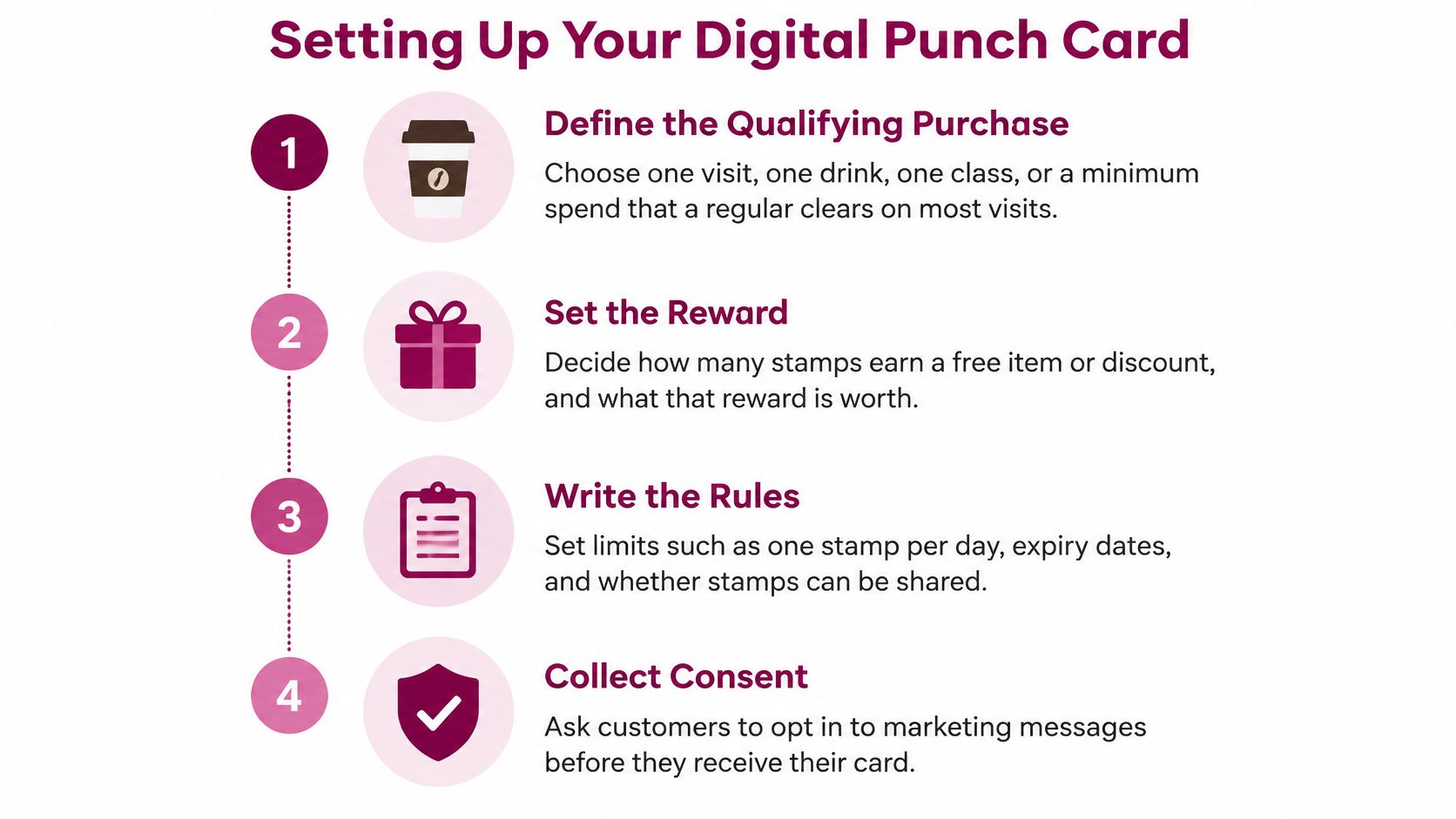
A customer reaches the counter with enough stamps, but the pass never explained which reward qualifies. Set the terms before building the pass. Clear rules save staff time and prevent disputes.
- Define the qualifying purchase. Choose a visit, drink, class, or minimum spend that regulars meet on most visits. If staff need a calculator, simplify the rule.
- Set the stamp count and reward value. Check the reward's direct cost against the margin across qualifying visits. Use that calculation when setting customer incentives that protect margin.
- Set the expiry rule. For example, stamps could expire after six months without a visit. Show the rule on the pass so customers can see it before stamps lapse.
- Limit stamping. Allow one stamp per transaction and one per customer per day, unless there's a clear reason to use a different limit. This gives staff a simple check at checkout.
- Write the reward in one sentence. State what the free item is, when it can be claimed, and what it excludes.
- Collect only necessary fields. Use what enrollment, redemption, and account recovery require, such as a first name and phone number or email. Explain each field in plain language.
- Record marketing permission separately. Let customers decline offers and still collect rewards. Joining the program should not automatically sign them up for marketing.
- Set a manual path. Offer an alternative for customers who won't provide identifiable information, such as a counter card with a staff-entered number. Make the process clear before the rush, not while a queue is waiting.
Privacy needs operating rules, not just policy wording. Specify what staff can view and change, and limit access to people who need it to enroll customers or resolve problems. If someone asks to correct a record, confirm the change with them before editing it. For deletion requests, name the person responsible, remove the customer's record from the loyalty system, and explain any information you must retain for a separate business requirement. If a pass is lost or replaced, verify the customer before transferring the balance, then deactivate the old pass to prevent duplicate stamps or redemption. Keep these steps consistent across locations.
Wallet Pass, App or Phone Lookup Compared
At a busy café counter, a loyalty option only helps if the customer can present it and staff can record the visit without slowing checkout. A digital wallet is familiar to many customers: digital wallets were used by approximately 4.3 billion people, about 53% of the world's population. That figure describes wallet use broadly, not demand for loyalty passes. Treat a wallet pass as one format to test, with a fallback for customers who prefer not to use one.
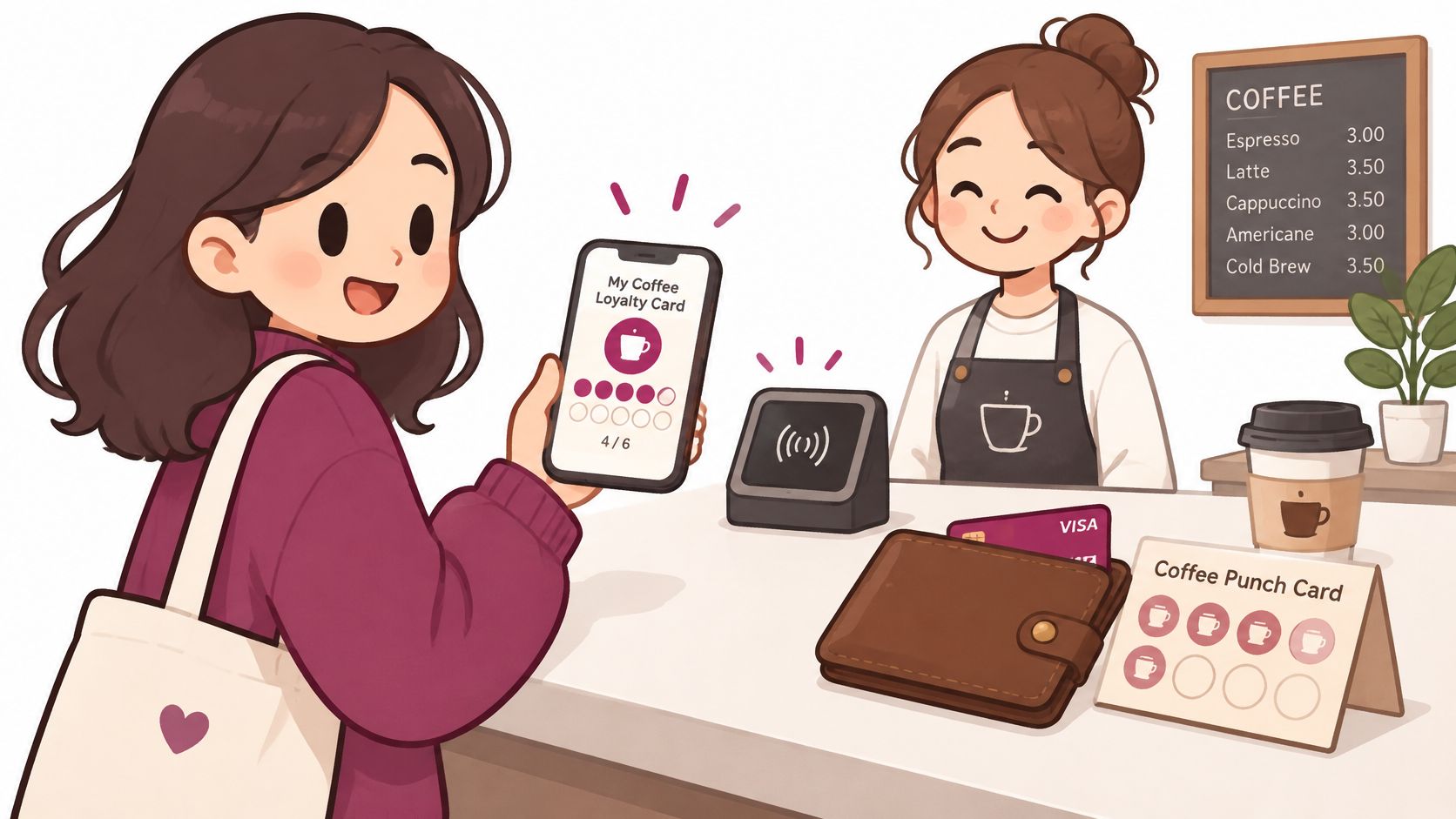
| Option | Customer effort | App download needed | Updates and replacements | Best fit |
|---|---|---|---|---|
| Apple Wallet or Google Wallet pass | Scan a QR code once and tap add | No | Balance updates automatically, reissue by sending a new pass | Cafes, bakeries and salons with phone-first customers |
| Standalone loyalty app | Download, sign up and log in | Yes | App updates and push notifications | Merchants with existing repeat app users |
| Phone-number lookup | Give a number at checkout | No | Staff edit the record directly | Gyms, micro-merchants and customers who refuse installs |
| Printed punch card | Carry the paper card | No | Reprint and replace by hand | Low-volume walk-in businesses only |
For phone-first regulars, a wallet pass avoids asking them to install a separate loyalty app. A phone-number lookup gives customers who decline a pass another way to collect stamps, but it adds a staff action and depends on accurate entry. Choose an app only when repeat customers already use it. Building one just to track stamps can add setup and maintenance without fixing the checkout routine.
This short walkthrough shows the pass experience from scan to stamp.
For wallet issuing, create separate Apple Wallet and Google Wallet pass variants, issue the pass after consent, attach a unique customer identifier, and update the visible balance after each verified transaction. Make the remaining stamp count easy to read with Apple Wallet pass design that keeps the balance readable. Customers need to check progress quickly at the counter.
Tools such as Loyal Customer let merchants run stamp or points cards from a phone and issue wallet-ready passes, which can suit businesses without dedicated POS integration. Keep phone number lookup available as a recovery route when a customer changes phones or does not want a pass. Test both paths with staff before launch, then compare how long each takes during a real rush.
Staff Checkout Routine and Fallback Enrollment
The pass format rarely kills a program. A slow till routine does.
If stamping takes longer than paying, staff will skip it during the rush, customers will notice the inconsistency, and your data will show a program that never really ran. Give the team a routine they can memorise and finish in under 30 seconds.
The Till Routine
- Scan the pass QR code or type the phone number.
- Confirm the name matches the person paying.
- Check the purchase qualifies under your one sentence rule.
- Add one stamp per transaction, not per item unless your rules say otherwise.
- Read the new count aloud, such as, "That's six of eight." Customers remember progress they hear.
- Redeem on the same visit if the threshold is reached, and mark it redeemed before they leave.
If the routine runs long, cut a step rather than relax the target. Drop a confirmation screen, preload the scanner, or move enrollment off the payment moment. Don't ask staff to be heroic at 8 a.m.
Each stamp should log timestamp, merchant location, pass identifier, staff or device identifier, and transaction reference. That log is boring until a customer disputes a missing stamp or a manager suspects friendly over-stamping. Then it's the whole investigation.
Each week, sample about 20 stamped transactions against till records. Flag bursts of stamps within seconds, repeated credentials, or one credential used at several locations in a pattern that doesn't make sense. You'll catch training problems more often than fraud, and both are worth catching early.
When a Customer Won't Add a Pass
Don't make wallet installation a prerequisite. In a 2025 American Express survey, 72% of merchants offered mobile wallet payments while 49% of consumers said they never or almost never used them for in-store shopping. Access isn't adoption, and your oldest regular may be the person least interested in adding a pass.
Offer a fallback that staff can run without a manager:
- Browser or SMS enrollment link: Send it so the customer can join after the queue clears.
- Staff assisted setup: Add the pass together when the shop is quiet, not during the rush.
- Phone number lookup: Stamp the record at checkout with no pass shown.
- Manual reward validation: Check the transaction reference before honouring a claimed reward.
- Lost phone recovery: Confirm the phone number and last visit, then reissue the pass.
- Duplicate rule: Merge duplicate records and keep the earliest start date so customers don't lose history.
A wallet pass removes app friction. It doesn't remove onboarding friction, and pretending otherwise is how good customers get excluded.
Promote the card where payment happens. Use a one sentence script, a receipt QR code, and a counter sign at the payment point. That visibility matters because only 19% of surveyed smartphone users had noticed a retailer using wallets for offers or loyalty, according to consumer research on mobile wallet loyalty awareness, while 85% said they'd receive a non-payment benefit through a mobile wallet. People are open to it, they just don't see it.
Measure activation, repeat visits, and redemption separately for wallet users and non-users, and compare both groups with matched non-members. If wallet users redeem more because they're younger and visit more anyway, the pass didn't cause that lift. Separate the cohorts and you'll know whether to fix the pass, the fallback, or the threshold.
Common Problems and How to Fix Them
Most launch problems aren't software failures. They're small workflow gaps that repeat until staff lose faith in the card.
The most common complaint is a missing stamp after a visit. It usually means the transaction was never linked to the pass during a busy moment, not that the system ate it.
| Symptom | Likely cause | Fix |
|---|---|---|
| Stamps missing after a visit | Transaction not linked to the pass | Search by phone number and add the stamp against the transaction reference |
| Customer has two cards | Duplicate record created at sign-up | Merge records and keep the earliest start date |
| Pass stops updating | Offline or interrupted phone session | Ask the customer to reopen the pass and check sync |
| Customer cannot add the pass | Wallet setting or expired link | Reissue the link, or switch to phone-number lookup |
| Reward claimed twice | Redemption never marked | Require a redemption flag on the same visit |
| Staff over-stamping | No transaction validation | Require a transaction reference for each stamp and audit weekly |
| Sign-ups stall | Promotion not seen | Move the counter QR code to the payment point and retrain the script |
Some fixes take minutes. Reissuing a link, reopening a pass, and moving a QR code to the card reader are same shift repairs. Do those first and watch whether the symptom returns.
Other fixes need a policy change. Requiring a transaction reference for every stamp, merging duplicates under one rule, and forcing same visit redemption flags change how staff work. Announce those once, write them on the till prompt, and audit them weekly until they're habit.
Don't treat every problem as a customer trying it on. Duplicate cards and missing stamps usually start with rushed enrollment or a skipped step at checkout. Fix the routine and most disputes disappear because there's less to dispute.
Launch This Week
- Write the reward and expiry on paper. For example, eight stamps for a free drink, with stamps lapsing after six months without a visit, and confirm the reward costs less than the margin it protects.
- Test the pass on two phones. Use one iPhone and one Android, and run the full journey from scan to add to balance update after a test transaction.
- Brief staff for fifteen minutes. Walk through the till routine and the counter script, then start the pilot that day.
Assign one person to own the weekly audit and completion numbers. If a typical customer can't finish inside the reward window for your business type, change the threshold before widening the pilot. Keep the pilot log from day one so your 30 to 60 day decision rests on cohort data, not impressions from the till.
Start your pilot without printing another stack of paper cards. Loyal Customer lets you run a digital stamp card or points program from your phone, issue branded Apple Wallet and Google Wallet passes, and update balances at checkout. Set up your eight stamp test this week, brief your team, and judge it on completed cards.