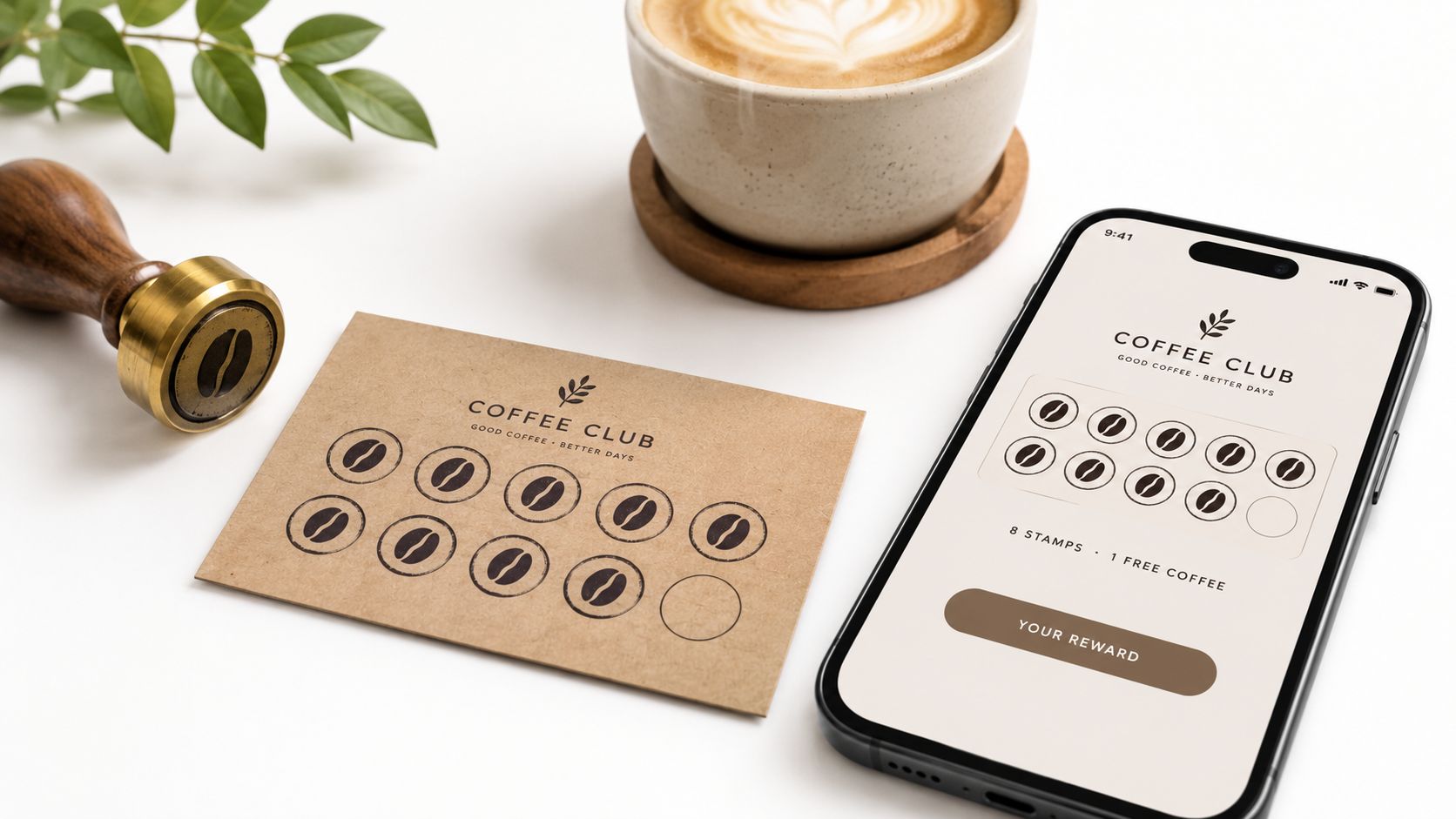
A café owner watches a customer reach the till, realize their paper punch card is at home, and shrug. The next customer has a card but can't remember how close they are to a reward. The owner wonders whether digital loyalty software would solve the problem or just add another task to a busy shift.
That's the right question. A loyalty program isn't successful because customers sign up. It's useful when customers understand it, use it, and choose to return. For a small business, the software decision is really about making repeat visits easier to encourage and easier to measure.
Table of Contents
- Why Small Businesses Are Moving Beyond Paper Punch Cards
- Choosing Between Points and Stamp Models
- Comparing Loyalty Software Options Against a Feature Checklist
- Wallet-Native Passes and What They Add for Customers
- Setting Up Your Program and Running Daily Admin
- Launching and Migrating With a 30 or 60 Day Pilot
- Taking the Next Step With a Free Trial
Why Small Businesses Are Moving Beyond Paper Punch Cards
A bakery owner may see a customer make several visits before realizing their punch card is missing. A salon faces a different version of the same problem: staff need to track progress across appointments, and customers may not know how close they are to a reward. Digital software can make rewards easier to check, but moving online does not by itself create repeat visits.
The distinction is between membership and activity. Forrester's 2024 Consumer Benchmark Survey found that 85% of U.S. online adults belonged to at least one retail loyalty program. A separate 2024 industry estimate put average memberships at 19 per consumer, with 9.3 active (Forrester's State of Retail Loyalty in 2024). For a small merchant, a card stored in a wallet or customer database is only a starting point. The customer still needs a reason and a practical way to use it.
A reward should support a behavior the business wants to encourage, such as another café visit or a return appointment. The measure is not how many customers signed up. Check whether they earn and redeem rewards, then compare visit behavior during a small pilot with the pattern before launch. Keep the offer and tracking simple enough for staff to maintain during a busy shift.
A useful test: Can customers explain how to earn the reward, and do they remember to use it? If not, extra software features are unlikely to solve the underlying issue.
Digital cards can reduce the chance of a card being forgotten, though customers may have different preferences or access to digital tools. A comparison of digital and paper loyalty cards can help frame the trade-offs. Offer a wallet-based option for customers who want it, while keeping a clear staff-assisted fallback for those who prefer paper or need help. That inclusive approach avoids making a smartphone a condition of joining.
Before choosing software, consider how the reward fits the business, whether staff can record activity consistently, and what the reports can show about visits and redemptions. The right setup makes engagement easier to observe, not just easier to count.
Choosing Between Points and Stamp Models
A café with similar-priced orders has a different loyalty decision from a salon where services vary widely in cost. The right model should fit both how customers spend and how staff can apply the rules during a busy shift. Treat the program as a way to encourage and measure repeat visits, not just as a discount.
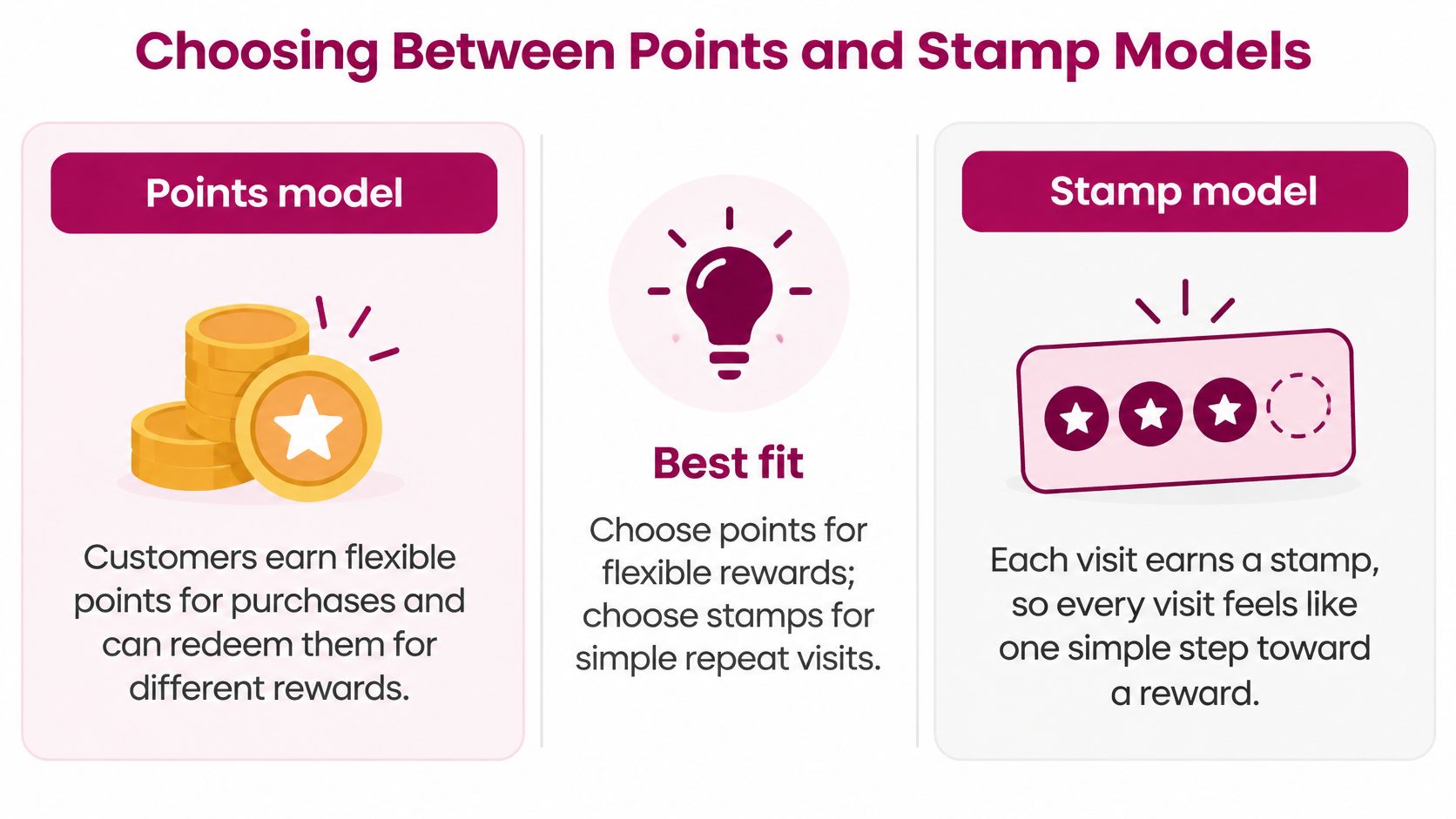
Stamps reward a repeatable visit
A stamp card gives customers one step toward a reward for each qualifying purchase or visit. A bakery could award a stamp for each purchase, then offer a reward after a set number. Customers can see their progress at a glance, and staff have a straightforward rule to explain.
That simplicity has a trade-off. If every visit earns the same stamp, a small pastry purchase counts as much as a larger order. Stamps also offer less room for tiers or rewards tied to spending. They suit businesses where transactions are similar and a clear reason to return matters more than differentiating purchase amounts.
Points handle more variation
Points can reflect what customers spend, which may suit a salon offering haircuts, color services, and treatments at different prices. A business can also set different reward values or tiers, giving it more ways to tailor offers.
The extra flexibility requires clear rules. Customers need to understand how points are earned and what their balance can buy. Staff must apply the rules consistently, and the business must keep balances accurate. If customers cannot work out the value of their points, the program may feel harder to use than a simple stamp card.
Match the model to the work
Use these criteria to narrow the choice:
- Choose stamps when transactions are similar and the goal is to encourage another visit, such as a bakery purchase or routine haircut.
- Choose points when baskets or services vary enough that one stamp per visit would overlook meaningful differences in spending.
- Account for staff workload. A system that takes too long to explain or update can slow checkout when the queue is moving.
- Make the reward visible. Customers should know what they are working toward and how close they are.
Check a typical group of transactions in your sales records. If values are mostly similar, one stamp per visit may feel fair and be easier to run. If amounts differ substantially across services or baskets, points may fit better. Either way, keep the rules simple enough to explain at the counter, and track whether customers return or redeem rewards. For examples of the trade-offs, see this guide to points versus stamp-card loyalty programs.
Comparing Loyalty Software Options Against a Feature Checklist
A busy café needs loyalty software that fits the till routine, gives customers a clear reason to return, and shows whether the program changes visit behavior. Feature counts alone won't tell you that. Deloitte's 2024 Global Consumer Loyalty Survey, covering more than 9,800 consumers, found that 86% rated financial rewards, simplicity, and ease of use as important or very important (Deloitte's Global Consumer Loyalty Survey). For a small merchant, that's a reason to put clarity and ease of use ahead of features that add little to daily operations.
Score the essentials first
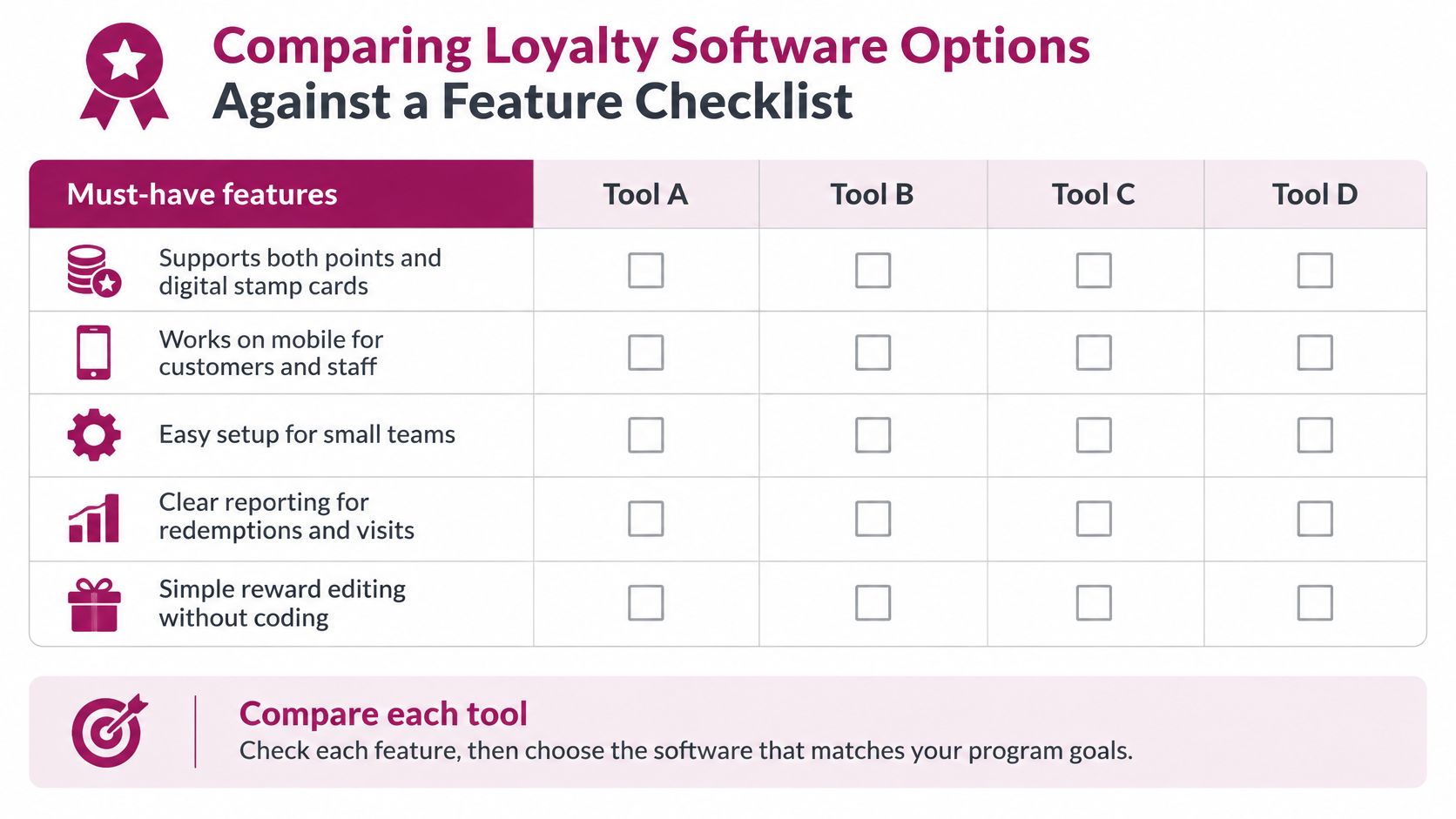
Before comparing products, list what the business needs to run and measure a program. Start with these checks:
| Feature to check | Why it matters |
|---|---|
| Points and digital stamps | Lets you select a format suited to your transactions. |
| Mobile-first administration | Lets staff manage everyday loyalty tasks without relying on a desktop or dedicated terminal. |
| Apple Wallet and Google Wallet passes | Gives customers a familiar place for a digital loyalty card. |
| Clear customer balances | Shows customers their progress and available rewards. |
| Straightforward reward rules | Helps customers understand the offer and staff apply it correctly at the till. |
| Earn and redemption reporting | Helps you assess activity beyond sign-ups. |
| A free trial | Gives you a chance to test setup and daily workflow before committing. |
Mark each option pass or fail against your must-haves, then note useful extras separately. Prioritize what staff can operate and customers can understand. Advanced personalization has little value if no one uses it.
Integrations and more detailed targeting can help when they solve a specific operational problem, such as duplicate data entry. They should not come before a clear way to earn and redeem rewards. In Deloitte's survey, four out of five consumers valued flexibility in how rewards were earned and redeemed, while 60% were satisfied with the personalized and targeted experiences they received. For a small business, the practical takeaway is to get the basic offer working before adding more complicated personalization.
Test the workflow, not just the feature list
Use the trial to set up one reward. Ask a staff member to record an earn and process a redemption, then check what the customer sees and how many steps staff need to complete. A tool may offer useful reporting but still slow down a busy checkout. Test both.
Loyal Customer is one option to assess. Merchants can run a points program or digital stamp card from a phone, issue Apple Wallet and Google Wallet loyalty cards, and try a basic program through a free trial. If the business relies on a barcode scanner or a particular point-of-sale integration, confirm compatibility directly before committing. A feature list can't show whether the software fits your existing setup.
Wallet-Native Passes and What They Add for Customers
A customer reaches the café counter and opens a loyalty pass on their phone instead of searching for a paper card. A pass in Apple Wallet or Google Wallet can make that exchange simpler without requiring a separate business app. The benefit depends on customers being able to find and present it quickly.
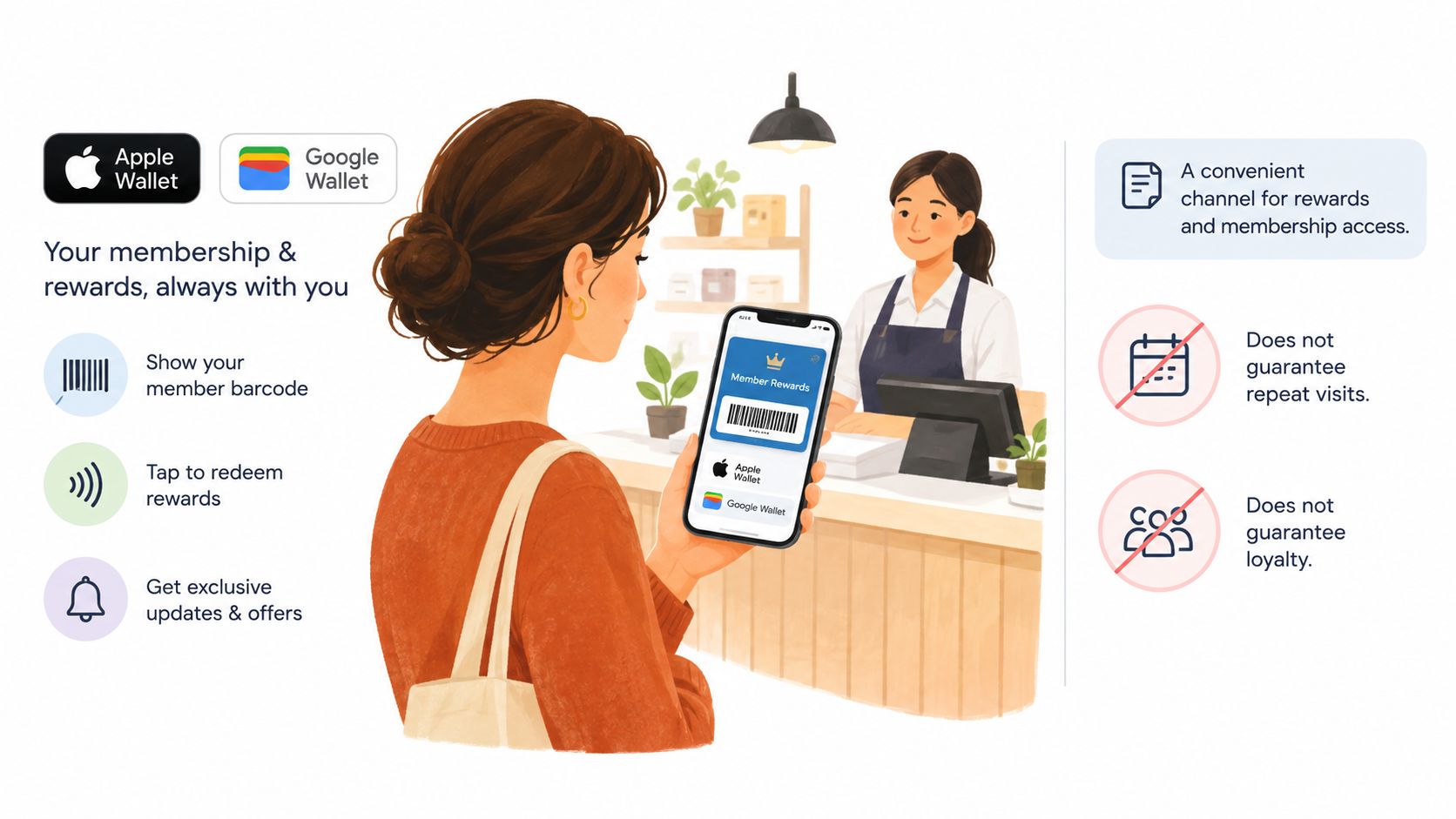
A Federal Reserve Bank of Boston analysis based on a 2016 survey found that 13% of consumers used mobile wallets for in-store payments, while 94% said they would use mobile wallets more often if they could earn and redeem loyalty rewards (the Boston Fed's mobile-payments analysis). These figures are historical, not a current adoption benchmark. They point to a practical design choice: give the pass a clear role in earning and redeeming rewards, rather than treating it as a digital membership card customers have little reason to open.
A wallet pass does not guarantee that every customer will join or present it. Some customers do not use mobile wallets, and others may struggle to find a pass among several apps. A dead battery, weak connection, or older phone can also slow checkout.
Keep access inclusive: Make the wallet pass the easy digital option, while keeping a practical fallback for customers who cannot or do not want to use it.
A printed card or staff lookup may work as a fallback, depending on how your business keeps customer records. Decide how staff will help before launch, and explain clearly what information you collect. A wallet pass can remove the need to download a separate app, but it should not be a condition of fair service. For setup considerations, see this guide to an Apple Wallet loyalty card.
Test the customer experience before relying on the pass at checkout. Ask a staff member to open it, present it, and explain the reward. Keep another way to identify a customer available if the phone or pass is unavailable.
Setting Up Your Program and Running Daily Admin
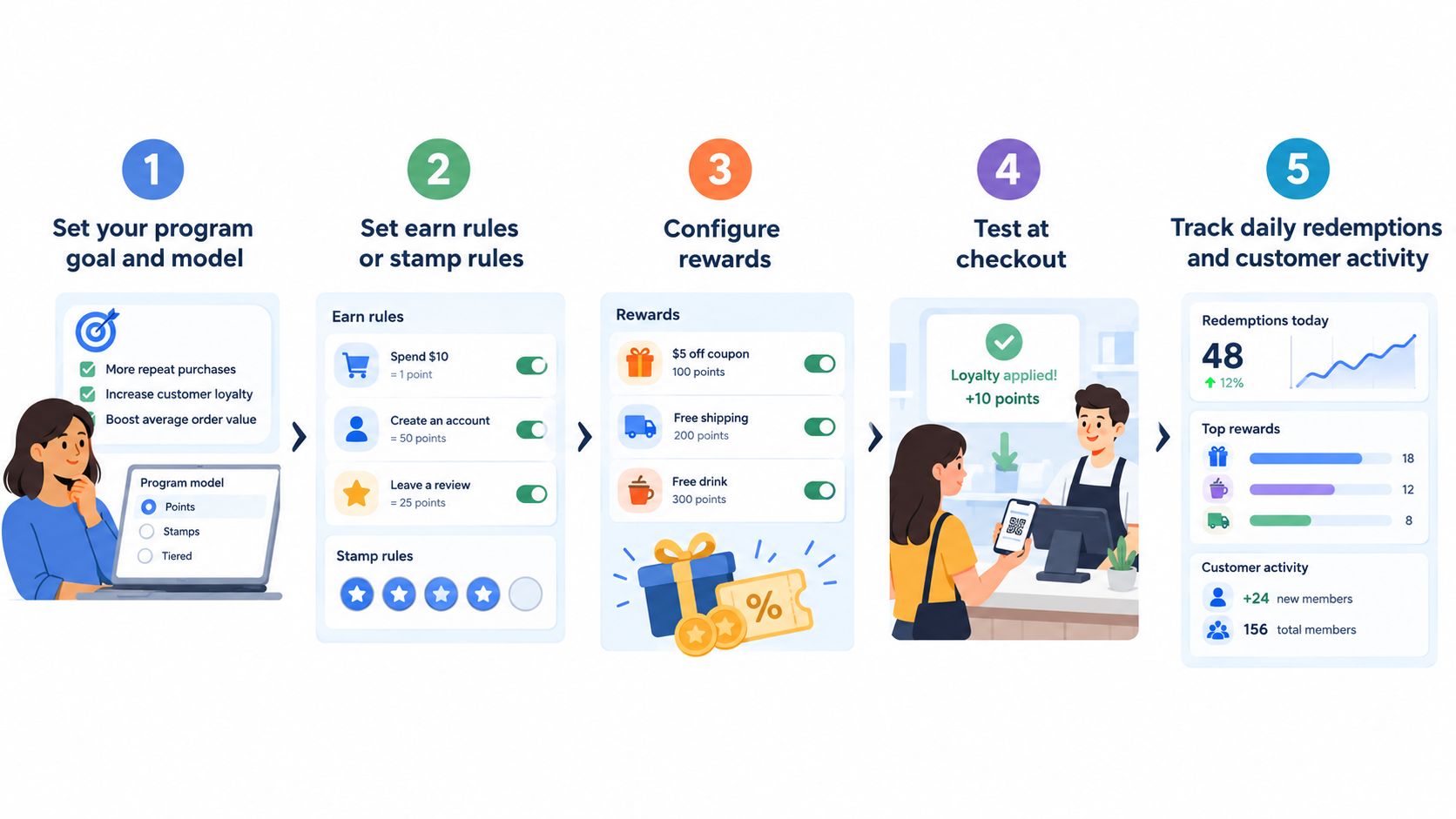
Good setup begins with a business goal, not a software screen. Decide whether you want to encourage repeat visits, bring back customers who've lapsed, or make an existing offer easier to manage. Then choose points or stamps, set a clear earning rule, and pick a reward customers can understand without a long explanation.
Set rules staff can apply consistently
Once the reward is defined, design the customer pass and decide how customers will join. Explain the offer at the counter, then show staff the routine: record a purchase or visit, check a customer's balance, and redeem the reward when it's due. If you update an offer, make sure the new terms are clear to both customers and employees.
The software should record each earn and redemption as an event, not just maintain a sign-up total. Useful fields include a customer identifier, timestamp, visit or purchase, points or stamps earned, reward redeemed, and the channel used. Those records can support questions such as whether enrolled customers return, how often customers redeem, and how visit intervals change after enrollment.
Reward rules need a history, too. If you change how many points earn a reward or how many stamps a customer needs, preserve the previous rule alongside the event records. Otherwise, you may compare activity from different program versions as if the rules had never changed.
Make admin light enough to sustain
A systematic review of 201 peer-reviewed articles found that loyalty effectiveness is increasingly associated with personalized digital experiences and customer engagement, rather than incentives alone (the review of loyalty-program research). For a small business, that doesn't mean building complex customer profiles. It means making the offer relevant, communicating it clearly, and paying attention to whether customers use it.
A manageable weekly routine can be brief: review earn and redemption activity, check for staff mistakes or customer questions, confirm that the reward still makes sense, and update any offer that has changed. Keep the routine consistent. A program that staff can operate during a normal shift is more useful than one that requires an owner to repair it after every busy day.
Launching and Migrating With a 30 or 60 Day Pilot
Don't transfer every paper-card holder into a new program and assume the change worked. Start with a soft launch among regular customers, explain the new offer at the counter, and set a pilot window of 30 or 60 days. If you're moving from paper cards or informal tallies, tell existing customers how their progress will be handled before the old system ends.
The difficult part is deciding whether rewards caused extra business or discounted purchases that would have happened anyway. Nearly 60% of companies reported ROI tracking as their greatest measurement difficulty, according to the research on loyalty-program ROI (CrowdTwist's guide to measuring loyalty ROI). A small merchant faces the same attribution problem, often with less time and fewer reporting tools.
Establish a useful baseline
Before launch, record visit frequency and average spend for several weeks. If you can, compare enrolled and non-enrolled customers, while remembering that people who opt in may already be more loyal. Record the program's costs as well as its sales: include reward costs, discounts, administration time, and promotion expenses.
Then review the pilot against that baseline. High redemption alone isn't proof of success. Customers may redeem rewards on visits they would have made regardless, which means the program could be subsidizing existing behavior rather than creating additional visits.
Track the outcomes that help you make an operating decision:
- Incremental visits: Did customers come more often than before, compared with a reasonable baseline?
- Margin after rewards: Did the extra activity remain worthwhile after discounts and reward costs?
- Dormant-customer reactivation: Did customers who had stopped visiting return?
- Break-even member volume: How many active members would the program need to cover its costs?
Don't treat a short pilot as universal proof that loyalty software will pay off. Evidence about the financial impact of loyalty programs across small businesses remains limited, so use early results as an experiment. If the numbers don't support the program, change the reward, simplify the rules, or stop before investing more time.
Taking the Next Step With a Free Trial
A café can set up a reward in minutes and still learn little if staff apply it inconsistently or the goal is unclear. Before starting, choose the reward model and the staff workflow, then decide what customer behavior the pilot should test.
This week, set up one points reward or digital stamp card on a phone. Add an Apple Wallet or Google Wallet pass, show staff how to enroll customers and record visits, and run a 30-day pilot. Keep a simple fallback, such as a physical card, for customers who don't use wallet passes. Compare results with your baseline before deciding whether to continue. Loyal Customer offers points programs, digital stamp cards, and wallet-ready passes for small consumer-facing businesses, with a free trial to test the setup.