A customer finishes her coffee, reaches for the loyalty card, and then remembers it's in yesterday's jacket. Another regular lost theirs months ago. A third customer has a nearly complete card but can't prove how many visits remain. Your staff either makes a judgment call or starts the count again.
That small moment is where many loyalty programs leak value. A punch card for business can encourage repeat visits, but only if customers can use it consistently and you can tell whether it changes their behavior. Digital cards remove some physical friction, but their real value comes from turning a vague promise of loyalty into a measurable customer journey.
Table of Contents
- Why Your Paper Punch Card Is Already Losing Customers
- How Digital Punch Cards Actually Work Under the Hood
- Paper vs Digital Punch Cards - A Practical Comparison
- Real-World Examples Across Different Business Types
- Setting Up Your Digital Punch Card in Minutes
- Measuring What Matters - Beyond Completed Cards
- When a Punch Card Is Not the Right Choice
Why Your Paper Punch Card Is Already Losing Customers
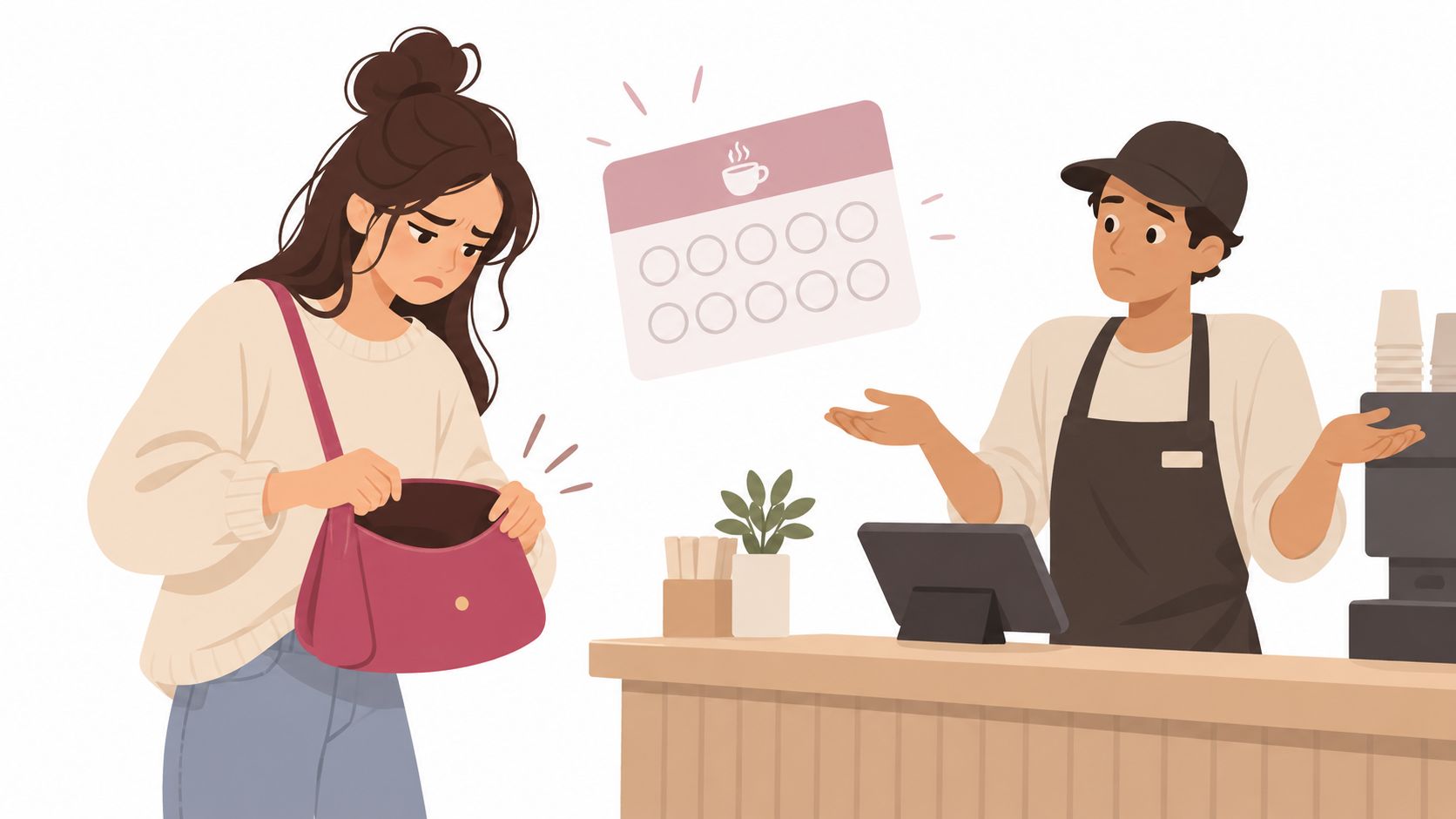
A regular reaches the counter, pats every pocket, then gives up. The card is at home, or in a coat they wore last week, or bent beyond recognition at the bottom of a bag. Staff can either wave it through, deny the stamp, or guess. None of those choices feels good to the customer, and over time the program starts to feel optional instead of built into the buying habit.
That is the first hidden cost of paper. You are not only printing cards. You are asking customers to carry a separate object, keep it legible, remember it at the exact moment of purchase, and trust that every employee will treat it the same way. A loyalty offer with that much friction loses people long before the reward is earned.
Paper also leaves you operating half blind. You can see that a card has stamps on it, but you cannot easily see who is coming back faster, who stalls just before redemption, or whether the reward changes behavior at all. If a program is supposed to create a habit, you need more than proof that transactions happened. You need some way to judge whether visit timing, frequency, or redemption patterns shift.
The analysis of paper punch-card advantages and limitations makes that trade-off clear for small businesses. Paper is simple to launch, but it offers limited visibility into the customer patterns behind the stamps.
Fraud and inconsistency make the economics worse. One loose stamping policy is enough to invite arguments at the register. One employee initials damaged cards, another refuses them, and a third punches extra visits for a familiar face. The direct loss from a few free rewards may be small. The bigger problem is that the rules stop feeling reliable.
I have seen owners focus on print cost because it is easy to count. The harder cost is missed measurement. You cannot identify dormant members, spot customers who are close to a reward, or test whether a promotion pulls visits forward. You give away the reward without learning which behavior you really bought.
A wallet pass on a phone removes much of the loss and forgetfulness problem, as described by Loyal Customer's guide to digital loyalty cards. That matters because digital punch cards are not just a cleaner format. They are a behavioral tool. If participation stays consistent, you can finally measure whether the program changes customer habits or just records them.
How Digital Punch Cards Actually Work Under the Hood
A digital punch card isn't merely a picture of a paper card on a phone. The important design choice is where the balance lives. The merchant should maintain the current stamp count centrally, then generate the customer-facing pass from that shared record.
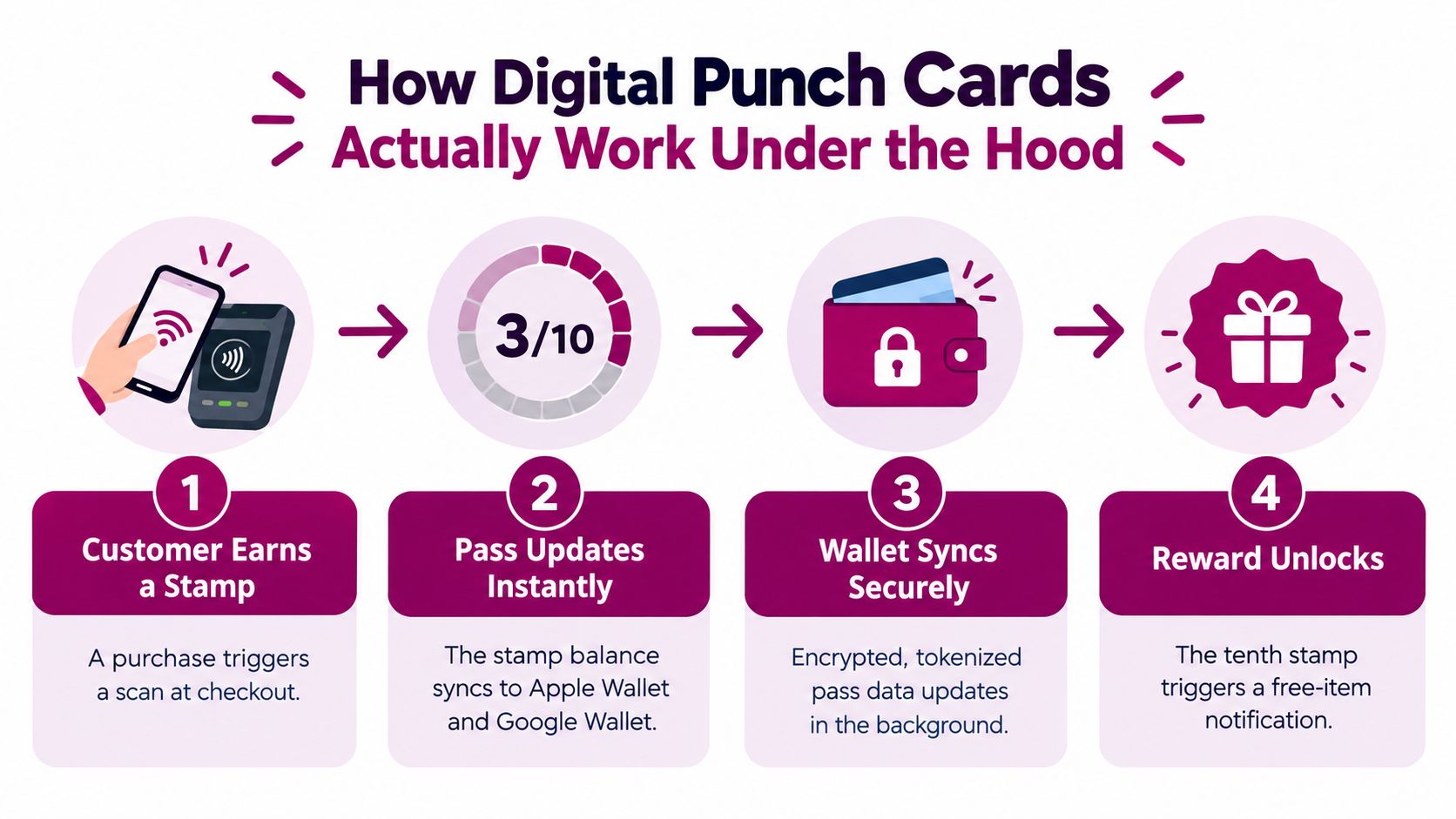
Apple Wallet uses an updateable pass
An Apple Wallet pass is a signed .pkpass package containing pass data, a manifest, images, localization files, and a cryptographic signature. Once installed, the customer's device registers with the issuer's HTTPS web service. When the merchant changes the balance, the issuer can send a push event, and the device fetches and compares the newer pass version.
In practical terms, the checkout workflow can be simple:
- The customer presents the wallet pass.
- The merchant identifies the customer and confirms the qualifying purchase.
- The backend increments the stamp balance.
- The pass receives an update and displays the new state.
- The system marks the reward available when the threshold is reached.
The pass isn't the authoritative ledger. It's the customer-facing representation of the ledger. That distinction matters when someone changes phones, reinstalls a wallet, or uses a different device.
Google Wallet separates the template from the customer record
Google Wallet uses a different object model. A reusable Class defines the shared card template, while an individual customer's Object stores the customer-specific pass instance. Your loyalty backend should therefore keep a stable customer identifier, current stamp count, reward threshold, issuance status, and update timestamp, then produce the appropriate Apple or Google representation from that same source.
This architecture prevents Apple and Google customers from drifting into separate balances. It also makes recovery more manageable because the merchant can recreate the pass from the central record rather than trusting whatever image remains on a phone.
For a more detailed explanation of pass behavior and update flows, see this guide to digital punch-card architecture. The technical lesson is straightforward: the phone displays the balance, but the business should own the balance.
Paper vs Digital Punch Cards - A Practical Comparison
Paper remains attractive because it's cheap to understand and quick to launch. A café can print cards, hand them over the counter, and train staff in minutes. That simplicity is real, especially for a small operation without a connected checkout system.
Digital cards introduce setup work and require customers to save a pass. In return, they reduce replacement friction and give the business a structured record of participation. The right choice depends on how much you need consistency, visibility, and control.
| Factor | Paper Card | Digital Stamp Card |
|---|---|---|
| Initial setup | Fast to print and distribute | Requires pass design, rules, and customer enrollment |
| Ongoing materials | Reprinting and replacement remain necessary | No physical reprinting for balance changes |
| Customer access | Easy to understand, but easy to forget or lose | Stored in a phone wallet and available during checkout |
| Fraud exposure | Staff over-stamping, copied cards, and ambiguous marks are harder to detect | Server-side updates can restrict who adds stamps |
| Data visibility | Usually limited to the physical card | Can support enrollment, activity, redemption, and timing records |
| Rule changes | Existing cards may show outdated terms | Pass content and reward rules can be updated centrally |
| Adoption friction | No digital action required | Customer must scan, save, or accept the pass |
| Recovery | Lost cards may mean lost progress | A central customer record can support pass recovery |
Where paper still makes sense
A paper card can work for a very small customer base, a short promotion, or a business where tracking isn't important. It also provides a fallback during a connectivity problem or when customers aren't comfortable with wallet passes.
The mistake is treating paper as free. The card itself may cost little, but staff time, disputes, unredeemed progress, and invisible customer behavior all carry operational consequences. You should compare the total burden, not just the price of printing.
Where digital earns its keep
Digital becomes more defensible when repeat visits matter, customers commonly carry phones, and you want to test whether the program changes visit frequency. It also helps when several employees need to apply the same rules without relying on handwriting or visual judgment.
Don't switch because digital sounds modern. Switch when the operational value of reliable balances and usable behavioral data outweighs the setup and adoption work.
Real-World Examples Across Different Business Types
A punch card works when the stamp reflects a meaningful customer action and the reward fits the business's margin. The same card structure shouldn't be copied across a café, salon, and social-commerce shop.
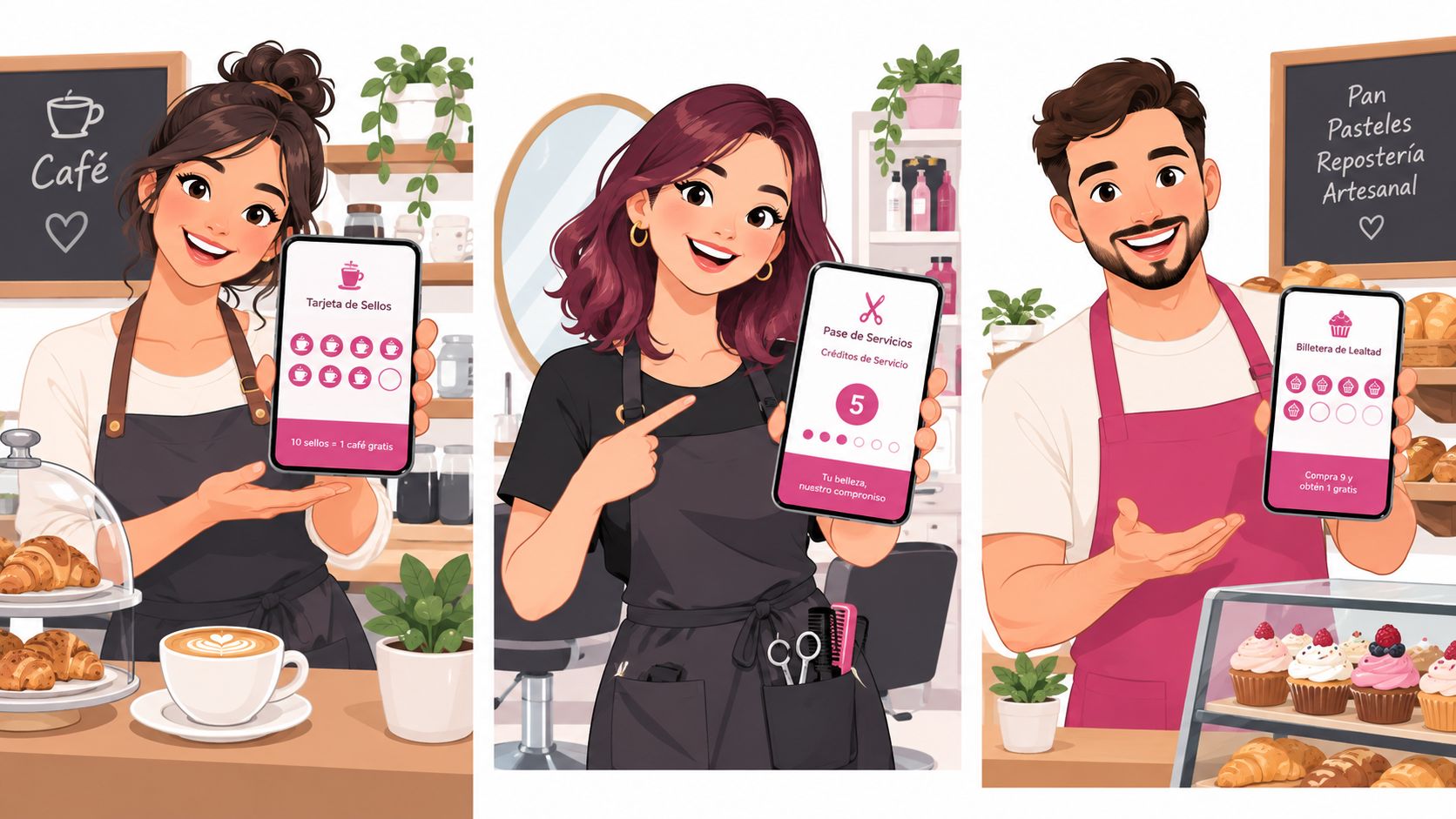
A café rewards a familiar purchase
A café might give one stamp for each qualifying drink and provide a free drink after the final stamp. The rule is easy for customers and staff because the qualifying event is visible at checkout. A small early perk, such as a size upgrade or add-on, can keep the card from feeling empty while the customer works toward the main reward.
The café should decide whether every drink qualifies or whether the program excludes heavily discounted items. That rule needs to appear wherever customers see the offer, because ambiguity creates disputes and can encourage staff to apply different standards.
A salon rewards service continuity
A salon often sees customers less frequently than a coffee shop, and the basket can vary sharply between appointments. A simple “one stamp per visit” card may still work, but a service-credit model can be more relevant. For example, each qualifying appointment can move the customer toward a defined add-on, such as a treatment or finishing service.
The reward should support the next appointment rather than discount a service the customer already planned to book. The salon also needs clear rules for cancellations, refunds, bundled services, and whether a qualifying visit requires a minimum purchase.
A short video can help staff and owners visualize how a wallet-based flow fits into a normal customer interaction.
A micro-merchant connects the card to conversation
An Instagram or WhatsApp seller may not have a traditional point-of-sale system. The merchant can present a QR code after a qualifying order, identify the customer through the digital card, and update the balance from a phone.
This model works best when the business defines the event precisely. Is the stamp earned per order, per product category, or after a minimum purchase? A single clear rule is easier to explain in a chat and easier to apply when orders happen across different channels.
These examples share a principle: the stamp should follow the customer's natural buying rhythm. If the threshold takes so long that the customer forgets why they joined, the program becomes a record-keeping exercise rather than a behavioral prompt.
Setting Up Your Digital Punch Card in Minutes
A workable launch doesn't require a large loyalty department. It requires a clear offer, one repeatable qualification rule, and a checkout process that staff can perform without slowing the line.
Start with the customer action
Define the event that earns a stamp before choosing colors or icons. For a café, it might be one qualifying drink. For a salon, it could be one completed appointment. For a gym, it might be one check-in, provided the same person can't create multiple stamps through an unclear self-service flow.
Then set the threshold and reward. Choose a reward with a predictable cost, and write the condition in plain language. “Free regular coffee after the completed card” is easier to apply than a reward with several exclusions and spending conditions.
Build the pass on your phone
A mobile-first platform such as Loyal Customer lets a merchant configure a digital stamp card, customize the reward and stamp icon, and issue a wallet-ready card for Apple Wallet or Google Wallet. A free trial gives the team a way to test the setup before committing to a wider rollout.
You can use a punch-card template for business to organize the reward wording and customer-facing structure before publishing it.
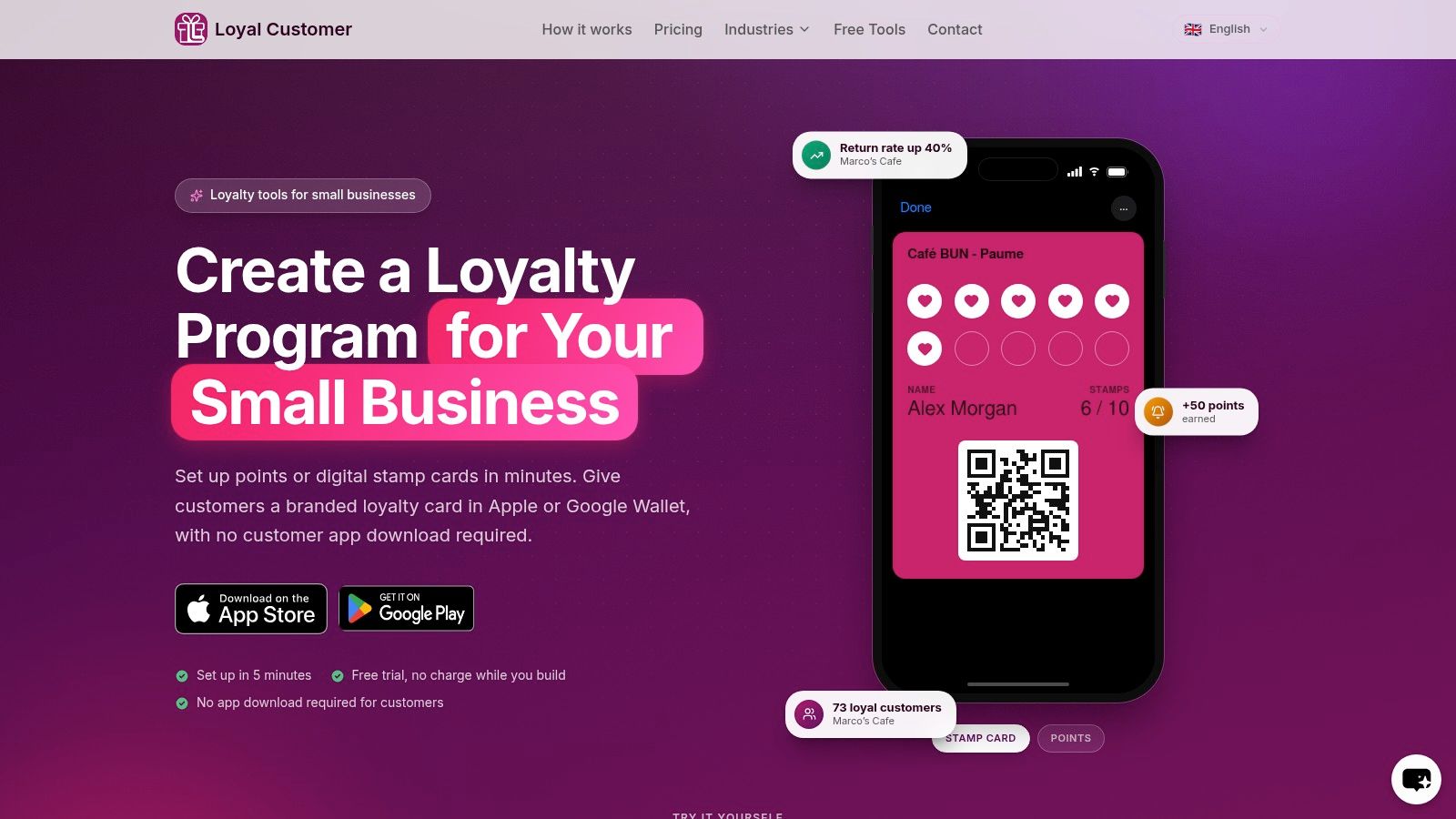
A practical launch sequence looks like this:
- Create the account: Begin the free trial and enter the business details customers should recognize.
- Design the pass: Add the business name, visual identity, stamp icon, reward text, and threshold.
- Set qualification rules: Specify which purchases, appointments, or check-ins earn a stamp and which do not.
- Prepare the staff flow: Decide who scans the pass, confirms the event, adds the stamp, and redeems the reward.
- Publish the entry point: Place the QR code or enrollment link at the counter, on receipts, in social profiles, and inside relevant customer conversations.
- Test both wallets: Create test passes on Apple Wallet and Google Wallet, then check the display, balance update, and redemption process.
Use this launch checklist
- Reward clarity: Can a customer understand the reward without asking a second question?
- Staff consistency: Can every employee apply the same qualifying rule?
- Redemption control: Does the system prevent a redeemed reward from being used again?
- Migration plan: Will you honor existing paper stamps during a defined transition?
- Customer reminder: Does the counter sign tell people exactly how to save the pass?
- Measurement baseline: Have you recorded current visit patterns before promoting enrollment?
Start with a small group of regulars, observe where staff hesitate, and revise the rules before promoting the program broadly. A technically polished pass won't rescue an unclear offer.
Measuring What Matters - Beyond Completed Cards
A completed card is satisfying, but it isn't enough to prove that the program works. Customers who already visit frequently may be the most likely to enroll, which means completion can reflect existing loyalty rather than a change caused by the reward.
A useful measurement system separates participation from business impact. The goal is to find out whether the program shortens the time between visits, increases profitable activity, or gives away rewards to customers who were already coming.
Track a minimum set of signals
- Enrollment rate: Measure how many eligible customers accept the program. Low enrollment may indicate poor explanation or too much signup friction.
- Active-member rate: Count members who have earned a stamp during the chosen reporting period, rather than treating every enrollment as current engagement.
- Completion rate: Record how many enrolled customers reach the threshold. This shows movement through the program, not causality.
- Redemption cost: Calculate the actual product, service, labor, or capacity cost of rewards.
- Incremental visits: Compare visit frequency before and after enrollment, using a simple non-member baseline where possible.
- Average spend from participating customers: Watch whether participating customers spend more, less, or about the same after joining.
Research on a financial-services loyalty program found that program loyalty was a stronger driver of purchase behavior than general company loyalty, and that the program reduced the time between purchases without increasing purchase volume or average expenditure. That distinction matters for a punch card for business. The most defensible target is often visit frequency, not an assumption that every customer will spend more.
Research involving 3,094 loyalty-program members also found that reward redemption was associated with increased purchase behavior before and after redemption, including when members redeemed only part of their accumulated points. The loyalty-program research on repeat purchasing and redemption supports treating redemption as a behavioral milestone worth tracking, not merely as a cost line.
A card that fills up is active. A card that changes visit timing may be valuable. Those are different conclusions.
Review the metrics together. If enrollment is strong but active-member rate is weak, the promise may not match customer habits. If completions rise but incremental visits stay flat, the program may be subsidizing existing demand. If visits increase but reward cost consumes the margin, redesign the reward before expanding enrollment.
When a Punch Card Is Not the Right Choice
Digitizing a weak loyalty mechanic doesn't fix its underlying economics. A punch card is structurally unsuitable when customers visit rarely, buy very different products, or take a long time to reach the reward.
The model is strongest when customers return frequently, purchase the rewarded category on most visits, and can carry the card through a realistic completion period. Guidance for independent stores identifies frequent visits, including at least three visits per week, as a favorable condition, along with a reward tied to a purchase customers make on nearly every visit. That recommendation appears in guidance on loyalty structures for independent convenience stores.
Signs you need another model
- Infrequent appointments: A salon may do better with a service credit, treatment milestone, or referral reward than a visit card that takes too long to complete.
- Variable baskets: A specialty retailer may need points linked to categories, margin, or spend rather than one stamp for every transaction.
- Long purchase cycles: A business selling products customers replace infrequently may get more value from replenishment reminders, targeted offers, or referral incentives.
- Unclear qualifying events: If employees can't agree what earns a stamp, the program will create more checkout friction than retention.
- Unprofitable rewards: If the reward subsidizes purchases that would've happened anyway, test a smaller add-on or a targeted offer instead.
Operational fairness matters too. Publish rules for qualifying purchases, exclusions, expiration, transfers, refunds, and future reward changes. Customers don't need complex terms, but they do need predictable treatment.
A points program can suit variable baskets. A referral incentive can suit a service business with infrequent visits. A targeted offer can reactivate a dormant customer without giving every regular the same subsidy. The practical decision isn't whether digital is better than paper. It's whether a punch-based reward matches the customer's natural reason to return.
For a focused explanation of reward structure and fit, review this guide to rewards and punch-card design. Start with the behavior you want to change, test the cost against incremental visits or margin, and only then choose the technology.
Loyal Customer provides phone-managed digital stamp and points programs, with wallet-ready loyalty cards for Apple Wallet and Google Wallet and a free trial for testing the setup. Visit Loyal Customer to create a practical punch card, define your reward rules, and give customers a pass they can keep.