The most popular advice about a loyalty rewards program is also the least reliable: offer a discount, collect as many sign-ups as possible, and wait for repeat business. That approach confuses membership with retention. A customer can join, receive a digital card, and never return, while the business gives away margin to people who would have purchased anyway.
A profitable program works differently. It treats every point or stamp as a future claim, removes friction at checkout, uses mobile wallets as an adoption channel, and collects only the data needed to make the reward useful. The key question isn't how many customers enrolled. It's whether the program creates additional visits, protects gross profit, and earns enough trust for customers to keep using it.
Table of Contents
- The Enrollment Illusion and Active Engagement
- Choosing Between Points Stamps and Wallet Passes
- Engineering the Economics of Reward Redemption
- Designing a Frictionless Mobile Onboarding Experience
- Balancing Personalization with Privacy Restraint
- Measuring Incremental Profit and True Retention
- Your Launch Checklist for Small Business Loyalty
The Enrollment Illusion and Active Engagement
A large membership list can make a loyalty program look healthy while hiding weak customer behavior. Sign-ups are an input, not an outcome. If members don't earn, check their balance, return, and redeem, the program is functioning as a database rather than a retention mechanism.
The saturation problem is clear in Boston Consulting Group's 2024 analysis of loyalty programs. The average US consumer belonged to more than 15 loyalty programs, yet engagement had fallen 10% since 2022, and more than 35% expected to cancel some memberships. Membership is growing, but attention is scarce. A café, salon, or independent retailer isn't competing only with nearby businesses. It's competing with every other card, app, email, and wallet pass on the customer's phone.
What customers actually use
Customers usually engage when the value is immediate and the rules are obvious. They need to understand three things without asking staff:
- How they earn: A visit, a purchase amount, or a specific action should produce a visible result.
- What they get: The reward should be concrete, relevant, and financially meaningful.
- When they can use it: The threshold and redemption conditions shouldn't require interpretation.
Deloitte's 2024 Consumer Loyalty Survey, which covered more than 9,800 consumers across the United States, United Kingdom, India, and Brazil, found that 86% considered financial rewards, simplicity, and ease of use important or very important program attributes. Approximately 80% valued flexibility in how rewards were earned and redeemed. The same survey found that only 60% were satisfied with personalized and targeted experiences in existing programs.
That combination points to a practical design rule: keep the core mechanics simple, then add flexibility where it helps. Don't begin with complicated tiers, bonus missions, or a long profile form. Begin with an earning action customers already understand and a reward they can reach through normal behavior.
Practical rule: Measure active members and completed redemptions before celebrating enrollment.
Remove friction before adding features
A sign-up process that requires an app download, password creation, extensive personal details, and a separate payment workflow asks customers to do too much at the moment they're trying to leave. Redemption creates another failure point if staff need to search through a system or explain exceptions.
You should track the movement from enrollment to activity. Look at members who earn, members who return, members who redeem, and members who become inactive. Those stages reveal where the experience breaks. If enrollment is high but earning is low, the offer or onboarding is unclear. If earning is healthy but redemption is rare, the threshold may be too distant or the reward may not matter.
A loyalty rewards program earns its place in the business when customers remember to use it without being reminded by staff every time. That means the balance must be visible, the next reward must feel attainable, and the process must fit naturally into the existing purchase.
Choosing Between Points Stamps and Wallet Passes
The right loyalty model depends on the rhythm and economics of the business. A coffee shop sees frequent, similar purchases. A salon may see fewer visits with a higher transaction value. An independent retailer may need rewards that reflect different basket sizes. Copying a large brand's points structure often creates complexity without improving behavior.
Match the mechanism to the purchase
A digital stamp card is usually the clearest option for a high-frequency business. “Collect a stamp per visit and receive a reward after completing the card” is easy to explain at a bakery, takeaway, or coffee counter. It works best when the business wants to encourage another visit rather than carefully differentiate between small and large baskets.
Points offer more flexibility. A merchant can award value based on spending, product categories, or selected actions. That makes points useful for retailers, salons, gyms, and restaurants with variable order values. The trade-off is cognitive load. Customers need to understand the conversion between spending, points, and rewards, while the merchant must maintain a more deliberate liability model.
Wallet passes aren't a separate earning model. They're the delivery layer for either points or stamps. A customer can store a digital card in Apple Wallet or Google Wallet rather than downloading a standalone loyalty app or carrying paper.
| Model Type | Best For | Customer Action | Merchant Flexibility |
|---|---|---|---|
| Digital stamps | Frequent visits with a familiar purchase pattern | Present the pass and collect a stamp | Simple rules, limited variation |
| Points | Variable spending and different reward values | Earn points from purchases and redeem at a threshold | More control over earning and offers |
| Wallet pass | Businesses serving mobile-first customers | Save the card and show it at checkout | Supports visible balances and updates for points or stamps |
Choose simplicity over theoretical precision
A points program can look more polished, but complexity isn't automatically useful. If a customer buys a similar coffee every morning, a stamp is often more legible than a points balance. If a salon sells multiple services and products, points may better reflect value than a single visit count.
The delivery method matters because customers don't want another destination to remember. A wallet-native card stays near other payment and membership credentials, and it can display progress without requiring a separate app session. Businesses evaluating implementation can compare the operational trade-offs in this guide to loyalty points software for small businesses, especially when deciding whether a points structure is justified.
Don't use points to disguise an unclear reward. A customer should be able to answer, “What do I get, and how close am I?” at a glance. If the answer requires a calculator, a dense terms page, or staff intervention, the program has already introduced a retention problem.
Consider the staff workflow
The best model is also the one staff can administer during a busy service period. A stamp should take seconds to apply. Points should update reliably after a purchase. Wallet passes should show the current balance and redemption rule clearly enough that staff aren't forced to become customer support.
For small businesses, the operational question is more important than the feature list. Select a model that fits your transaction frequency, gross margin, staff capacity, and customer expectation. A modest program that gets used consistently will outperform a richer program customers abandon.
Engineering the Economics of Reward Redemption
A loyalty reward is not free marketing. It represents a future claim on a product, service, inventory unit, or margin. The moment you issue a point or stamp, you create an obligation that must be estimated, monitored, and eventually redeemed, expired, or otherwise resolved.
That accounting perspective changes the design conversation. Instead of asking how generous the offer looks, ask whether the reward creates enough incremental gross profit to cover its expected cost. A program can increase redemption and still lose money if it discounts purchases that would have happened without the incentive.
Treat every issued unit as a claim
The key variables are straightforward:
- Earn velocity: How quickly a typical customer reaches the reward.
- Reward cost: The true expense of the free item, discount, or service to the business.
- Redemption probability: How likely issued rewards are to be used.
- Outstanding balance: The value already promised but not yet redeemed.
- Breakage: The share of rewards that are never redeemed.
Breakage reduces the expected cost of outstanding rewards, but designing for maximum non-redemption is a mistake. Customers who repeatedly fail to reach a reward, lose progress, or discover restrictive expiry rules may stop participating. The target is predictable and attractive completion, not customer frustration.
The accounting principle is set out in this practical guide to customer loyalty program economics: expected reward cost equals issued reward units multiplied by the estimated redemption rate and the cost per redeemed reward. Use that formula as a planning model, then compare the result with incremental gross profit from member behavior.
Set a threshold customers can reach
A reward threshold should fit realistic purchasing behavior. If a café customer needs an excessive number of visits to complete a card, the program becomes background noise. If a salon customer receives a reward after almost every appointment, the business may be subsidizing demand rather than creating it.
Start with a reward that feels meaningful but doesn't consume the margin from the qualifying purchases. Then test the pace. If members take too long to earn, simplify the path or adjust the earning rule. If almost everyone redeems quickly and member behavior looks identical to non-member behavior, the incentive may be too generous or poorly targeted.
The comparison isn't only between the full price and the discounted price. Include the cost of goods, labor, payment processing, redemption volume, and staff time. A “free” item can still require preparation, packaging, or capacity that affects the business during peak periods.
Watch for discount cannibalization
Discount cannibalization occurs when a customer uses a reward on a purchase they would have made anyway. That transaction looks successful in the loyalty dashboard, but the program hasn't generated additional demand. It has only reduced the amount the customer paid.
You can reduce this risk by testing rewards that change behavior rather than merely lower price. Examples include a reward tied to a quieter trading period, a bonus for an additional category, or an experiential benefit that costs less than a blanket discount. Keep the rules easy to understand, and record issuance, redemption, expiration, and outstanding balances separately.
A points system should support repeat purchasing, not train customers to delay purchases until a promotion appears. For a deeper comparison of earning structures and operating choices, see this overview of a points-based loyalty program.
Designing a Frictionless Mobile Onboarding Experience
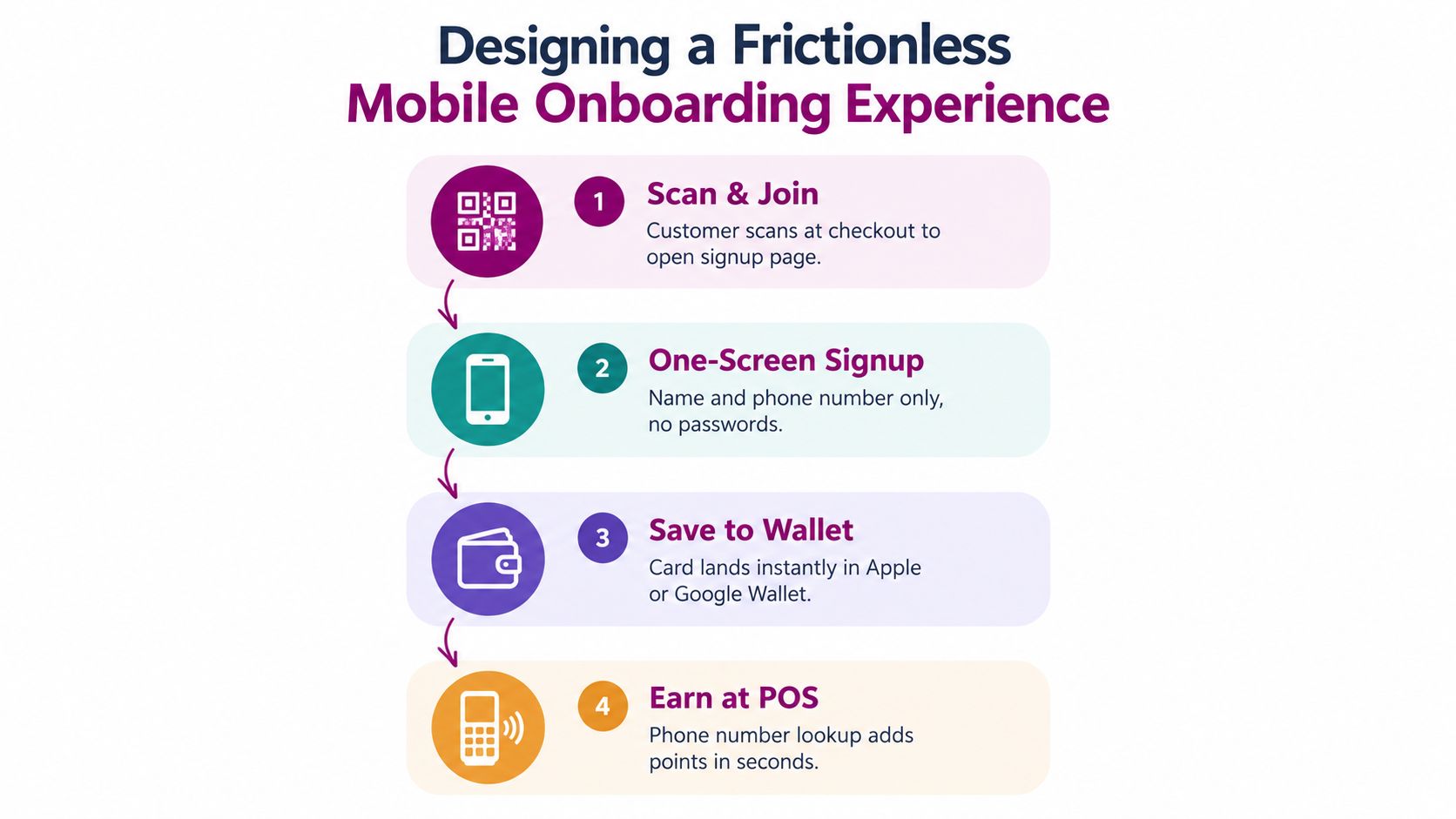
The checkout counter is where loyalty programs either become habitual or disappear. Customers are already paying, staff are already serving them, and the business has a natural opportunity to explain the next benefit. Onboarding should use that moment without turning it into a form-filling exercise.
Build the journey around four actions
- Scan and join. Place a QR code at the counter, on receipts, or near the collection point. The scan should open a mobile signup page immediately.
- Keep signup to one screen. Ask for only the information needed to identify the member and operate the reward. Avoid passwords and unnecessary profile questions.
- Save to the wallet. Let the customer add the pass to Apple Wallet or Google Wallet while the reason to join is still clear.
- Earn at the point of sale. Use a phone number lookup, pass scan, or another quick method that staff can complete without disrupting service.
The pass should show the current points or stamp balance, the redemption threshold, and any essential conditions. Updates need to appear promptly after purchase. A delayed balance weakens the connection between the transaction and the reward, while an unclear threshold makes progress feel abstract.
A Federal Reserve Bank of Boston review reported that 94% of surveyed consumers said they'd use mobile wallets more frequently if they could earn and redeem loyalty rewards directly within them. That figure reflects stated preference, not a randomized estimate of added sales, so treat wallet delivery as an adoption hypothesis to validate rather than a guaranteed revenue result.
Make administration as light as customer use
The merchant workflow should work from a phone for ordinary tasks. Staff need to find a member, add points or stamps, confirm a redemption, and correct an error without a dedicated scanner or complicated terminal setup. Owners also need to adjust reward rules, review balances, and see basic activity without waiting for a desktop implementation project.
A useful guide to creating Apple Wallet passes can help clarify the pass setup, but the same design principle applies to both major mobile wallet ecosystems. The pass should act as a persistent reminder and a clear transaction record, not as a second app that customers must learn.
Use a short staff script: explain the reward in one sentence, show the QR code, and tell the customer where the pass will live. Don't make employees recite a full terms page at the counter. Put the detailed conditions where customers can access them later, while keeping the essential earning and redemption rule visible immediately.
Balancing Personalization with Privacy Restraint
Small businesses don't need an elaborate behavioral profile to make a loyalty rewards program relevant. A café can understand purchase frequency without knowing a customer's broader identity. A salon can track visits and service categories without collecting intimate personal details. An independent retailer can use aggregated buying patterns without following every individual action across channels.
The useful distinction is between operational data and high-risk profiling. Purchase history, visit date, reward balance, and redemption status may be necessary to run the program. Precise location trails, inferred personal circumstances, unrelated browsing behavior, and sensitive attributes usually aren't necessary for a basic reward.
Ask for a visible benefit in return
Customers tolerate data collection when they can see what they receive. PwC's 2025 customer experience survey found that 53% of consumers considered sharing personal information worthwhile when it made interactions smoother, while 93% said mishandling that data would make them lose trust.
That gap is the central privacy trade-off. A smoother experience can justify limited data collection, but poor handling can erase the value of the reward. Explain what you collect, why you collect it, how long you retain it, and how a customer can opt out. Use plain language instead of hiding the explanation in dense legal copy.
Use restraint as part of the value proposition
A privacy-conscious setup can follow a simple hierarchy:
- Collect the minimum: Start with an identifier and transaction or visit history. Add fields only when a clear reward depends on them.
- Separate consent: Don't make marketing messages appear mandatory for joining the core program.
- Aggregate where possible: Use broad purchasing patterns to plan offers without exposing individual behavior to unnecessary staff or systems.
- Make control visible: Give customers an easy way to update details, stop communications, or leave the program.
- Limit access: Staff should see what they need to apply a reward, not an expansive customer profile.
Personalization should make the next interaction more useful, not make a regular customer wonder how much the business knows about them. A birthday reward, a reminder based on an ordinary visit pattern, or an offer for a category the customer already buys can be relevant without becoming surveillance.
The contrarian point is important: more personalization isn't automatically better loyalty. Relevance must come with restraint, a clear benefit, and a credible explanation of how the data supports that benefit.
Measuring Incremental Profit and True Retention
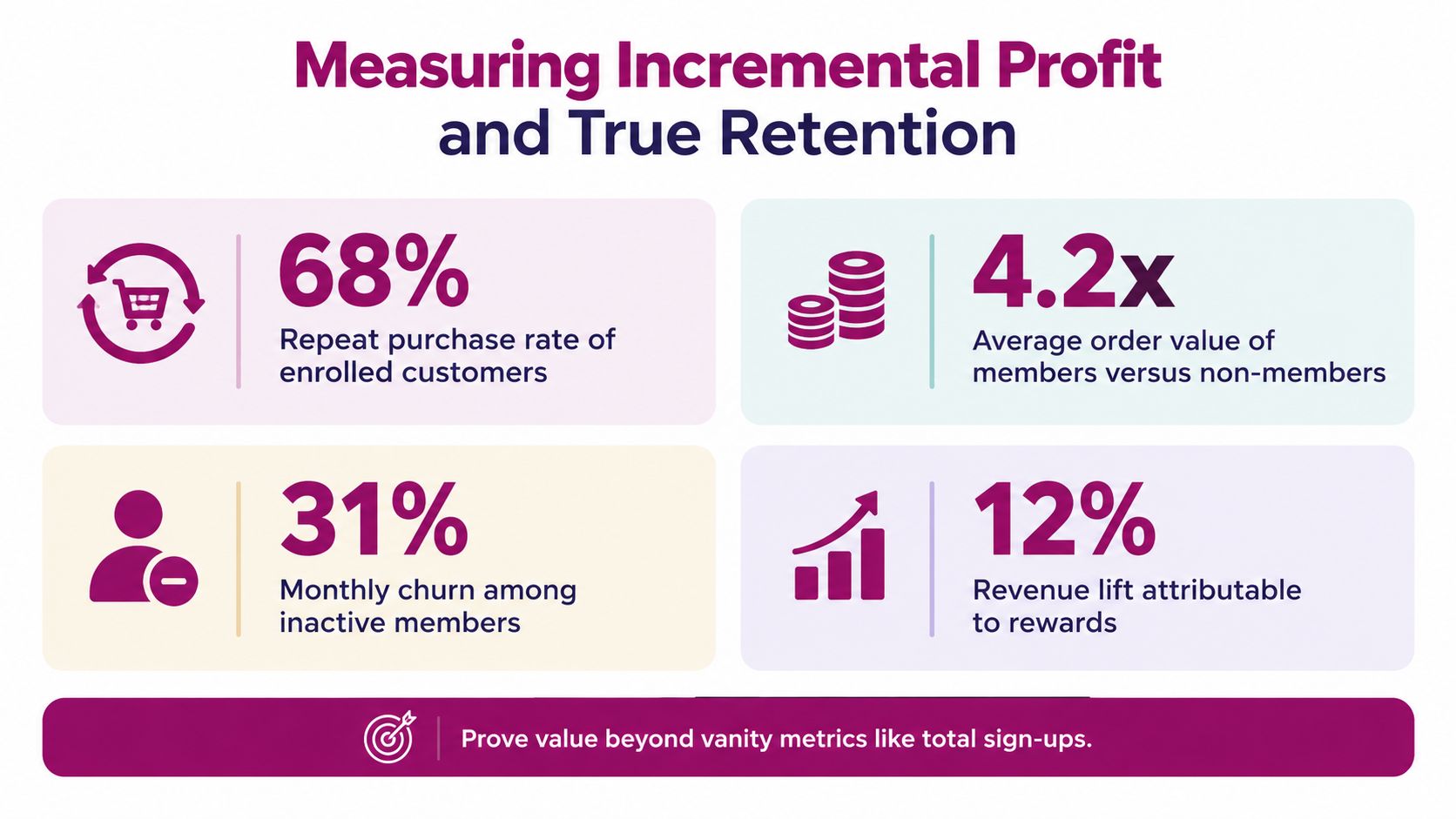
Total sign-ups are easy to display and difficult to interpret. Points issued can rise while customers redeem less, visit no more often, and receive deeper discounts. A small business needs a measurement system that separates activity from profitable change.
Start with a baseline before launch or before a major redesign. Then compare enrolled customers with a suitable group of non-members, or compare member behavior before and after participation. The comparison won't be perfect, especially for a small customer base, but it will be more useful than counting cards.
Track the behavior that affects margin
A practical dashboard should include:
- Visit frequency: Compare how often active members return with comparable non-members.
- Average transaction value: Check whether members buy more, less, or about the same per visit.
- Redemption rate: Measure how many issued rewards are used, and how quickly.
- Reward cost: Calculate the actual cost of redeemed products, services, discounts, and administration.
- Incremental gross profit: Estimate the profit created by additional visits or basket value after subtracting reward costs.
- Inactivity: Identify members who have stopped earning or returning, rather than treating their enrollment as continued engagement.
Recent data reinforces the need for this discipline. The Wiser Research report published by The Wise Marketer found that 47% of US consumers disengaged from at least one loyalty program during the previous year. Among respondents, 51% cited difficulty earning rewards and 41% said benefits lacked relevance.
Test whether the reward changes behavior
A reward has economic value only when it changes an outcome that matters. If a member makes the same purchase on the same schedule but pays less, you've measured discount usage, not retention. If the reward produces an additional visit but the cost of that reward exceeds the resulting gross profit, you've bought activity at a loss.
Use cohort reviews rather than one headline number. Compare customers who joined in the same period, then examine earning, return visits, redemption, and margin over time. Look for differences by store location, service type, customer frequency, and reward path. A coffee shop might find that a visit-based stamp card works for regular drinks, while a points offer performs better for food add-ons.
Change one major variable at a time. Adjust the threshold, reward, or earning rule, then observe whether behavior improves without an unacceptable rise in reward cost. A program earns continued investment when it produces measurable repeat visits and profitable basket behavior after incentives are included.
Your Launch Checklist for Small Business Loyalty
A small business doesn't need to build a large ecosystem before testing a loyalty rewards program. It needs a clear rule, a manageable workflow, and a measurement plan that can expose weak economics quickly.
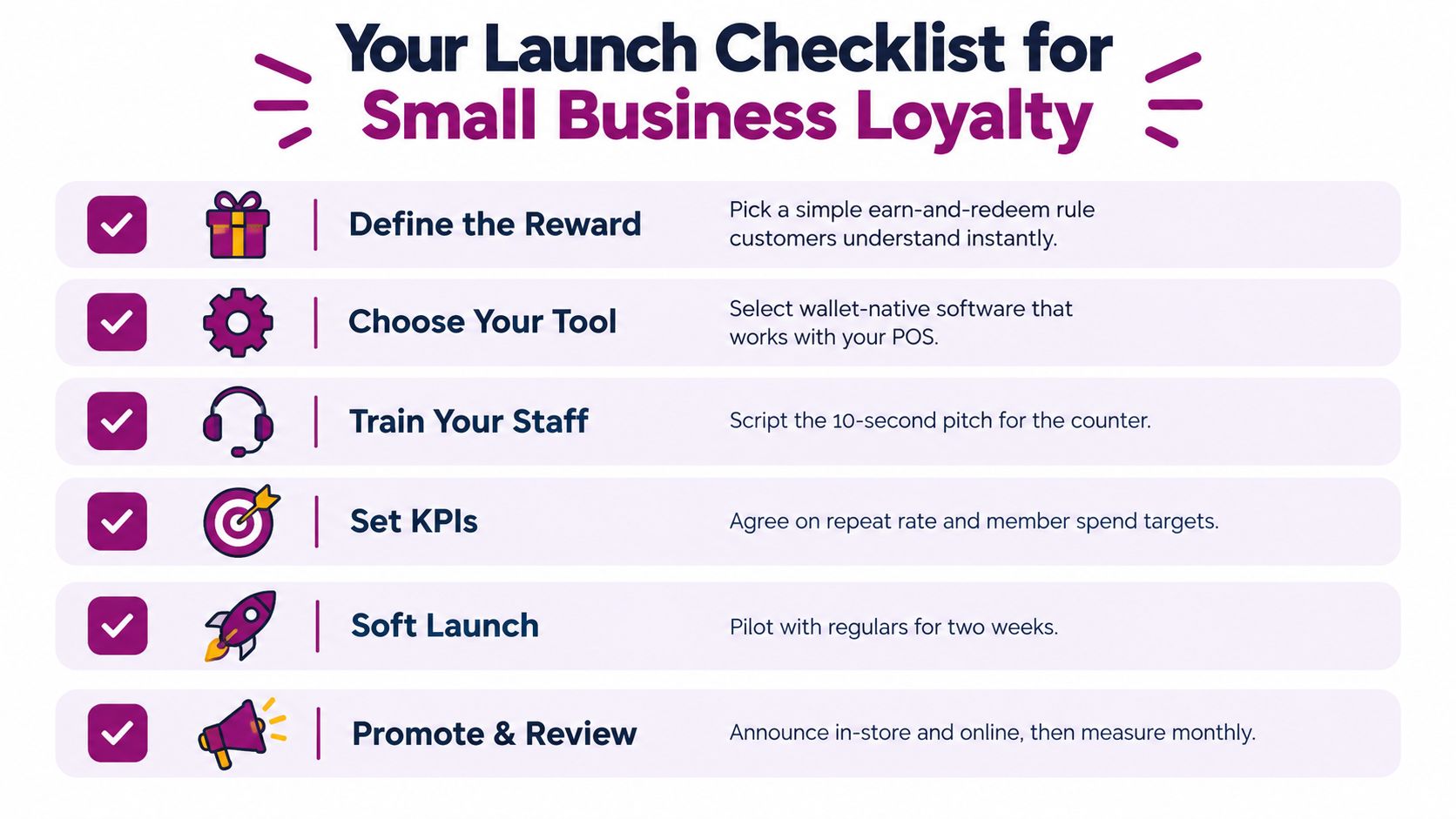
Define the reward. Choose one earning action and one reward customers can understand immediately. Check that the threshold is reachable through normal purchasing without putting the margin under pressure.
Choose the tool. Select points or stamps based on transaction frequency and basket variation. Prefer a wallet-native option if customers shouldn't have to download another app.
Prepare the staff workflow. Write a ten-second explanation for the counter. Train employees to enroll customers, apply earning credit, and process redemption consistently.
Set the measurement baseline. Record member and non-member visit frequency, average transaction value, redemption, reward cost, and incremental gross profit. Decide who will review the figures and how often.
Run a soft launch. Use the free trial or pilot period to test the pass, signup flow, balance updates, and staff process with existing regulars. Fix unclear wording before promoting the program broadly.
Promote and review. Put the invitation at checkout, on receipts, and in the channels customers already use. Review activity and economics monthly, then simplify or adjust the program when the data shows friction or weak profitability.
A useful launch test has a clear stop condition. If customers don't understand the reward, staff can't administer it quickly, or the cost rises without additional visits, pause promotion and redesign the mechanics. A smaller program with visible progress, limited data collection, and controlled redemption is easier to improve than a complicated scheme built around vanity metrics.
Loyal Customer provides phone-managed points programs and digital stamp cards, with wallet-ready loyalty cards for Apple Wallet and Google Wallet and a free trial for testing the setup. Visit Loyal Customer to configure a mobile-first program, test the earning and redemption flow, and measure whether it drives profitable repeat visits.