A regular smiles at the counter, rates her flat white a five, and tells you she'll see you soon. Next week she's buying the same drink two streets away because it's on her walk to the station. Nothing went wrong. She meant the score. She just didn't come back.
That's the gap most small businesses live in. You get quick proof that a visit landed well, and slow, unclear proof about whether anyone returns. Customer satisfaction and loyalty sound like one thing, but they aren't. One is a judgment about today. The other is a choice you only see later, when a customer has other options and picks you again.
Table of Contents
- Satisfied Customers Who Never Come Back
- Scores That Separate Satisfaction from Loyalty
- The Path from a Good Visit to a Return
- Why a High Score Still Loses the Next Sale
- What Cafes Salons and Shops Should Watch
- Six Moves to Turn Satisfaction into Repeat Visits
Satisfied Customers Who Never Come Back
Say a cafe serves a guest a five star latte. It's hot, balanced, fast, and exactly what she ordered. She taps five stars on a prompt, leaves happy, and then never returns. Satisfaction is her verdict on that one visit. Loyalty is what happens on the next weekday morning, when she's tired, in a hurry, and walks past three other places to buy from you again.
The same split shows up everywhere. A salon client loves today's cut, but loyalty is whether she rebooks before her color grows out. A diner praises Friday lunch, but loyalty is the next reservation. A shopper has a smooth checkout, but loyalty is the same basket coming back next week.
Teams confuse the two because the score arrives immediately. The repeat visit doesn't. A rating pops up before the cup is washed, so it feels like the result. The return visit may come tomorrow, in six weeks, or never, and by then nobody connects it to that earlier visit.
The link usually breaks in three ways:
- The memory fades: A good visit isn't distinctive enough to come to mind at the next purchase.
- Convenience wins: A nearer, faster, or easier option beats a place the customer liked.
- One bad visit wipes the slate: A late order or a billing error cancels several good visits because nothing repairs it.
A five star visit with no reason built into the next one is satisfaction without loyalty.
What follows moves in a practical order. First, the scores that separate a feeling from a behavior. Then, the path from a good visit to an actual return, and where rewards help or paper over weak service. Finally, the moves a cafe, restaurant, salon, shop, bakery, or gym can make this month with the staff and tools already on hand.
The test is simple. By the end, you should be able to name one satisfaction score you'll collect, one loyalty behavior you'll watch, and one change that connects them. If you can name only the score, you're measuring the visit and guessing about the customer.
Scores That Separate Satisfaction from Loyalty
Pick from the table first, then argue about targets later. You need at least one measure from each side of it.
| Measure | What it captures | How to calculate it | Loyalty question it answers |
|---|---|---|---|
| CSAT | Feeling about one visit | Top-box answers divided by all answers, usually 4-5 on a 1-5 scale | Did this visit feel good enough to remember |
| NPS | Willingness to recommend | Percent scoring 9-10 minus percent scoring 0-6 | Will they advocate, not whether they buy again |
| Customer effort | Friction of the visit or redemption | Low-effort share on a short post-visit scale | Is returning or redeeming harder than it should be |
| Retention rate | Customers who stay over a period | (Ending customers minus new customers) divided by starting customers | Who is still active, regardless of how they feel |
| Repeat-purchase rate | Buyers who come back | Repeat buyers divided by all buyers in the period | Who actually returned after a purchase |
| Redemption rate | Use of an earned reward | Rewards redeemed divided by rewards issued | Who is engaged, not merely enrolled |
The attitude scores
CSAT is the share of top-box answers, usually 4 or 5 on a 1 to 5 scale, taken right after the visit. It tells you this visit felt good. It says nothing about next month. NPS subtracts the share scoring 0 to 6 from the share scoring 9 or 10. It speaks to recommendation, not to the next purchase. A customer can happily recommend your salon to a friend and still book wherever has a free slot first.
Customer effort flags friction at ordering, booking, or redemption. It's the score that explains why satisfied people drift away. If rebooking takes three screens and a phone call, effort catches the problem CSAT misses.
Don't assume a steady score is a safe score. In 2024, US customer satisfaction declined by 1 percentage point, according to Forrester's Customer Experience Benchmark Survey of 98,363 consumers evaluating 223 brands across 13 industries. Your regulars compare you against every visit they make elsewhere, not against your own history.
The behavior scores
Retention rate counts customers still active at period end after new arrivals are removed, so a busy month of first-timers can't hide regulars leaking out. Repeat-purchase rate divides buyers who came back by all buyers. Redemption rate divides rewards used by rewards issued, and it's the sharpest separator between sign-ups and people using your program. A long member list with low redemption is a mailing list, not loyalty.
Read the pairs, not the single numbers. High CSAT with a flat repeat rate means the visit is fine and the reason to return is missing. High redemption with rising complaints means the reward is covering a service problem, and you're paying people to tolerate you. If you want the deeper distinction, the difference between a liked brand and a chosen one is worth understanding before you set targets.
Review one attitude score and one behavior score on the same visits, split by whether the last visit was rated well or poorly. Before you read any gap, confirm each group has enough responses to be stable. A two week comparison of a few dozen guests can swing on a single visit, so widen the window or the sample before you change the program.
The Path from a Good Visit to a Return
A kitchen is a good comparison. Service quality is the ingredients. Satisfaction is whether the guest likes the taste. Loyalty is whether they book the next meal. Better ingredients help, but taste carries only part of the effect. Habit, location, price, and the ease of coming back all pull on that next booking too.
Here's how that path looks when you map it out.
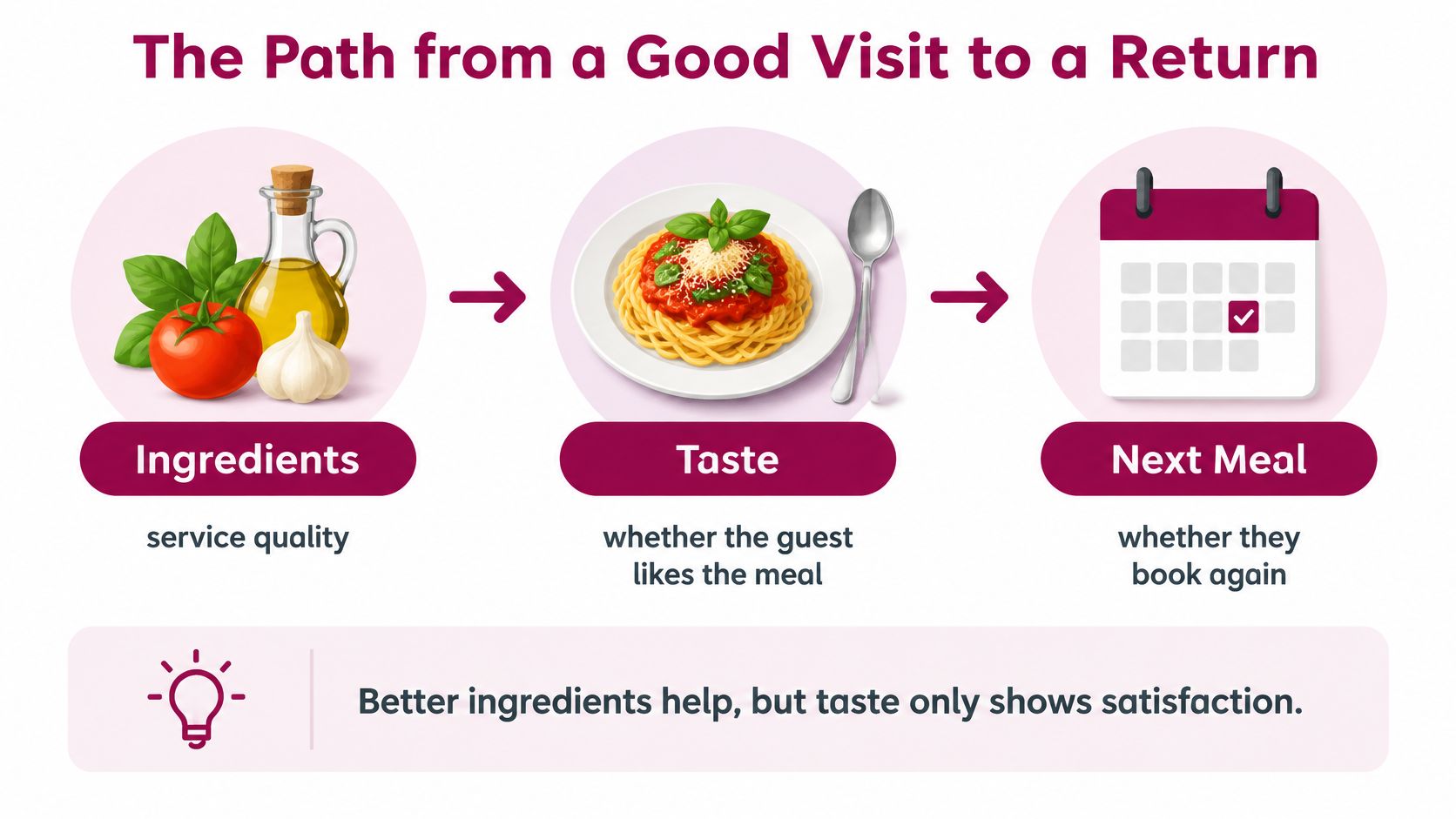
That partial link isn't a guess. In a structural-equation study of 535 mobile-service users, service quality, satisfaction, and switching costs each directly influenced service loyalty, while satisfaction partially mediated the relationship between service quality and loyalty.
Read that plainly for a cafe, restaurant, salon, or shop. Improving the visit doesn't maximize return visits unless the guest notices the improvement as more value or a better experience. Faster ticket times your team can see on a screen don't count if the guest still feels she waited too long. And satisfaction isn't the only road to a return. The cost and hassle of switching, or the ease of staying, moves people on its own.
Measure the whole funnel
Enrollment counts tell you almost nothing. Measure the full path instead:
- Interaction quality: Was the drink right, the cut right, the order right?
- Satisfaction straight after: Collected while the visit is still fresh.
- Reward engagement: Did they check a balance or collect a stamp?
- Redemption: Did an earned reward get used?
- Time between purchases: Is the gap shrinking, holding, or stretching?
- Repeat probability: How often do people return after a good visit, and after a bad one?
Split satisfaction by how often someone already visits. If you mix first-timers with regulars, you'll get one muddy average that describes neither group. A regular rating you a 4 may be cooling off. A first-timer rating you a 4 may be warming up. Same score, opposite meaning.
Design the reward to reinforce the service rather than replace it. A clear, attainable reward after a few visits tells the guest their progress counts and the next visit has a point. A discount alone just trains people to wait for a cheaper price.
Practical rule: A points or stamp program is working only when repeat-purchase probability rises among the customers who were satisfied, not when the member list grows.
Why a High Score Still Loses the Next Sale
A program can raise visit frequency while the relationship stays fragile. That's the uncomfortable starting point. Stamps get collected, points get spent, and one bad visit still ends the relationship because the customer was loyal to the reward, not to you.
The perception gap behind that fragility is wide, and this comparison puts a number on it.
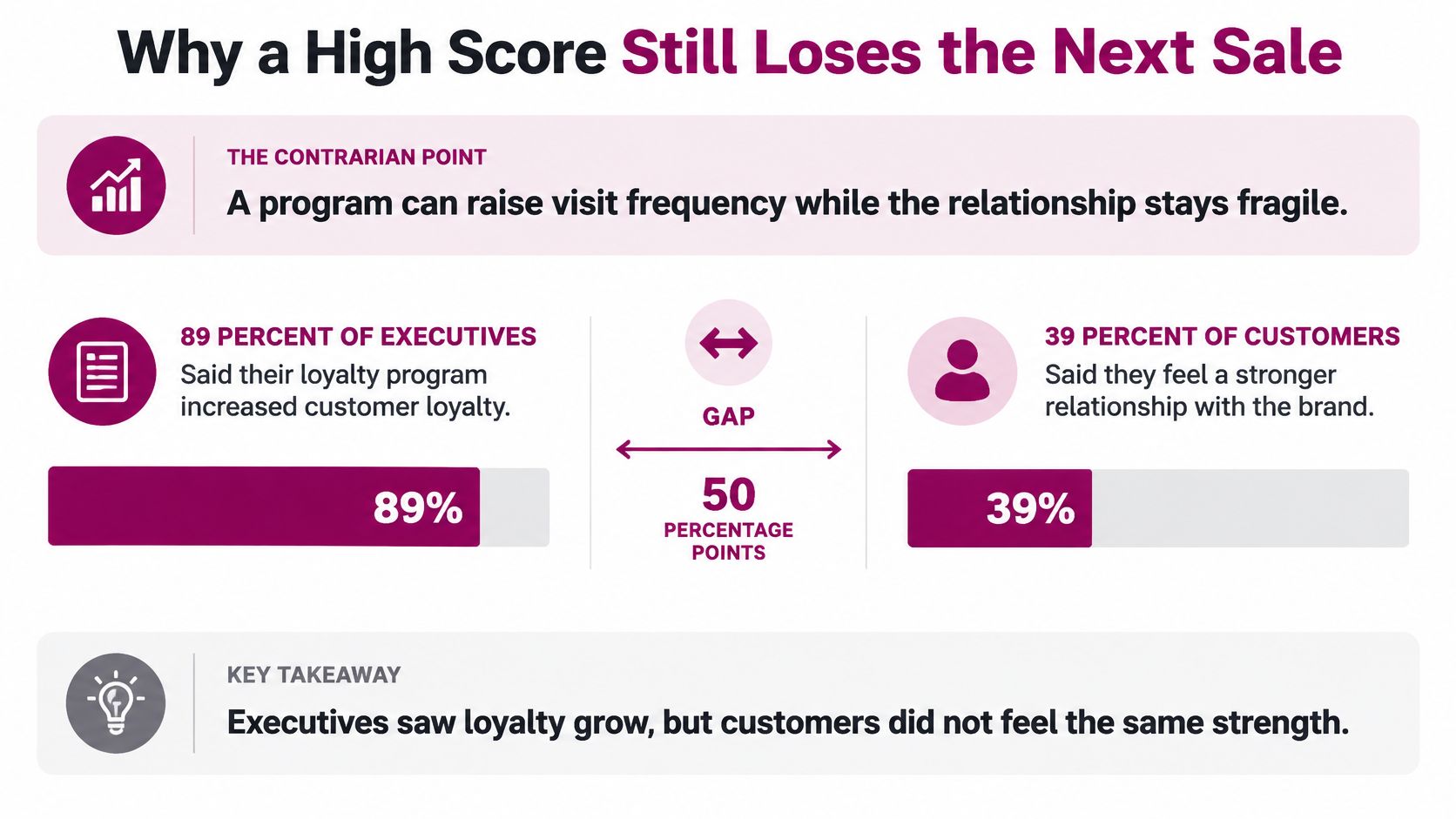
PwC's 2025 customer experience survey found that 89% of executives believed customer loyalty had grown, while only 39% of consumers agreed. In the same survey, 52% of consumers said they had stopped buying because of a bad product or service experience, and 29% stopped because of poor online or in-person customer experience. Points and stamps don't repair that. They sit on top of the experience, and when the experience cracks, they crack with it.
| Signal | Type | What to watch | What a weak result means |
|---|---|---|---|
| Return after a bad visit | Behavioral | Comes back inside their normal gap after a delay, stockout, or poor visit | The relationship did not survive the failure |
| Redemption | Behavioral | Rewards used, not only issued | Enrollment without use |
| Inactivity | Behavioral | No visit inside the customer's usual cycle | Silent loss before a formal cancel |
| Churn | Behavioral | Stopped buying | The relationship is already gone |
| Recommendation | Attitudinal | NPS or an unprompted review | They may like you and still not return |
| Forgiveness after a fix | Attitudinal | Returns once the complaint was acknowledged and the experience changed | A discount was used instead of a repair |
The measure that matters most in that table is loyalty resilience, whether the guest returns after a late order, a sold-out item, a billing error, or a disappointing visit. Behavioral signs like repeat visits, redemption, inactivity, and churn tell you what happened. Attitudinal signs like trust and willingness to forgive tell you what's likely to happen next.
Recovery beats a richer reward here. Sogolytics reported that 53% of customers who saw clear improvements after giving feedback described themselves as very loyal, compared with only 30% among customers who saw no change. A customer who complains and watches you fix the problem has evidence you listen. A customer who gets a bigger discount has evidence you're cheaper this week.
This short video is worth a watch before you redesign anything, because it reinforces how quickly a service failure, not a missing reward, decides the next sale.
Make returning easier, not leaving harder
Switching costs cut both ways. A meta-analysis covering 51 service industries found external switching costs had a stronger average effect on loyalty than internal ones, and later healthcare research found procedural switching costs had the largest impact and partly mediated the effects of satisfaction on loyalty.
For a merchant, positive continuity is saved progress, a recognizable reward, and a pass already on the customer's phone. Negative friction is a confusing sign-up, a hidden balance, or a redemption that needs a manager. Run one fair test if you're unsure which shape fits you: stamps versus points with the same reward value, then compare completion and repeat visits. Track pass use, redemption, inactive members, and churn after any reward change.
What Cafes Salons and Shops Should Watch
Every trade has the same three-part test. Name the satisfaction moment, the loyalty behavior, and the false signal that looks like loyalty but isn't. The pattern below applies it across five common scenes.
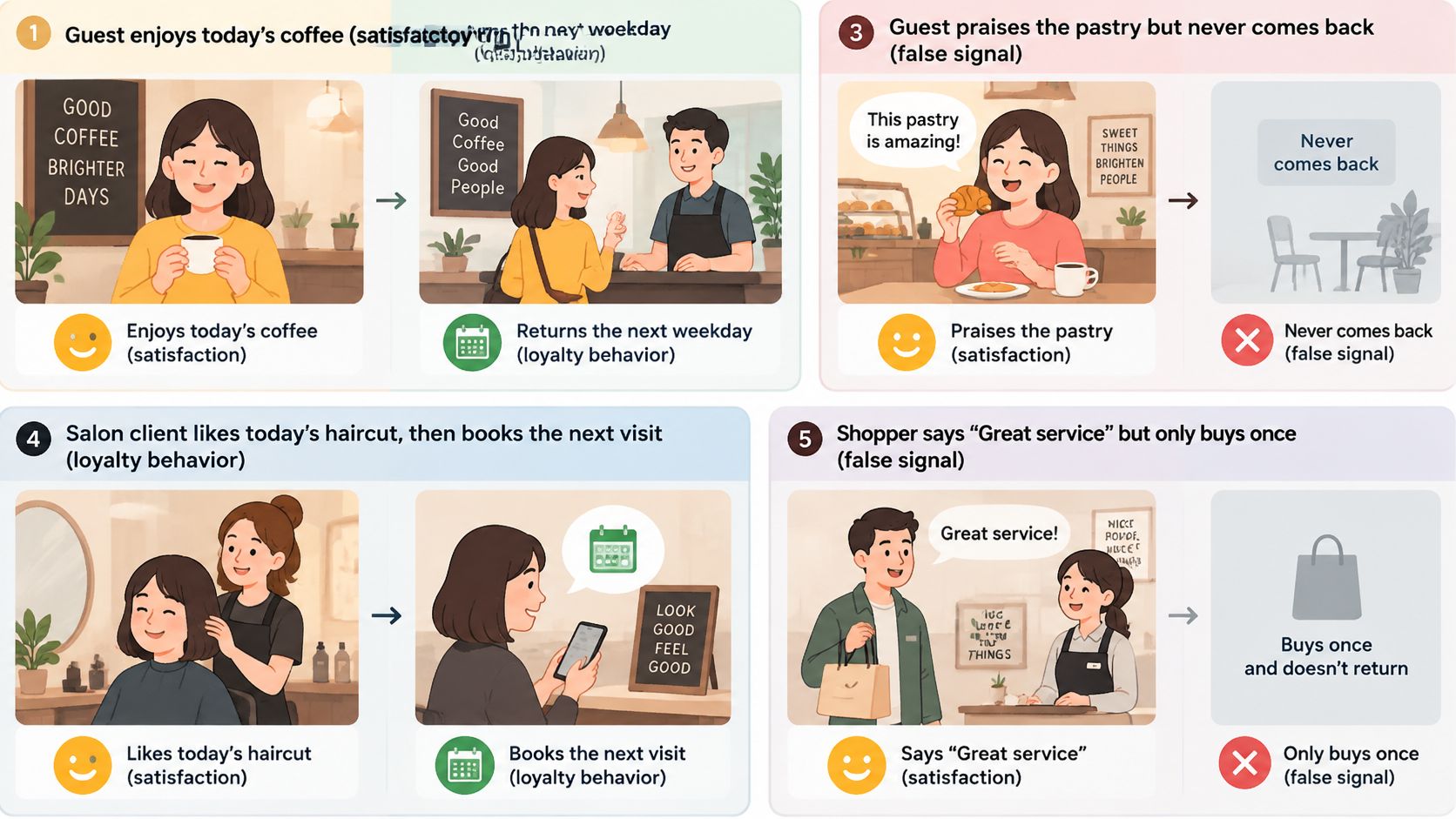
Cafe or bakery. The guest likes today's coffee. That's satisfaction. Loyalty is the next weekday morning, same time, same order. The false signal is a paper card left at home. It looks like a loyal customer who forgot her tally, but you have lost the record and she has lost her progress. A digital stamp for similar cups fits here, and a free tenth drink should be easy for the guest to see counting up.
Restaurant or takeaway. A praised Friday meal is satisfaction. Loyalty is next Friday's booking. The resilience test is a delayed order, and a voucher doesn't replace an apology plus a corrected ticket. Watch whether guests who waited too long book again within their usual gap. If they don't, your food scores are hiding a service problem.
Hair salon or spa. A loved cut is satisfaction. Rebooking the color cycle is loyalty. Points fit better than stamps when a full color service spends far more than a fringe trim, because a stamp treats both visits as equal when they aren't. The false signal is a client who books whoever is free. She's a regular at getting her hair done, not at your chair. A well-built beauty salon loyalty program should reward the rebooking at the chair, while the next appointment is still easy to say yes to.
Independent grocery or retail. A smooth checkout is satisfaction. Loyalty is the same basket returning next week. Saved progress toward a known reward beats a one-off percent off, because the discount is gone the moment it's spent while progress keeps pulling the next shop toward you.
Gym or studio. A good class is satisfaction. Loyalty is the next booked session, made before the membership starts feeling unused. The false signal is a paid-up member who hasn't attended in weeks. She's retained on paper and already gone in practice.
The edge cases that distort your numbers
A tourist who gives five stars and leaves town isn't a retention failure. Take her out of your repeat rate or she'll make a healthy local business look leaky. An Instagram or WhatsApp seller has no front door, so the repeat order is the only loyalty evidence there is, and a wallet pass still has to be obtainable without downloading a new app.
Match your loyalty behavior to your normal gap between visits, or you'll call slow customers lost and fast customers loyal for no reason.
Look at the five scenes and ask which one matches your average ticket and your usual gap between visits. That answer decides your behavior metric more than any score target.
Six Moves to Turn Satisfaction into Repeat Visits
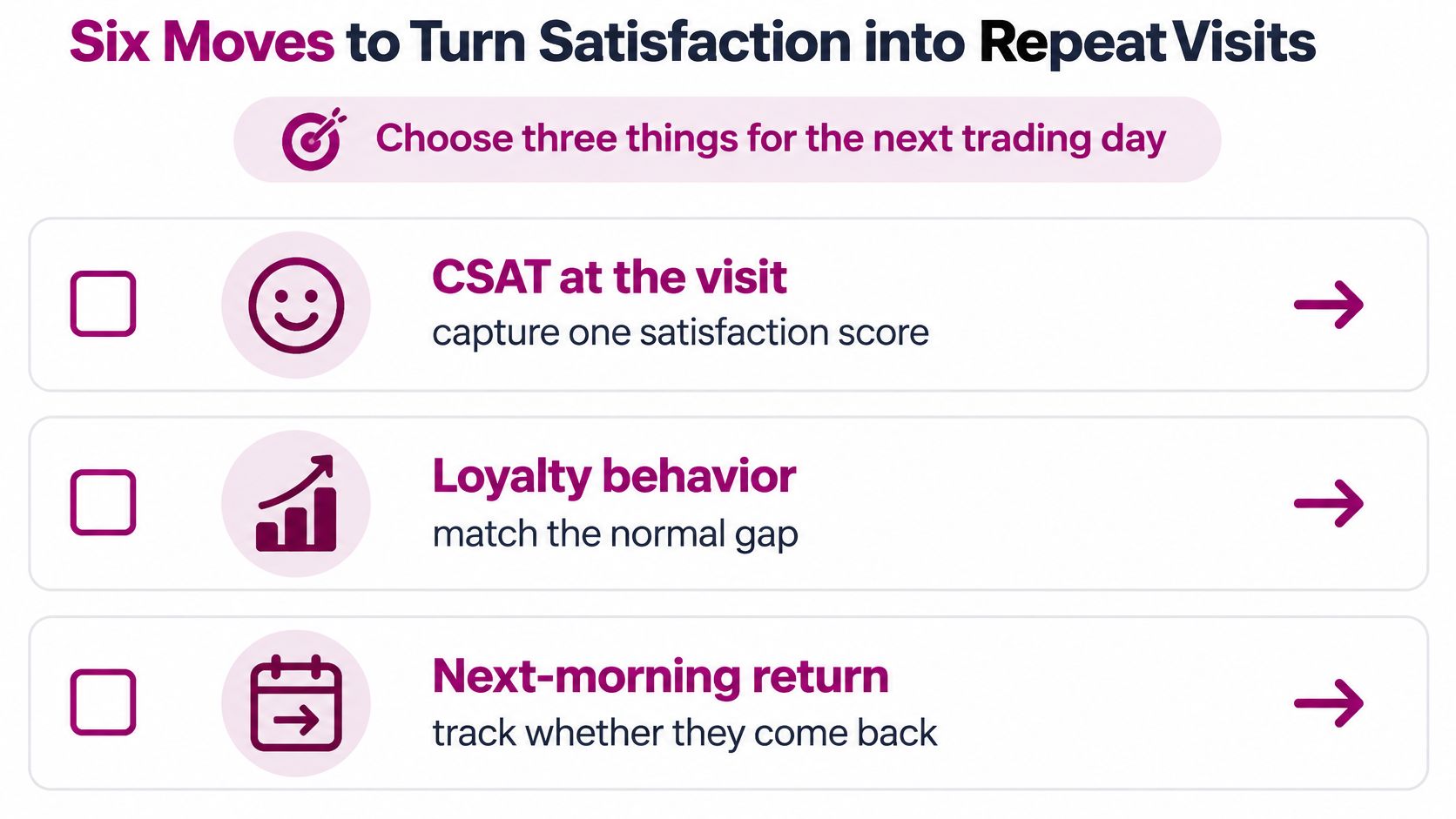
Choose three things for the next trading day. One satisfaction score taken at the visit, usually CSAT. One loyalty behavior matched to your normal gap, such as next-morning return for a cafe, a rebooked color for a salon, or the next class for a gym. And a program shape: stamps when most purchases look alike, points when spend varies.
Keep the design simple, because customers vote for simple. In 2024, 86% of consumers surveyed by Deloitte rated financial rewards, simplicity, and ease of use as important or very important loyalty-program attributes, in a Deloitte survey covering more than 9,800 consumers across multiple countries. A program nobody understands at the counter won't survive contact with a queue.
The six moves
Ask at the counter or in the chair. Put the satisfaction question where the visit just happened, not in an email a week later. A score collected late belongs to whatever the customer did since, not to your visit. The slip-up is asking five questions. Ask one, and you'll get an answer before the card machine beeps.
Pair every score with one behavior. For the same group of guests, ask one follow-up question: did they return inside their normal gap? I would start with this pairing before buying anything new, because it tells you whether you have a service problem or a return problem. Those need different fixes and different budgets.
Make the next reward visible and close. Progress toward a known prize pulls harder than a vague balance. "Two stamps to a free coffee" gives the next visit a job. "You have some points" doesn't. The common mistake is setting the first reward so far away that new members never reach it and stop collecting.
Cut the procedural cost. A pass already in Apple Wallet or Google Wallet, a balance the guest can see without asking, and redemption that takes seconds. Tooling matters for that reason. We run a digital points program or digital stamp card from a phone, with no hardware and no app for customers, businesses build their loyalty card in a few minutes, and the plan costs $12 per month or $120 per year and covers up to 100 customers. Whatever you use, the test is the same. If joining takes longer than paying, you've built friction, not loyalty.
When a visit fails, repair it in the open. Acknowledge what happened, fix it, and show what changed. Don't answer a bad experience with a bigger discount, because that teaches the customer the experience is worth less, not that it's now better. If you want ideas for rewards that support a recovery instead of replacing one, these customer incentives work best after the fix, not instead of it.
Review inactive members separately. People who joined and went quiet are a different problem from people who never joined, and they need a different response. A short, specific nudge tied to their saved progress beats a generic blast. And when you compare stamps with points, hold the reward value constant, or you'll end up measuring generosity instead of design.
The weekly check
Once a week, look at three numbers for the same people. Satisfaction from recent visits. The repeat rate of those same guests inside their normal gap. And redemption of the reward they were promised. If satisfaction is high and repeats are flat, work on the reason to return. If repeats are fine and redemption is low, your reward is invisible or too far away. If both drop after a service change, stop touching the program and fix the visit.
Judge every choice by whether satisfied guests return, redeem, and come back after a miss. Not by how many people join. A member list is easy to grow and almost useless as proof. A guest who walks past your competitors next Tuesday is the only proof that counts.
If your scores look healthy but your regulars keep drifting, put a simple points or stamp program in place that makes progress visible and redemption effortless, then judge it by repeat visits instead of sign-ups. Loyal Customer lets you run that program from your phone with wallet-ready cards your customers already know how to use, so you can start connecting a good visit to the next one this week.