American shoppers belonged to an average of 17.9 loyalty-program memberships in 2023, up from 14.8 in 2019, a 21% rise in four years. Only about half of those memberships were active, according to eMarketer's look at loyalty membership. A card that never gets opened doesn't buy you another visit.
A loyalty rewards program for small business has to earn a slot on that crowded phone. For a café, salon, bakery, or independent shop, the useful version is short, visible, and cheap enough that the extra visits still leave margin. Price every reward as a cost line. Treat the wallet pass as a privacy, consent, and recovery decision you own, not as a free digital sticker.
Table of Contents
- Why Small Merchants Are Adding Loyalty Programs Now
- Choosing Between Stamps, Points and Wallet Passes
- Reward Costs and How to Keep Margin Intact
- How to Set Up a Program in Six Steps
- Enrolling Customers Without Losing Their Trust
- Metrics That Show Whether the Program Pays
- Run a 60-Day Test Before Scaling Your Program
Why Small Merchants Are Adding Loyalty Programs Now
In 2025, 73.2% of surveyed U.S. micro and small businesses operated without a formal loyalty program, according to SumUp's survey of 617 business owners. A simple program is still a real differentiator, because most neighboring shops haven't built one.
Think of it as the regular's tab at a neighborhood pub, written down so every visit is remembered. The bartender used to keep that tab in their head. A stamp, a point, or a pass lets a new staff member honor it on a Tuesday morning.
Four results are worth paying for:
- More visits from people who already know you: You're asking a proven buyer to return, not paying to introduce the shop.
- A reason to come back on a quiet weekday: An off-peak visit still counts, so slow hours get a pull without a blanket discount.
- A record of who buys what: You can aim a short offer at people who already purchase, instead of blasting strangers.
- A reward for regulars without ad spend: The cost sits in product or a perk, not in a campaign to find new names.
Cafés, salons, bakeries, gyms, and independent retailers gain the most. Their cycle runs in days or weeks, and the same person can return often. A program will not rescue a weak product, slow service, or an unclear price. If the flat white changes every shift, a free tenth drink just funds another disappointment.
Practical rule: Launch only if repeat customers already exist, the purchase cycle runs from days to weeks, and the margin on each sale can fund a reward.
The choices that decide whether it pays are the model, the cost of each reward, the launch, and the numbers you check afterward.
Choosing Between Stamps, Points and Wallet Passes
| Model | How customers earn | Best fit | Reward flexibility | Main weakness |
|---|---|---|---|---|
| Digital stamp card | One stamp per visit or qualifying purchase, reward after a set count | Cafes, bakeries and barbershops with uniform tickets | Low: one fixed reward | Ignores the size of each purchase |
| Points program | Points per amount spent, such as 1 point per $1 | Restaurants, salons and retailers with varied baskets | High: tiers, add-ons and any reward value | Needs clear point values and balance tracking |
| Wallet-native pass (points or stamps) | Same rules as the underlying model, stored in Apple Wallet or Google Wallet | Merchants with phone-first customers and no budget for a separate app | Same as the underlying model | Customers on unsupported devices need a fallback |
| Paper punch card | One punch per visit | Very small counter services with no technology budget | Low: one fixed reward | Lost or forged cards, over-punching by staff, no customer data |
Stamps count visits. Points count money spent. A wallet pass is the carrier that holds either one. It isn't a third earning model.
When stamps beat points
If every visit is roughly the same transaction, use stamps. A bakery selling a similar pastry and coffee each morning doesn't need to price every dollar. One stamp per paid visit, a reward after a fixed count, and the customer can see the finish line.
If basket size swings, use points. A restaurant check of $18 and a check of $64 shouldn't earn the same prize. One point per dollar, with a published value, keeps the reward proportional to what was spent. If you want tiers or a choice of perks, stay on points, and add tiers only after the base earn rate is stable. Copying a competitor's model fails when your ticket is different from theirs.
Why the pass has to work at the till
A survey of 1,500 U.S. loyalty-program members found that 92% belonged to between 1 and 20 programs, and 94.4% said they would use a mobile wallet more frequently if they could earn or redeem points or miles with purchases, reported in The State of Mobile Wallet Loyalty and Engagement. That same research found 33% of surveyed smartphone users had used wallets for non-payment functions such as coupons or loyalty-card storage, while only 19% had noticed retailers using wallets for offers or loyalty programs.
A pass already sitting in Apple Wallet or Google Wallet competes better than another app nobody opens. Show the current balance, state the redemption rule in one sentence, and update the pass after each qualifying sale. Use one identity key per customer. Log issuance, activation, balance changes, redemptions, and pass removal, then match redemptions to sales so a duplicate claim shows up.
Wallet reach isn't proof the program works. Judge incremental margin per active pass against customers with no pass, or against a paper-only offer. Check Apple Wallet and Google Wallet separately on device mix, activation, active-pass rate, redemption, and repeat-purchase lift.
Paper is the cheapest start. Lost, forged, or over-punched cards cause most disputes, and a paper card leaves you with no customer record.
Reward Costs and How to Keep Margin Intact
These figures are a worked example, not a price list. Swap in your own ticket, product cost, and earn rate before you print a rule.
| Business | Typical spend | Example reward | Cost to you | Spend per reward |
|---|---|---|---|---|
| Coffee shop | $4.50 per drink | Free drink after 10 stamps | $1.35 product cost | $45 |
| Salon | $60 per visit | $10 credit after 5 visits | $10 | $300 |
| Restaurant | $25 per check | 250 points worth $10, at 1 point per $1 | $10 per redemption | $250 at 1 point per $1 |
| Independent grocery | $30 per basket | 5% points back | $1.50 per basket | $30 per basket |
Three drivers sit under those lines, and generic "10% off" advice usually skips them.
Breakage is rewards that are earned and never used. A high unused share makes the program look cheap on paper and useless to the guest. Redemption timing is how long after earning the reward gets used. A credit cashed the same week hits cash harder than one spread over a month. Incremental versus existing purchases asks how many redeemed rewards would have been bought at full price anyway. If your Tuesday regular was coming regardless, the free drink is a discount on a sale you already had.
In the 2025 Global Customer Loyalty Report, 69.8% of global loyalty members join to earn rewards, discounts, or cashback, and 81.2% prefer brands that let them customize rewards, while only 49.2% of program owners currently offer that customization. Letting someone pick among two or three perks creates relevance without a long profile. That same report notes that only 58% of consumers in one 2025 study agreed loyalty data was used responsibly, so a short menu of choices beats a questionnaire.
Three questions merchants actually ask
A coffee shop with uniform tickets should use stamps. A free drink after a set count is easier to explain than tiers, and the cost line above is one product, not a percentage off every cup.
A salon should not put a discount on the next full-price appointment. That trains clients to wait. Offer priority booking or an add-on, such as a treatment upgrade, so the visit still happens at the normal price.
A redemption rate is financially safe when expected reward cost per member stays below that member's extra margin in the test period. There isn't a universal safe percentage. If you can't name the cost of one redemption, you aren't ready to promote it. Compare that cost with the ideas in this guide to incentives for customers, then test one reward against a control period before you scale it. I would start with an add-on, an upgrade, or off-peak priority, not a permanent percentage off the menu.
How to Set Up a Program in Six Steps
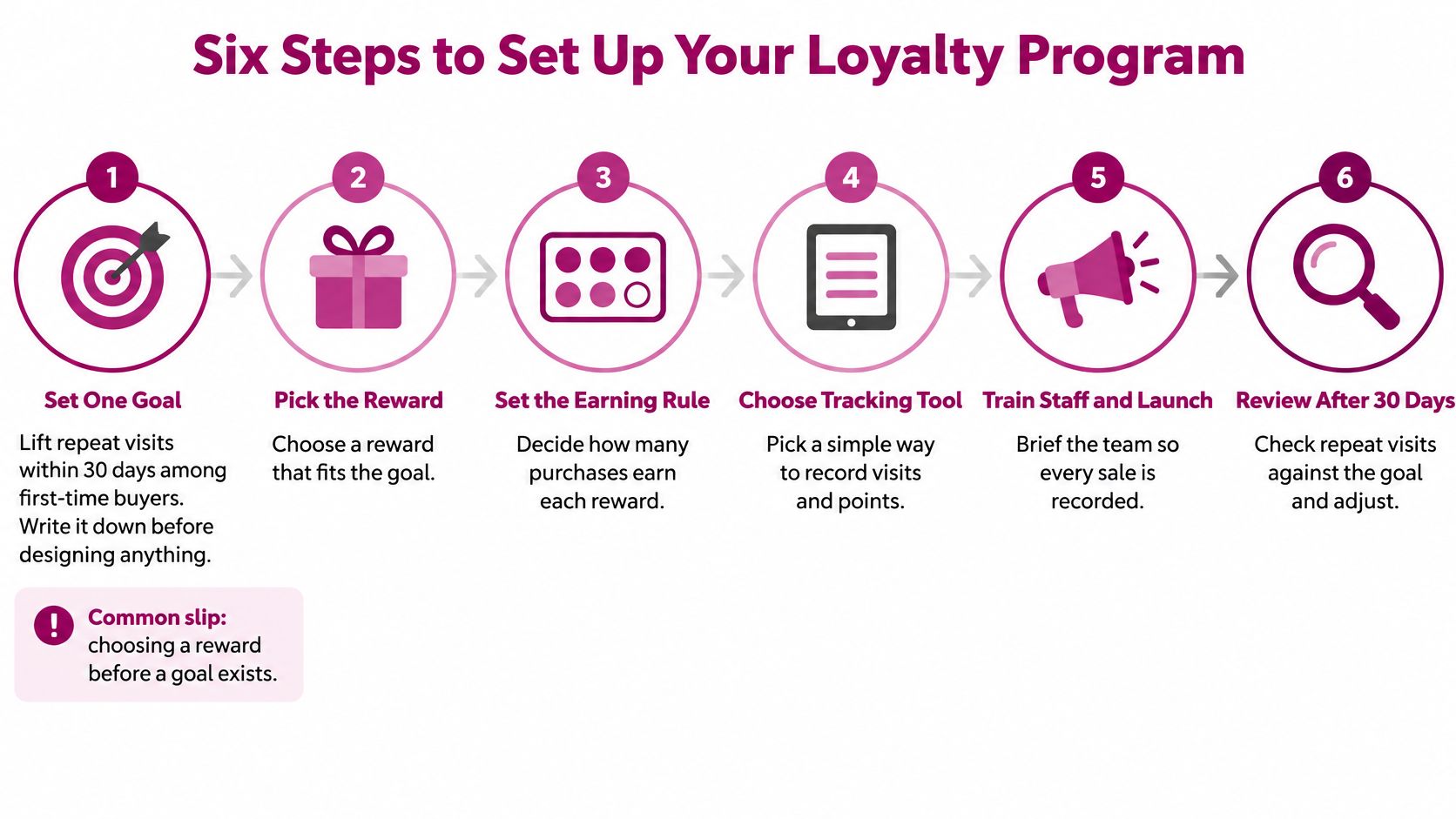
Build one loop you can explain at the counter. A digital punch card for small business is one way to hold stamps without paper, but the sequence below is the same whether you use stamps or points.
- Set one goal before any reward. Write a single line, such as more repeat visits within 30 days among first-time buyers. The usual slip is picking a free item because it sounds generous, then discovering it doesn't match the behavior you needed.
- Pick the model from your ticket, not from a neighbor. Uniform visits point to stamps. Wide baskets point to points. Copying the café next door fails when your checks vary and theirs don't.
- Price one reward at your cost, not the menu price. Set the threshold on a real cycle. About 8 to 10 visits fits a weekly coffee buyer. About 3 to 5 visits fits a salon client who returns every six weeks. A threshold nobody reaches is a poster, not a program.
- Build the pass with only what the till needs. Program name, logo, the reward rule in one sentence, the current balance, and one field that lets staff recognize the customer. Asking for a birthday and a home address at sign-up is the slip that kills completion.
- Train a ten-second script. Cover how to add a stamp or points, how to redeem, and what to do when the phone is dead. The slip is a beautiful pass with no redemption step at the till, so staff guess.
- Soft-launch to regulars for two weeks. Fix the confusion they report, then put a sign at the counter. Launching with no staff briefing means the first ten guests get ten different explanations.
On day one a working setup is one reward, one threshold, one pass, and a staff member who can explain all three before the card machine finishes.
Keep prices and service the same during launch. If you change the menu and the program in the same week, you won't know which one moved visits.
Enrolling Customers Without Losing Their Trust
A loyalty sign-up should make the value clear and the data request easy to understand. 53% of consumers say sharing personal information is worthwhile when it makes brand interactions smoother, while 93% say mishandling that data causes a brand to lose their trust, according to PwC's 2025 customer experience survey. Many shoppers are wary of how retailers use personal information, yet still join when the value is clear. A careless handoff of their details can undermine that trust.
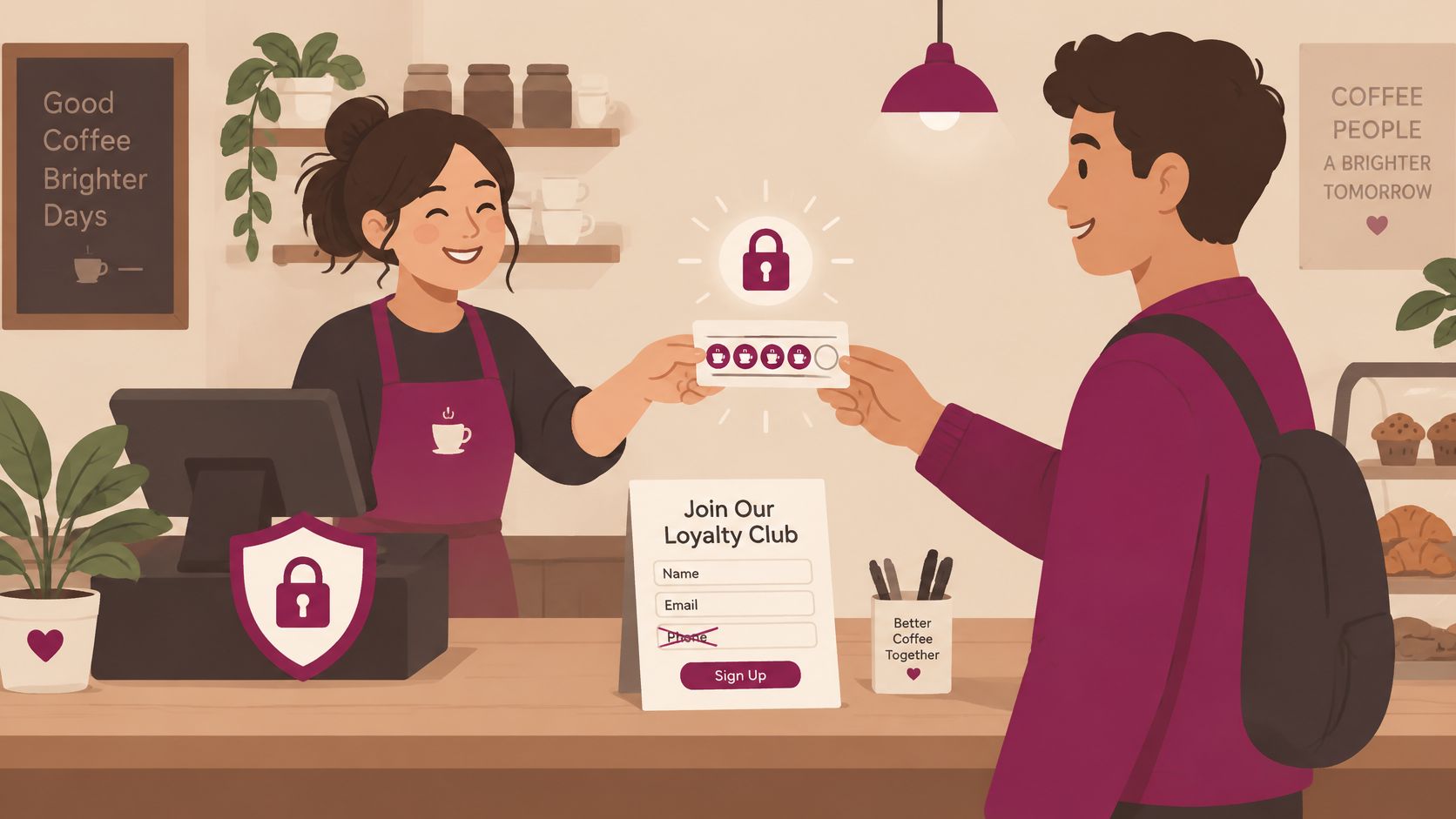
A wallet pass avoids an app download, but it does not explain what a customer is consenting to or what happens if their phone is lost. Keep a printed card or code available for customers who do not use a wallet or have an older device.
Questions to settle before the first sign-up
Can a customer join with a wallet pass and no account? Yes. Tie the pass to a phone number or card number the customer can show at the counter. A stamp card does not need a password.
What happens when a phone is lost or replaced? Let staff re-issue the pass after checking the phone number or name on the record. Explain the recovery process at sign-up, so customers know how to regain access.
Can staff identify someone without a phone number? Offer a printed card number or QR code. Customers who prefer not to share a number can still collect and use rewards.
How do you handle consent, deletion, and history? Ask only for what the program needs, such as a name or nickname and one contact field. Explain in plain language what you store and why, and give customers a simple way to request deletion or check reward history. A birthday adds no value if the program only needs to track coffee visits.
Staff should be able to enroll customers who avoid apps or use older phones. Take a name, issue a fallback card or code, and explain the same reward rule shown on the wallet pass. If the customer later wants the wallet version, attach it to the existing record rather than starting over. That gives people a choice while keeping the program focused on the information needed to run it.
Metrics That Show Whether the Program Pays
Registrations are vanity. These six checks tell you whether the program earns its keep. Run the sums in a loyalty program ROI calculator once you have a month of real visits, not before.
| Metric | What it tells you | How to calculate | Check at |
|---|---|---|---|
| Activation rate | Share of issued passes that customers actually add or use | Activated passes divided by passes issued | 30 days |
| Time to first reward | How fast customers see value from joining | Days from first visit to first reward | 60 days |
| Repeat-purchase interval | The rhythm of return visits | Average days between member visits | Monthly |
| Redemption rate | Whether rewards motivate action | Redeemed rewards divided by earned rewards | Monthly |
| 30/60/90-day retention | Whether a sign-up cohort keeps returning | Cohort members active in the window divided by cohort size | 90 days |
| Incremental margin per member | The economic result after rewards and costs | Member gross profit minus reward and program costs, compared with a control group | Quarterly |
The chain is short. A reward triggers a repeat visit. Repeat visits raise how often someone buys. Higher frequency adds lifetime margin, and that margin has to cover the program. Model customer lifetime value as contribution margin per transaction times expected transactions, minus program costs. Research on loyalty-program outcomes treats repeat-purchase behavior, how long the relationship lasts, and share of wallet as the core results, with lifetime value as the net profit from that customer.
The self-selection trap
Frequent buyers join first. If you compare "members" with "everyone else" and stop there, you'll credit the program for habits that existed before the pass. Set the stamp or point threshold on a realistic short cycle, then compare enrolled customers with a non-enrolled group or a pre-launch baseline, using cohorts.
A fair test randomizes the sign-up incentive, the reward threshold, or who gets invited, while prices and service stay constant. The program is positive only when extra gross profit from additional visits and basket margin beats reward liability, discounts, pass issuance, staff time, and any messaging cost. That test fits a café, a salon, a bakery, a fitness studio, or an independent retailer, because it scores behavior and unit economics, not a headline revenue number.
Run a 60-Day Test Before Scaling Your Program
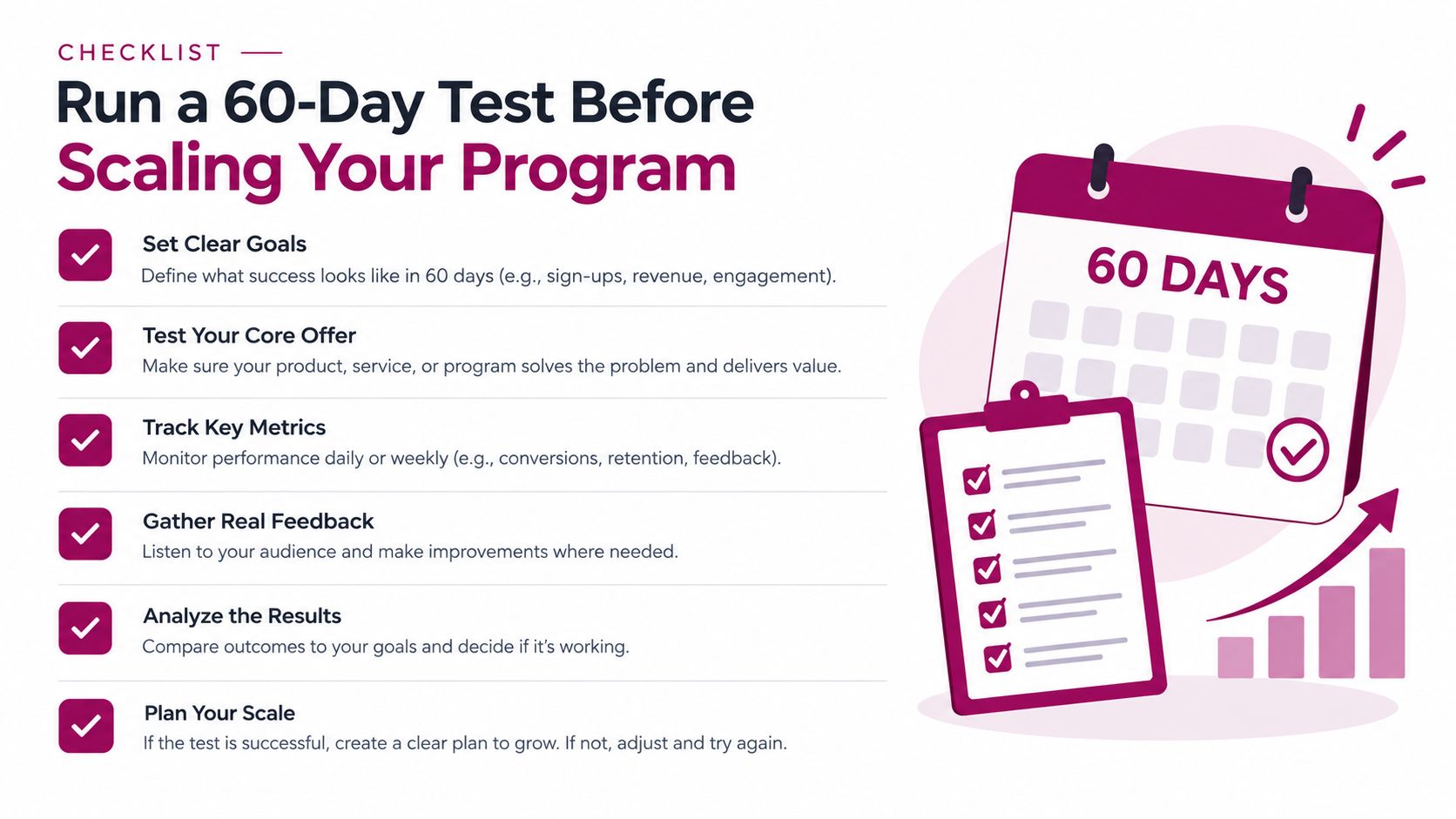
You've already chosen the model, the reward, and the pass. This window only tests that setup.
Split regulars at random into a pass group and a no-pass control. If a split isn't practical, compare the 60 days after launch with the 60 days before, and keep prices and service identical. Each week, match redemptions to sales records so duplicate or false claims show up early. Watch activation and the gap between visits as early warnings. Judge activation at 30 days. Judge margin per member only at the 60-day close.
Apply one rule.
- Go: Keep it if margin per member is positive after reward and program costs, and activation is steady.
- Adjust: If the result is flat, change one variable only, the threshold or the reward, and run it again.
- Stop: End it if reward cost exceeds the margin from the extra visits it produced.
Loyal Customer lets a shop run points or a digital stamp card from a phone and issue Apple Wallet and Google Wallet passes, so this test doesn't need a separate app. Confirm trial terms with the provider before you start. Once the test is positive, the next question is whether to add tiers, and you answer that with the same control-group method.
Loyal Customer gives cafés, salons, restaurants, and other small shops a phone-based way to run points or digital stamps and put the pass in Apple Wallet or Google Wallet. If you're ready to price one reward, issue one pass, and test it for 60 days, start with Loyal Customer.