You're wiping down the counter at close, looking at a quieter Tuesday than you used to get, and wondering where two or three regulars went. You don't need a chain sized marketing department. You need a cheap, honest test: will a simple reason to return bring people back sooner, and will it do so without giving away your margin?
That's what a free loyalty program for small business should be. It's not a brand campaign and it's not a discount habit. It's a way to measure one behavior, usually a repeat visit, before you pay for software, scanners, or integrations you may never need.
Table of Contents
- Why Small Businesses Are Testing Free Loyalty Programs Now
- What a Free Loyalty Program Actually Includes
- The Adoption Gap Most Small Businesses Miss
- Points Versus Stamps and Which Fits Your Business
- Why Wallet Passes Beat Standalone Loyalty Apps
- What 'Free' Really Costs and How to Budget the Reward
- Setting Up Your Free Program From a Phone in One Afternoon
- Measuring What Changed and Knowing When to Upgrade
Why Small Businesses Are Testing Free Loyalty Programs Now
Most owners I know didn't reject loyalty. They postponed it. The till was busy, paper punch cards worked after a fashion, and every software pitch sounded like a monthly bill plus training plus a terminal nobody wanted.
Then the pattern changed. A regular who came twice a week started coming once. A salon client stretched appointments. A takeaway customer ordered from whoever showed up first on their phone. Replacing those visits costs time and advertising, while keeping an existing customer mostly requires a visible, easy reason to choose you again.
Test Behavior, Not Affection
Launch loyalty to change what customers do, not to prove they love you. A meta-analysis covering 429 effect sizes from loyalty program studies published between 1990 and 2020 found strong evidence that programs improve behavioral loyalty, while changes in attitudinal loyalty are harder to achieve. That distinction matters for a small shop.
Pick one target before you enroll anyone. A second visit within a defined window, a completed stamp card, or a steadier appointment interval works. If you can't state the behavior in one sentence, you'll end up celebrating sign ups while the till tells a different story.
Enrollments are not results. A customer who joins and never returns has only added a name to your list.
A free, phone based program lowers the cost of that test. You can run it from the phone already at the counter, skip dedicated hardware, and learn whether customers respond to visits or spend. You'll also learn practical things vendors gloss over, such as whether staff offer enrollment during a rush and whether customers understand the reward without a speech.
Start with the smallest version you can launch this month. Keep the reward concrete, keep the balance visible, and keep redemption boringly simple. If customers have to ask how it works twice, the design is too clever.
The question isn't whether loyalty belongs in a small business. It's whether your specific customers change their visit pattern when you give them a clear, reachable incentive. A free tier lets you answer that question before loyalty becomes another fixed cost you defend out of habit.
What a Free Loyalty Program Actually Includes
Free means the software bill starts at zero. It doesn't mean the program costs nothing, and it doesn't always mean free forever. Read the tier like you'd read a lease, because the limit that matters usually appears after you've enrolled your best customers.
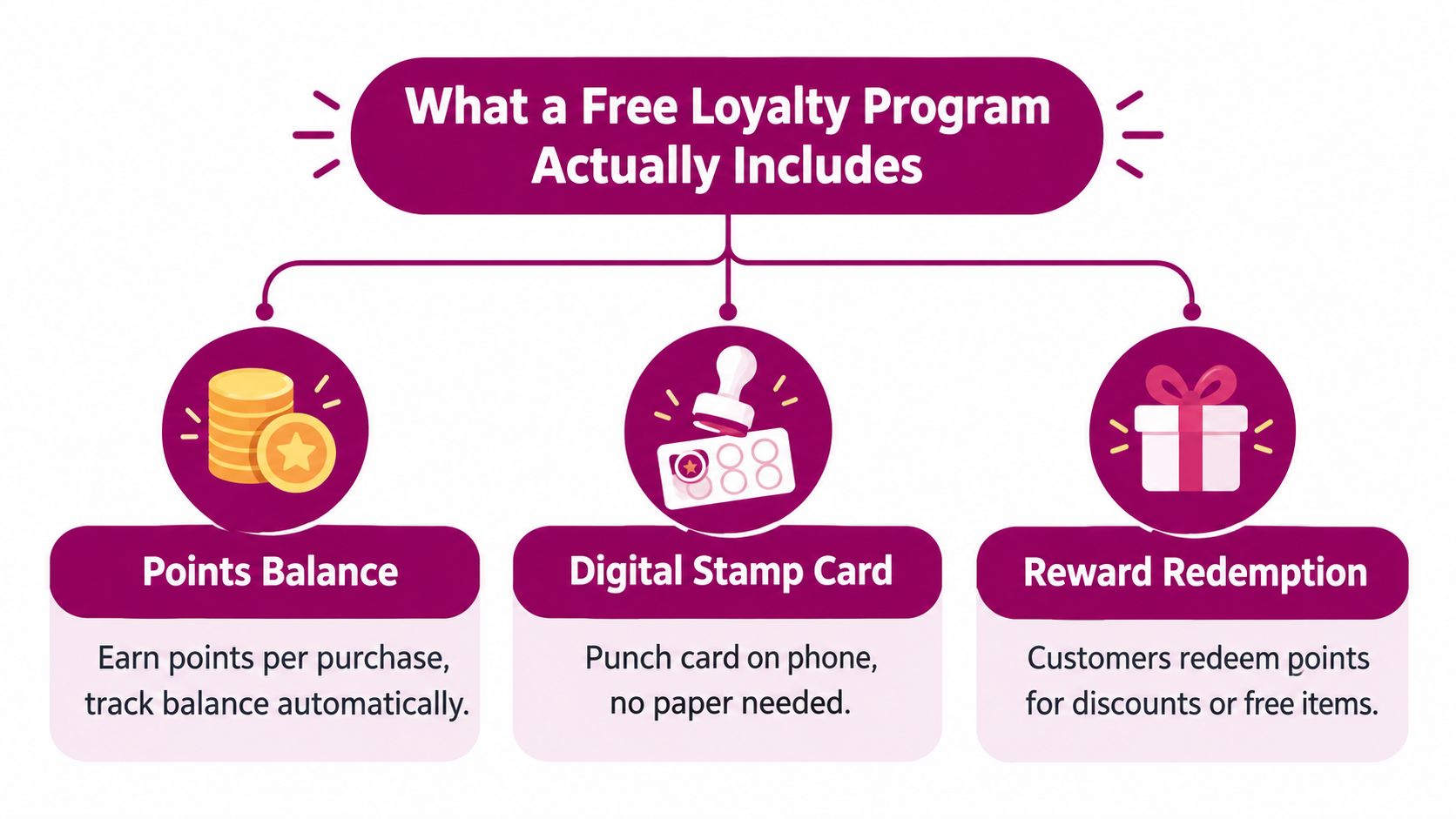
The Three Building Blocks
- Points balance: Customers earn points on qualifying purchases, watch the balance grow, and redeem points for a discount or item. This suits baskets that vary, because earning can scale with spend or selected products.
- Digital stamp card: One qualifying transaction adds one stamp, and a full card grants the reward. It's the paper punch card without printing, lost cards, or staff hunting for a pen.
- Wallet pass: The card sits in Apple Wallet or Google Wallet, so the customer doesn't install your app to participate. You issue, update, and redeem from your side, while they present a pass they already know how to open.
A useful free tier includes enrollment, balance tracking, stamp or point issuance, and redemption. A trial may show you more, including campaigns or deeper reporting, then remove those features when the clock runs out. Don't build your launch process around a feature you won't keep.
Watch for quieter costs. Some offers are free until a customer limit, some are only a timed trial, and some keep the core card free while charging for messages, extra locations, extra card designs, or premium branding. Per customer and per message charges can turn a cheap test into a variable bill you didn't forecast.
Practical rule: If you can't explain what triggers the first charge, you haven't found a free plan yet. You've found a delayed invoice.
Phone based administration is the operational difference that matters most for independents. Traditional POS integrated loyalty can automate earning at checkout, but it ties you to that till, that contract, and that setup. A mobile first system lets an owner configure the program, scan or look up a customer, add a stamp, and redeem a reward without adding a scanner or replacing a working POS.
That trade off is honest. You give up some automation and gain speed, portability, and a much lower cost to prove demand. For a cafe, salon, bakery, or independent retailer testing its first program, that's usually the right exchange.
The Adoption Gap Most Small Businesses Miss
Your competitors probably talk about retention more than they practice it. A 2026 SumUp survey of 617 micro and small business owners found 73.2% operated without a formal loyalty program. That's not a crowded field. It's an opening, provided you don't copy the vague approach that made others quit.
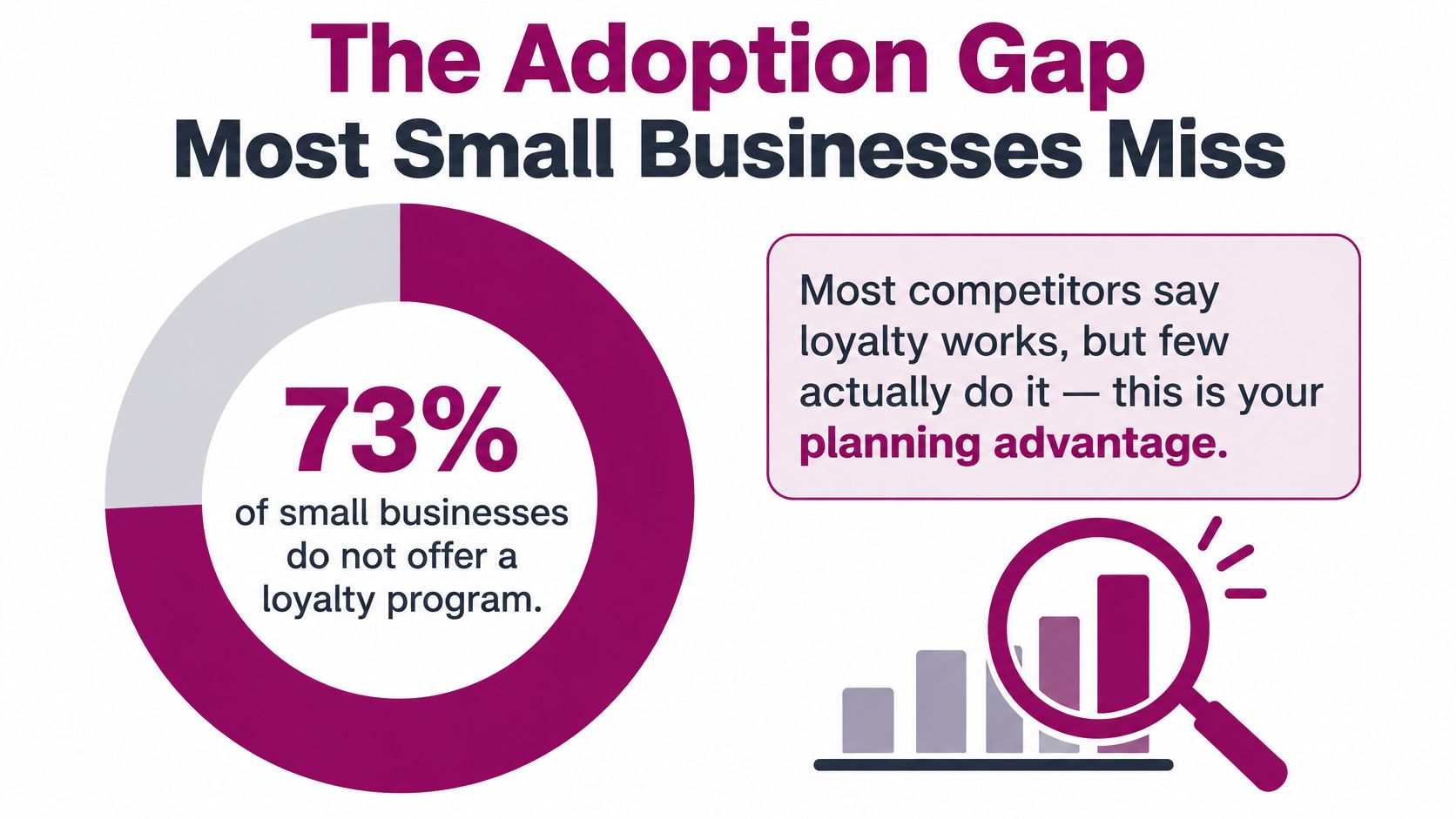
The same survey gives you a reason to test, not a promise. Among businesses that invested in retention, 69.1% reported a major or moderate increase in sales, using that same SumUp survey. Treat that as reported experience, not proof your program will lift sales automatically. Design and staff follow through decide whether you join that group.
Why Owners Haven't Started
Barriers explain more than disinterest. In the SumUp survey, 26.9% of quick service restaurants said they lacked knowledge about how to implement a program. Among service providers, 26.8% considered loyalty programs irrelevant to their business model.
Those are different problems. The first group needs a simple starting point, not an enterprise demo. The second group may be imagining points at a grocery checkout when their real opportunity is steadier rebooking or a reward tied to a service bundle.
Customers create the second trap. A 2023 Publicis Sapient survey of more than 6,700 consumers found participants belonged to an average of 6 programs but actively used only 3. That 50% gap between membership and active use comes from the same Publicis Sapient survey.
So your planning advantage isn't merely launching before the shop down the street. It's launching something easy enough to enter the customer's active set. Put the pass where they already keep cards, show the balance without a login hunt, and make the next reward obvious at checkout.
Most small businesses haven't formalized retention. Most customers won't actively use another complicated membership. The business that connects those two facts, with a small program customers use, gets the advantage.
Points Versus Stamps and Which Fits Your Business
Don't start by asking which model sounds modern. Start by looking at your till receipts. If most transactions are similar and your goal is another visit, stamps usually win. If one customer spends a little and the next buys a full basket or premium service, points give you a fairer way to reward value.
A digital stamp card earns one stamp for one qualifying transaction. Customers understand it instantly, staff can explain it in seconds, and the finish line stays visible. It breaks down when a tiny purchase earns the same stamp as a large one, unless you set a sensible qualifying rule.
Points can scale with spend or selected products, which helps salons, takeaways, and retailers with uneven baskets. The cost is comprehension. If customers can't convert points into a real benefit in their heads, they'll ignore the balance. I've seen elegant points schemes fail because nobody at the counter could answer what the points were worth.
Choosing Between Points and Digital Stamps
| Business Signal | Better Fit | Why It Wins | Where It Breaks Down |
|---|---|---|---|
| Similar ticket, frequent visits | Stamps | One visit moves the customer visibly closer | Small purchases may earn too much progress |
| Wide variation in basket value | Points | Higher spend can earn proportionally more | Customers may not understand point value |
| Infrequent, higher value services | Points | Progress can accumulate across different services | Slow earning can feel distant |
| Mixed products with a hero item | Hybrid approach | Stamps drive visits while points reward add ons | Two rules can confuse staff and customers |
Cafes and coffee shops usually fit stamps because the desired behavior is visit repetition. Bakeries often sit in the middle, since a daily loaf buyer and a weekend cake buyer shouldn't necessarily progress at the same rate. Salons and takeaways often need points because service and order values swing widely.
Read the detailed points versus stamps loyalty comparison if your basket sits between those patterns. Then pick one model for launch. Testing both at once splits staff attention and muddies your results.
My recommendation is simple. Choose stamps when the visit is the unit you want more of. Choose points when spend is the unit you need to protect. Complexity can come later, after customers prove they'll participate in the basic version.
Why Wallet Passes Beat Standalone Loyalty Apps
Your customer doesn't want another app for a coffee, haircut, or sandwich. I wouldn't install one either. Every extra download, password, and update prompt at checkout gives a busy person a polite reason to say they'll join next time, then forget.
The image below shows the simpler path, adding a pass to a wallet the customer already uses.
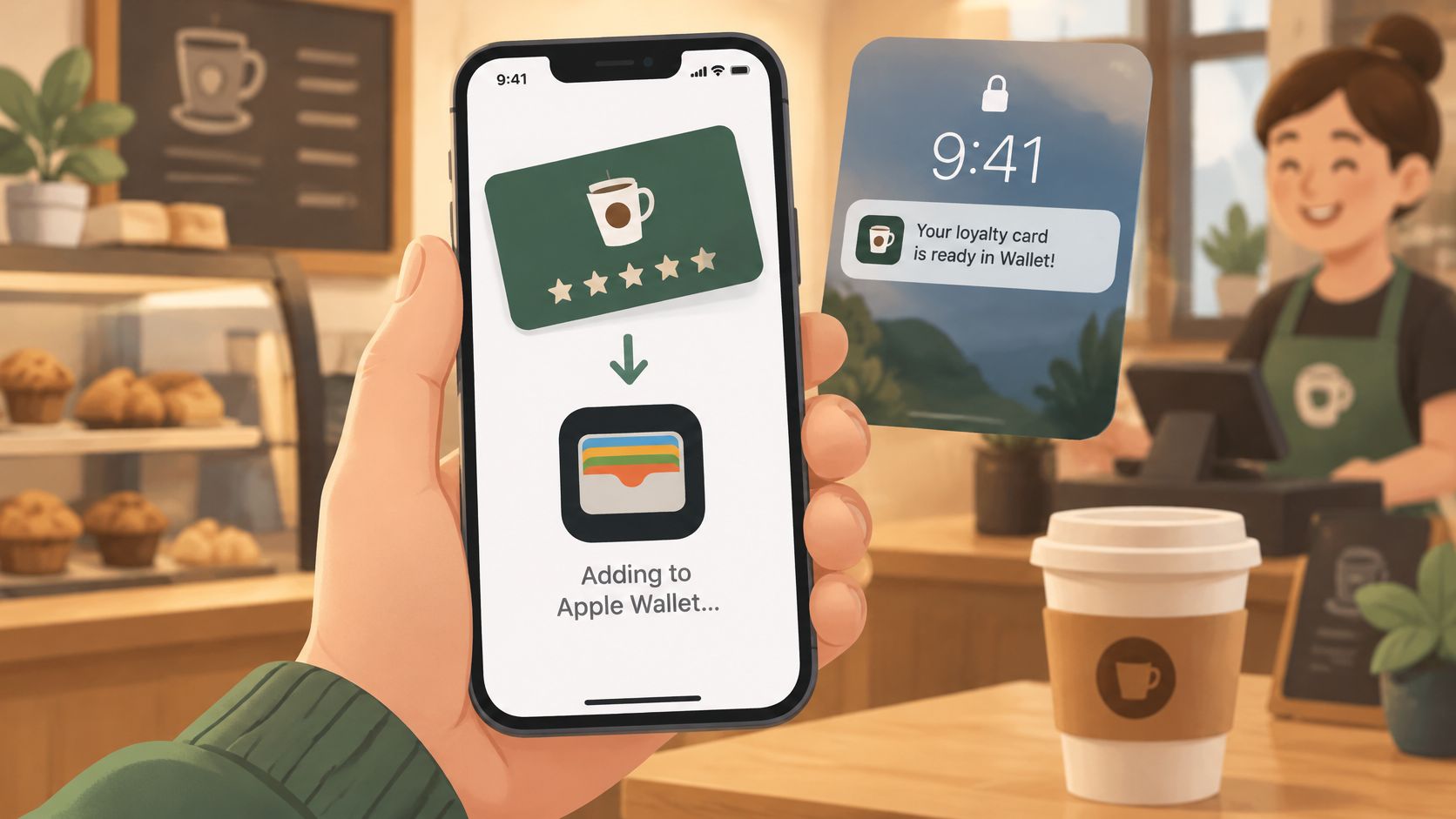
A wallet pass persists on the phone, can surface when needed, and keeps the balance where customers already store payment and travel cards. You don't maintain separate iOS and Android apps, and your staff don't troubleshoot forgotten passwords while a queue forms.
Cover Both Ecosystems
Support both wallets unless you enjoy excluding paying customers. Independent estimates put U.S. active users at approximately 65.6 million for Apple Pay and 35 million for Google Wallet in 2025, as reported in the mobile wallet research summary. A single ecosystem strategy leaves a large part of your counter traffic with a worse enrollment path.
Operationally, wallet native delivery changes the job at the till. You issue a pass, add stamps or points from your phone, and redeem when the customer presents it. There's no dedicated scanner requirement for common workflows and no box of replacement paper cards.
This short walkthrough shows how that pass based flow feels from the customer's side.
Fewer lost cards help, but visibility helps more. A pass in an existing wallet reminds the customer progress exists without asking them to manage another account. That's the difference between a program they joined once and one they use during ordinary transactions.
Don't mistake wallet delivery for a complete marketing system. It solves access and presentation beautifully. You still need a worthwhile reward, consistent staff offers, and clear rules, or the pass becomes another silent card sitting behind the payment cards.
What 'Free' Really Costs and How to Budget the Reward
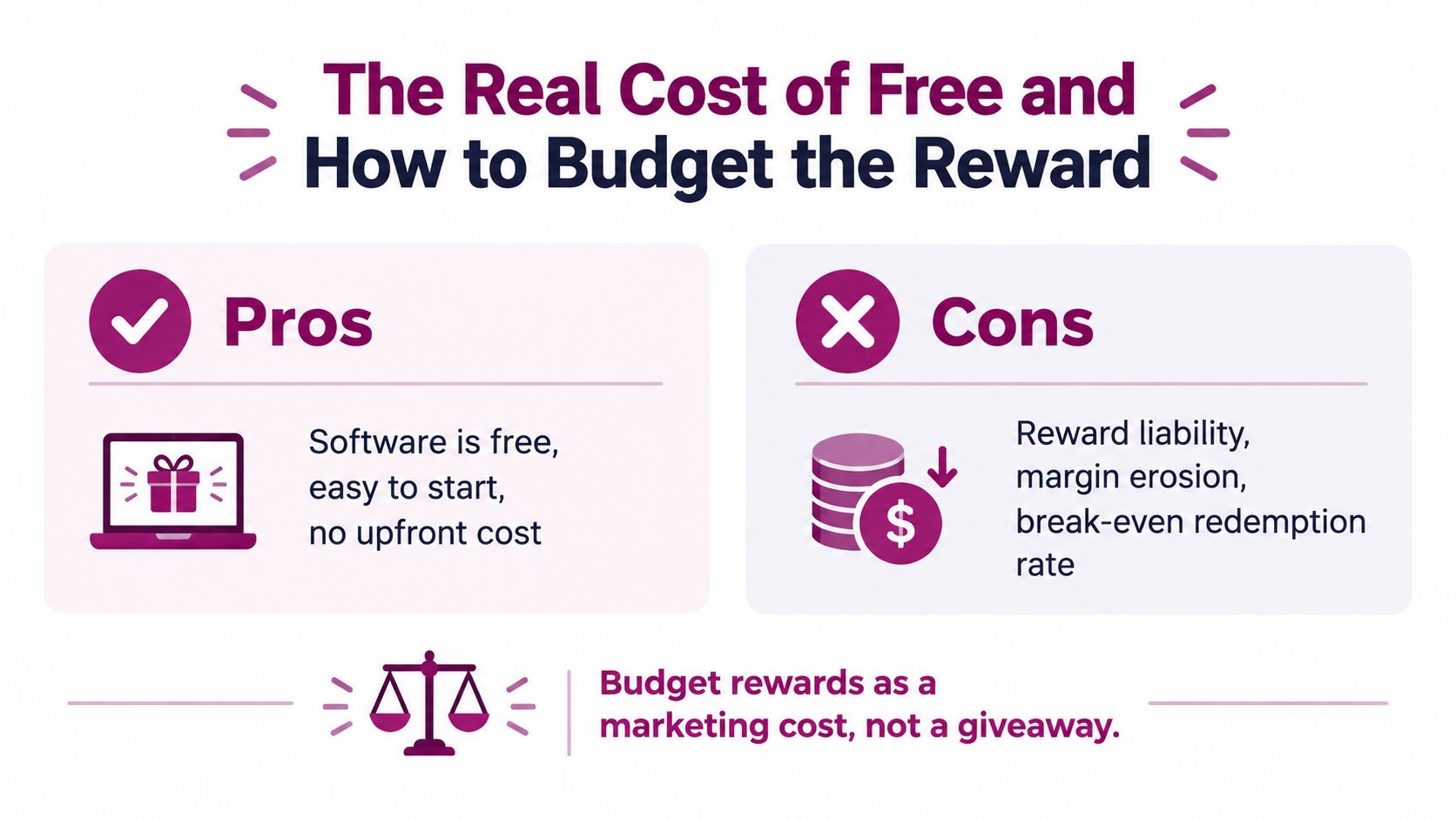
Free software can still fund an expensive giveaway. Split the decision into two costs. The app costs nothing. The reward is the recurring liability, and it leaves your business as product, labor, discount, or margin. Owners get hurt when they price the app at zero and never price the promise attached to it.
One small business guide suggests budgeting 5–10% of customer lifetime value for rewards and reports dedicated software can cost $50–$300 monthly, according to Priorise guidance on loyalty programme ROI measurement. Treat those figures as a budgeting prompt. Your margin, ticket size, and visit frequency decide what you can safely give back, and a cafe selling low-margin drinks has a very different ceiling than a salon with high-margin services.
Calculate Profit Per Redemption
Start with the margin on the qualifying purchases needed to earn the reward. Subtract the direct cost of the free item or discount, any funded offer cost, and the staff or messaging cost tied to redemption. What remains still isn't incremental profit, because some of those customers would have visited anyway.
That's why member revenue is a weak success metric. Your best regulars enroll first, which makes member sales look strong even when their behavior never changed. Compare enrolled customers with a holdout or matched control group where practical, then subtract reward and operating costs from the incremental margin.
Run the numbers through the loyalty program ROI calculator so every input sits on one page before launch. If the reward only works when almost nobody redeems it, you've built a trap for customers and a liability surprise for yourself.
A reward customers never reach isn't cheap. It's a failed incentive that still costs staff time and trust.
Design the reward off your margin, not off a template. Monetary value is easier for customers to judge than vague status, badges, or gamified language. A free item after a realistic run of qualifying purchases, or a clear discount at a stated point balance, tells customers why joining matters today.
Set the threshold close enough to create a feedback loop. If the first reward demands months of perfect behavior, you'll discount the customers who were already loyal and motivate almost nobody else. Budget the reward as a marketing cost with a break-even redemption assumption, then review that assumption against actual redemptions.
My rule is blunt. If you can't afford enthusiastic redemption, reduce the reward value or narrow what earns it before launch. Don't launch generously and later make redemption harder.
Setting Up Your Free Program From a Phone in One Afternoon
Set aside one quiet afternoon and do the unglamorous decisions first. The card design is the fun part, but rules keep the program from becoming a margin argument at the till.
Launch Sequence
- Choose the mechanic: Pick points or stamps based on the behavior you want, then define exactly which purchases qualify. Exclude gift cards, already discounted bundles, or low margin items if they would distort the economics.
- Set the first reward: Make it concrete and reachable within a realistic run of visits. Write the customer facing explanation in one short sentence your newest employee can repeat.
- Configure the pass: Add your business name, clear reward progress, and redemption instructions. This guide on how to create Apple Wallet passes helps you check the customer facing details before issue.
- Test as a customer: Enroll on your own phone, earn a stamp or points, redeem the reward, and try the awkward cases. Test a wrong balance correction, an expired reward, and a customer who changed phones.
- Train the offer: Give staff one line at checkout and one answer for what the reward is worth. Inconsistent invitations will starve the program faster than a plain card design.
Write down four liability rules before the first enrollment: reward expiry, qualifying purchases, redemption limits, and how you'll track outstanding rewards. Those controls protect margin while keeping the exchange fair and understandable.
Collect the minimum data you need to operate the program, and say plainly how you'll use it. Some customers are comfortable sharing details for offers, while others aren't, and your checkout script should respect both without a lecture on privacy law. Make opt out and deletion requests easy to handle instead of improvising when someone asks.
One option is Loyal Customer, which lets merchants run points or a digital stamp card from a phone and issue wallet ready cards for Apple Wallet and Google Wallet. Judge it the same way you'd judge any tool: enroll a test customer, redeem a reward, and confirm the free limits fit your pilot.
Put a counter sign where payment happens, not by the door. Customers decide while their phone is already in their hand. Launch to regulars first, watch the redemption process under real pressure, and fix friction before promoting the program more widely.
Measuring What Changed and Knowing When to Upgrade
Give the pilot a defined review date or it'll drift into a permanent discount. Track four numbers from day one and write them where you'll look at them.
Your First 30 Days
- Enrollment conversion: How many eligible customers accept when staff offer the program.
- First reward time: How long enrolled customers take to reach the first redemption.
- Redemption rate: How many earned rewards customers use.
- Repeat visit lift: Whether enrolled customers return more often than a comparable non enrolled group.
Also track average transaction value, but don't let one large basket hide weak visit frequency. The winning pattern is reachable rewards, steady redemption, and repeat visits that create enough incremental margin after reward cost. The warning pattern is fast enrollment, slow progress, and staff avoiding the offer.
Stay on the free tier while it supports clean issuing, visible balances, and reliable redemption. Upgrade when a named limitation costs you customers or hours, such as customer caps, multi location reporting, automated win back messages, or a POS integration your volume now justifies. Don't upgrade because a dashboard looks empty. Upgrade when you can point to the revenue, saved labor, or retention job the paid feature will perform.
If repeat behavior doesn't move, change the reward, threshold, or staff offer before buying more software. Tools amplify a program customers understand. They rarely rescue one customers ignore.
Start your pilot with Loyal Customer, where you can set up points or a digital stamp card from your phone and issue wallet ready passes for Apple Wallet and Google Wallet. Launch the simple version, measure repeat visits and redemptions, and only pay for more when your own numbers say the program has earned it.