A café owner can usually spot the loyalty problem before opening the till. There's a stack of paper cards beside the register, several customers have forgotten theirs, and staff are trying to remember whether a nearly full card belongs to the person in front of them. Meanwhile, regulars ask how many visits or points they have, and the answer depends on a manual tally.
Loyalty rewards software replaces that fragile process with a working customer record. It can apply earning rules, track points or visits, manage redemptions, and keep the customer's current status available across physical and digital interactions. The right buying decision isn't about collecting the longest feature list. It's about removing the most friction from the next purchase without creating more work for your team.
Table of Contents
- Why Small Merchants Are Rethinking Their Loyalty Stack
- Points vs Stamps and the Mechanics Behind Both
- What Loyalty Rewards Software Actually Does Every Day
- Three Implementation Paths and Which One Fits
- How Wallet Passes Work Without an App Download
- The Checkout Friction Most Buyers Overlook
- Why Transparent Rewards Often Beat Heavy Personalization
- A Short Checklist for Choosing Your Platform
Why Small Merchants Are Rethinking Their Loyalty Stack
The old paper card solved one narrow problem. It reminded a customer to return, but it didn't maintain a reliable balance, distinguish between different reward rules, or give the owner a clear operational record. A digital platform can handle those jobs while supporting customer engagement across channels.
The category has moved from basic membership databases to software that manages earning rules, redemption, personalization, and customer activity. Market research estimates that software represented 58.2% of loyalty-management-industry revenue in 2025, making it the largest component of that market segment (Grand View Research's loyalty management market analysis). Cloud-based and AI-enabled tools have helped businesses operate loyalty programs across channels and tailor offers to customer behavior.
That shift matters to a small merchant because loyalty is no longer only a promotional extra. The software can become part of daily operations. A café can record visits, a salon can track treatment rewards, and an independent shop can maintain a points balance without asking staff to update a spreadsheet after every transaction.
The market is widening beyond large retailers
Large enterprises accounted for 65.42% of loyalty-management spending in 2025, while adoption among small and medium-sized businesses was expanding at a 17.26% compound annual growth rate, according to the same market source. Those figures point to a category that began with major retailers but is spreading toward businesses that need simpler, lower-cost systems.
That doesn't mean every small business needs an enterprise platform. A multi-location chain may need deep integrations, centralized rules, and advanced reporting. A neighborhood salon may need only a phone, a clear reward rule, and a customer credential that doesn't get lost.
Practical rule: Buy loyalty software as an operations tool first and a marketing tool second. If staff can't award or redeem rewards quickly, attractive campaigns won't rescue the program.
The best system for a café, salon, restaurant, or independent shop makes repeat purchasing easier to recognize and easier to reward. It should also reduce questions at checkout, not add another account, terminal, or complicated process for staff.
Points vs Stamps and the Mechanics Behind Both
Most small-business loyalty programs start with one decision: should customers earn points or complete stamps?
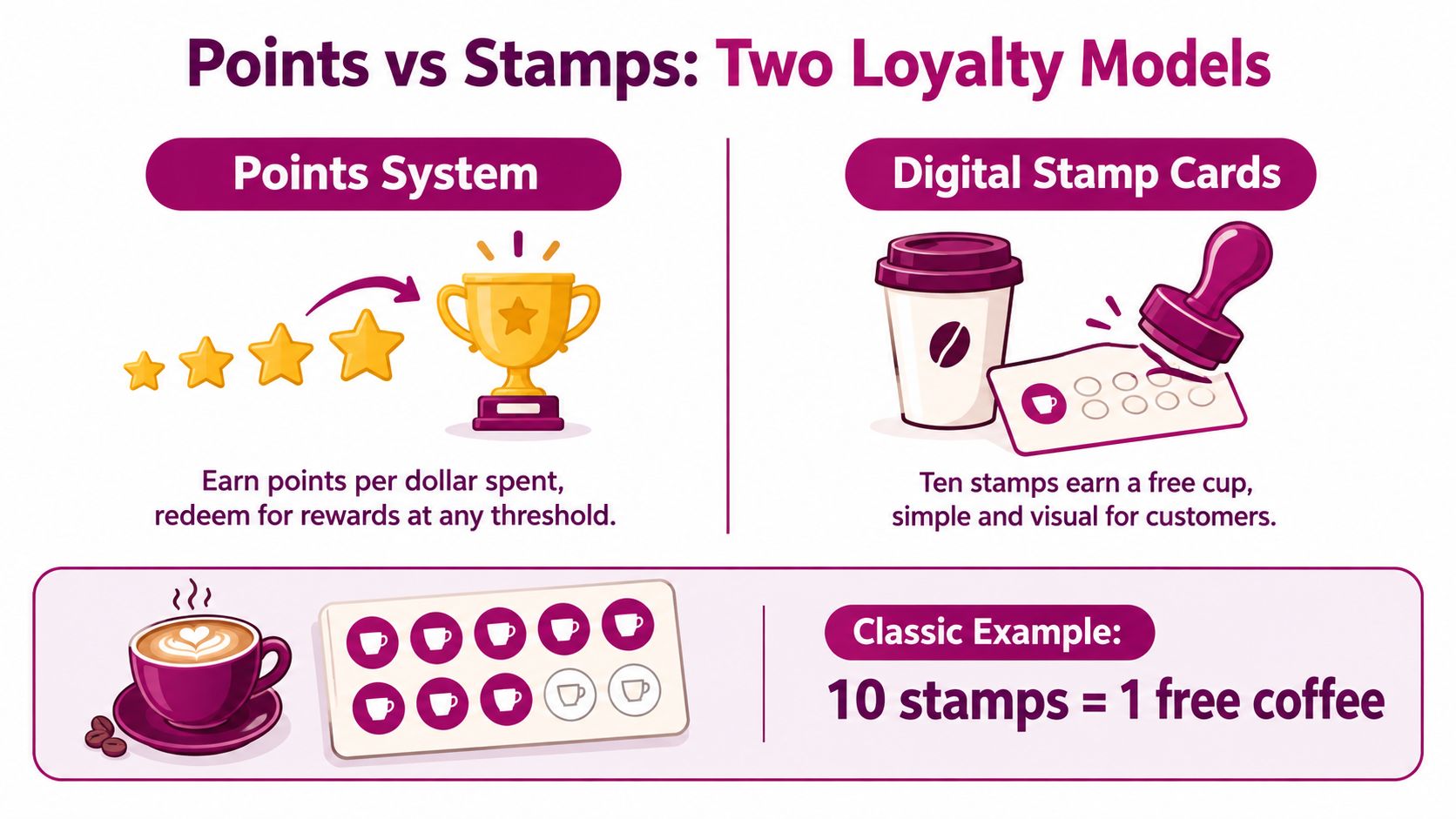
A digital stamp card is the cleaner choice when purchases are similar. A coffee shop might award one stamp per qualifying drink, with a free coffee after ten stamps. The customer sees progress immediately, and staff can explain the program in one sentence. This model works because the business is rewarding a visit or unit, not carefully measuring the value of every order.
A points program fits better when basket values vary. A customer might earn points based on spend, product category, or a chosen action. Someone buying a large order can earn more than someone buying a single item, and the merchant can define rewards at different thresholds.
Match the model to the transaction
Use this simple test:
- Choose stamps when customers buy roughly the same thing, such as coffees, wash services, or routine beauty treatments.
- Choose points when order values vary, customers buy across categories, or you want to reward higher-value purchases.
- Offer a simple reward when staff need to explain the program while serving the next customer.
- Add flexible redemption when customers have different preferences and may value a free item, discount, or service credit differently.
The mechanics behind both models should remain invisible to the customer. The system stores an authoritative balance, applies the earning rule, checks whether the reward threshold has been reached, and records the redemption. A ten-visit customer shouldn't receive a free treatment merely because a card was marked incorrectly, and a points customer shouldn't lose progress because a paper record disappeared.
Digital records remove paper's weak points
Paper cards depend on physical possession and honest manual marking. Digital records can connect the customer identity, the current balance, and the transaction history. That creates a more dependable process for both sides, provided the merchant uses clear rules and staff follow the same checkout workflow.
For example, a café can award one stamp when a qualifying drink is sold, then mark the reward available once the customer reaches the program threshold. A salon can award points after a paid appointment and permit redemption only after the ledger confirms the balance. The customer sees progress, while the owner has a record that can be corrected without reissuing a card.
For a practical explanation of the visit-based model, see this guide to loyalty card stamps. The right choice is the one your staff can apply consistently and your customers can understand without instructions.
What Loyalty Rewards Software Actually Does Every Day
A loyalty platform earns its place by performing four basic jobs reliably. Everything else is secondary.
First, it maintains the customer's balance. For a salon, a qualifying $12 haircut could add 12 points if the business chooses a point-per-dollar rule. The system needs to record that transaction and show the updated balance without relying on a staff member's memory.
Second, it applies the earning rule at the moment of purchase. The rule might be one stamp for a qualifying visit, points for eligible products, or a reward only after a customer completes a defined action. Good software makes the rule configurable but keeps the customer-facing explanation simple.
The four operational jobs
- Store the authoritative balance. Points and stamps should live in a dependable loyalty ledger, not only in a customer-facing pass or image.
- Apply earning conditions. The system should know which purchases, visits, products, or services qualify.
- Control redemption. A reward should become available only after the balance reaches the required threshold and the redemption is confirmed.
- Show current status. Customers should be able to see progress, available rewards, and recent activity without asking staff to investigate.
A ten-visit regular who has earned a free treatment should see that status clearly. Staff should see the same state when the customer redeems it. If those records disagree, the program creates an argument at the counter instead of a reason to return.
Simplicity beats decorative features
Deloitte's 2024 Consumer Loyalty Survey, which covered more than 9,800 consumers across the United States, United Kingdom, India, and Brazil, found that 86% considered financial rewards, simplicity, and ease of use important or very important attributes of a loyalty program (Deloitte's Consumer Loyalty Survey). Four out of five respondents valued flexibility in how rewards were earned and redeemed, while only 60% were satisfied with the personalization they currently received.
Those findings support a practical buying order. Start with visible balances, understandable earning rules, flexible redemption, and a customer experience that works on a phone. Personalization can help later, but it can't compensate for a missing balance or a confusing reward threshold.
Three Implementation Paths and Which One Fits
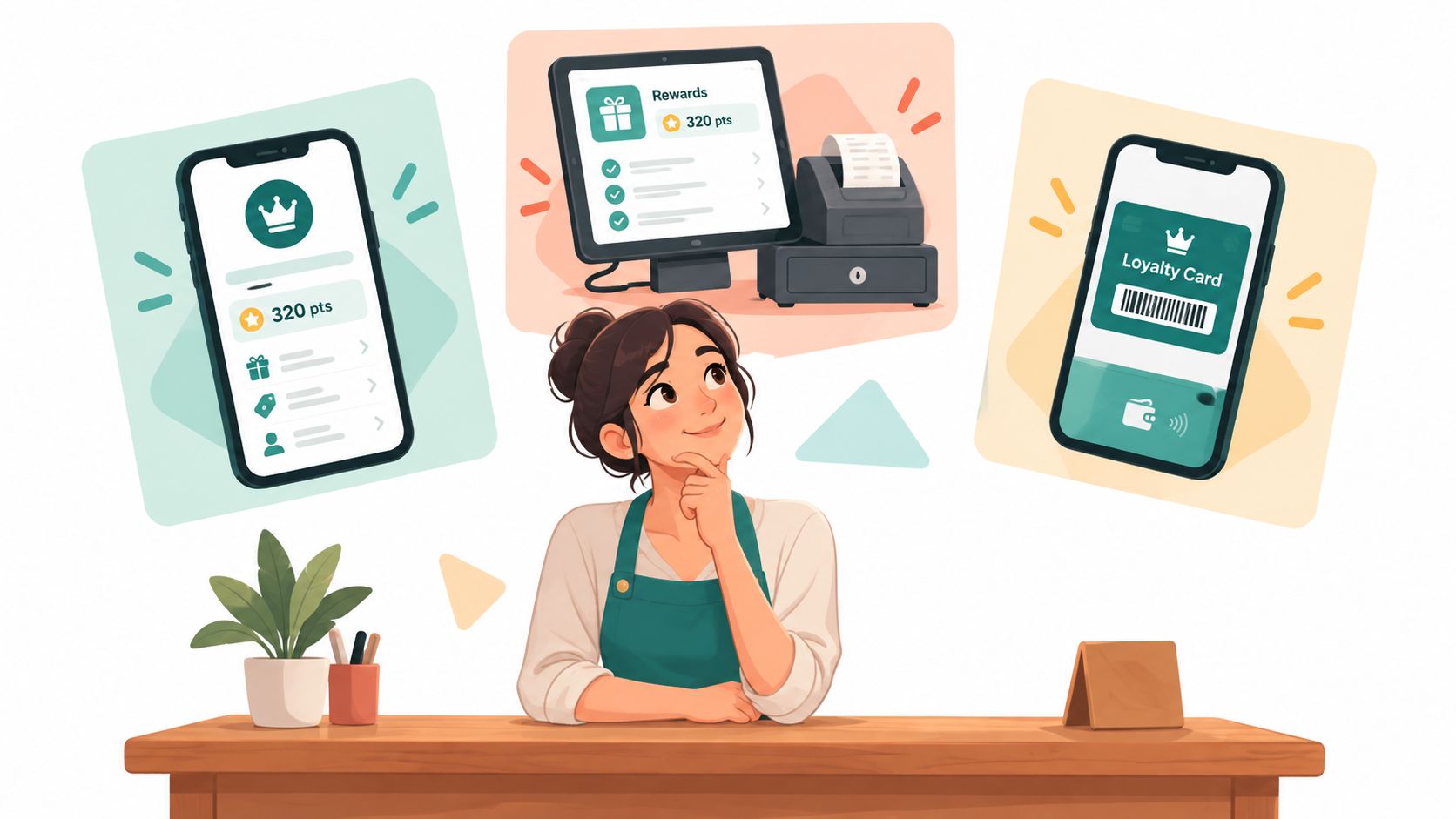
Small merchants usually choose among three implementation paths: a standalone app, a POS-integrated platform, or a wallet-native pass.
A standalone mobile app gives the business its own customer environment. It can support richer profiles and notifications, but customers must download it, create an account, remember it exists, and open it at the right moment. That's a demanding routine for a neighborhood business unless the app also provides substantial value beyond loyalty.
A POS-integrated platform connects earning and redemption directly to the payment workflow. That's attractive for merchants already committed to a compatible system. The trade-off is dependency. The loyalty program may be tied to one POS, require implementation work, and become part of a larger technology decision.
Why wallet-native passes suit smaller teams
A wallet-native pass sits inside Apple Wallet or Google Wallet. Customers don't need a separate loyalty app, and the merchant can operate the program through a phone-based workflow. For cafés, salons, studios, takeaways, and independent shops, that often removes more adoption friction than a branded app.
The important distinction is that wallet storage doesn't automatically mean wallet payment acceptance. A customer can present a loyalty card from a phone even when the merchant accepts payment through an ordinary card terminal or cash process.
| Path | Main advantage | Main trade-off |
|---|---|---|
| Standalone app | More room for accounts and engagement | Requires another download and habit |
| POS integration | Strong transaction automation | May require integration work and system commitment |
| Wallet pass | Low customer adoption friction | Merchant workflow still needs careful design |
A phone-operated platform such as Loyal Customer supports points programs and digital stamp cards, issues Apple Wallet and Google Wallet cards, and lets merchants handle routine loyalty actions from a mobile device. That approach is appropriate when the priority is a lightweight launch rather than a large enterprise integration.
The test is simple: count the steps for enrollment, earning, and redemption. If a customer must download an app, create a password, find the app at checkout, and explain the process to staff, the program has already created friction before it delivers value.
How Wallet Passes Work Without an App Download
A wallet pass isn't merely a static picture of a loyalty card. It's a synchronized digital record that presents current information while the merchant's backend remains authoritative.
With Apple Wallet, the device registers for update notifications. When the merchant confirms that a pass has changed, the server identifies the affected pass, sends a push notification, and the device retrieves the latest version. Apple permits pass fields to change while preserving the pass's serial number and authentication token, so a balance, reward status, brand message, or offer can change without issuing a new customer identity record (Apple Wallet passes documentation).
What the buyer should ask about Apple Wallet
A credible vendor should explain how it maps the customer to the pass. The operational relationship needs to remain durable among the customer ID, pass serial number, device registrations, and current reward state.
Updates should happen only after a confirmed state change. If the customer earns points or redeems a reward, the loyalty transaction should be committed first. The pass-update event should follow, with retries available if delivery fails. Otherwise, the customer may see a stale balance or receive an update that the backend cannot reproduce.
Google Wallet uses a related but distinct structure. A Loyalty Class stores shared program properties, while a Loyalty Object represents the individual customer credential. Google requires these resources to be encoded in a signed JSON Web Token when the pass is issued, using credentials registered in the Google Wallet Business Console (Google Wallet's loyalty card issuance flow).
Keep business logic outside the pass
The pass should present the current state, not become the only place where that state exists. Points and stamp balances belong in the loyalty backend, with the wallet object acting as a customer-facing access layer.
Ask vendors three direct questions:
- Where is the authoritative balance stored?
- What event triggers a pass update?
- How are signing credentials protected and compromised passes retired?
For a practical look at the customer-facing experience, read this guide to an Apple Wallet loyalty card. You don't need to be a developer to evaluate the architecture. You need to know whether the vendor can keep the displayed balance aligned with the transaction ledger.
The Checkout Friction Most Buyers Overlook
A wallet loyalty card can reduce customer-side friction without solving merchant-side friction.
Verizon's 2025 survey of 600 U.S. small and midsize business decision-makers found that just over half said their businesses accepted payments from Google Wallet and Apple Wallet (Verizon's 2025 State of Small and Medium Business report). That finding concerns wallet payments, not loyalty passes, and the distinction matters. A business may issue a loyalty pass while still accepting payment through cash, a physical card, or another terminal.
Separate the two wallet decisions
Wallet loyalty means the customer stores a digital credential and presents it for identification, earning, or redemption. Staff may scan a QR code or barcode with a phone camera, look up the customer, or enter the adjustment manually.
Wallet payments mean the customer uses a phone-based payment method at the terminal. A merchant can support one without supporting the other.
That creates the question most buying guides skip: can a café, salon, or micro-merchant issue a wallet loyalty card without a POS integration, dedicated scanner, or wallet payment terminal? Yes, but the workflow still needs to identify the customer, apply the reward rule, update the ledger, and trigger the pass refresh.
Measure steps removed, not features added
Test the program with a real scenario:
- The customer opens the wallet pass.
- Staff scan or read the customer credential.
- The system identifies the correct account.
- The transaction earns points or a stamp.
- The balance updates.
- The customer sees the new status.
If staff must switch between several apps, manually calculate rewards, or ask the customer to prove an old balance, the wallet pass hasn't removed enough friction. A vendor that “supports Apple and Google Wallet” may still leave the hard work to your team.
For customers checking their status, a clear rewards card balance is more useful than a pass that looks polished but doesn't reflect the latest confirmed transaction.
Why Transparent Rewards Often Beat Heavy Personalization
A customer standing at a busy café counter does not need a prediction engine to feel recognized. They need to know what earns progress, how close they are to a reward, and which reward suits the next visit. For small merchants, that clarity usually matters more than a larger feature list.
A 2025 global EPAM survey of 10,000 consumers found that 93% had used or would use features that let them customize how they earn or choose rewards. Four in five preferred brands that offered that control (EPAM's research on consumer control over loyalty rewards). The finding supports a practical buying rule: give customers a few clear choices before collecting more personal data or building complex segments.
Low-data design builds a clearer exchange
A café could offer a choice between a free drink and a discount. A salon could provide a service credit or a product reward. In each case, the customer can see what the business records and what value comes in return.
Ask for birthdays, demographic details, or location access only when the program uses that information. Extra requests can turn a simple reward into an unclear data exchange. Local businesses with personal customer relationships often gain more from rules staff can explain than from a segmentation model nobody understands.
Measure behavior that affects the shop:
- Redemption rate: Do customers use the rewards they earn?
- Repeat visits: Do members return under the program's rules?
- Opt-outs: Are customers rejecting messages or data collection?
- Customer questions: Do people understand the balance and reward conditions?
Personalization has a role for businesses with broad product ranges or distinct customer groups. It should not lead the buying decision. Start with transparent points or stamps, clear reward choices, and a checkout process staff can run without extra explanation. A simpler program customers trust will usually outperform a complex one they cannot understand or use.
A Short Checklist for Choosing Your Platform
Use this checklist before booking demos or comparing feature pages:
- Program fit: Choose points when spend varies and stamps when purchases are uniform.
- Checkout method: Confirm whether staff can run the workflow from a phone without a dedicated scanner or POS integration.
- Wallet coverage: Verify support for both Apple Wallet and Google Wallet if your customers use both mobile ecosystems.
- Balance authority: Ask where points and stamp records live and how corrections are handled.
- Pass updates: Confirm that balances and reward status refresh after a confirmed transaction.
- Data transparency: Check what the platform collects, what customers can control, and what staff can see.
- Trial access: Use a free trial to test enrollment, earning, redemption, and pass updates with real staff.
- Operational fit: Run the program through a busy service period before making a long commitment.
Don't evaluate loyalty rewards software by the number of dashboards it includes. Evaluate the number of checkout steps it removes, the time required to launch, and the clarity of the customer's reward status. For a café, salon, or independent shop, a wallet-native, phone-operated system that supports both points and digital stamps is usually the sensible starting point, provided the merchant workflow is simple.
Loyal Customer provides points programs, digital stamp cards, and Apple Wallet and Google Wallet loyalty cards that merchants can manage from a phone. Visit Loyal Customer to test whether its wallet-first workflow can reduce checkout friction for your business before you commit to a more complex loyalty stack.