38% of global shoppers surveyed in 2025 said they were loyal to five or fewer brands, according to Attentive and CITE Research's survey of consumers in the United States, United Kingdom, and Australia. For a neighborhood café, salon, or independent shop, that raises a useful question: are customers choosing your business, or choosing the most convenient deal?
A busy rewards program won't answer that question on its own. Customers can collect stamps, redeem points, and return regularly without developing much preference for the business behind the reward.
Table of Contents
- What Customer Brand Loyalty Means in Plain Terms
- How Many Purchases Turn a Customer Loyal
- Three Drivers That Build Loyalty Over Time
- Measuring Loyalty and Testing Habit Against Preference
- Strategies That Grow Loyalty Without Discounts
- Loyalty Programs That Build Preference, Not Just Points
- Start Testing Whether Your Customers Are Truly Loyal
What Customer Brand Loyalty Means in Plain Terms
Say a regular customer keeps visiting a neighborhood café after another café opens nearby. They like how the staff prepare their coffee, trust the quality, and recommend it to friends. Another customer visits just as often but switches whenever someone else offers a cheaper drink.
Customer brand loyalty is a customer's repeated, preferred choice of a brand over alternatives, supported by both attitude and behavior. Returning matters, but so does the reason for returning. Willingness to recommend the business or accept a modest price difference can provide additional evidence of preference.
The distinction is easier to understand when you separate the reasons customers come back.
Repeat buying can mean different things
- Habit: The customer follows an established routine without actively comparing alternatives.
- Convenience: Your shop is beside their workplace, or your booking system fits their schedule.
- Discount dependence: Your reward makes the transaction attractive, but the customer has little attachment beyond it.
- Preference: The customer values something about your business enough to choose it when reasonable alternatives exist.
These motives can overlap. Someone might discover your bakery through convenience, develop a routine, and eventually prefer your bread and service.
Choosing a favorite involves more than recognizing a familiar name.
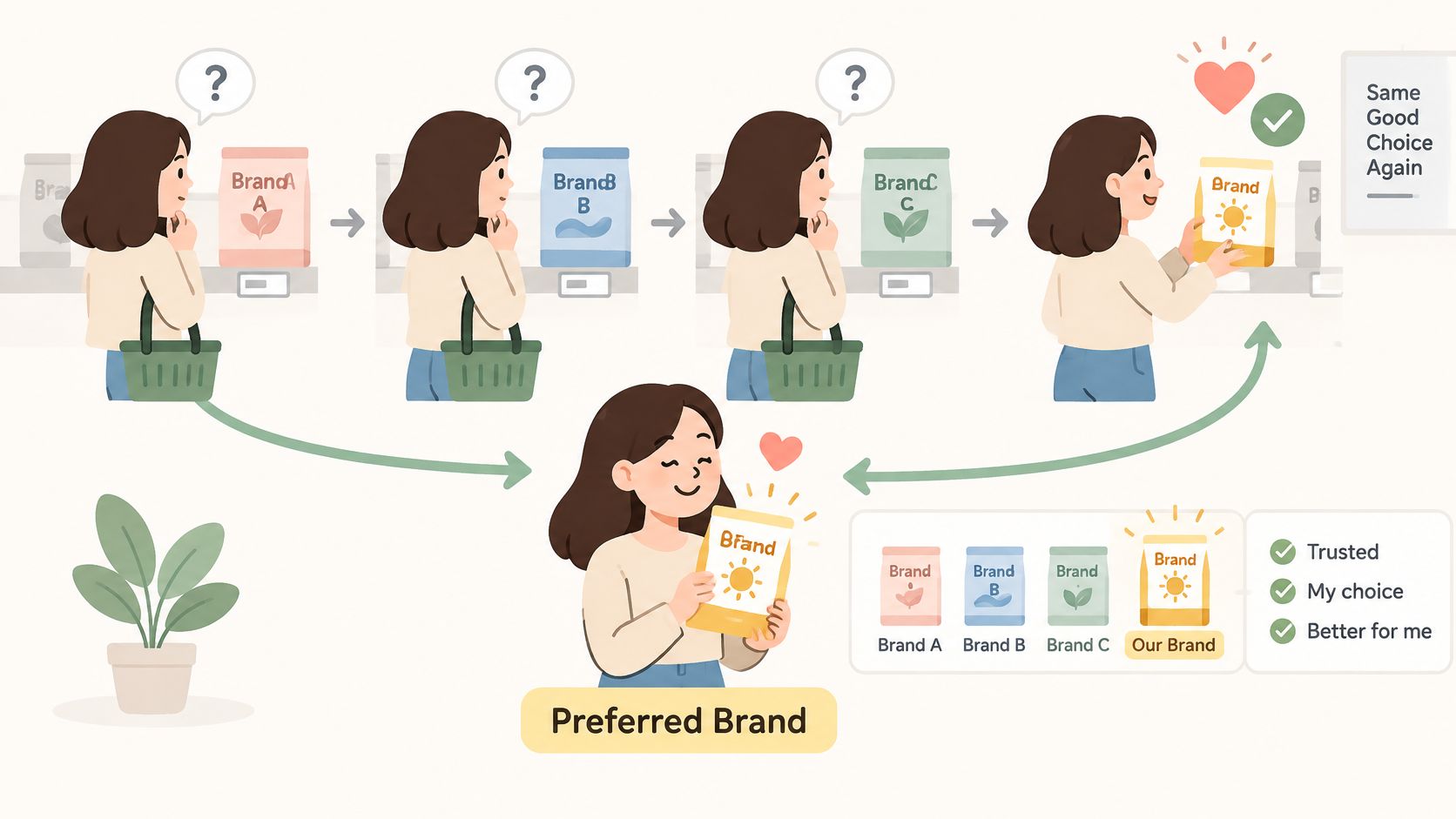
For budgeting, don't automatically classify every reward as an investment in stronger relationships. A benefit given to someone who would have bought anyway is a cost unless it produces another useful outcome, such as greater spend, advocacy, or lower risk of leaving.
Practical rule: Treat repeat visits as evidence to investigate, not a verdict that loyalty exists.
Nor should you dismiss convenience or price-sensitive customers. They can be valuable customers. The task is to understand what sustains their purchases so you can measure loyalty, improve its underlying drivers, and avoid paying for visits that don't strengthen preference.
How Many Purchases Turn a Customer Loyal
Loyalty usually takes more than a successful first transaction. In a YouGov analysis published in 2022 across 17 international markets, 14% of consumers considered themselves loyal after one or two purchases, 38% after three or four, and 27% after at least five.
That distribution is useful for planning, not for assigning a loyalty label at checkout. Completing another purchase gives a customer another experience to judge. It doesn't automatically create commitment.
The chart highlights the most commonly reported threshold.
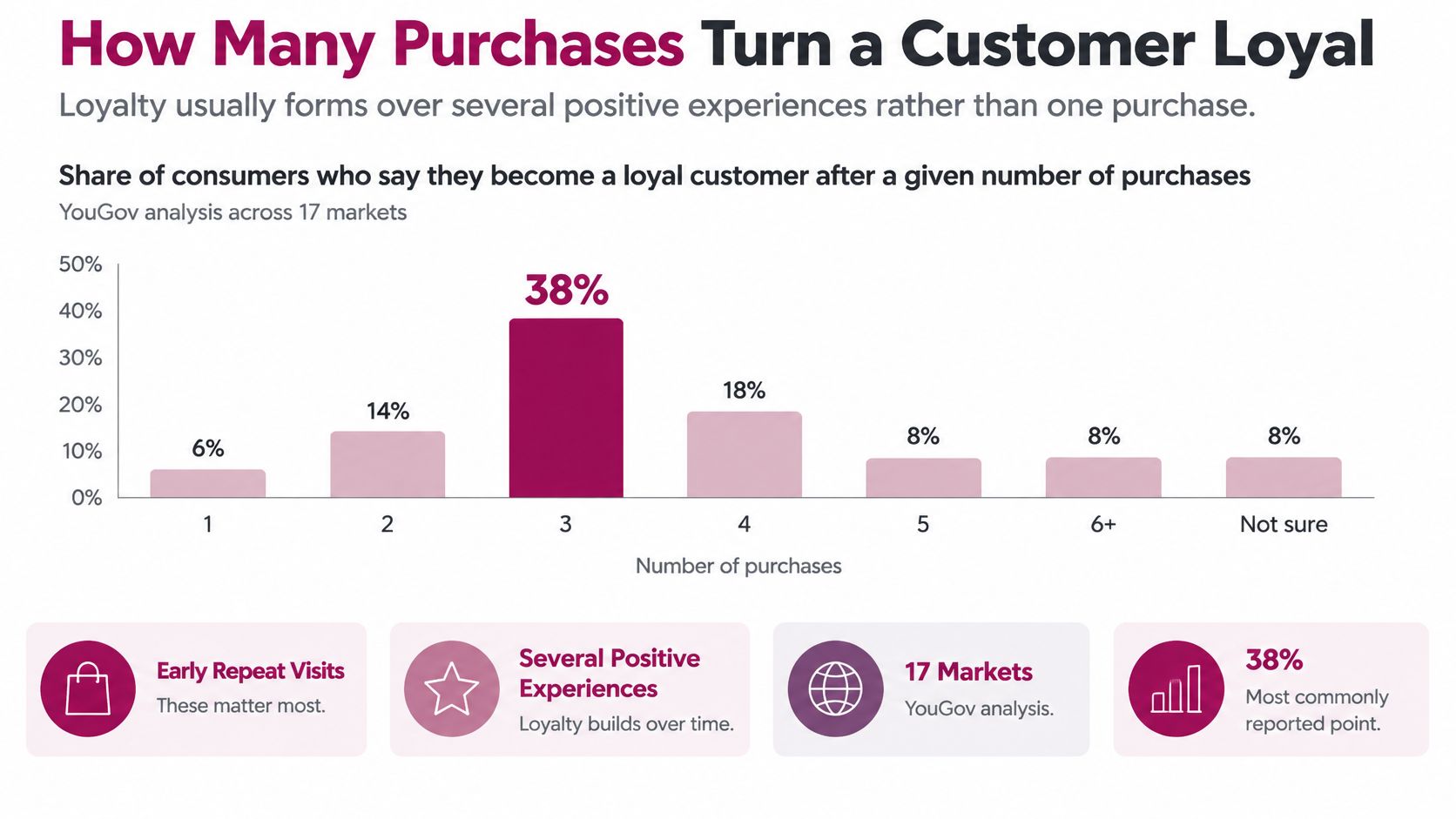
Purchases needed before consumers identify as loyal
The same YouGov analysis reported the following shares across all markets and selected segments. Not reported means the available findings don't provide that figure, not that nobody selected that answer.
| Segment | After 3-4 Purchases | After 5+ Purchases |
|---|---|---|
| All markets (17 countries) | 38% | 27% |
| Consumers aged 18-24 | 41% | Not reported |
| Consumers aged 25-34 | 40% | Not reported |
| Consumers aged 55 and older | 34% | Not reported |
| Urban Mexico | Not reported | 46% |
| Spain | Not reported | 41% |
The age differences suggest that customers don't all describe loyalty at the same purchase threshold. The country differences also caution against copying another merchant's assumptions about how quickly a relationship should develop.
Don't interpret the unreported cells as values you can calculate by subtraction. Customers could select other purchase thresholds, so the columns aren't complementary categories.
Make early returns worth repeating
For a café, the second through fourth visits are a sensible period to emphasize recognition and clear progress. Staff should know how to find the customer's card, explain the next reward, and resolve a missing stamp without an awkward exchange.
For a salon, the equivalent opportunity might be the next appointment: remembering a stated preference, keeping the booking process straightforward, and delivering a consistent result. Match your review period to the customer's natural buying cycle rather than borrowing a café's timetable.
This accompanying video offers another way to consider the customer relationship.
These thresholds are self-reported feelings, not observed switching behavior. Someone can call themselves loyal and still leave for a competitor. Use purchase milestones to organize care and recognition, then test whether preference survives beyond the immediate reward.
Three Drivers That Build Loyalty Over Time
Think of loyalty as a relay rather than a switch. Good service and worthwhile value must translate into satisfaction before a business can reasonably expect a stronger relationship.
A meta-analytic structural equation model covering 153 studies found that satisfaction directly drives loyalty, while perceived service quality and perceived value primarily influence loyalty through satisfaction; service quality also positively shapes perceived value. The practical implication is straightforward: points should reinforce a satisfying experience, not compensate indefinitely for an unsatisfying one.
Check the experience, value, and trust
First, is the service worth remembering? That doesn't require theatrical gestures. At a takeaway, an accurate order, a realistic collection time, and a helpful response to an allergy question give customers concrete reasons to feel satisfied.
Next, is the benefit worth the effort? A reward can look generous on a poster yet feel unappealing once customers discover exclusions or a difficult redemption process. Ask staff to explain the benefit without reading a script. If they struggle, customers may struggle too.
Finally, do customers believe you'll honor the rules? A consumer-trust meta-analysis covering 549 studies and 324,834 respondents across 71 countries found that integrity-based antecedents were stronger trust drivers than reliability-based antecedents, and that trust improved attitudinal loyalty, purchase intentions, behavioral loyalty, and willingness to pay. Keeping an honest promise matters alongside delivering consistently.
Diagnose the weak link
Consider a bakery whose customers enjoy the products but repeatedly need a manager to approve rewards. Adding more points won't remove the uncertainty. The useful intervention is a clear redemption process that every shift can follow.
Compare customers receiving equivalent benefits but reporting different service experiences. If satisfied customers return while dissatisfied customers redeem and disappear, investigate the service problem before increasing reward generosity.
A thoughtful surprise-and-delight approach can complement dependable service, such as offering relevant help or acknowledging a customer's stated preference. It shouldn't become a substitute for accuracy, fair treatment, or honoring commitments.
Customers shouldn't need a special gesture to receive the service you already promised.
Keep feedback questions separate: Was the interaction satisfactory? Was the benefit worthwhile? Were the terms trustworthy? A single overall score can conceal which part of the experience needs attention.
Measuring Loyalty and Testing Habit Against Preference
A rising repeat-visit rate can mean your program is changing behavior. It can also mean customers are timing purchases around benefits while their underlying preference stays unchanged.
That distinction matters in a price-sensitive environment. EPAM's 2025 global consumer loyalty research predicted a 25% decline in brand loyalty even as loyalty-program usage increased. That was a prediction, not proof that every merchant experienced that decline, but it illustrates why participation and preference shouldn't be treated as interchangeable.
Read the metrics together
Use a spreadsheet containing customer identifiers, transaction dates, spend, reward activity, and relevant service feedback. Define the observation window before calculating results, and use the same definitions throughout.
Loyalty metrics, what they reveal and how to calculate them
| Metric | What It Reveals | How to Calculate |
|---|---|---|
| Repeat-visit rate | Whether customers return within a set window | Returning customers divided by all customers in the period |
| Redemption-adjusted purchase frequency | Buying frequency after excluding redemption transactions | Purchases excluding reward redemptions divided by active customers |
| Churn rate | Share of customers lost over a period | Customers lost divided by customers at the start of the period |
| Repurchase without incentive | Whether customers return without an offered reward | Unrewarded repeat rate compared with rewarded repeat rate |
| Post-reward retention | Whether customers stay after a reward is reduced | Customers still active after the change divided by customers active before it |
| Voluntary advocacy | Whether customers recommend the brand unprompted | Unprompted referrals or reviews divided by active customers |
| Redemption failure rate | Whether customers can successfully use earned benefits | Failed redemption attempts divided by total redemption attempts |
Redemption-adjusted frequency is only a proxy. Removing redemption transactions doesn't remove purchases motivated by earning a future reward. Likewise, the repeat-visit rate measures the share who return, not how many visits each returning customer makes.
Define “lost” using a reasonable inactivity window for your business. A salon customer and a daily coffee buyer shouldn't be judged against the same expected return schedule. Record delayed redemptions separately from outright failures so staff can identify the actual problem.
Run a low-cost comparison
Create comparable groups. Record repeat rates for rewarded customers and an unrewarded comparison group over the same period. Match customers on prior frequency, spend, and acquisition timing. Where practical, randomly assign eligibility for a new optional promotion rather than comparing enthusiastic members with all nonmembers.
Compare visits and spend. Check both purchase frequency and contribution after reward costs. A gap suggests the program may be changing behavior, but nonrandom groups can differ for other reasons. No clear gap suggests you may mostly be rewarding established habits, although a small sample or short observation period can conceal an effect.
Test weaker incentives carefully. Reduce or pause a prospective promotional bonus for a segment and monitor subsequent activity over several weeks or an appropriate buying cycle. Don't remove earned balances or rewrite existing promises. Keep an unchanged group for comparison.
Record unprompted advocacy. Tag referrals customers mention and reviews that weren't solicited through an incentive. Count these consistently, and don't assume quieter customers lack preference.
Judge what survives. Look for continued purchases when incentives weaken, supported by satisfaction and advocacy. Compare customers with similar rewards but different service experiences to identify operational problems that a promotional comparison alone might miss.
Segment results by store, acquisition cohort, channel, and device platform where the information is available and appropriate. A redemption problem affecting Android customers at a particular location isn't evidence that everyone has lost interest.
Measurement caution: A rewarded purchase proves that a transaction happened. It doesn't reveal what the customer would have done without the reward.
Use a loyalty-program ROI calculator to explore reward-cost assumptions alongside your observed comparisons. Treat the output as a scenario, not evidence that the program caused additional sales.
Strategies That Grow Loyalty Without Discounts
A salon can give a returning customer a better experience without cutting the appointment price. Staff can retain an opted-in styling preference, prepare for the service requested, and explain aftercare clearly. Those actions give the customer something useful to prefer.
Prioritize changes that customers experience directly, especially during early return visits. A personalized message won't compensate for an appointment that starts late without explanation.
Make recognition useful
- Recognize without presuming familiarity. Ask whether the customer wants their usual order rather than announcing personal details across the counter. Let them change preferences easily.
- Show meaningful progress. After an eligible purchase, make the updated stamp or points balance visible. Explain what remains to earn the benefit without pressuring the customer to buy immediately.
- Standardize the basics. Give every shift the same checklist for order accuracy, greeting customers, issuing rewards, and handling exceptions. A customer shouldn't need to find a particular employee to receive correct treatment.
Say a café discovers that returning customers repeatedly explain the same milk preference. With permission, staff can make that preference available for future orders. The useful personalization is less effort for the customer, not evidence that the business has collected a detailed profile.
For more ways to translate recognition into daily practice, compare these customer loyalty examples with the moments customers find frustrating in your own business.
Handle difficult moments honestly
Communicate changes before customers encounter them. If an offer is ending, explain the timing and how existing eligibility will be handled. Avoid leaving frontline staff to improvise an answer after a customer has already tried to redeem it.
When someone complains, acknowledge the specific issue, explain what you can do, and assign responsibility for following through. A resolved complaint gives customers evidence of how you behave under pressure, but don't assume recovery leaves them more loyal than an error-free visit would have.
Personalize only within agreed boundaries. Use stated preferences and permitted transaction information to make interactions easier. Don't infer sensitive circumstances or turn a service preference into permission for unrelated marketing.
Review each change against an outcome it could plausibly affect. Recognition might improve satisfaction or unincentivized returns; a clearer counter procedure might reduce redemption failures. If only reward activity increases, investigate before declaring that you've strengthened customer brand loyalty.
Loyalty Programs That Build Preference, Not Just Points
American Airlines' AAdvantage, launched in 1981, and the United Kingdom's Tesco Clubcard, launched in 1995, illustrate the shift toward structured, trackable rewards for returning customers described in the University of California, Berkeley discussion of modern loyalty programs. Today's digital cards retain that basic mechanism: identify activity and exchange it for benefits.
The mechanism alone doesn't determine whether customers value the program. In Deloitte's 2024 survey of more than 9,800 consumers across multiple countries, 86% rated financial rewards, simplicity, and ease of use as important or very important loyalty-program attributes.
Choose the simplest suitable model
| Format | Useful when | Design question |
|---|---|---|
| Digital stamps | Eligible visits or purchases are straightforward to count | Can staff explain exactly what earns a stamp? |
| Points | Purchase values differ and earning follows spend or defined actions | Can customers understand the reward's value? |
| Wallet pass | Customers need an accessible credential without a separate merchant app | Can they see their status and get help easily? |
A stamp card can suit a bakery with a clearly defined eligible purchase. Points may fit a retailer whose baskets differ substantially in value. Neither is naturally a stronger loyalty tool.
Apple Wallet and Google Wallet passes can replace printed credentials without requiring customers to download a standalone merchant app. That convenience still needs operational support: staff must know how to issue benefits, correct errors, and explain the displayed balance.
Make the rules visible before enrollment
State what earns credit, what doesn't, how redemption works, and whether expiry applies. Explain how customers can inspect their information, request corrections, and leave the program.
Walk through the process from both sides of the counter. Check what happens when a customer changes phones, a balance appears wrong, or a staff member can't complete redemption. Resolve those scenarios before promoting enrollment widely.
Personalization has a trust cost
In PwC's 2025 U.S. customer-experience survey, 53% of consumers considered sharing personal information worthwhile when it made interactions smoother, while 93% said a brand would lose their trust if it mishandled that information. Willingness to share isn't permission to collect everything.
Begin with purpose-limited information: purchase frequency, reward balance, and opt-in communication preferences. Add stated product or service preferences only when they have a clear use.
Keep enrollment separate from optional marketing consent, explain who can access information, and make opting out understandable. A simple reward card shouldn't become an unexpected tracking arrangement.
Start Testing Whether Your Customers Are Truly Loyal
You don't need an elaborate analytics system to start. You need consistent definitions, a manageable customer segment, and a comparison that doesn't confuse a service failure with weak preference.
Choose a segment with a recognizable buying cycle, such as returning takeaway customers or salon clients booking the same service category. Avoid combining unrelated purchasing patterns just to make the spreadsheet larger.
Put a small evaluation into practice
Choose a behavior measure and a trust measure. Pair repurchase without incentive or post-reward retention with redemption failure rate or complaint incidence. Write down what counts before reviewing results.
Establish a baseline. Track both for a full quarter before changing a reward, extending the period if your normal buying cycle requires it. Note closures, availability problems, and unusual promotions that could distort the comparison.
Limit collection to useful information. Keep purchase frequency, reward balance, and opt-in preferences at the center of the exercise. Don't collect detailed personal profiles merely because the software has fields for them.
Set up the comparison. Separate rewarded and comparable unrewarded customers. Break out store, device platform, and acquisition month where you have suitable records, while keeping groups large enough to interpret cautiously.
Apply a decision rule. Continued purchasing under weaker incentives, supported by growing voluntary advocacy, is evidence consistent with preference. More redemptions without stronger repeat behavior calls for a review of service, reward clarity, and program costs before adding benefits.
Decide what to change, not just what to report
If customers encounter failed redemptions, fix the process before testing reward appeal. If operations are dependable but customers disappear after a bonus ends, reconsider whether the additional purchases justify the promotion's cost.
Customer brand loyalty combines preferred choice with repeated action. It develops through experiences customers value, and you test it by observing more than the transactions attached to a benefit. Start by pulling a quarter of redemption and repeat-purchase records for a single segment, then identify the first question those records can credibly answer.
Loyal Customer offers phone-managed points programs and digital stamp cards, with loyalty passes for Apple Wallet and Google Wallet. Visit Loyal Customer to try a basic program and assess how its earning and redemption workflow fits your customers before expanding it.