41% of consumers said a loyalty-rewards program helps keep them loyal to a brand, compared with 33% who cited product or service quality, in a 2025 EY study cited by Shopify's salon loyalty guide. That doesn't make rewards more important than a good haircut. It means clients may actively consider the benefit of returning, rather than relying on their relationship with a stylist alone.
For an independent salon, the useful question isn't whether to offer rewards. It's whether a beauty salon loyalty program can generate enough additional contribution to pay for those rewards, without slowing checkout or discounting appointments clients would have booked anyway.
Table of Contents
- Why a Beauty Salon Loyalty Program Pays Off
- Points, Stamps, or Tiers for Your Salon
- Designing a Wallet-Ready Loyalty Pass
- Building an Enrollment Flow Your Staff Can Actually Run
- Choosing Rewards That Protect Your Margins
- Running the Program Day to Day at the Chair
- Measuring What Matters and Avoiding Common Traps
Why a Beauty Salon Loyalty Program Pays Off
A salon can have a busy diary and still struggle to turn first-time guests into dependable regulars. Acquisition fills an appointment today. Retention helps the owner plan staffing, manage chair capacity, and reduce the uncertainty around future bookings.
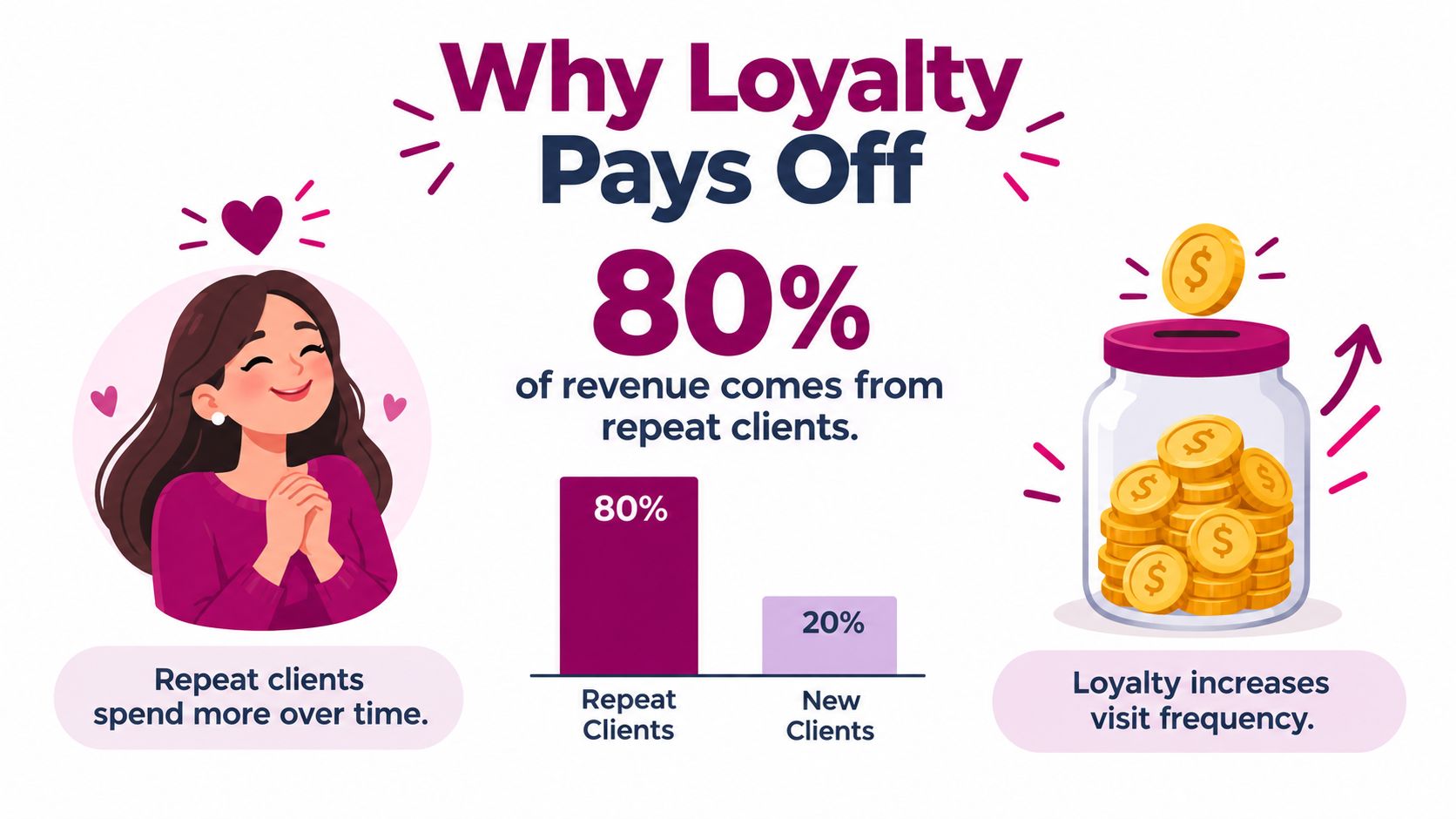
The revenue split makes that distinction commercially important.
Where Salon Revenue Comes From
| Client segment | Share of clients | Share of revenue | Impact of loyalty program |
|---|---|---|---|
| Clients visiting more than once annually | 42% | 80% | Loyalty programs increased the number visiting at least five times annually by 9%, according to Zenoti's 2025 beauty and wellness benchmarks. |
| First-time or single-visit guests | The remaining client base | The smaller revenue share | The practical opportunity is converting occasional guests into returning clients. |
This is a software-industry benchmark, not a guaranteed result for your salon. The repeat-client category also includes people visiting relatively infrequently, not just your most devoted regulars. Nevertheless, the concentration explains why a modest reward can be commercially useful when it changes appointment behavior.
Buy a behavior change, not just goodwill
Define the appointment behavior you want before choosing the benefit. A new-client offer should encourage a return appointment. An incentive for an established client might instead support a relevant treatment add-on or a booking during a quieter period.
Those are different commercial jobs. Giving every client the same discount makes it harder to tell which job you're paying for.
Practical rule: Name the behavior the reward should change before deciding what the reward should be.
Establish your own baseline for repeat visits, average ticket, rebooking interval, and contribution margin. Separate first-time guests, occasional visitors, and established regulars, because their reasons for responding may differ.
Don't interpret frequent visits among members as proof that the program works. Your most loyal clients may be the people most willing to enroll. You need evidence that the reward changes what happens next.
Treat the program as a structured retention investment this quarter, with an owner, a budget, and a review date. The stylist relationship remains essential. The reward should give staff a useful reason to continue that relationship between appointments, not become a substitute for it.
Points, Stamps, or Tiers for Your Salon
Choose the mechanic your staff can explain while taking payment. If the explanation needs a lengthy comparison of conversion rates, service categories, and membership levels, simplify it before launch.
Stamps recognize visits. Points recognize eligible spending. Tiers recognize an ongoing relationship. Each measures something different, so start with your service mix rather than whichever format looks most polished.
Points vs Stamps vs Tiers for Salons
| Mechanic | Best fit for salons | Friction for client | Margin risk | Setup complexity |
|---|---|---|---|---|
| Digital stamps | Similar-price, recurring services such as blowouts or maintenance haircuts | Low when each completed visit qualifies | Cheap services can earn the same benefit as expensive services | Relatively simple |
| Points | Mixed treatment menus, color services, and retail purchases | Moderate, unless earning and redemption are easy to understand | Different service margins may not support the same earning rate | Requires eligible-spend and redemption rules |
| Tiers | Established client bases that value recognition and access | Higher if qualification or status changes are unclear | Recurring benefits can become expensive obligations | Requires ongoing tracking and administration |
Match the mechanic to the menu
For a studio focused on comparable maintenance appointments, stamps offer a straightforward path. Clients understand that completing a qualifying visit moves them toward a named benefit. The weakness appears when a quick service and a long appointment earn identical progress despite producing very different contributions.
Points are more appropriate when clients combine treatments and retail products or purchase services at substantially different prices. They can make higher spending feel recognized without inventing separate stamp rules for every service.
But revenue isn't margin. An expensive color appointment may require substantial product, labor, and processing time. Don't assume it can fund a more generous reward because its ticket is larger.
Tiers can work when status benefits are useful, such as advance access to newly released appointments. They're harder to justify when a small team must manually track qualification, explain downgrades, and administer overlapping discounts.
Make the reward cost predictable
A stamp program needs a defined qualifying visit and a specific reward. A points program needs a clear earning rule and an understandable redemption value. A tier program needs a budget for the benefits clients can repeatedly use.
Avoid letting clients choose any service as their reward unless you've costed the entire eligible menu. Otherwise, the least expensive interpretation in your spreadsheet may become the most expensive interpretation at reception.
- Choose stamps when visit values are broadly comparable and speed matters most.
- Choose points when spending varies and the system can track eligible transactions reliably.
- Choose tiers only when recognition benefits justify the administrative work.
For a time-poor owner, simplicity isn't a compromise. It's a condition of consistent execution.
Designing a Wallet-Ready Loyalty Pass
A wallet pass is the presentation layer, not the program itself. Decide the earning rule and reward economics first, then design a pass that makes those decisions visible inside Apple Wallet or Google Wallet.
Compared with paper, a digital pass removes the need to replace and manually reconcile physical cards. Compared with a dedicated salon app, a wallet-native design avoids asking clients to install another application just to participate. Neither advantage guarantees engagement, so test whether clients can find and present the pass.
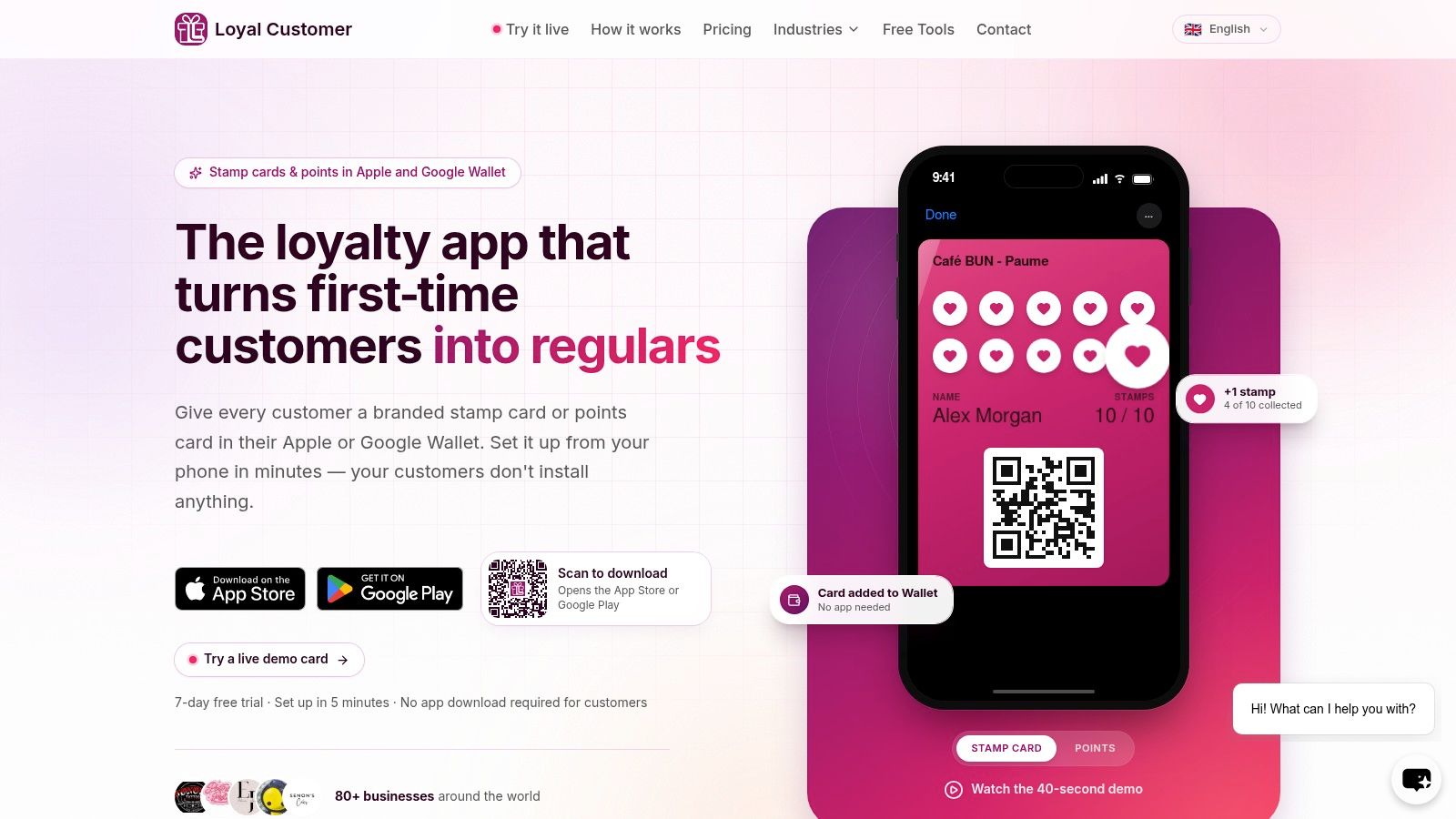
Use this screenshot as a visual reference while planning the information hierarchy.
Put useful information before decoration
The front should identify the salon, show the current balance, and explain the reward clients are working toward. A logo matters, but not more than readable progress.
For stamps, show completed progress against the reward threshold. For points, display both the balance and the benefit it can provide. Don't make clients calculate redemption value from a points total they can't interpret.
Use the Apple Wallet pass design guide when briefing a provider on layout and field priority. Check the equivalent Google Wallet presentation separately rather than assuming both versions display identically.
The details area should cover:
- Qualifying activity: State which completed services or purchases earn rewards.
- Reward conditions: Identify eligible treatments, booking requirements, and restrictions.
- Expiry policy: Explain how long balances remain valid and what triggers expiry.
- Help route: Tell clients how to query a missing transaction or incorrect balance.
Design the staff lookup alongside the pass
Include a customer identifier that staff can match to the correct member record. A visible balance is useful for the client, but staff should confirm the authoritative system record before making changes.
For a scan-free workflow, require a searchable customer record and a clear confirmation step before awarding or redeeming. If the provider supports QR scanning, test it on the phones staff will use. Don't assume either workflow requires a dedicated scanner or integrates automatically with your booking software.
Ask the provider to demonstrate earning, redemption, balance refresh, and a correction to an erroneous entry. Also test what happens when connectivity fails.
The pass should remain understandable without a verbal explanation. If a client needs reception to translate every field, the design is doing too little of the work.
Building an Enrollment Flow Your Staff Can Actually Run
Enrollment needs a natural place in the appointment journey, not a separate sales routine. Give the booking message, stylist, and reception desk different jobs so clients don't hear the same pitch repeatedly.
In the booking confirmation, introduce the benefit and provide the signup route:
“You can collect rewards on qualifying visits. Add our loyalty pass to your phone's wallet before your appointment, or ask us at checkout.”
That's suggested staff wording, not a promise about a particular system. Adapt it to the earning rule you've approved.
Make the invitation useful
During the service, the stylist can connect the reward to the client's normal care routine. For example: “Your maintenance visits qualify for our treatment reward. Reception can show you how to join.”
Don't interrupt a consultation to collect marketing details. The stylist's job is to establish relevance; checkout is the better place to complete enrollment and confirm the benefit.
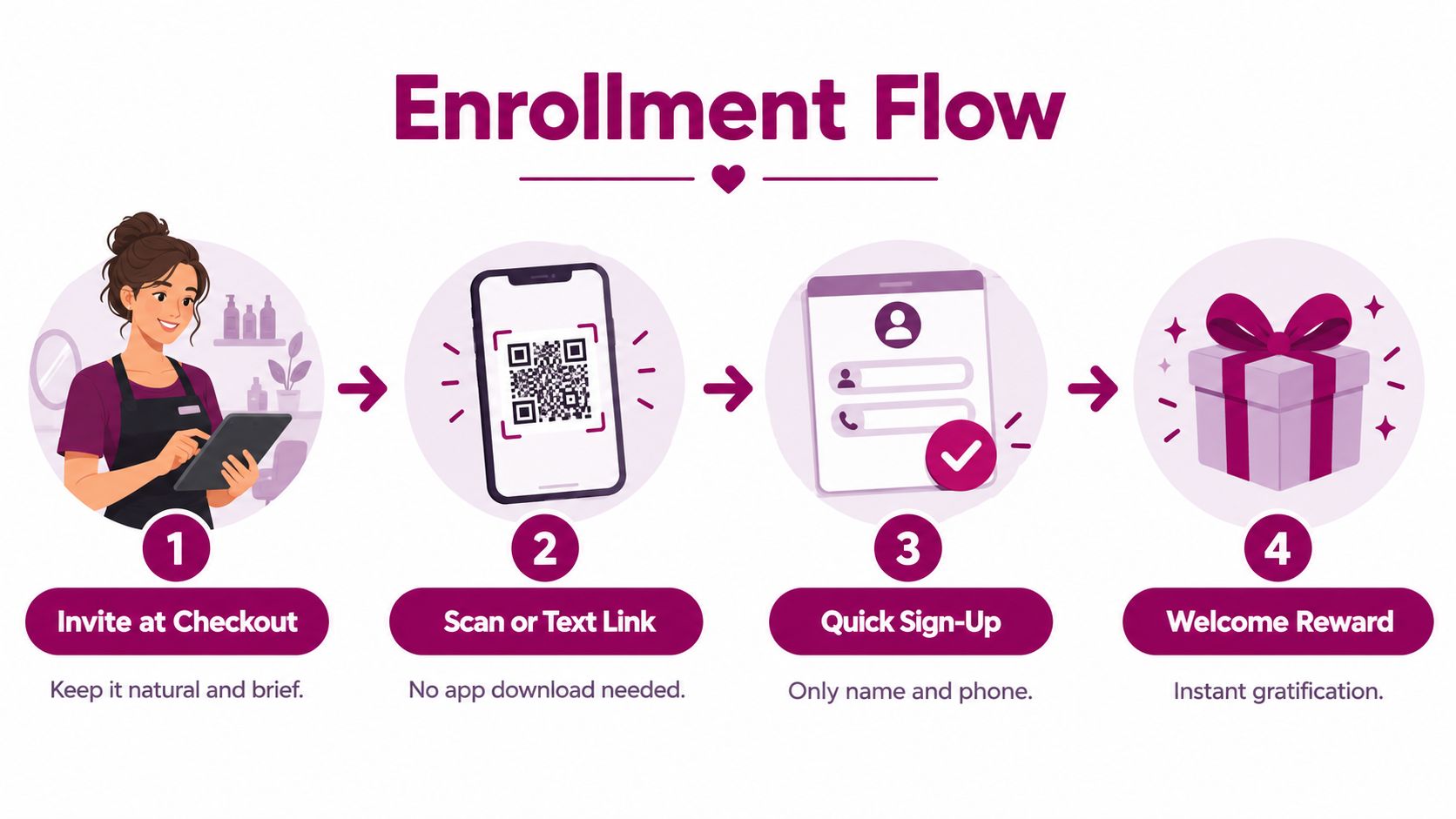
For walk-ins, place a QR signup prompt where clients wait to pay. Keep it readable and explain what scanning does. The salon and spa loyalty app guide provides a useful reference when mapping this appointment-to-enrollment workflow.
The visual below illustrates the invitation and signup sequence. Treat any welcome reward as an optional, costed offer rather than an automatic giveaway.
Separate participation from marketing permission
If clients object to another app, explain that a supported wallet pass doesn't require a separate salon app. Offer an alternative account lookup where your system permits it.
Collect only the details needed to administer the program. Don't automatically request birthdays, treatment histories, or sensitive preferences just because the software includes those fields.
- Explain contact use: Distinguish account administration from optional promotional messages.
- Ask separately: Let clients choose whether they want reminders by email or SMS.
- Provide control: Make message preferences and opt-out routes easy to find.
- Respect refusal: A declined invitation shouldn't change the quality of service.
Before launch, rehearse joining, declining, finding an existing account, and correcting an entry. Assign someone to resolve exceptions so stylists aren't improvising policy between appointments.
Recognize staff for accurate transactions and clear explanations, not enrollment volume alone. Signup targets without quality checks can encourage duplicate accounts and rushed consent.
Choosing Rewards That Protect Your Margins
Consider a color client who already books consistently at full price. A discount may delight that client without producing an additional appointment. You've paid for goodwill, but you haven't necessarily improved the economics.
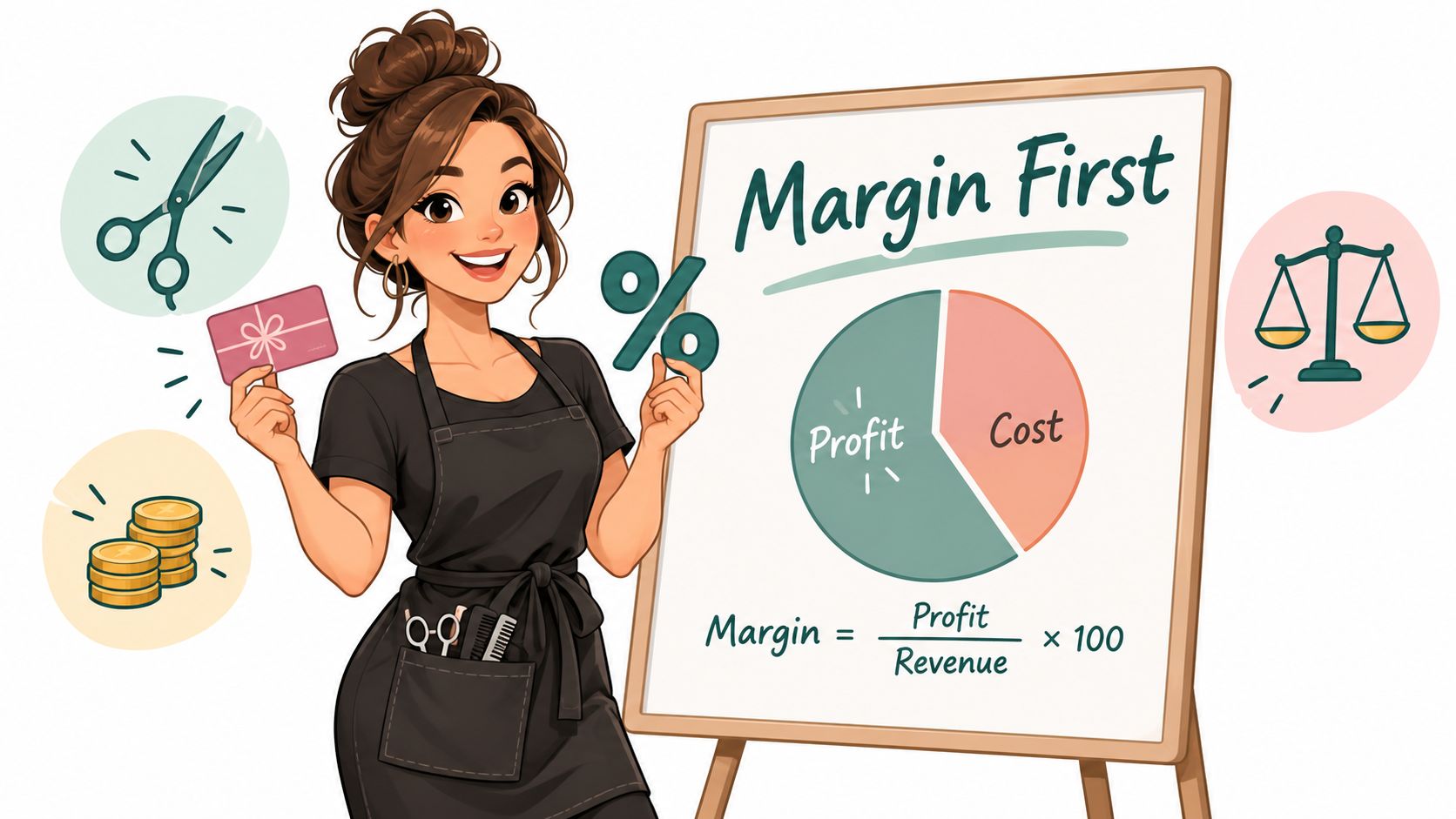
Start reward discussions with service contribution, not the menu price. This visual reinforces the distinction staff and owners need to understand.
Cost the reward in the appointment where it lands
For a percentage discount, reward cost equals eligible service price multiplied by the discount rate. A fixed-value credit is easier to cap, but it can consume a large share of a smaller ticket unless you apply a minimum spend.
For a blowout reward, include product, compensation, and appointment capacity. An empty off-peak slot and a slot that could sell at full price don't have the same economic cost.
A facial upgrade may preserve the headline service price, but it still uses consumables and staff time. Check whether it extends the appointment, displaces another booking, or replaces an upgrade the client normally purchases.
A complimentary add-on is only inexpensive when its product, labor, and capacity costs are genuinely limited.
Use this break-even test:
Incremental contribution from changed client behavior must exceed reward costs, administration costs, and displaced full-price contribution.
Estimate contribution using net service revenue after variable delivery costs. Include commission or contractor arrangements according to your actual compensation model. Divide total program cost by the contribution from an additional qualifying visit to estimate the extra visits needed to break even.
The video provides another format for discussing the program with your team; use your own service-cost records for the decision.
Use discounts where there's a reason
Discounts aren't wrong. In Square's 2024 salon-client survey, one in three clients had explored alternatives outside their main hairstylist, and 52% of that group said loyalty discounts could persuade them to return.
That supports testing a targeted return incentive, not discounting the entire diary.
- For a color retouch: Consider a capped credit tied to a relevant return appointment.
- For a blowout series: Restrict complimentary redemption to capacity you can afford to allocate.
- For a facial package: Test a costed upgrade instead of reducing every treatment price.
- For recognition: Offer priority access only if you can deliver it without disadvantaging other bookings.
Publish minimum spend, peak-period restrictions, and limits on stacking before clients start earning. Don't change the rules at redemption because the reward suddenly looks expensive.
Running the Program Day to Day at the Chair
A loyalty transaction should sit inside the existing checkout routine. It shouldn't require the stylist to leave a client waiting while someone searches for instructions.
After a completed appointment, confirm the service and payment, identify the correct member record, apply the eligible earning rule, and check that the entry saved. If staff enter transactions manually, reconcile them against completed appointments rather than relying on memory.
Make balance confirmation part of checkout
Give staff a short sequence they can practice:
- Check the account: Match the client to the member record before changing a balance.
- Review eligibility: Confirm the completed service qualifies under the published rule.
- Apply redemption: Check available rewards and record the benefit used.
- Record earning: Follow the policy on whether redeemed purchases also earn.
- Confirm progress: Tell the client the updated balance and available next benefit.
Suggested wording is straightforward: “I've added today's qualifying visit. Your updated balance is on your pass.”
If the client has earned a benefit, name it and explain any booking requirement. Don't ask clients to choose an unfamiliar treatment while they're trying to pay and leave.
Resolve exceptions without inventing new rules
A client short of the stamp threshold may ask to pay for a future visit today and collect the remaining progress immediately. If the program rewards completed visits, advance payment doesn't qualify. Explain that distinction consistently rather than making an exception for whoever asks most firmly.
Points programs may permit partial redemption, but staff need a documented rule. If partial redemption isn't supported, don't create a manual workaround that leaves the account balance inconsistent with the receipt.
For refunds, define whether associated earnings are reversed and how previously redeemed rewards are handled. Limit correction permissions, and record the reason for adjustments.
At checkout: Staff should explain the rule, not negotiate it.
Finish with a service-led rebooking prompt: “Shall we reserve your next maintenance appointment with your usual stylist?” Mention a reward only when it's relevant to that appointment.
For chair-rental salons, agree who funds rewards, who can redeem them, and whether balances apply across stylists. Without that agreement, a shared pass can create disputes over who bears the cost.
Keep a staff reference covering eligibility, redemption, refunds, corrections, and escalation. Review exceptions with the team each week, then adjust unclear procedures before they become repeated client complaints.
Measuring What Matters and Avoiding Common Traps
Enrollment tells you who joined. It doesn't tell you whether clients changed their behavior or whether the salon earned more after paying for rewards.
Use the engagement framework described in Bloy's beauty loyalty analysis to build a compact dashboard.
| Metric | What it tells you |
|---|---|
| Enrollment-to-first-earn | Whether joining leads to qualifying activity |
| Earn-to-second-visit | Whether clients return after their initial earning event |
| Redemption rate | Whether members reach and use the benefit |
| Incremental revenue per member | Whether spending exceeds a comparable baseline |
| Unredeemed reward exposure | The outstanding benefits you may need to fund |
Compare behavior and contribution
Where practical, compare eligible clients receiving the offer with a similar holdout group. Match service mix and previous visit frequency, and allow enough time for the normal repurchase cycle. Otherwise, you may mistake existing loyalty for program impact.
Use the loyalty program ROI calculator to organize assumptions, then replace estimates with actual redemption and delivery costs. Revenue growth without contribution growth isn't a satisfactory result.
Keep the launch manageable
For an initial month-long launch:
- Before rollout: Establish the baseline, approve reward costs, and publish terms.
- At launch: Test pass access, staff entries, and correction handling.
- During operation: Review inactive accounts and recurring checkout problems.
- At review: Compare return behavior and contribution, extending observation when clients aren't yet due.
Avoid expiry shorter than the normal visit cycle, excessive tiers, and rewards funding unchanged purchasing behavior. Success is a measurable improvement in profitable rebooking, not a large membership list.
Loyal Customer offers phone-managed points programs and digital stamp cards, with loyalty passes for Apple Wallet and Google Wallet. Visit Loyal Customer to trial a simple salon program, test earning and redemption with your staff, and check the reward economics before a wider rollout.