Loyalty card benefits really come down to three things: more repeat visits, easier reward tracking, and less dependence on paper punch cards. A good rewards setup creates that value on both sides of the counter at once, for the customer and for the business.
Table of Contents
- The Quick Answer On Loyalty Card Benefits
- Quick Summary Of Loyalty Card Benefits
- Why It Matters In Practice
- The Pull of a Nearly Full Card
- Retention Versus Acquisition in Plain Terms
- Near-Term Rewards Beat Distant Jackpots
- The Everyday Friction Paper Cards Create
- How the Customer Experience Works
- Why This Makes Loyalty Card Benefits Clearer
- What Customers Gain
- What Business Owners Gain
- Paper Punch Cards Compared With Wallet Loyalty Cards
- Where the Real Value Lives
- Why Simple Programs Win
- How a Cafe Stamp and a Salon Visit Work
- Gyms, Baskets and Phone-Only Shops
- Why the Scale Doesn't Have to Be Large
- Map the Customer Journey
- Run It from a Phone
- Measure What Matters
- Are Loyalty Cards Only for Large Businesses?
- Do Customers Need to Download an App?
- How Fast Can You Launch a Digital Card?
- How Do You Know the Program Is Working?
The Quick Answer On Loyalty Card Benefits
Picture the usual coffee shop stamp card. A stamp by itself is only ink on cardboard, yet each visit brings the customer closer to a free drink. That small sign of progress changes behavior over time, because “come back soon” stops being a vague idea and becomes something they can count.
That is the basic mechanism behind every loyalty card, whether it is paper, plastic, or a digital pass in Apple Wallet or Google Wallet. The customer always knows the next step, and the business has a simple way to recognize people who keep coming back.
A loyalty card works because coming back feels like progress.
For customers, the appeal is easy to see: fewer cards to carry, rewards they can check quickly, and less chance of losing the card before the freebie. For owners, the value shows up as steadier retention, less printing, and a clearer view of who returns and how often.
Quick Summary Of Loyalty Card Benefits
Before getting into the details, here is the short version of who gains what.
| Benefit | What It Means | Who Feels It Most |
|---|---|---|
| Repeat visits | Customers come back more often to reach the next reward | Business owners |
| Easier reward tracking | Balances and stamps update after each visit | Both |
| No paper cards | Nothing to print, replace, hand out again, or lose | Both |
| No extra app | Cards sit inside wallets customers already use | Customers |
| Better insight | Merchants can see return patterns more clearly | Business owners |
The pattern is simple: customers get a smoother experience, while merchants get repeat behavior they can actually observe.
Why It Matters In Practice
Repeat visits matter because regulars are easier to serve than strangers. They already like the product, they need less convincing, and a visible reward gives them one more reason to choose you today.
Digital wallet cards remove the little annoyances that quietly kill paper programs. There is no “I left it at home,” no soggy card in a jeans pocket, and no replacement stamp card starting from zero.
The gains are different for each side, but they reinforce one another:
- Customers get convenience, visible progress, and rewards that feel within reach
- Owners get retention, fewer printed cards, and better visibility into returning guests
- Staff get a cleaner process with less explaining at the till
This guide looks at the full picture: why repeat visits carry so much commercial weight, how wallet-based cards reduce everyday hassle, what customers and merchants each gain, where the benefits show up in cafes, salons, and gyms, and how to launch something you can measure.
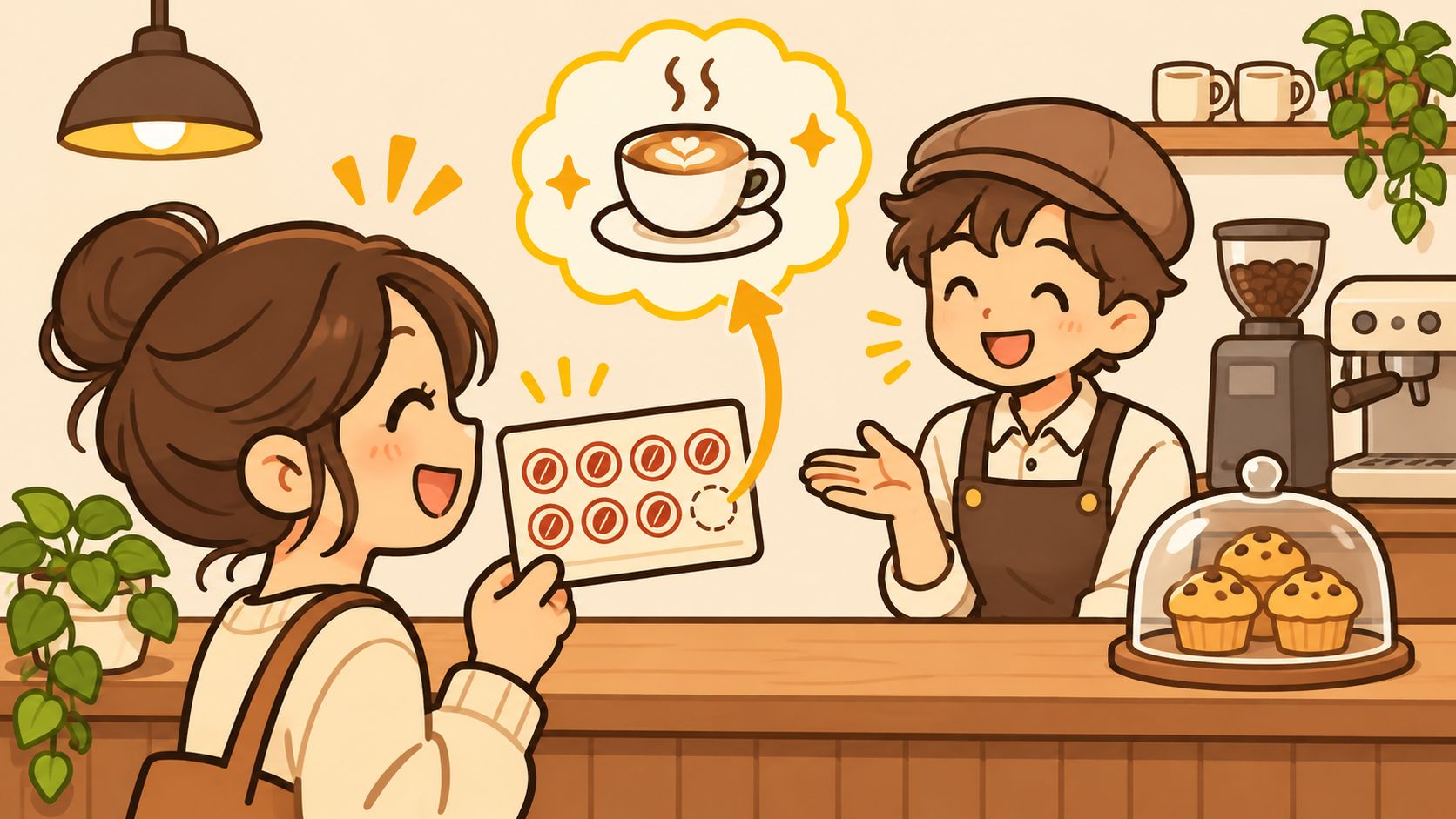
A loyalty card quietly turns a single sale into the start of a habit. It gives the customer an obvious next step, and it gives you an easy way to notice and thank the people who keep coming back.
The Pull of a Nearly Full Card
Think about a coffee stamp card with nine of ten squares already filled. That one empty box often does more work than a percentage off, because the customer can almost taste the free drink.
Salons see the same effect. A regular who knows her next cut and color will earn a bonus treatment feels a small tug to book six weeks out. Rebooking stops feeling like a chore and starts feeling like progress.
A reward that is easy to picture is a reward customers actually chase.
That's why loyalty card benefits usually show up as steady repeat visits rather than occasional spikes. The card doesn't just say thanks for stopping by. It shapes the decision people make on their next visit.
Retention Versus Acquisition in Plain Terms
Winning a brand-new customer takes ad spend, staff time, and a good measure of luck. Keeping someone who already likes you costs far less, which is why loyalty programs fit so well with the bigger goal of keeping existing customers engaged. This guide to keeping ecommerce customers longer covers that idea well.
The catch is distance. A reward ten visits away feels abstract on a slow Tuesday afternoon, but a reward two visits away feels like something worth finishing.
The numbers point the same way. Members who join and then actually redeem a reward tend to buy again more often. We go deeper into that in our piece on whether loyalty programs increase sales.
Near-Term Rewards Beat Distant Jackpots
Plenty of owners assume the prize has to be big to matter. In practice, a modest reward that's close usually beats a dazzling one that's far away, simply because the customer can see the finish line.
Good near-term rewards tend to share a few traits:
- One stamp per visit, so progress shows up every single time
- A reward within a handful of visits, not a handful of months away
- A finish line worth wanting, so the last square feels worth the effort
Design matters more than size. A café that offers a free coffee after eight visits sees steady returns, while a lavish prize sitting thirty visits away mostly goes untouched.
Simplicity helps your team too. A card that explains itself at the till gets mentioned at the till, and a card nobody mentions earns nothing.
The idea is simple enough: make the next reward close enough to see, but valuable enough to chase. Get that right, and the card stops being a giveaway and becomes the reason someone chooses you on a slow Wednesday.
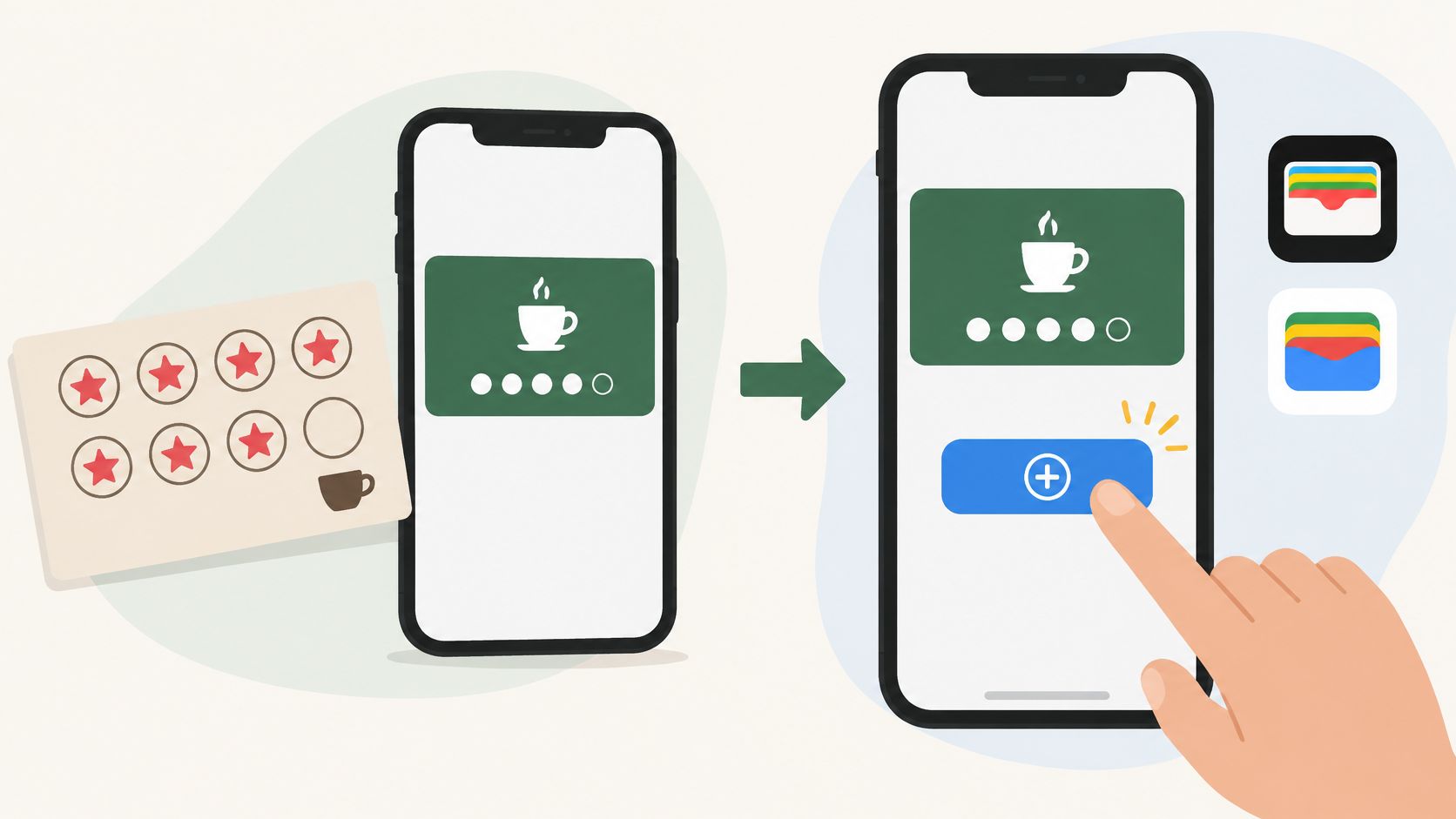
A paper punch card has one job, and it fails at it more often than most owners would like. It gets left in a jacket, washed in a pocket, or forgotten on the exact day the customer earns the free drink.
Digital loyalty cards take that friction out of the picture. The card lives in Apple Wallet or Google Wallet, sitting right beside payment cards and tickets, so it is already open when the customer reaches the till.
The Everyday Friction Paper Cards Create
Think about standing at the counter and realizing your stamp card is still sitting on the kitchen table. The barista has no record of your visits, you can't prove you earned anything, and the reward quietly slips away.
That moment costs more than a free coffee. It breaks the thread of progress that makes a loyalty card worth carrying in the first place.
A wallet pass closes that gap. The stamp count or points balance stays with the customer and updates after every visit, so nobody has to rebuild the history at the counter.
When the card updates itself, the reward stops depending on memory.
How the Customer Experience Works
Here's how it usually plays out. The customer taps a branded public link, confirms their identity, and adds the card to their wallet in a few taps. There's no separate app to download.
Supporting both iPhone and Android matters more than it sounds. If a business offers only one format, half its customers end up in an ecosystem they may not use, and that alone can be enough to make them skip the program.
- Apple Wallet works for iPhone users with no extra setup
- Google Wallet does the same job for Android users
- One public link serves both groups from a single branded page
Then the card does its work at checkout. The customer shows the pass, staff scan the QR code, and the balance updates on the spot. Nothing is printed, nothing is reissued, and the card never resets to zero because a paper version was left at home. For regulars, that continuity is everything.
Why This Makes Loyalty Card Benefits Clearer
The benefits of a digital card are easiest to see in the moment of use. Customers stop losing progress, and staff stop pausing to ask whether a paper card was stamped.
Owners get cleaner tracking too. Repeat visits become visible, rewards get redeemed without awkward guesswork, and the whole program runs from a phone instead of a drawer full of cards.
If you want the full setup details, our guide on adding a loyalty card to Apple Wallet walks through it step by step.
A loyalty card works best when it asks nothing extra from the customer. Wallet passes do exactly that, which is why they make the benefits of a loyalty program so easy to feel.
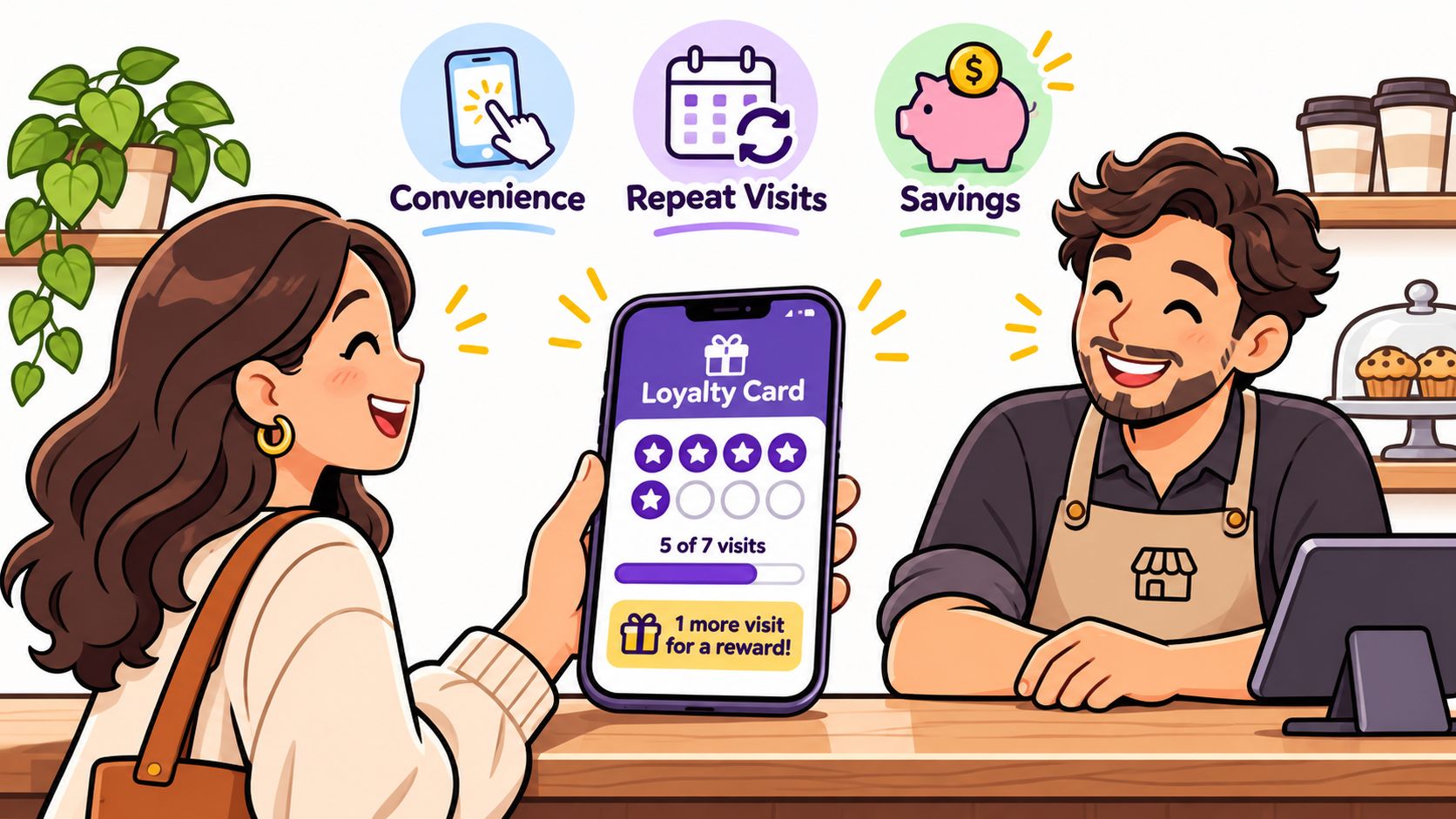
Every loyalty card comes down to one simple question: who gains what? The answer changes depending on which side of the counter you're standing on. Still, the two sides depend on each other more than most owners expect.
What Customers Gain
Customers notice the benefits in small, everyday moments. A card that fits into their routine is the card they actually keep using.
- Convenience: the card sits in a wallet they already open for payments and tickets.
- Visible progress: every stamp or point shows how close the next reward is.
- Fewer lost cards: nothing gets left behind in a jacket pocket, and the balance stays with them.
- No new app: the card lives in Apple Wallet or Google Wallet, so there's nothing extra to download.
What Business Owners Gain
For owners, the payoff shows up in two places: the sales figures and the printing bill. Nearly all of it traces back to one thing, a customer who keeps coming back.
- Repeat visits: regulars return more often because the next reward feels within reach.
- Easier reward tracking: balances update after each visit, so staff never have to reconstruct history at the till.
- Lower printing costs: no reprinted cards, no replacements, and no stamp cards handed out again.
- Clearer customer insight: you can see who returns and how often.
Paper Punch Cards Compared With Wallet Loyalty Cards
Paper still works for some shops, but the differences become obvious once you see the two side by side. The table below shows where they split apart and why each difference matters at the counter.
| Area | Paper Punch Cards | Digital Wallet Loyalty Cards | Why It Matters |
|---|---|---|---|
| Access | Tucked in a pocket, and easily left at home | Stored in the phone's wallet | Customers almost always have it with them |
| Tracking | Staff check the card by hand | The balance is visible on the pass | Fewer checkout mistakes |
| Updates | Stamped manually after each visit | Updates automatically after each visit | Less time spent at the till |
| Replacement | Reprinted and handed out again | Reissued without printing | Lower ongoing costs |
| App Requirements | None | Built-in wallet apps only | No extra download |
Wallet cards remove the small frictions that slowly wear down a paper program. Each row in the table is a little bit of time or effort that no longer lands on either side.
Where the Real Value Lives
The card itself is only a tool. What matters is the habit it encourages.
A customer comes back, the business notices, and the next reward feels a little closer. That loop repeats with every visit, and it's how a single sale slowly turns into a routine.
Every recognized return is a small win for both sides.
Why Simple Programs Win
Simple programs often beat complicated ones. Staff and customers can understand them at a glance, even during a busy rush.
A stamp card that anyone can explain in one sentence gets mentioned at the till. A complicated tiered system, on the other hand, often gets ignored.
Start with one clear reward and explain it in a single sentence. Customers trust a program they understand, and that trust brings them back. Often, a short explanation at checkout is all it takes to turn a visitor into a regular.
Small shops get the same benefits as big chains, even though they rarely look like a supermarket or an airline. A card that tracks progress, plus a phone that can update it, is all a team of two needs.
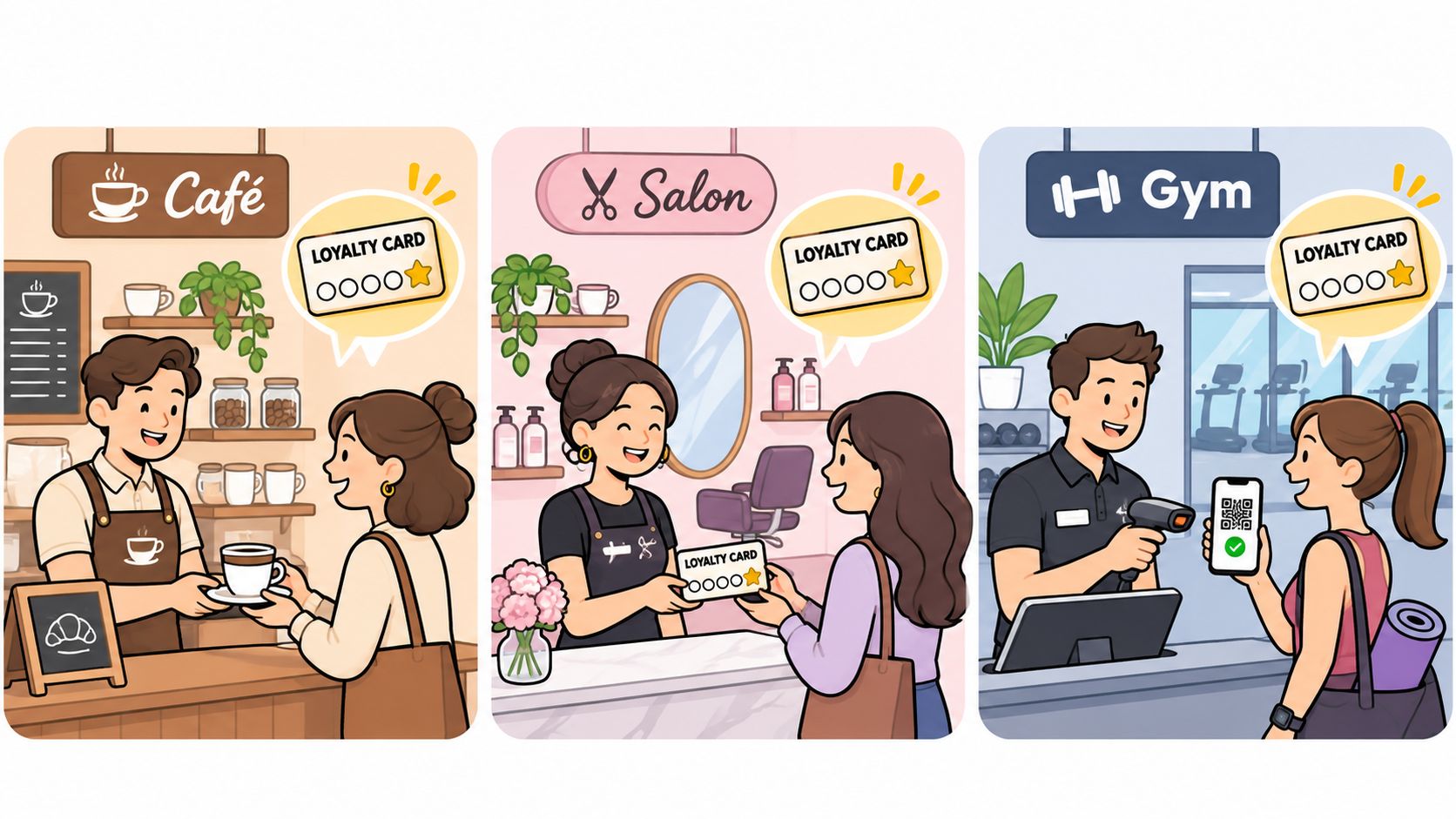
Those scenes show how the mechanism works. They don't promise you'll see the same results. Two things matter most: the customer has to see a reward they actually want, and the staff member has to finish the update during an ordinary checkout.
How a Cafe Stamp and a Salon Visit Work
Take a cafe that gives one stamp per checkout, with a free drink when the card fills up. The customer watches the empty squares shrink, and that small bit of progress is often enough to bring them back. The owner also gets a reason to greet a regular by name instead of treating every cup as a one-off sale.
A salon can run the same idea with points for the client who books every six weeks. That client has a clear reason to rebook before the color fades. The owner sees fewer gaps in the calendar, and doesn't need to invent a new offer every month.
Both setups suit a small team working from a phone:
- One action at the till, a scan that adds the stamp or points
- No paper to reprint when a card goes missing
- A balance the customer already carries in Apple Wallet or Google Wallet
Staff don't need a terminal or a long script. They mention the next reward while the payment is still open, then move on to the next person in line.
Gyms, Baskets and Phone-Only Shops
A gym can reward milestone visits, such as a guest pass after a set number of check-ins. Members get a push to show up on a slow week, and the studio gets a clear picture of who is actually using the membership. This pairs well with incentives like the ones in these referral program tips from Fitness GM.
A bakery or independent grocery can reward a regular's basket the same way. The customer sees progress toward a free loaf or a small discount. The shop sees which customers keep coming back, without counting paper punches at closing time.
A micro-merchant selling through Instagram or WhatsApp can share a public link instead of asking people to download an app. The customer adds the card in a few taps, and the seller updates it from the same phone used to take the order.
Loyalty cards aren't just a big-chain tool. They're a repeat-visit habit that fits any counter.
Why the Scale Doesn't Have to Be Large
People often assume loyalty cards only suit supermarkets and airlines. The underlying logic is much simpler. A customer buys again, the business notices, and the next reward gets a little closer.
That loop doesn't need a national brand, a call center, or custom hardware. It needs a reward people understand and a way to record it before the customer walks out the door.
If you want more examples like these, check out our guide on customer loyalty examples from everyday shops. Treat them as patterns to adapt, then test one reward with your own regulars before you expand the offer.
A loyalty card program lives or dies on the reward, not the software. The card is just the delivery method. Stamps suit visit-based habits like coffee or haircuts, since every visit is worth about the same. Points suit varied spending or recurring services, where one ticket is rarely identical to the next.
Choose the model your regulars already understand. A café might hand out one stamp per checkout and a free drink once the card is full. A salon could award points for color, cuts, and add-ons, then let clients spend them on their next booking.
Map the Customer Journey
The path has to feel short, or people won't bother. A customer opens a public link, confirms who they are, and adds a pass to Apple Wallet or Google Wallet. No separate app needs to be downloaded.
Checkout is where the card either earns its place or gets forgotten. Staff scan a QR code to add a stamp or points, or to redeem a reward, all while payment is still open. A short line works better than a speech: "You're one visit away from a free drink."
A loyalty card works when coming back feels easier, not when it adds another chore.
That reminder matters more than it looks. If staff never mention the card, the benefits stay on the customer's phone and never make it to the till.
Run It from a Phone
Plenty of owners assume a loyalty program means a full POS integration. For most small shops, it doesn't. A phone-based workflow with QR scanning handles stamps, points, and redemptions without extra hardware or a dedicated terminal.
Loyal Customer is built around that approach. You can set up a branded card in a few minutes, share one public link, and update balances from the same phone you already use at the counter. The pass refreshes after every visit, so nobody has to rebuild a customer's history by hand.
Keep the rules simple enough to explain in one sentence:
- One stamp per checkout, or a points rate staff can say out loud
- One reward people can name without checking a menu
- One scan to add value or redeem it
- One reminder from staff while the customer is still at the till
Measure What Matters
Start small, then watch three signals. Repeat visits tell you whether people are coming back. Reward redemptions tell you whether the prize feels close enough to chase. Card presentations tell you whether customers actually open the pass.
The real problems are usually ordinary. Rewards nobody understands get ignored, and staff who forget to mention the card quietly kill the habit you're trying to build. The myths are different. You don't need a national brand, a special terminal, or a giant prize for the loop to work.
Test one offer with a handful of regulars before you scale up. If they come back, redeem, and show the card, the program is doing its job.
Small shops tend to get stuck on the same four questions. Below are the answers that usually settle the objections, along with a practical next step so you can decide whether to start this week.
Are Loyalty Cards Only for Large Businesses?
Not at all. A café, a salon, a gym, a bakery, or a phone repair shop can run the same loop a national chain does. A customer comes back, you notice, and the next reward moves a little closer.
You don't need a national brand, a call center, or any extra hardware. Choose stamps if your customers visit for the same thing each time, or points if their spending varies. Then test one reward with a handful of regulars.
Do Customers Need to Download an App?
They don't. Customers open a unique public link, confirm who they are, and add a pass to Apple Wallet or Google Wallet.
The card sits right beside the payment cards they already carry. You can share that link in person, on Instagram, or over WhatsApp, and nobody has to install a third-party app.
If the card lives in a wallet they already open, joining takes a few taps.
How Fast Can You Launch a Digital Card?
Faster than you'd expect. A business can build a branded card in a few minutes. Loyal Customer runs a digital stamp card or points program from a phone, with no POS system and no extra scanner.
Set one stamp per checkout, or pick a points rate your staff can explain in one sentence. At the till, scan a QR code to add or redeem value while the payment is still open. The pass updates after every visit, so nobody has to rebuild a customer's history by hand.
How Do You Know the Program Is Working?
Ignore the vanity totals and watch three signals instead.
- Repeat visits show whether people actually come back
- Reward redemptions show whether the prize feels close enough to chase
- Card presentations show whether customers remember to open the pass
If regulars return, redeem, and show the card, the program is doing its job. If your staff never mentions it, fix that reminder before you touch the reward. Start with one clear offer, share the public link, and check those three numbers after a short test.
Loyal Customer lets a small team run that test from the phone already sitting on the counter. Build a wallet card, share one public link, and see who comes back. Start a free trial with Loyal Customer.