The lunch queue is building, a regular can't find their punch card, and the next customer wants to know where you'll park tomorrow. You'd like to reward both of them, but you can't turn every checkout into a sign-up conversation.
Good food truck loyalty cards fit around service, not the other way round. Choose a card customers can present quickly, give them a reward worth finishing, and make bringing a friend part of the same routine. Then plan for the awkward bits: weak signal, replacement phones, duplicate claims and customers turning up at the wrong truck.
Table of Contents
- Loyalty Card Options That Suit a Food Truck
- How to Set Up a Stamp Card Customers Finish
- Asking Satisfied Customers for Referrals
- Following Up on Referral Requests Over Thirty Days
- Problems With Mobile Loyalty Cards and Their Fixes
- Confirm Your Referral Plan Before the Next Market
Loyalty Card Options That Suit a Food Truck
Loyalty card types for food trucks compared
| Card type | Best for | Reward model | Main drawback |
|---|---|---|---|
| Loyal Customer digital stamp or points card | Trucks with regular daily customers | Stamps or points in Apple Wallet and Google Wallet | Requires a phone at checkout |
| Paper punch card | Fixed-spot trucks at one market or office park | One stamp per visit, free item when the card is full | Customers can lose it, and staff can over-stamp |
| Printed coupon book | Festival and event trucks | Fixed percentage discount | Discounts may reduce takings without building repeat visits |
| Points card tracked on a tablet | Trucks with varied menu prices | Points per dollar spent | Staff must log each sale |
| Tiered visit card | Trucks with high-frequency regulars | Better perks at 10 and 20 visits | Harder to explain at a busy window |
| Referral card | Trucks that want new customers | Reward when a regular brings a friend | Requires a way to track who earned the reward |
Choose for the way you trade
Loyal Customer is one option for a truck with regular daily customers, letting you manage digital stamps or points from your phone with branded cards in Apple Wallet and Google Wallet. Customers do not need a separate app, and the card updates after each visit. At checkout, someone still needs to scan the customer's pass, so keep the step quick enough for the queue.
A paper punch card suits a truck that returns to the same office park or market. Give one stamp per checkout and a reward when the card is full. It is familiar and simple, but customers can lose cards and staff have little way to confirm missing progress.
A printed coupon book fits a festival truck selling across a weekend. A fixed discount is easy to understand and may prompt another purchase during the event. The trade-off is that it cuts the price on purchases customers might have made anyway, without necessarily giving them a reason to find you afterwards.
Match complexity to the reward
A tablet-tracked points card can suit a menu with widely varying prices. Set a clear points-per-dollar rule, then make the redemption threshold easy to explain. Manual entry adds work at the window, particularly when one person handles payment and food.
A tiered visit card suits committed regulars. For example, better perks at 10 and 20 visits can give customers a reason to keep coming back, as long as each benefit is affordable and the rules fit in a short explanation.
A referral card puts the request to bring a friend alongside the loyalty reward. Give each regular a trackable code, and award the referral reward when a new customer buys with it. A shared discount code without a record of who referred the customer cannot reliably credit the right person.
Repeat purchasing deserves attention: Circana figures reported by DataCandy put loyalty members at 39% of restaurant visits, up from less than 20% five years earlier. That is restaurant-wide context, not a forecast for a particular truck.
For ideas on connecting loyalty rewards with customer communication, see Purple Engage restaurant loyalty guides.
Practical rule: Choose the card your regulars will use at the window, and make the referral reward easy to track without slowing service.
How to Set Up a Stamp Card Customers Finish
Start with a card the cashier can explain while handing over an order. Keep the qualifying purchase, reward and redemption rule visible together, rather than hiding the exceptions on another screen.
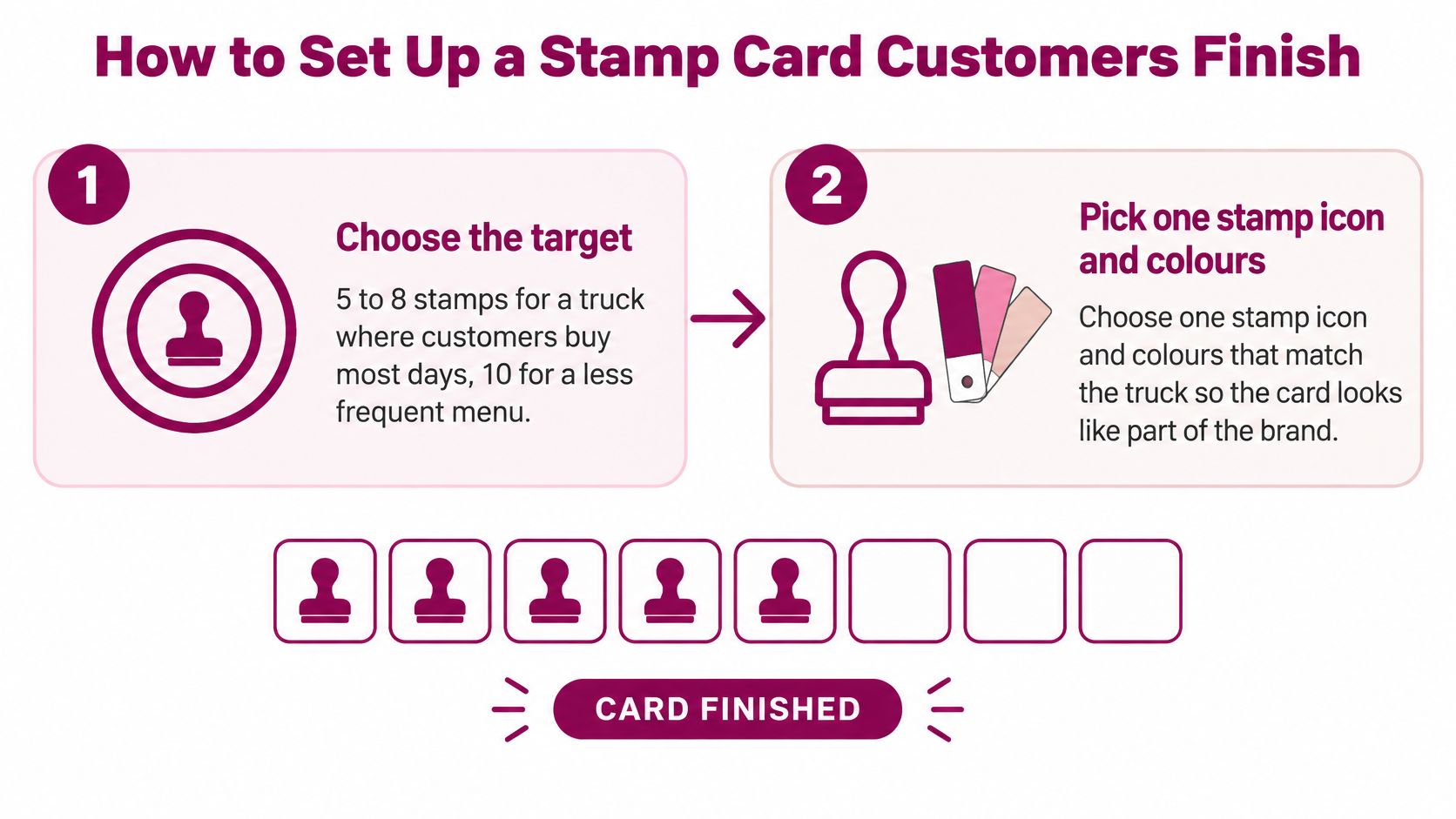
Use this visual as a setup prompt, then settle the operating rules before issuing cards.
Build the card around a reachable reward
Choose the target. As a starting scenario, test 5 to 8 stamps where customers buy most days, or 10 for a less frequent menu only if customers still have a realistic route to completion. The slip is choosing a large target to protect margin, then discovering nobody gets close.
Pick a stamp icon and colours that match the truck, with enough contrast to read outdoors. The common mistake is treating the pass like a miniature menu board, when customers mainly need to see progress and the reward.
Choose an affordable reward, such as a drink or side, and name the eligible item precisely. Avoid promising any free item if your menu includes products with very different ingredient costs.
Give customers visible starting progress: the Nunes and Drèze car-wash experiment described by Tableport found completion rose from 19% to 34% with a head-start card, while both groups still needed eight purchases. Test a bonus stamp or two, but distinguish bonus progress from paid purchases and adjust the displayed target transparently.
Make the window routine repeatable
Enrol customers while the queue is short, and explain what they're agreeing to before collecting contact details. The slip is asking a customer to complete verification while everyone behind them waits to pay.
Issue one stamp per checkout and log it against the receipt, with a separate record for promotional bonuses. Staff double-stamping during a rush is the preventable failure here, so check the receipt before adding progress rather than relying on memory.
For reward variations, use these stamp card ideas to compare a drink, side or upgrade against your menu costs. If your truck returns to recurring events, MODERN LYFE's guest retention ideas for event planners provide another way to think about the next invitation, not just today's purchase.
A sensible first-week picture might include several customers with two or three stamps and a clear understanding of what comes next. That's an example of useful early progress, not a completion benchmark. If customers keep asking what the card means, simplify the wording before adding points, tiers or extra offers.
Asking Satisfied Customers for Referrals
Ask for a referral when the customer has a reason to recommend you. A stamp milestone gives you a natural opening because you're already discussing their card. Praise for the food is another good trigger, as is a regular returning for a third or fourth visit.
The invitation should feel like part of the reward, not a sales task handed to the customer. Choose a moment after they've received the right order and aren't trying to move out of someone's way.
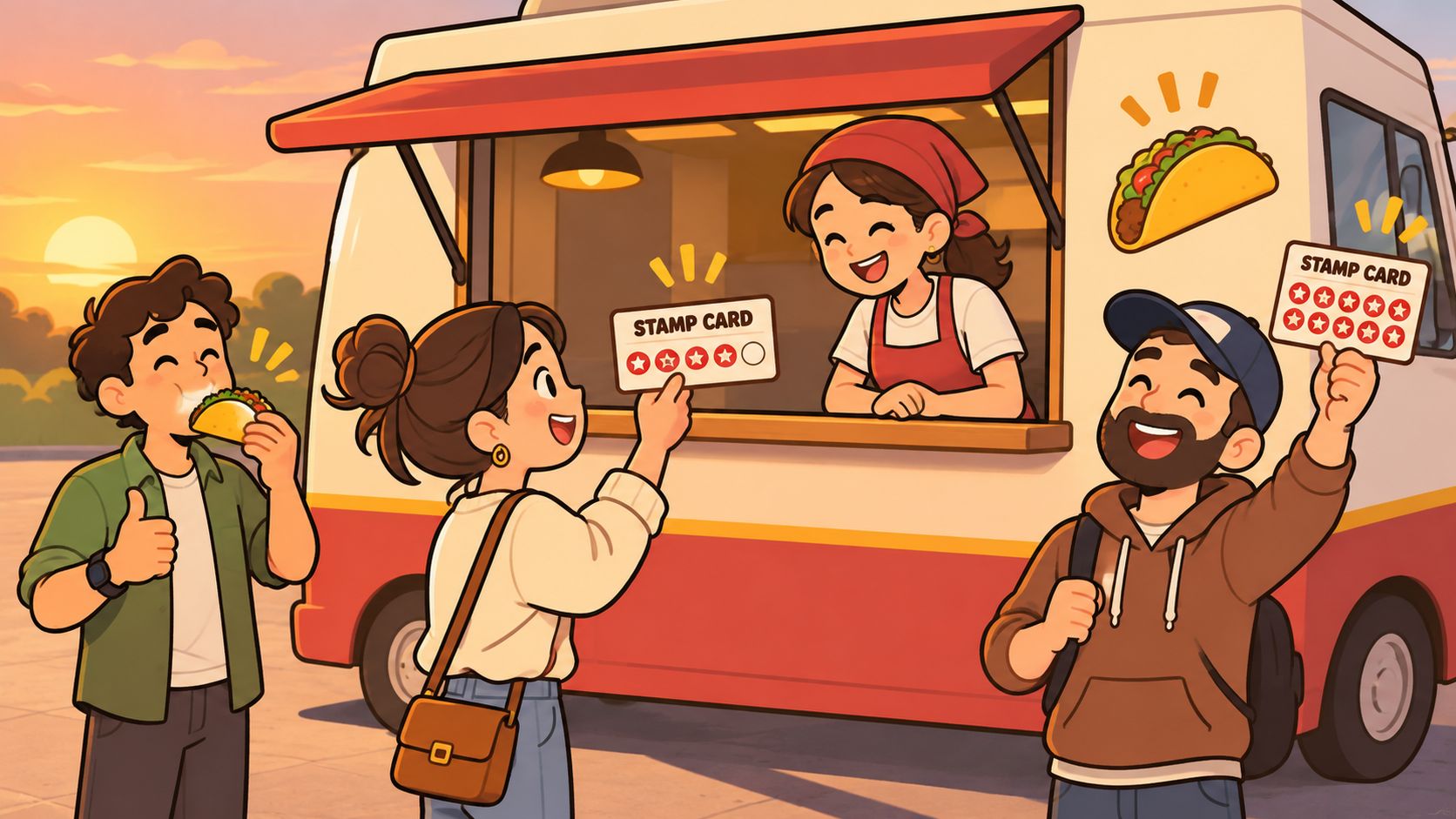
A shared meal is the situation you're encouraging, not another code scan.
Say exactly what the friend gets
For a taco truck, a useful owner-to-regular script would be:
Bring a friend this week and you both get a free horchata. Share your card link and have them show your code when they order a meal.
That's a hypothetical offer, so cost both drinks before using it. The wording gives the regular a reward, an action and a qualifying purchase without asking them to explain your whole loyalty program.
Keep the spoken request under two sentences. Don't ask someone to share, follow, review and refer during the same exchange, and don't approach every first-time buyer as though they've already become an advocate.
Give staff a way to verify it
Have the friend open the shared card link and present the regular's short referral code at checkout. Staff should attach the new customer's qualifying receipt to that code and note who referred whom in the transaction log. A common enrolment link alone doesn't identify the referrer.
Keep the referral record separate from the earned-stamp total. Otherwise, staff can't tell whether a reward came from purchases, promotional progress or a referred sale. These customer referral program ideas can help you choose the incentive, but the checkout record is what makes it manageable.
Avoid asking while the queue is backing up, and don't offer a referral reward larger than the contribution margin available from the qualifying sale. If both people receive a perk, include both costs.
Your day-one task is small: write one script, print one trackable code for the test cardholder and choose one trigger to test for a week. Use the same offer throughout that test so staff aren't explaining different deals to neighbouring customers.
Following Up on Referral Requests Over Thirty Days
Referral follow-up schedule
| When | What to send | What to check |
|---|---|---|
| Same day | Thank-you with the current stamp count | Card was added to the wallet |
| Day 3 | Referral request with one shareable code | Truck is trading that day, otherwise next trading day |
| Day 10 | Reminder that the friend gets a bonus stamp | Whether the friend has redeemed the code |
| Day 30 | Short note to lapsed cardholders | Whether the cardholder visited since the last note |
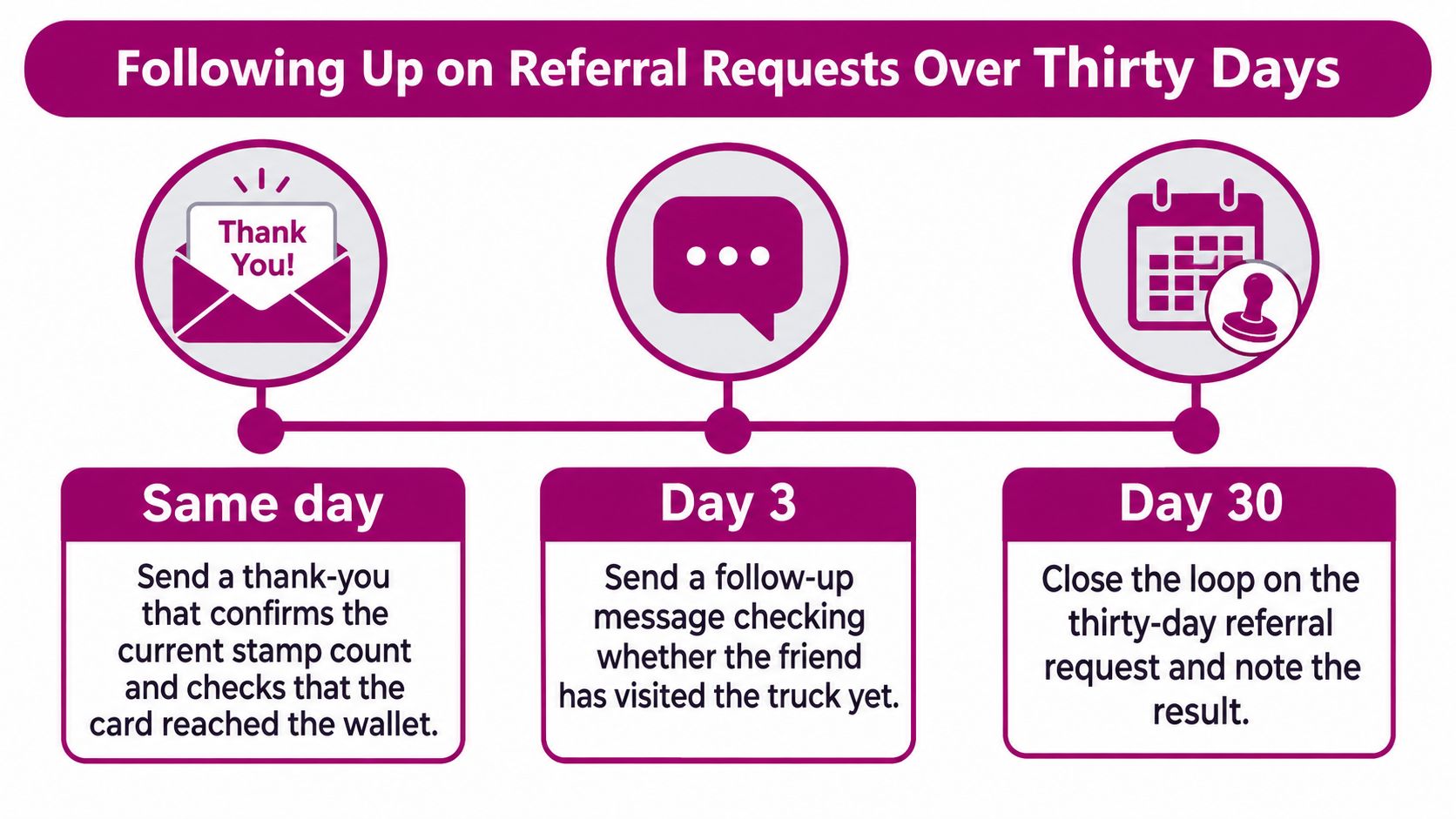
Same day, confirm the recorded stamp count and make sure the customer can find the card. Send follow-ups only through a channel they've agreed to use, and don't confuse saving a wallet pass with consent to unrelated marketing.
Keep the schedule visible beside your trading calendar.
Send when customers can act
On day 3, send the referral request with the customer's shareable code and your current location. If you're closed, move it to the next trading day. An invitation without an available service gives the customer another thing to remember.
On day 10, remind them that their friend gets a bonus stamp, if that's the offer you've chosen. Check the transaction log first and suppress the reminder when the friend has already redeemed.
On day 30, contact lapsed cardholders with a short location-specific invitation. Check for visits since the previous message so you don't tell a customer you miss them after serving them yesterday.
Use the video alongside your written workflow when preparing staff for the follow-up routine.
Measure referred purchases
- Thank promptly: Acknowledge each referrer within 48 hours as an operating target.
- Record the sale: Log every redeemed referral against its transaction record.
- Review weekly: Check referred purchases, reward costs and customer returns together.
Define referral rate as new customers who used a shared code divided by active cardholders over the same period. Decide what counts as active before starting, rather than counting everyone ever enrolled.
Record the first four weeks as your baseline, not an industry benchmark. Change one element of the offer at a time and compare the next period against that starting point, while noting changes in trading locations.
Problems With Mobile Loyalty Cards and Their Fixes
A dead signal at a busy festival is the failure to prepare for first. Keep the queue moving with a documented fallback, not a promise that every loyalty action will work offline.
With the customer's permission, record their phone number against the receipt and issue a temporary receipt code. Reconcile it later against the purchase before adding progress, then mark the code as used. A pass being available offline doesn't guarantee that balance updates or reward verification will synchronize during an outage.
Protect the customer's existing progress
Lost or replaced phone: Recover the existing card through the verified enrolment link instead of opening another account. The pass on the old device isn't a guarantee that it has transferred to the replacement, so confirm identity and the saved balance.
Duplicate stamp or reward claim: Compare the claim with the transaction log before redemption. Flag repeated claims made within minutes for review, but don't accuse a customer when a staff mistake or delayed update could explain them.
A receipt code is evidence to reconcile, not permission to issue an unchecked reward.
Put restrictions where customers can see them
- Multiple trucks: State that the reward applies only at the issuing truck, unless you've deliberately established shared redemption. Explain this before customers collect progress elsewhere.
- Unused rewards: Consider a clearly displayed expiry, such as 90 days, as a policy example rather than a universal rule. Check applicable requirements and make sure customers have reasonable trading opportunities to redeem.
- Wallet confusion: Show staff how to distinguish the loyalty pass from a payment card, so customers don't repeatedly open the wrong screen.
Wallets are already familiar payment tools: Statista reports they accounted for 56% of worldwide e-commerce transaction value in 2025. That measures payments, not loyalty adoption, but supports offering a wallet pass rather than requiring another customer app.
Use this mobile loyalty program guide when documenting the checkout and recovery process. Printing fallback receipt codes is a one-day fix; testing whether a different reward improves returns needs a month of consistent trading records.
Confirm Your Referral Plan Before the Next Market
Choose the card that matches your trade, establish a finishable stamp target with a transparent head start, and schedule the referral invitation around actual service days. The important connection is operational: the cashier must be able to verify both earned progress and a referred purchase without improvising.
Before launch, cost the reward using contribution margin rather than selling price. Suppose your average ticket is $12 and a reward drink costs you $1.50. Those are hypothetical inputs, not food-truck benchmarks, and the ticket alone doesn't tell you how much you can afford to give away.
Check the economics and the full path
Calculate contribution per extra visit after ingredients, packaging and other sale-linked costs. Divide total monthly reward and program costs by that contribution, then round up to find the extra visits needed to cover the program. For a referral offer, include every perk issued and keep its combined cost below the margin you retain on the qualifying sale.
Create a window enrolment code and a distinguishable referral-card code using the tools already available in your point-of-sale or wallet platform. Confirm that the referral code identifies the regular, rather than merely opening a generic sign-up page.
- Test both phones: Add your own card, earn a stamp and open a shared referral code from another phone.
- Check the record: Confirm that staff can connect the referred purchase, reward and receipt.
- Book the review: In two weeks, count stamps issued, referrals tracked and rewards redeemed before deciding what to change.
Before the next trading day, prepare the window sign and enrol your first five regulars while the queue is short. Watch where they hesitate, and fix that step before inviting the whole lunch crowd.
Loyal Customer lets you run a branded digital loyalty program from your phone, with cards for Apple Wallet and Google Wallet and no third-party app for customers. Visit Loyal Customer to build your card, and use the free Loyalty Program ROI Calculator or Branded QR Code Generator to prepare your food truck's first test.