59% of consumers said they may never return to restaurants with complicated ordering and payment experiences, according to the 2025 Restaurant Consumer Insights Report. That reframes food service rewards: a benefit that slows the queue can undermine the return visit you're trying to earn.
For a cafe or restaurant owner, the useful questions aren't just how many people join. They're what each reward costs, whether it changes buying behaviour, and how easily staff can handle it at checkout. A good program gives customers a reason to return without making every purchase cheaper.
Table of Contents
- How Food Service Rewards Work
- How Customers Join, Earn and Redeem at Checkout
- Why Rewards Bring Customers Back
- Reward Designs Customers Actually Redeem
- Protecting Margin When Rewards Cost You
- Measuring Whether the Program Pays
- Choosing Your Program and Launching It
How Food Service Rewards Work
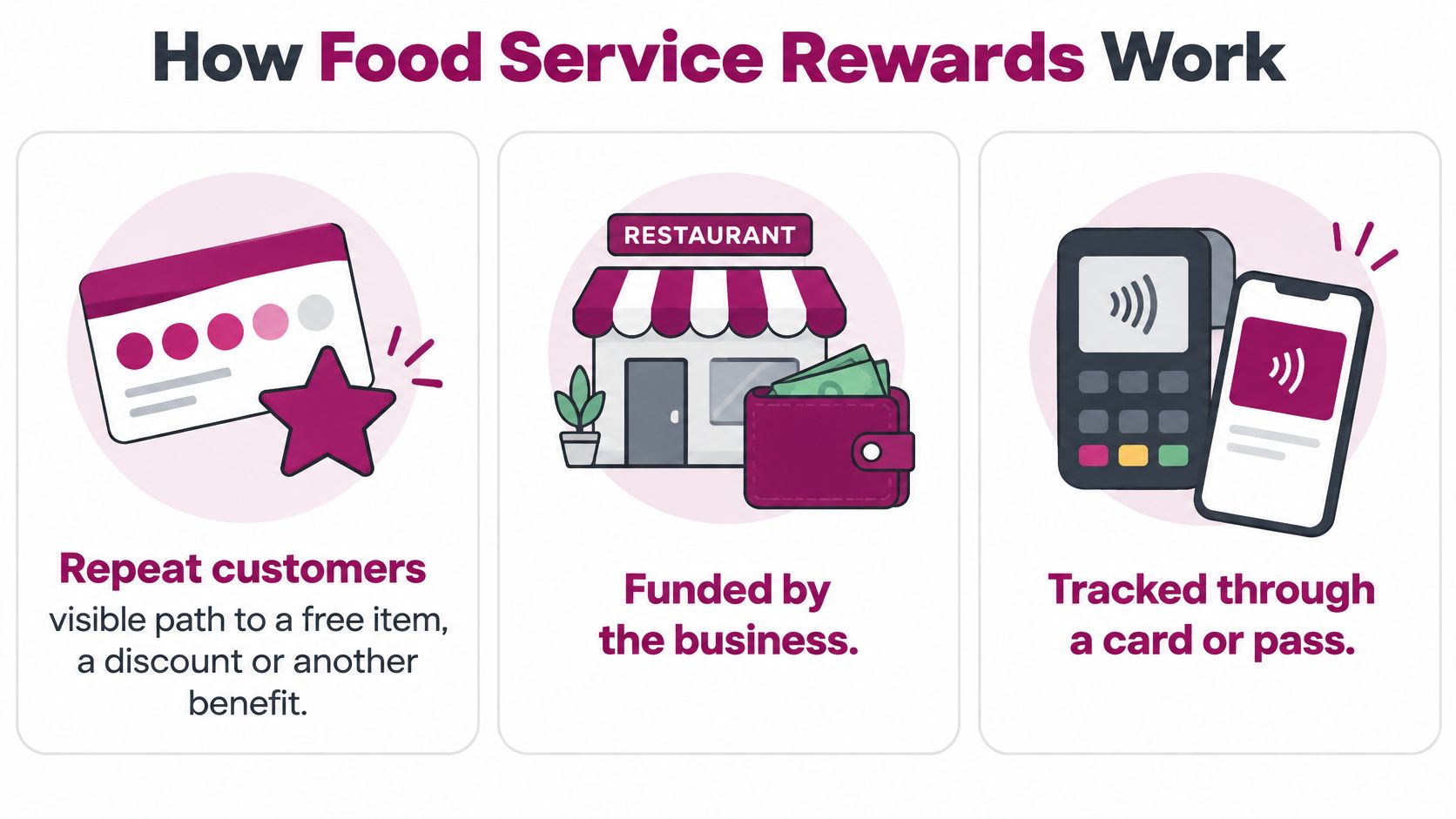
A food service rewards program gives repeat customers a visible path to a free item, discount or another benefit. The business funds the reward and tracks progress through a card or wallet pass.
The basic choice is between rewarding visits and rewarding spending. Both can work, but they encourage different behaviour.
Digital stamp cards and points programs compared
| Model | How customers earn | Reward setup | Best fit |
|---|---|---|---|
| Digital stamp card | One stamp per checkout | Target of 3 to 10 stamps; reward when the card is full | Cafes, bakeries and takeaways with similar orders |
| Points program | Points per dollar spent or by spend tier | Set thresholds per reward, such as 50, 100 or 250 points | Businesses with varied basket sizes |
A stamp card treats every visit the same, while points reward bigger baskets. Say a bakery mainly sells a drink and pastry together. Stamps keep the explanation short; a takeaway selling everything from individual lunches to family orders may prefer points linked to spending.
The underlying arrangement is straightforward.
Choose the behaviour you want to encourage
Rewards can affect the choice of restaurant before an order happens. In the National Restaurant Association's 2024 industry report, 78% of participating consumers said they were more likely to visit a restaurant offering points even when it was less convenient, while 48% said rewards made them less likely to try new restaurants.
Those are reported preferences, not a promise that your program will produce extra sales. You still need a reward customers value and a business they want to revisit.
With Loyal Customer, we let you run either model from a phone, without extra hardware or a separate customer app. Stamp cards also let you choose an icon, such as a coffee cup or star, but the earning rule matters more than the artwork.
Before choosing, review your recent orders. If most baskets are similar in value, stamps are simpler; if basket sizes differ widely, points give you a closer connection between customer spending and reward eligibility.
How Customers Join, Earn and Redeem at Checkout
The checkout routine should be easy enough for a new employee to explain while preparing an order. Keep payment, earning and redemption distinct so staff know what's already happened.
Here's the customer journey in a compact form.
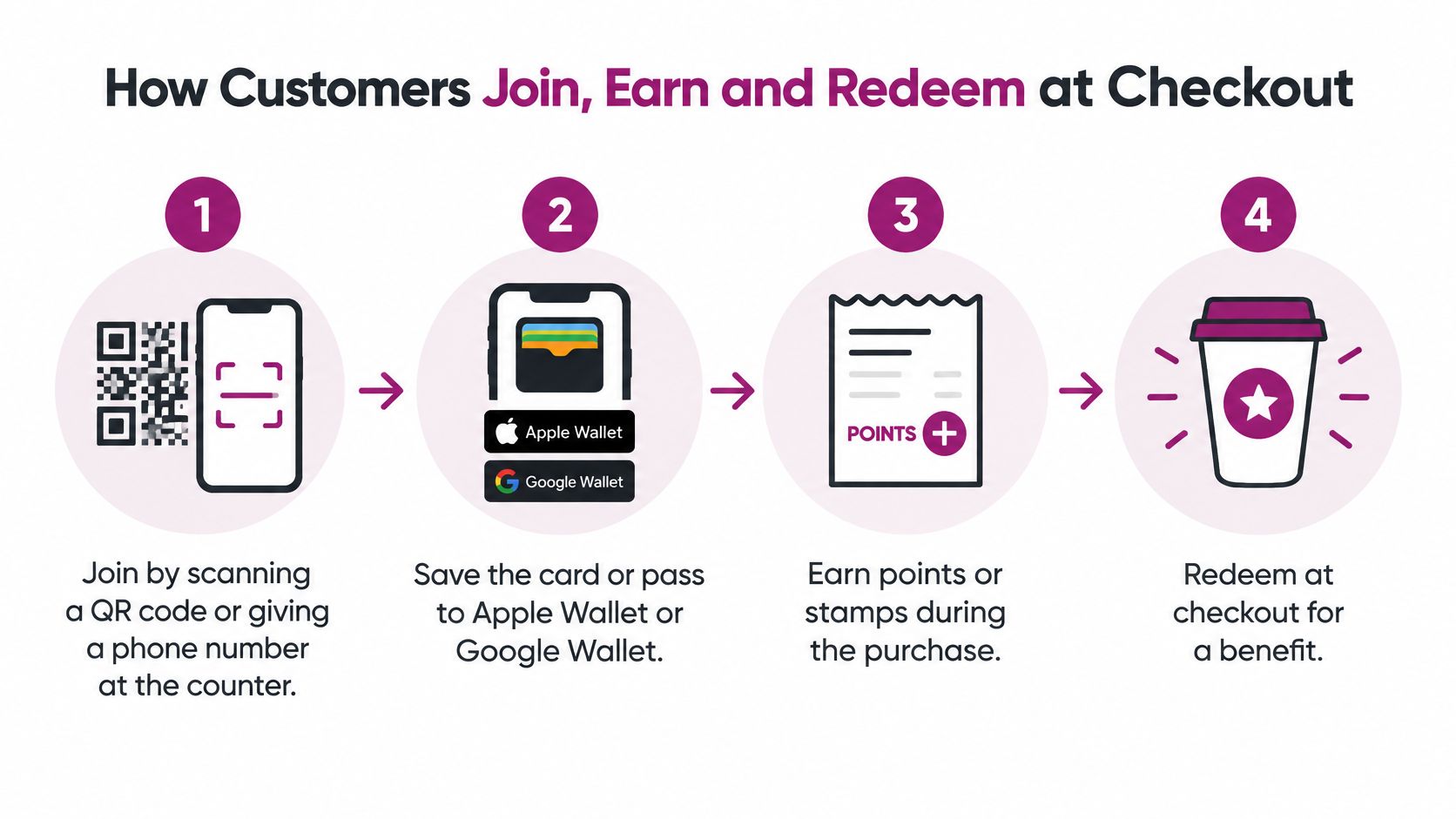
- Invite the customer to join. They scan your QR code or give a phone number at the counter. Explain the actual benefit before asking for details, rather than presenting registration as another checkout requirement.
- Save the loyalty pass. The customer adds their card to Apple Wallet or Google Wallet. They don't need to download a separate rewards app.
- Scan at checkout. Staff use the built-in QR scanner in our mobile app to scan the customer's code. It works on any smartphone and doesn't require a point-of-sale system or extra hardware.
- Add the purchase's earnings. Apply the stamp or the points earned under your rules. The loyalty card updates automatically after each visit, so customers can see their current progress.
- Make the earned reward visible. When the customer reaches the threshold, the available reward appears in their wallet. Staff should explain what it covers, especially if premium products or extras aren't included.
- Redeem on the next checkout. The customer presents the reward, and staff redeem it and mark it used. Treat that as a separate action from adding earnings for the current purchase.
Keep a fallback at the counter
Customers who don't want to present a wallet pass don't need to hold up the queue. Our customer lookup lets staff find them by name, email or phone instead of scanning.
Explain what information you collect and why. Don't ask customers to announce personal details across a crowded counter, and don't make joining a condition of receiving normal service.
If you're replacing paper cards, this comparison of digital and paper loyalty cards can help you decide how to handle the change without confusing regulars.
Counter rule: One employee should own the loyalty action for each transaction. A handover shouldn't trigger another stamp.
Double-scanning is an easy mistake during busy shifts. For stamp cards, apply the rule of one stamp per checkout, confirm that the first action succeeded, and avoid scanning again because another employee takes over.
During your first week, rehearse an ordinary purchase, a customer lookup and a reward redemption. Watch where staff hesitate, and keep a written fallback for connectivity problems so they can record the transaction for later reconciliation rather than guess.
Why Rewards Bring Customers Back
There's room to win customers who aren't already committed to a restaurant program. A Square survey of 1,200 consumers across the United States, Canada and the United Kingdom found that 52% belonged to at least one restaurant loyalty program and 31% belonged to none.
The practical opportunity is to make joining worthwhile, not to assume every guest wants membership. A clear benefit gives staff something concrete to offer beyond another account.
A visible stamp card makes that benefit easier to understand at the counter.
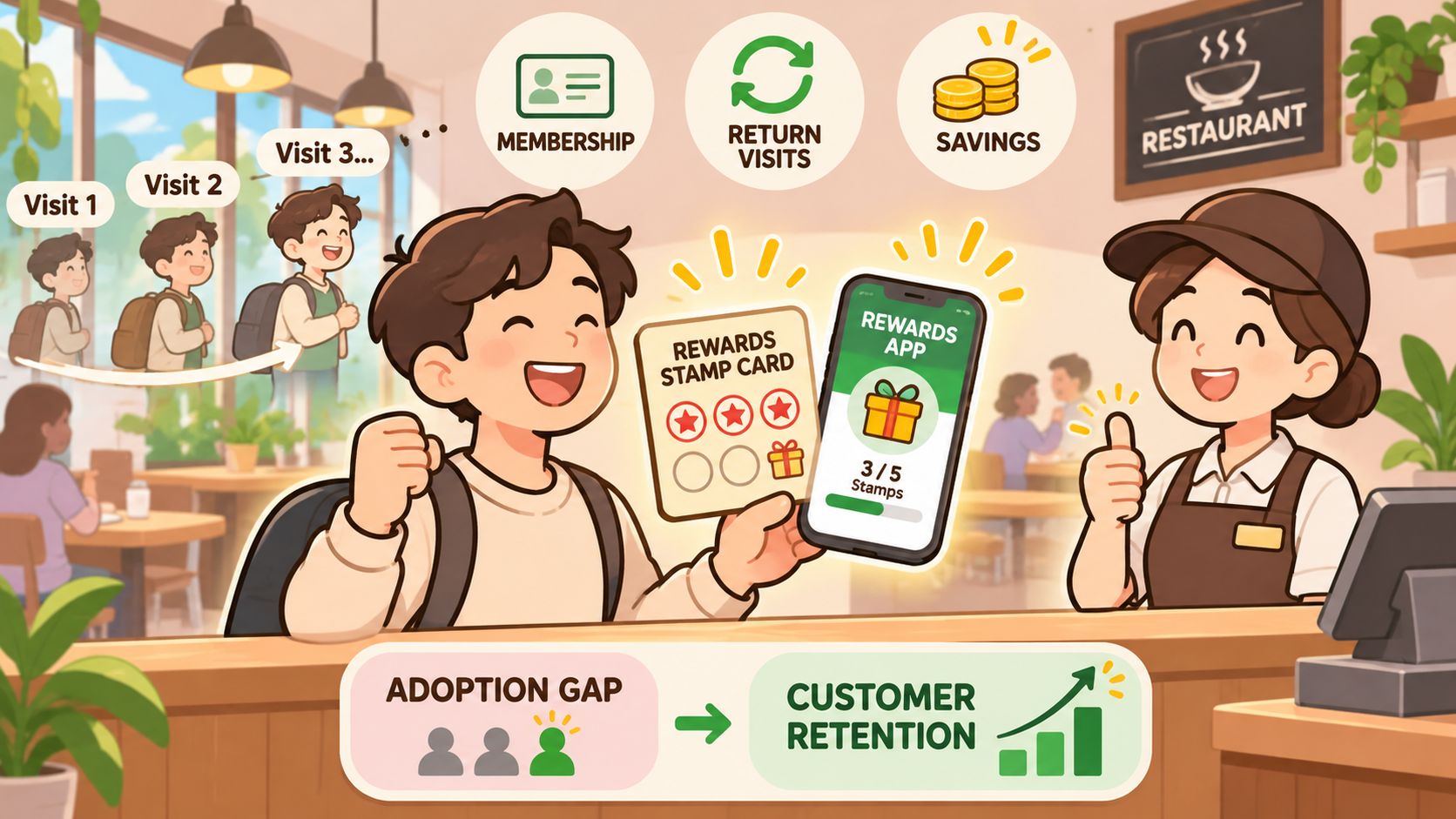
Think of a half-finished puzzle
A partly completed puzzle gives someone a reason to finish. A loyalty card can create a similar feeling, though customers will still weigh your food, service, prices and convenience.
These are familiar behavioural-economics ideas, not mechanisms tested by the Square survey:
- Progress motivation. Visible progress can make the next purchase feel purposeful. A nearly complete card is easier to understand than an unexplained points balance.
- Loss aversion. Customers may feel that progress they've already earned is worth protecting. That's a reason to make balances dependable, not a reason to threaten customers with constant expiry warnings.
- Reciprocity. A useful reward can feel like recognition of a customer's continued support. That goodwill is more plausible when redemption is friendly rather than full of exceptions.
None of these ideas means a rewards card can repair poor service. If someone returns for a benefit but finds their order wrong or the queue disorganised, the underlying problem remains.
For a broader view of the relationship around the reward, 10Seat on keeping diners returning is a useful companion to the mechanics of points and stamps.
The video below provides another way to consider the loyalty experience.
Make returning feel achievable
Design for the customer's actual buying rhythm. Someone who visits occasionally shouldn't need to behave like a daily regular to experience any value.
The first reward should feel reachable, and progress should stay visible in the wallet. Keep participation optional, too: a customer who declines can still become a valuable regular through good food and consistent service.
Reward Designs Customers Actually Redeem
Saving money was the leading benefit in an Alchemer survey of 800 U.S. adults who had recently bought from a quick-service restaurant and belonged to a QSR loyalty program; discounts, buy-one-get-one offers and free items were the strongest enrollment and engagement drivers, while 35% said points expired too quickly and 44% said they didn't use a program because it didn't come to mind.
That points toward tangible rewards customers can recognise without calculation. An impressive-sounding membership level is less useful at checkout than a clearly defined drink or discount.
Example reward thresholds and what they deliver
| Reward | Points threshold | What the customer gets | Design note |
|---|---|---|---|
| Free coffee | 50 points | One free drink | Low-cost early reward that shows progress fast |
| $5 off an order | 100 points | Fixed-amount discount | Easy to value at checkout |
| 15% off everything | 250 points | Percentage discount | Cost grows with spend; set a cap |
These are example configurations, not recommended economics for every menu. A free coffee is only a low-cost reward relative to your own ingredient, packaging and preparation costs.
Set the earning rate before judging the threshold
A points threshold doesn't tell you how generous a reward is. You also need to know how customers earn the points.
Work backwards from the qualifying spending or visits you want before redemption. Then check whether an ordinary customer can reach the entry reward within a few visits, rather than needing an unusually large order.
Apply these design rules:
- Keep the first reward attainable. Give customers an early reason to believe the program is usable. Reserve more expensive benefits for a longer earning path.
- Allow a realistic redemption window. Match expiry to how customers visit. A deadline that looks reasonable for a commuter cafe may be unsuitable for an occasional dining destination.
- Show the balance clearly. Keep progress and available rewards visible in the wallet. Staff should be able to explain both without opening a separate set of terms.
- Bound percentage discounts. Set a maximum discount amount in your offer terms and confirm how staff will apply it. A percentage offer without a limit exposes you to larger costs on larger orders.
- Define the product. State whether a drink reward includes every size, alternative milk or other additions. Handle those choices before a customer reaches the till.
Change offers without undermining trust
Our points programs support free items, fixed-amount discounts and percentage discounts at thresholds you choose. You can update or remove offers at any time, which lets you tune the reward ladder after reviewing actual use.
That flexibility needs careful communication. Avoid surprising customers who have been working toward a clearly advertised benefit; explain changes and decide how to handle progress already earned.
Don't build a large catalogue just because you can. Start with rewards staff can describe accurately and customers can compare easily, then add options only when there's a clear purpose.
Protecting Margin When Rewards Cost You
A blanket discount isn't a complete answer to price pressure. PAR Technology's U.S. consumer findings reported that 45% of consumers skip dining out because of menu inflation even when loyalty discounts are available; discounts were the most influential reward for 40%, while free items or upgrades influenced 22%.
The lesson isn't to eliminate discounts. It's to stop treating every discounted transaction as a sale you wouldn't otherwise have received.
Reward mechanics ranked by margin exposure
| Mechanic | How it works | Margin exposure | Best for |
|---|---|---|---|
| Blanket percentage discount | Same percentage off every order | High: applies to every qualifying transaction | Rare, short promotions |
| Buy nine, get one | One free item after nine stamps | Low to moderate: one item per completed card | Cafes and bakeries with frequent small orders |
| Visit threshold | Reward after a set number of visits | Moderate: cost tied to visit frequency | Regulars who visit often |
| Off-peak reward | Extra stamp or points in quiet hours | Low immediate cost, but creates future reward obligations | Restaurants with uneven trade |
| Minimum-spend unlock | Reward once a basket passes a set value | Moderate: controlled partly by qualifying spend | Takeaways seeking larger baskets |
| Personalized win-back offer | Sent to customers who haven't visited recently | Moderate: controlled through targeting and offer size | Re-engaging lapsed customers |
These are design comparisons, not guaranteed cost rankings. A premium free item can cost more than a tightly capped discount, and bonus points still create a future obligation.
Calculate extra contribution, not just extra sales
Contribution margin is the money left from a sale after the costs that change with that sale, such as ingredients, packaging and relevant transaction fees. That's the money available to help cover rent, permanent staffing and profit.
Use this calculation:
Extra contribution from genuinely additional purchases, minus reward costs and program costs, equals the program's estimated contribution.
For a stamp scheme, track the economics per completed card as well as across the business. Compare the reward's cost with the extra paid visits you reasonably believe the card encouraged.
The distinction matters. If a regular would have bought the same products anyway, you've funded a reward without gaining an additional visit. If a customer brings forward a purchase but then skips their usual visit, you may have changed timing rather than total demand.
Don't train regulars to wait
Choose the reward around a specific trading problem. An off-peak offer should encourage purchases during a quiet period; a minimum-spend offer should leave useful contribution after the extra products and reward are funded.
Keep food quality and normal pricing credible. Constant promotions make it difficult to tell whether customers value the restaurant or the next discount.
When a broad discount is unavoidable, restrict it to your slowest periods or customers who have gone quiet. Don't subsidise every transaction to solve a problem that affects only part of your trade.
Measuring Whether the Program Pays
A South African fast-food study reported positive associations with customer retention for loyalty participation, with a regression coefficient of 0.28, and redemption frequency, with a coefficient of 0.20.
Those coefficients aren't percentage increases and don't prove cause and effect. They make redemption worth monitoring, but you need to verify the relationship in your own business.
Measure the journey beyond joining
Enrollment tells you who registered, not who changed their purchasing. Track customers through earning, redemption and the purchases that follow.
- Participation rate. Measure the share of eligible customers who actively earn, using a consistent definition. Keep registrations separate from active use.
- Reward attainment. Track the share of members who earn a reward within a review window you choose. This shows whether the earning path works for ordinary buying patterns.
- Redemption frequency. Record how often earned rewards are used, alongside the time between earning and redemption.
- Average order value. Compare redeemers with non-redeemers, but remember that your strongest regulars may be more likely to redeem in the first place.
- Reward cost. Include free-product costs, discounts, packaging and other relevant variable costs. Record software costs separately.
- Breakage. Measure the share of earned rewards never redeemed. Distinguish expired rewards from those customers still have time to use.
- Returning lapsed customers. Track who purchases after a reminder, then check whether they return again without another offer.
Use our Loyalty Program ROI Calculator to organise assumptions about program costs and additional business. Replace estimates with observed results as your records improve.
Read patterns before changing the offer
Rising participation with flat redemption is a warning to investigate. The reward may be too distant, customers may have forgotten it, or staff may be struggling to redeem it.
High redemption with flat order value isn't automatically failure. The program could still be increasing visit frequency; it could also be giving away margin on purchases customers would have made anyway.
Compare visit frequency, contribution and reward costs together. Where practical, compare similar customer groups or trading periods, and allow for menu changes, weather and other promotions.
A large unused rewards balance isn't proof of success. It may mean you've promised value that customers can't easily obtain.
Your operating goal is to shorten the gap between earning and successful redemption without letting reward costs consume the additional contribution. Keep the measurement simple enough that you'll review it.
Choosing Your Program and Launching It
Launch with a manageable offer and a clear staff routine. You'll learn more from a program you can operate consistently than from a complicated setup nobody explains correctly.
- Configure the chosen model. Write down the earning rule, qualifying purchases and redemption procedure before publishing the card.
- Load the opening rewards. For points, give customers a reachable entry option and a larger option. For stamps, define the completed-card reward precisely.
- Publish the terms. Explain eligibility, expiry and product exclusions in plain language. Make sure staff use the same explanation.
- Place the joining invitation. Share the wallet pass at the counter, on receipts and on a window sign. Put the QR code where customers can scan without obstructing payment.
- Schedule the review. Compare participation, redemptions, breakage and costs against your baseline after an initial trading period.
Use our loyalty program launch playbook to organise setup and staff preparation. During the first week, observe the checkout routine, check for duplicate stamps and write down any recurring questions.
Test the operation before expanding
Our single plan includes up to 100 customer slots, branded card design, a custom customer onboarding page, unlimited offers, discounts and stamp rewards, plus email support. Points or stamp cards run from a phone, with Apple Wallet and Google Wallet integration and QR scanning at checkout.
The 7-day free trial starts when you launch, and you can cancel at any time. Use that period to test setup, joining and checkout handling; don't mistake a short operational test for proof of long-term profitability.
Keep the launch focused. The best program is one customers understand at a glance and staff can deliver accurately during a rush.
Build a points program or digital stamp card with Loyal Customer, and give customers a wallet-ready way to earn and redeem. Start with a clearly costed reward, test it at your counter, and judge it by repeat purchases and margin rather than sign-ups alone.