Mister Car Wash's Unlimited Wash Club generated about 75% of its total wash sales by late 2024, according to Cinch's Retail-to-Member report. That reframes the car wash loyalty card: it isn't a way to give away a wash. It's a decision about how you'll encourage customers to return, recognize their visits, and make repeat business worthwhile.
A small operator doesn't need to copy a national chain's subscription model. You need a reward structure that fits how your customers buy, protects your wash margin, and produces visits you wouldn't otherwise have earned.
Table of Contents
- Car Wash Loyalty Card Models and Why Repeat Visits Matter
- Choosing Stamps, Points or Membership by Situation
- How a Digital Stamp Card Works at Checkout
- Setting Stamp Targets, Rewards and Offer Rules
- Early Visits That Predict Whether Members Stay
- Launch Your Digital Loyalty Card This Week
Car Wash Loyalty Card Models and Why Repeat Visits Matter
A car wash loyalty card is a visible record of repeat visits or spending that rewards customers when they reach a stated target. A membership works differently: customers pay for ongoing access rather than gradually earning a reward.
Loyalty card models compared
| Model | How customers earn | Reward | Best fit | Main drawback |
|---|---|---|---|---|
| Stamp card | One stamp per checkout | Free wash when the card is full | Standard wash at the same price | Does not reward bigger spending |
| Points program | Points for each amount spent | Points redeemed for a wash or upgrade | Mixed prices and add-on services | More tracking and explaining for staff |
| Membership | Monthly fee for unlimited or set washes | Washes included in the plan | High-frequency regulars | Churn when payments fail or cancelling is hard |
With stamps, the customer tracks visits. With points, the customer tracks purchase value. With membership, the customer buys access under the plan's terms.
That distinction matters at checkout. A customer buying a basic exterior wash and another buying a labor-intensive package can earn the same stamp, but they shouldn't necessarily earn the same spending-based reward. Membership introduces a different calculation: can the fee cover the service customers use?
Frequency matters more than enrollment
A 2016 International Carwash Association survey put U.S. professional-wash users at 13.6 washes annually, while more recent industry reporting places members at approximately 28 to 31 visits annually, as summarized by Kleen-Rite's car wash facts guide. Those are different customer groups and reporting periods, not proof that issuing a card doubles visits.
The useful lesson is narrower: frequent customers and occasional customers need different offers. Someone who already washes regularly may value predictable access. Someone who comes only when their vehicle looks dirty may prefer progress toward a reward without another recurring bill.
Weather and driving conditions also shape that routine. For a practical example of how local conditions affect washing frequency, Prime Shine's Perth washing schedule tips can help frame the customer conversation without prescribing the same schedule to everyone.
Practical rule: Choose the earning method before choosing the giveaway. A generous reward won't fix a program that measures the wrong behavior.
Digital delivery doesn't change that choice. Our wallet card updates by itself after every visit, but the operator still decides what a qualifying visit earns.
Start with facts you already have: how often customers return and how much their purchases vary in price. Those tell you more than the number of people willing to accept a card.
Choosing Stamps, Points or Membership by Situation
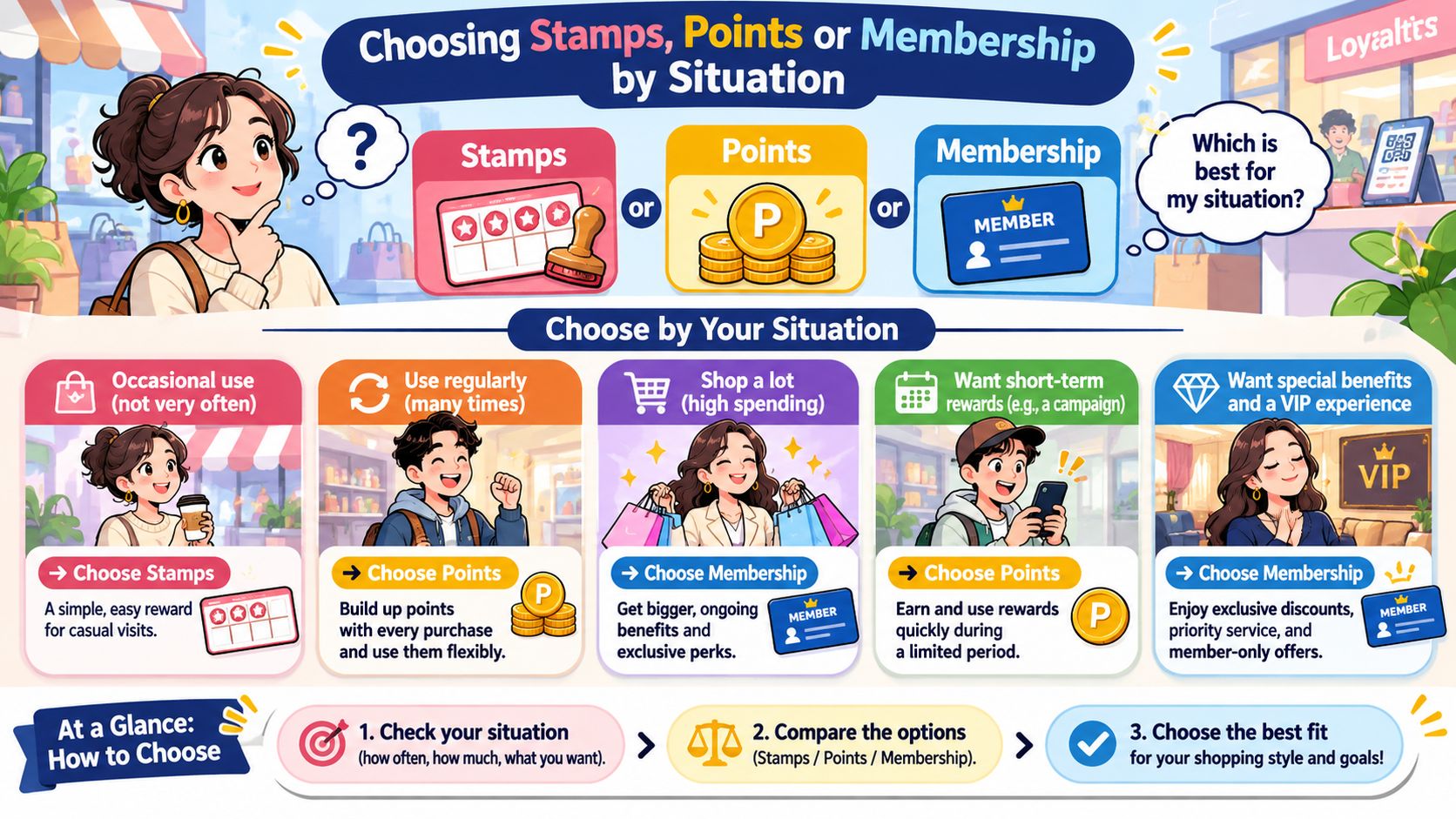
An unlimited plan isn't automatically the most advanced choice. For an occasional customer, a subscription can feel like paying for unused washes; for a frequent customer, a long stamp card can feel unnecessarily slow.
Use this visual to frame the choice around buying habits.
Questions to answer before choosing
- Return frequency: Do customers come routinely, or only when they notice dirt?
- Vehicle count: Is the relationship with a driver, a household, or a particular vehicle?
- Seasonality: Will travel, rain, or changing road conditions interrupt use?
- Wash margin: What remains after labor, chemicals, utilities, and payment costs?
- Cancellation risk: Will customers understand the commitment and find it easy to leave?
For an occasional customer buying the same wash, choose stamps. There's no need to explain a conversion rate, and the reward follows paid visits rather than a billing schedule.
For customers mixing basic washes, premium packages, and add-ons, choose points. Write the earning and redemption rules together so customers can understand what their balance will buy. Our points versus stamps comparison examines that trade-off in more detail.
Membership suits regulars whose usage you can serve profitably. When reviewing how a public membership offer is presented, the VIP Car Wash unlimited wash club provides a useful reference to examine alongside your own proposed inclusions, vehicle rules, and cancellation terms.
The video offers another format for considering the program choice.
Plan for the ways each model breaks
Stamp and points programs create outstanding reward obligations, sometimes called reward debt. Track earned benefits, disclose expiry before enrollment, and remind customers before rewards disappear. If you cap stored points, explain what happens when someone reaches the cap.
Memberships require billing care. Use automated payment retries and payment-update reminders to address failed charges, while keeping cancellation straightforward. A customer who intentionally leaves shouldn't have to fight the payment system.
Consider a clearly defined seasonal pause or bad-weather credit if your economics support it. State eligibility in advance rather than asking attendants to negotiate exceptions.
Choose a model for a defined trial period, keep the earning rules stable, and review customer behavior and margin before switching.
How a Digital Stamp Card Works at Checkout
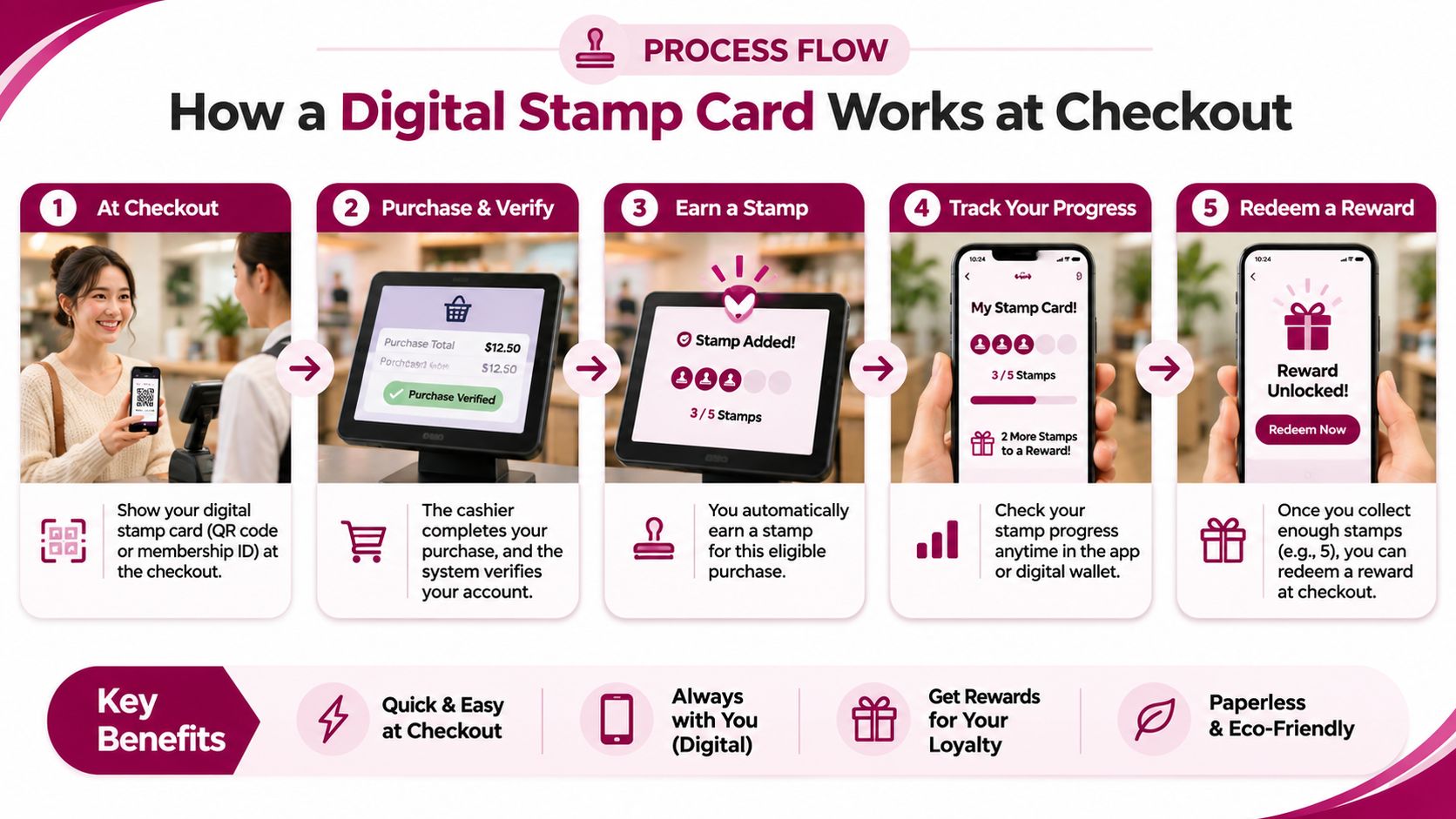
A digital stamp card replaces the paper card, not the need for a consistent checkout routine. The customer keeps a wallet pass, and staff record the qualifying purchase.
The diagram shows the enrollment-to-reward journey.
From joining to redeeming
Open the business's unique link. The customer reaches a branded web page rather than an app-store listing. They can start while waiting at the counter without downloading another app.
Verify the phone number. The customer enters a one-time code, also called an OTP. This verifies the number used to join and helps establish the customer's account.
Add the pass to Apple Wallet or Google Wallet. The card goes directly into the phone's wallet. Staff should confirm that the customer has saved the pass, not merely opened the enrollment page.
Present the QR code at checkout. A staff member scans the customer's pass with a phone and adds a stamp for the qualifying visit. The scan connects the transaction to the right card instead of relying on a handwritten tally.
Let the pass update automatically. Once the business records the stamp, the customer's wallet card updates without further action from them. They can see progress without keeping a receipt or manually refreshing a separate account.
Exchange the completed card for the reward. At the next checkout, staff redeem the completed card and provide the stated benefit. Recording redemption matters just as much as recording earning, because the same completed card mustn't fund another reward.
For help understanding the customer-facing pass, our Apple Wallet loyalty card guide explains the wallet format.
Avoid duplicate and missing stamps
A repeat scan mustn't become another stamp for the same purchase. Train staff to check the latest recorded activity before adding a stamp when there's any uncertainty, particularly during shift changes or interrupted checkouts.
A forgotten card creates a different problem. Ask customers to save the pass during enrollment and show them where to find it, rather than leaving them with a browser page they may close.
A successful scan isn't just a staff action. The customer should leave knowing what they earned and what they're working toward.
Make the finished card easy to read: a visible stamp count, a plain-language reward line, and an earning rule staff can apply consistently. Don't make customers infer whether an upgrade, a free rewash, or a reward redemption qualifies for another stamp.
Setting Stamp Targets, Rewards and Offer Rules
Set the stamp target from the customer's likely return pattern, then check whether the reward is affordable. A long card may look inexpensive to the operator but offer little motivation to an occasional visitor.
Our stamp-card setup supports 3 to 10 stamps, and the business chooses the reward for completing the card. The following are hypothetical starting configurations, not measured industry benchmarks.
Stamp target by visit pattern
| Typical visit pattern | Stamp target | Why it fits |
|---|---|---|
| Weekly visits | 8 to 10 stamps | In this example, the card fills in roughly two months |
| Visits every few weeks | 3 to 5 stamps | A shorter example target keeps the reward within a more manageable run of visits |
Name the reward precisely, such as free basic exterior wash. If premium services aren't included, say so on the card, and explain whether customers can pay the difference for an upgrade.
Assess the reward using fulfillment cost and displaced revenue. A free service costs more than its chemicals if it occupies labor or bay capacity that you could have sold.
Rules customers should see before joining
- Message restraint: Use a conservative reminder schedule and suppress messages after a recent visit.
- Visible expiry: Display the expiry date and explain whether it applies to stamps, completed rewards, or both.
- Clear value: Name the included service and its current menu value.
- Marketing consent: Obtain consent before sending promotional messages, and provide a straightforward way to stop them.
- Fair earning: State whether discounted purchases and redeemed rewards earn stamps.
Personalization should make the offer more relevant, not more intrusive. ICA findings summarized by Carwash.com's Q3 2026 Pulse coverage identified personalized offers and rewards as the strongest technology-related switching reason for 29% of consumers overall and 36% of current members.
Collect visit dates, wash type, vehicle count, and location for offer decisions, alongside the contact information needed to operate the account. Don't collect unrelated personal details just because a form allows it.
Before sending a win-back offer, distinguish a lapsed customer from someone waiting out wet weather. After a failed wash, address the service problem directly with a make-good offer, such as a rewash credit, rather than sending a generic promotion.
Measure incremental visits against comparable customers or a comparable operating period, and track reward redemption separately. Start with a simple test: a target, a named reward, and an expiry date.
Early Visits That Predict Whether Members Stay
Members averaging 1.7 or fewer washes in their first 30 days were 75% less likely to reach a second month, according to a GHL Car Wash Snapshot analysis covering more than 100 U.S. wash sites, which also reported the other retention relationships shown below.
First-month visits and retention effects
| First-30-day washes | Reported retention effect | What the card should do |
|---|---|---|
| 1.7 or fewer | 75% less likely to reach a second month | Consider a reminder after 14 to 21 days without a visit |
| At least 3 | 76% more likely to renew | Test an accelerated reward after the second or third visit |
| 4 or more | Stronger six-month retention, exact figure not given | Track six-month return rate for this group |
The 1.7-wash threshold is an average, not a visit count an individual can complete. Use whole recorded visits when deciding which customers need attention, and treat the average as a warning about low early usage.
Early use can make the benefit tangible. A member who repeatedly uses the service has an experience to compare with the fee; an inactive member has a charge without much practical value.
That doesn't establish that rewards alone cause retention. Frequent users may already have stronger washing habits, more convenient access, or a greater need for the service.
Turn the pattern into an onboarding test
Group new customers by enrollment date and early visit count. Separate those who haven't returned from those who have started a routine, rather than sending the same message to everyone.
For a pay-per-wash card, test a modest early benefit without changing the permanent earning rule. Keep the offer cost visible so that improved return behavior doesn't conceal an unprofitable giveaway.
Measurement caution: A relative increase in renewal likelihood isn't a guaranteed renewal rate, and subscription-member findings aren't a forecast for stamp-card customers.
Track second-month return behavior, visit frequency, and reward cost per retained customer. Use the same definition of an active customer throughout the test so a change in reporting doesn't look like an improvement.
Our guide to increasing repeat customers offers broader ways to connect an initial purchase with a return visit. For the loyalty-card test, keep the weekly question focused: how many new cardholders reached their third visit?
Launch Your Digital Loyalty Card This Week
Choose a model based on your customers' buying pattern, then resist the urge to launch every possible offer. If stamps fit, make the initial launch a checkout habit your team can perform reliably before adding promotional complexity.
A focused launch sequence
Write the offer before building the card. Put the stamp target, reward, qualifying purchase, and expiry terms on paper. Ask a staff member to explain them back to you; any uncertainty needs fixing before customers enroll.
Build and brand the pass. Add your business name and recognizable branding, then check the reward wording on a phone screen. Our phone-based workflow supports branded Apple Wallet and Google Wallet cards, and the built-in mobile QR scanner records points at checkout without a POS system or extra hardware.
Put the joining link where customers can use it. Add it to a counter sign, your checkout conversation, and relevant social posts. Position the sign where drivers can stop safely, not where they'd need to use a phone while moving through the wash.
Rehearse the staff routine. Practice enrollment, earning, redemption, and an interrupted scan before launch. Give each shift a named person to resolve questions so attendants don't invent different rules under pressure.
Review behavior after the opening month. Look at new cardholders' return visits, completed rewards, and fulfillment costs. If customers enroll but don't return, examine whether the offer is relevant, the pass is being used, and staff are recording purchases consistently before making the reward more generous.
Make a controlled adjustment. Change the target, early benefit, or reminder approach separately, not all together. Keep a record of when the change began so you can compare customers who joined under different terms.
Check the customer experience yourself
Run a test enrollment from the public joining page and inspect the saved pass. Then have another staff member handle a mock checkout using the written instructions, without coaching them through each action.
That exercise can uncover unclear reward wording or a missing step before a paying customer encounters it. Keep a simple issue log during launch, separating enrollment problems, scanning mistakes, and questions about eligibility.
Write your offer today, assign responsibility for checkout training, and schedule the review before you publish the joining sign. A loyalty card becomes useful when your team can operate it consistently and you can tell whether customers are returning more often.
Loyal Customer lets you run a digital stamp or points program from your phone, with branded cards customers save in Apple Wallet or Google Wallet without downloading another app. Visit Loyal Customer to build your car wash loyalty card and test a clearly defined reward at checkout.