Friday, 6:40pm, and the same order goes through the till: a large pepperoni, extra cheese, a garlic dip. The customer has ordered it most weeks for two years. Nobody behind the counter knows their name, and the shop has no record that this person exists beyond a receipt.
The customer, meanwhile, is wondering something simple. Do these people notice me at all? Would it cost them anything to notice?
A pizza loyalty card is the cheapest answer to both questions. It records repeat purchases and turns them into something the customer gets back, whether that's a stamp on a card, points on an account, or a free side with the next order. Done badly, it's a piece of cardboard that ends up in a jacket pocket. Done well, it changes where a household spends its Friday money.
This guide judges every reward design by one test: does the customer feel a saving soon after the first order? A card that looks attractive on the counter but pays out in three months fails that test, and the numbers below show why.
Table of Contents
- What a Pizza Loyalty Card Actually Does
- Stamp Cards Versus Points Cards Side by Side
- How a Visit Turns Into a Reward
- Reward Designs and What Customers Actually Feel
- Digital Passes, Delivery Orders and Edge Cases
- Choose the Right Pizza Loyalty Card for Your Shop
What a Pizza Loyalty Card Actually Does
A customer orders a pepperoni pizza, earns progress toward a reward, then chooses where to order next time. That is the basic job of a pizza loyalty card: it records repeat purchases and gives customers a reason to return.
The card can use paper stamps, digital stamps or points. The format matters less than whether the customer can understand the progress and feel a saving soon after the first order. A reward that takes too long to reach may look appealing but fail to change the next choice.
A well-designed program can encourage another visit or shape an order. For example, a customer might add garlic bread to meet a reward threshold. The trade-off is that a complicated offer can make the value harder to see, while an overly generous one can reduce what the shop earns from the order.
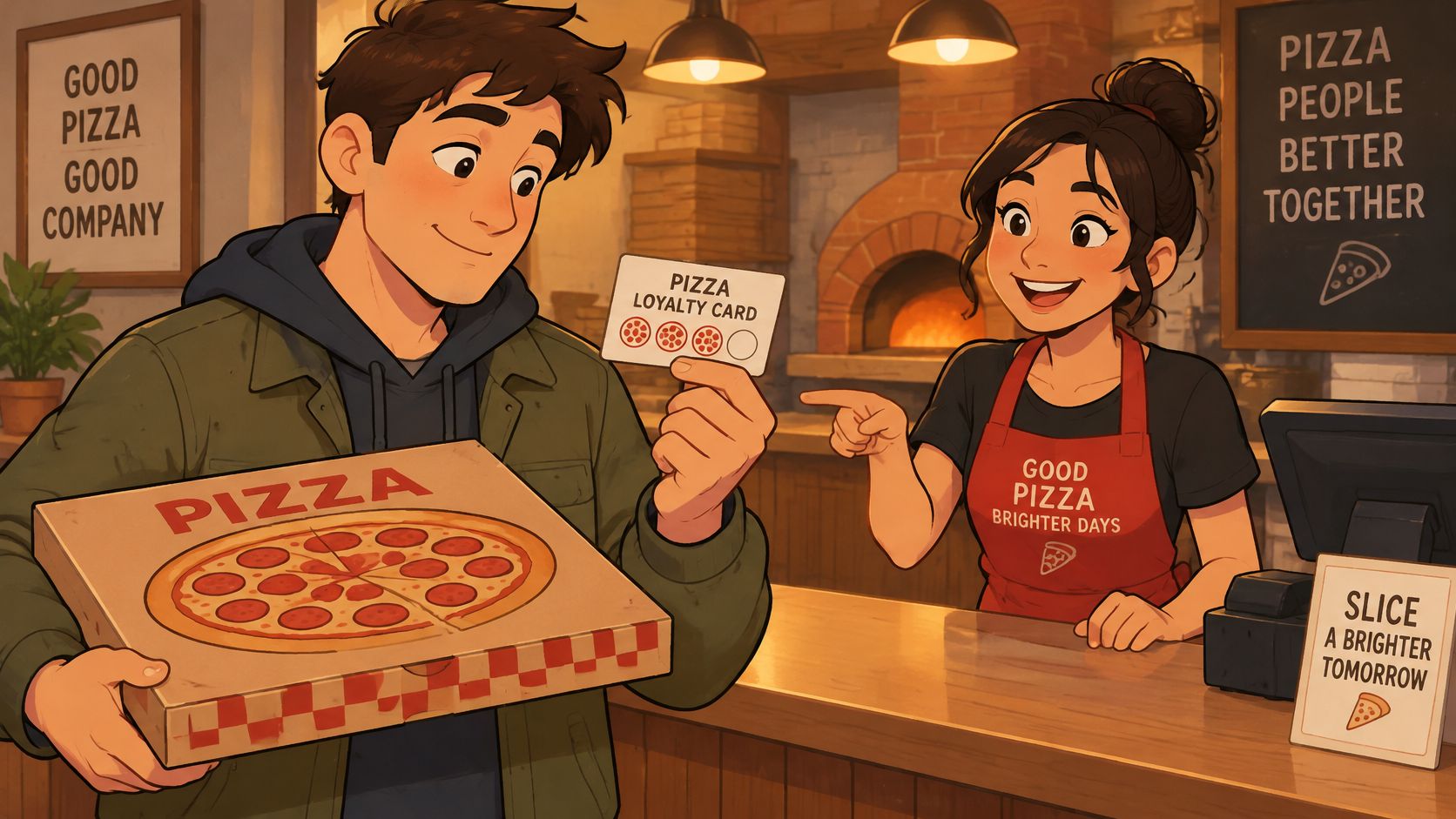
The 2019 Pizza Power Report reported that 41.71% of surveyed pizza businesses used a loyalty program, roughly two in five. That suggests loyalty programs are a familiar tool in the pizza business, though a card only helps when its reward feels worthwhile to customers.
A useful program also gives the shop a clearer record of repeat visits. Rather than relying only on receipts, the business can see customer activity and use that information to make the reward fit the way people order.
The plain version: a pizza loyalty card records repeat orders and connects them to a reward. Its value depends on how soon customers can see a worthwhile return.
Stamp Cards Versus Points Cards Side by Side
One customer, one order. They collect a large margherita and the shop wants to reward them for it.
A stamp card adds one mark, because one visit is one visit. A points card set at one point per dollar adds twelve, because the order came to twelve dollars. At the till the two feel identical. Three weeks later they don't: the stamp card is three marks from a free pizza, and the points balance reads 96 with no obvious meaning to anyone who wasn't paying attention.
| Criterion | Stamp card | Points card |
|---|---|---|
| Ease of understanding | Immediate, everyone has seen a stamp card | Needs a short explanation of points per dollar |
| Reward for larger orders | Same stamp for a slice and a family pie | Points rise with the amount spent |
| Flexibility of rewards | One fixed reward, such as a free pizza | Multiple offers and percentage discounts possible |
| Effort at the counter | One mark per checkout | Points calculated for each order |
| Tracking detail | Visit count only | Balance, spend and transaction history |
| Fraud risk | Paper cards can be over-stamped or forged | Lower when the record is digital |
Why the Ten Stamp Card Survives
Ten stamps for a free pizza endures because it needs no explanation. The customer counts the remaining marks in two seconds and knows exactly what they're working toward. It fits a shop where most visits look alike: one pizza, maybe a drink, occasionally a side. The reward is generous and arrives without a calculator.
Where the Stamp Card Breaks
Now put a family-size pie with two sides on that same card. The customer spends three times as much and gets one mark, the same as the person buying a single slice on the way home. Repeat that for a few months and your best customers work out that the card isn't really aimed at them.
How Points Close the Gap
Points rise with spend, so the big order earns more than the small one. The trade-off is comprehension: a customer has to believe the math is fair before the reward feels earned. One point per dollar with a clearly stated reward is easy to follow. One point per three dollars against a 200-point target is a puzzle, and many customers won't bother solving it.
Choosing rule: pick stamps when your menu is simple and your visits look similar, and pick points when you sell small, medium and family sizes and want the big orders rewarded.
One last consideration applies to both models. The reward has to be reachable. If a customer can't picture themselves holding that free pizza within a month of ordinary ordering, they won't start collecting.
How a Visit Turns Into a Reward
Every card runs on the same five-step loop, whether the customer holds paper or a phone. When one step leaks, the customer notices long before the owner does.
Here's the loop as the customer experiences it.
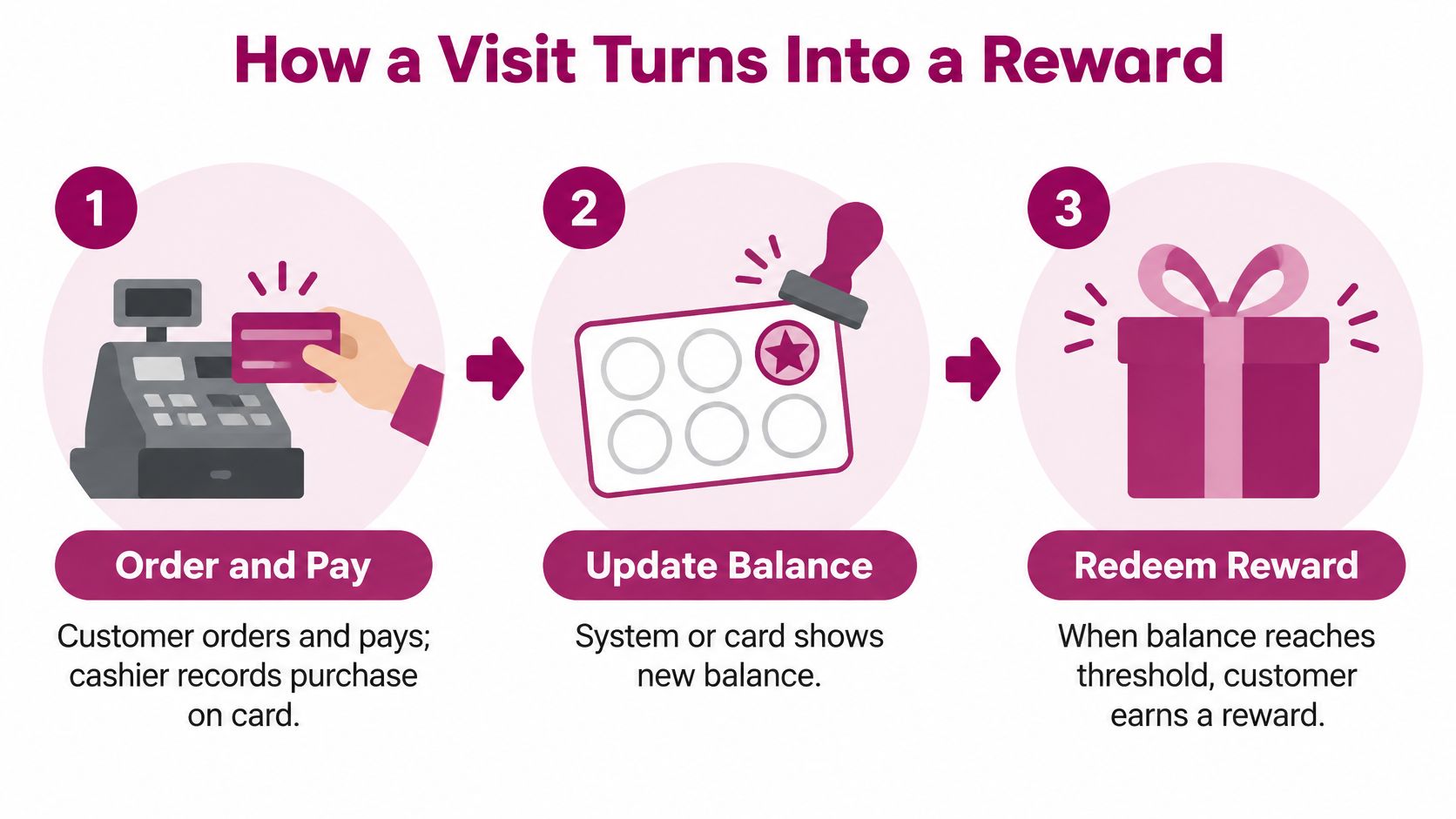
- The order and the payment. The customer orders and pays, and the cashier records the purchase, either by adding a mark or by crediting points for the order value. The common slip is a rush: the queue is out the door, the stamp never gets added, and the customer is too polite to mention it.
- The visible balance. The card or the app shows the new balance right away, so the customer knows how close the reward is. If the balance only updates overnight, or needs a login to check, that step is no longer visible to many customers.
- The reward becoming available. Once the card is full or the points reach the threshold, the reward is marked as available and the customer is told which offer applies. Vague wording is expensive here, because "a free item" leaves staff and customers negotiating at the till.
- The redemption. At the next order the customer presents the card or pass, and the reward comes off the bill before payment. The most common error is arithmetic: a reward applied before tax and then miscounted, or applied to a delivery fee the offer never covered.
- The reset. The record resets or deducts the used balance, and any remaining points or partial stamps carry over. Customers watch this step closely. A card that wipes a whole balance instead of deducting one reward loses trust faster than a card with no reward at all.
The Two-Sided Test Any Shop Can Run
Place a test order yourself, as a customer, and walk the entire cycle through to redemption. Then compare what the customer's card shows with what the shop's record shows. If the two disagree at any point, staff are fixing errors by hand, and a busy Friday will multiply those errors.
A card is only as trustworthy as the record behind it. Customers forgive a slow app. They don't forgive a lost stamp.
The mechanics of accrual and redemption are the same across systems, and this explanation of how loyalty points work covers the arithmetic before you set your own thresholds.
Reward Designs and What Customers Actually Feel
A pizzeria runs a two-for-one every Tuesday for a month. Orders jump in week one, hold in week two, and flatten by week four. The owner concludes that loyalty programs don't work. What happened is narrower: the reward triggered a visit, then stopped being a reason.
The test that separates a working card from a decorative one is timing. Does the customer feel a saving soon after the first order? A reward that arrives after a long wait has to compete with every other offer in the neighbourhood for three months first.
| Reward design | Effective discount | Visits to first reward | Main risk |
|---|---|---|---|
| Free pizza after 10 stamps | About 10% over ten visits | 10 visits | Long wait, customers may lapse before the reward |
| Free topping after the second visit | About 10% on one order | 2 visits | Low perceived value per order |
| 5% off every order after 3 visits | 5% per order | 3 visits | Margin erosion on every order |
| 1% of spend back as points | 1% of spend | Immediate accrual | Customers may not see progress |
The math explains the behaviour. A free pizza after ten stamps returns roughly one order in ten, which is a real saving, but the customer has to fund ten visits before touching it. Five percent off every order after three visits pays out almost immediately and is easy to feel. One percent of spend back as points accrues from the very first order, yet the balance moves so slowly that most customers can't tell whether it's working.
What Customers Say About Cost
Sentiment lines up with that arithmetic. In recent U.S. restaurant research, 45% of consumers said they had skipped dining out because of menu inflation, even with loyalty discounts available, while nearly 70% said loyalty programs help them manage costs, according to Par Technology's research on loyalty and cost-conscious dining. The same work found that only 33% of diners said points or rewards encouraged them to eat out more often.
That's the honest split. People want relief on price, not another reason to spend.
Promotion Response Is Not Preference
Discounts move people around. They don't necessarily keep them. A 2024 summary of Vericast dining research found 40% of respondents had no preference for a particular pizza restaurant, and among frequent pizza consumers 58% said a coupon or discount had changed where they chose to dine or order during the previous 30 days, per PMQ's report on the dining survey. Just 33% said coupons and discounts made them more loyal to a restaurant. A card that only issues occasional discounts buys a visit, not a habit.
Operators already sense the gap. In 2024, 80% of surveyed brands, particularly in pizza, said their current loyalty programs were ineffective, according to PMQ's coverage of Qu's State of Digital survey.
Margin rule: if the reward hurts, narrow it before you shrink it. A free topping on slower weeknights protects a margin that a free pizza on Friday destroys.
Test a small early reward, such as a free topping after the second purchase, against the long-cycle free pizza. Judge both by how many cardholders order again within sixty days of signing up. Enrollment counts flatter a launch; the sixty-day return rate tells you whether the card did anything. If you're tightening a visit-based design, these stamp card ideas cover the variations worth testing.
Digital Passes, Delivery Orders and Edge Cases
The paper card lives in a jacket pocket. It goes through the wash in March, comes out as pulp, and the customer never mentions it because asking for a replacement feels petty. Six months of visits disappear with it.
A digital wallet pass avoids that particular failure. It sits in Apple Wallet or Google Wallet on the phone the customer already carries, opens in one tap, and can be scanned at the counter with no download.
The bigger problem is identity, not storage. Customers order through your website, by phone, through a marketplace, over social messages, and in person. Each channel is a chance for a purchase to go uncredited, and an uncredited purchase is worse than no card at all, because the customer did the right thing and got nothing back.
Why Another App Is Usually the Wrong Answer
Delivery customers care about rewards more than most. The National Restaurant Association's 2025 State of the Industry report found that loyalty membership is an important choice factor for 61% of delivery customers, compared with 54% of quick-service, snack, deli or coffee-shop customers and 41% of full-service customers. Those diners are choosing a restaurant partly on the strength of its program.
They just won't add a fifth app for it. In the same research, 58% of surveyed consumers preferred managing no more than five loyalty accounts. A standalone app competes for a slot that's already taken.
| Card format | Lost or forgotten risk | Online and delivery coverage | Fallback needed |
|---|---|---|---|
| Paper punch card | High, easily lost | None, in-store only | Replacement card or manual record |
| Standalone app | Medium, depends on phone and login | Depends on integration | Phone number lookup |
| Wallet pass | Low, stays on the phone | Depends on how orders are linked | Phone number lookup or receipt recovery |
The Edge Cases Nobody Puts on the Poster
Plan for these before launch, not after the first complaint.
- Marketplace orders. If the delivery platform takes the payment, you may never see the customer's phone number, so the order can't be credited automatically.
- Shared family numbers. One number, four eaters, one account. Points land on whoever answered the phone.
- Duplicate accounts. A customer signs up twice with two spellings of their name and splits their own balance.
- Expired stamps. Decide in writing whether stamps expire, and tell the customer before they do.
- Refunds and split payments. A cancelled order has to reverse the accrual, and a bill split three ways should credit once, not three times.
- Delivery fees. Say plainly whether the fee counts toward the reward. Customers notice when it doesn't.
Two numbers matter more than sign-ups: the share of eligible orders successfully credited, and the redemption rate by channel. If counter orders redeem at a healthy rate and delivery orders barely register, the card isn't broken. The attribution is.
Because phone-number lookup depends on personal data, collect the number with clear consent at sign-up, say what it's used for, and give staff a scripted way to fix a missing credit. A wallet pass reduces friction. It doesn't remove the need for a fallback. If you're weighing formats, this walkthrough of adding loyalty cards to Apple Wallet shows what the customer sees.
Choose the Right Pizza Loyalty Card for Your Shop
The decision is easier than the brochures suggest. Choose stamps when your menu is short and most visits look the same. Choose points when order sizes vary and you want spend rewarded. Then go digital if customers reach you through more than one channel, because paper can't follow them.
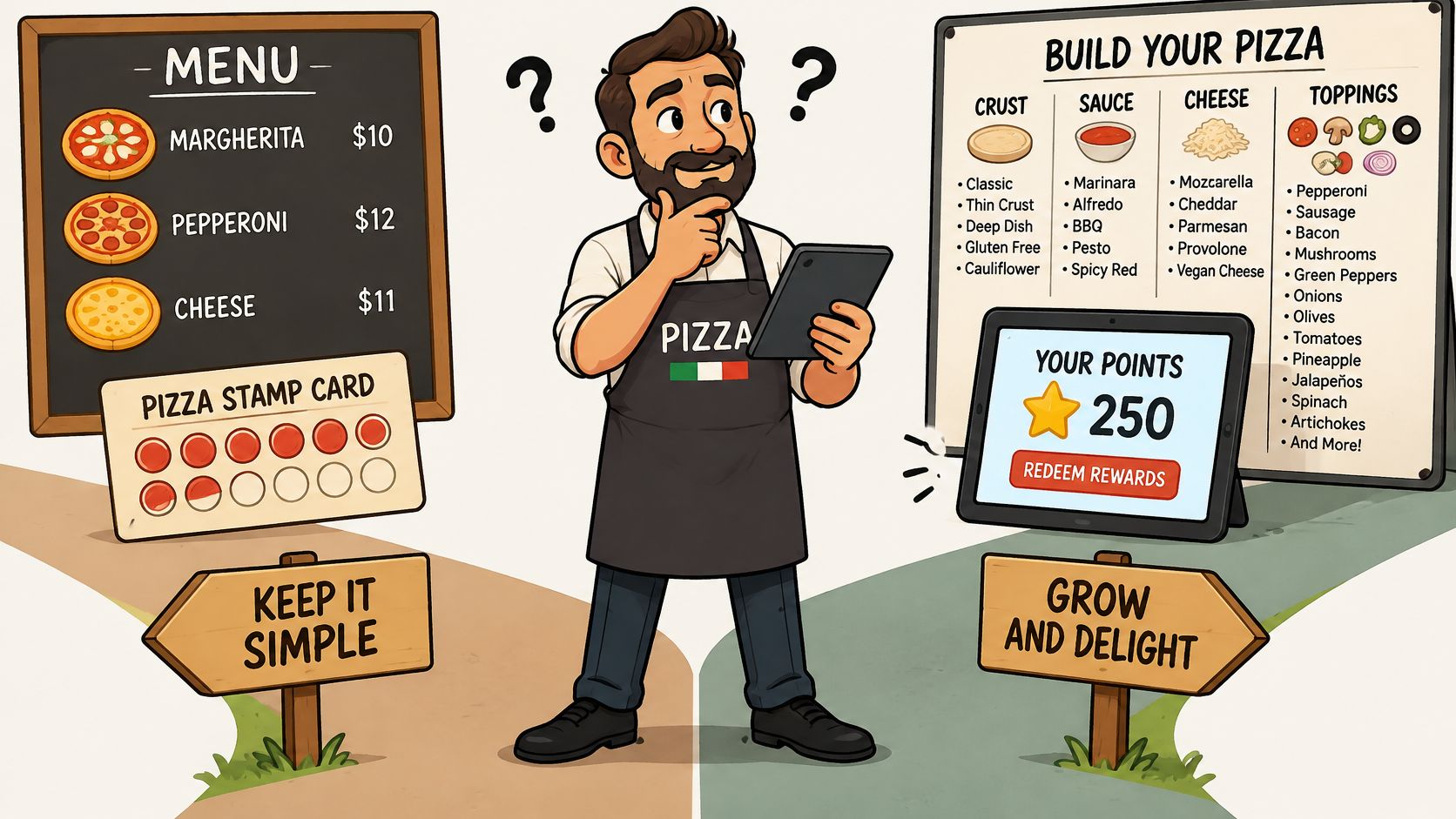
Four questions settle most of the remaining doubt.
- Does the first reward arrive within three or four visits? If not, shorten the cycle before you change anything else.
- Does it work at the counter without extra hardware? A process that needs a tablet, a login and a second pair of hands won't survive a Friday rush.
- Can someone join without downloading an app? A link that adds a pass to Apple Wallet or Google Wallet clears that bar. A third-party download usually doesn't.
- Is there a fallback when the pass is missing? Phone-number lookup, a printed receipt, or a staff override. Someone will forget their phone by week two.
Two Shops, Two Answers
A neighbourhood shop with ten menu items and mostly single-size orders should run a stamp card with a free pizza at ten visits. The menu is simple, visits are comparable, and the customer can count their marks without help.
A shop selling small, medium and family pies alongside bundles should run points instead, either at a flat rate with one clear reward or with a fixed discount given after a spend threshold. Order values swing too widely for one mark per visit to be fair, and the customer feeding a family every Sunday will notice.
The tooling doesn't need to be heavy. We build branded Apple Wallet and Google Wallet passes at Loyal Customer, and a business can set one up from a phone in a few minutes. The QR scanner inside our app adds or redeems points at checkout on any smartphone, with no POS system and no extra hardware at the counter.
Here's a short walkthrough of the kind of card setup involved before you commit to a format.
Pick one reward design, run it for a single month, and check the two numbers at the end: the credit rate and the redemption rate by channel. Then change one variable rather than five, because a card that fails on timing often looks like a card that failed on value, and only one of those is worth fixing.
Loyal Customer gives a pizzeria a digital loyalty program it can run from a phone, with branded Apple Wallet and Google Wallet cards, a choice of stamps or points, and a QR scanner that credits a visit at checkout in one tap. If the goal is a saving the customer feels within the first few visits, that's the shortest route to testing it without buying hardware. Visit Loyal Customer to build your card and see the whole cycle from the customer's side.