At the counter of a neighborhood cafe, a regular opens a wallet pass and sees 80 points. She asks the barista whether that is enough for the free drink. The barista points at a handwritten sign that says 100 points, then at a smaller line that mentions a dollar value, and admits she isn't sure how the two connect.
How do loyalty points work comes down to three moving parts: an earning rule that adds points, a balance that carries them across visits, and a redemption that trades them for a reward. The confusion usually starts because customers see only the last two, while the shop owner has to choose all three and pay for them. The loop is easiest to see in one customer's visits, and the cost is easiest to see when each rule is priced before launch.
Table of Contents
- From Spending to Free Rewards
- How Earning Rules Turn Purchases Into Points
- How Points Balances Are Tracked
- Redeeming Points and What Each Reward Really Costs
- Tiers, Expiry and Breakage Explained
- What Customers Give Up for Points
- Points Problems and How to Fix Them
- Confirm Your Points Rules Before Launch
From Spending to Free Rewards
A loyalty points program is a running balance that a business keeps for each customer. One earning rule adds points when the customer buys, and a redemption subtracts points when the customer claims a reward.
Take a cafe that awards 1 point per $1 spent and charges 100 points for a free drink. The same customer visits four times, then redeems once. Her balance looks like this:
| Visit | Spend | Points earned (1 per $1) | Running balance |
|---|---|---|---|
| Visit 1 | $12 | 12 | 12 |
| Visit 2 | $25 | 25 | 37 |
| Visit 3 | $30 | 30 | 67 |
| Visit 4 | $40 | 40 | 107 |
| Redeem free drink | - | -100 | 7 |
The customer is not thinking about points on visit one. She is thinking about coffee. The shop is running a small prepaid tab: it has promised a future drink in exchange for purchases that already happened. That promise has a cost.
An operations-management study of loyalty points as a currency describes points as “a new currency” and explains that their monetary value is recorded as a liability on the issuer's balance sheet until redemption or expiry. Airline programs show the scale. American Airlines launched AAdvantage on May 1, 1981, and one industry analysis cited in that study reported that, by 2005, the total value of airline points collected by customers exceeded $700 billion. A cafe's liability is smaller, but the structure is the same.
For a small merchant, three numbers matter:
- Earning rate: how many points each dollar or visit produces.
- Reward cost: what the shop gives up when points are redeemed.
- Balance per customer: how much unredeemed value each member is carrying.
The customer sees only the balance and the reward, so both have to be visible on the pass or card. If the pass shows 80 points but not the 100-point target, the customer has to ask. If it shows the target but not the reward, she has to guess whether the drink is a small drip coffee or any drink on the menu.
The merchant's test: For every reward, ask whether the extra visits it creates are worth more than the margin you give up when it is redeemed.
Trace your own last three purchases through the loop. Name the reward you would want at 100 points, then check whether the shop could afford to give it at that rate.
How Earning Rules Turn Purchases Into Points
The earning rule is the sentence a customer checks against a receipt. Most small businesses choose one of four models.
Four earning models
| Rule | How points are earned | Example | Best suited to |
|---|---|---|---|
| Points per dollar | 1 point for every $1 spent | $20 spend earns 20 points | Cafes and retail with varied ticket sizes |
| Visit-based | 1 point per qualifying visit | 10 visits earn 10 points | Salons and clinics with fixed-price services |
| Bonus points | Extra points for a first visit, birthday or referral | 50 bonus points on sign-up | Any business wanting faster sign-ups |
| Spend tiers | Higher multiplier above a spend threshold | 2 points per $1 above $50 | Restaurants with larger tickets |
Points per dollar feels fair when tickets vary. Visit-based points behave like a digital stamp card and suit a haircut or a clinic appointment where the price is predictable. Bonus points buy attention at signup, a birthday or a referral. Spend tiers reward larger baskets, but they add a second sentence to the rule.
The $64 check
A restaurant bill of $64 earns 64 points under a flat 1 point per $1 rule. Under a spend-tier rule that pays 1 point per $1 up to $50 and 2 points per $1 above $50, the same bill earns 50 + 28 = 78 points. The extra 14 points are the cost of encouraging a larger order. Run that arithmetic on your own average ticket before choosing a tier.
In 2024, 86% of surveyed consumers rated financial rewards, simplicity, and ease of use as important or very important loyalty-program attributes, according to Deloitte's global survey of more than 9,800 consumers. A rule that needs a paragraph of explanation fails that test. A rule a customer can predict from a receipt passes it.
Rounding and caps are where quiet costs hide. Decide whether a $4.60 coffee earns 4 or 5 points, and write the answer down. Set a maximum points per visit so one large catering order cannot drain the budget. State minimum spends and excluded items, especially gift cards and discounted goods, because those are the purchases that can turn a generous rule into a loss.
Write the rule as a receipt test: If a customer cannot calculate the points from the total on the receipt, the rule is too complicated for a counter conversation.
Can a customer predict their points before they reach the register? If not, simplify the rule before adding another reward.
How Points Balances Are Tracked
A points balance is a ledger, not a single number that someone edits. Each purchase adds an entry, each redemption subtracts one, and the displayed balance is the sum of those entries. That distinction matters when a customer says the total looks wrong. You don't argue about the number. You open the ledger.
Say a member spends $25 and earns 25 points. The ledger records plus 25. Later she redeems a 100-point reward, and the ledger records minus 100. If she returns the $25 purchase, the refund reverses the points earned on that purchase, so the balance is never double-counted. The same logic applies to a cancelled appointment or a voided order.
Pending, posted and reversed
Card payments can create a gap between the sale and the points. A payment may sit as pending until the sale clears, then post to the balance. The program should say how long that takes, because a customer who sees no points after an hour assumes the program is broken. Cash sales usually post immediately.
Matching is the other quiet failure. A phone number or card ID links each transaction to one member. Duplicate accounts happen when a customer signs up with a different phone number or a staff member creates a second profile. Decide the merge rule in advance: which account survives, what happens to the points, and who can approve the merge.
A balance should never go below zero. If a customer redeems more than she has, the system should block the redemption, not create a negative balance that nobody can explain. Manual adjustments are sometimes necessary, but each one should be logged with a reason and the staff member's name. For a closer look at how a wallet pass presents that history, this guide to rewards card balances walks through what the customer should see.
On the pass, show three things: the current balance, the last three to five transactions, and the next expiry date. Those three answer most counter disputes before they start.
Ledger check: Pick any member and confirm the displayed balance equals the sum of their entries. If it doesn't, the problem is the ledger, not the customer.
Redeeming Points and What Each Reward Really Costs
The exchange rate is the number that makes points tangible. A fixed rule, such as 100 points equals $1, lets a customer do the math on the way to the counter. A variable rule makes the same balance buy different rewards depending on availability, restrictions or changing prices.
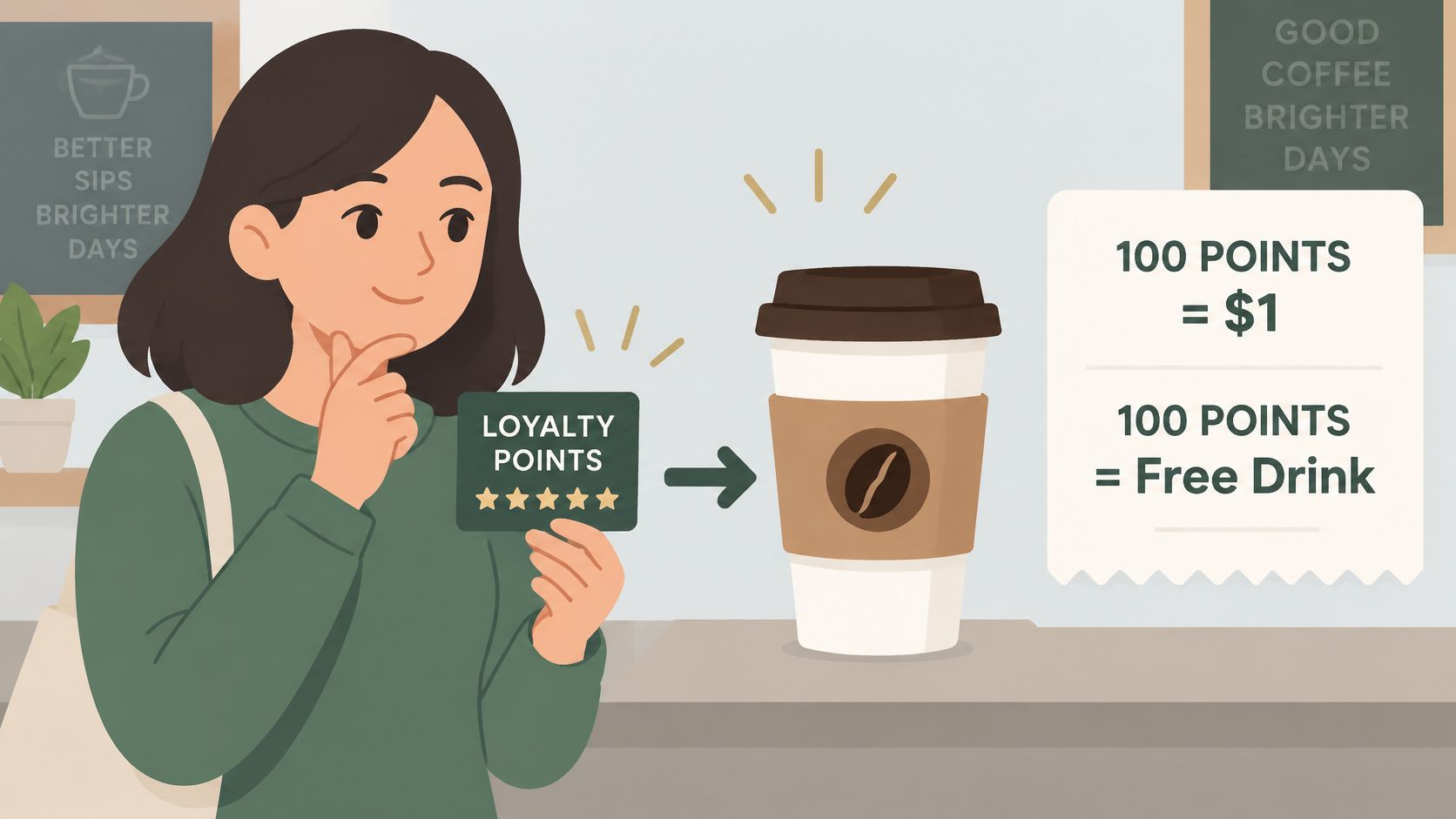
Research summarized by the American Marketing Association found that consumers are less likely to redeem when the money-to-points exchange rate is variable than when it is fixed, even when the average underlying value is held constant. Variable rates create optimism about future opportunities, so customers postpone redemption. A postponed redemption is not a benefit the customer has felt. It is a promise she is still testing.
Pricing three rewards
| Reward | Points needed | Merchant cost | How cost scales |
|---|---|---|---|
| Free item | 100 | a few dollars of goods | fixed per redemption |
| Fixed $5 discount | 150 | $5 of revenue | fixed per redemption |
| 15% off everything | 250 | $9 on a $60 order | grows with basket size |
Each reward gets its own points price. The free drink at 100 points does not have to match the everyday 100-to-$1 rule, because the shop's cost is a few dollars of goods, not a dollar-for-dollar discount. The $5 discount at 150 points costs $5 of revenue when claimed. The 15% discount at 250 points costs $9 on a $60 order and more on a larger basket, so the shop's exposure grows with the customer's order.
Publish three things with every reward:
- Points needed: the exact threshold, not a range.
- Money value: what the reward is worth in dollars, or the item's menu price.
- Exclusions or minimum basket: what does not qualify and what the customer must spend.
Reward preference is not uniform. In 2024, 52% of U.S. consumers enrolled in loyalty or membership programs used points to buy themselves a gift, while 42% preferred discounts, according to Fiserv's survey of more than 1,000 adults. A free item feels like a gift. A percentage discount feels like a sale. Both can work, but they carry different costs.
The budgeting target is simple: the cost of redeemed rewards must sit below the extra profit that repeat visits generate. If 30% of members redeem in a month, does the margin still cover it? Run that number before launch, not after the first busy month.
Margin rule: A small shop with thin margins should start with a free item or a fixed discount, because the cost is capped. A percentage off everything is the reward most likely to grow faster than the visits it creates.
Tiers, Expiry and Breakage Explained
A membership tier is a status level. Members start at a base level and move up after reaching a spend or visit threshold. The higher level offers a better earning rate or a better reward. That is different from a spend-tier earning rule, which changes the multiplier inside a single purchase. A membership tier changes what the member gets across all purchases after she qualifies.
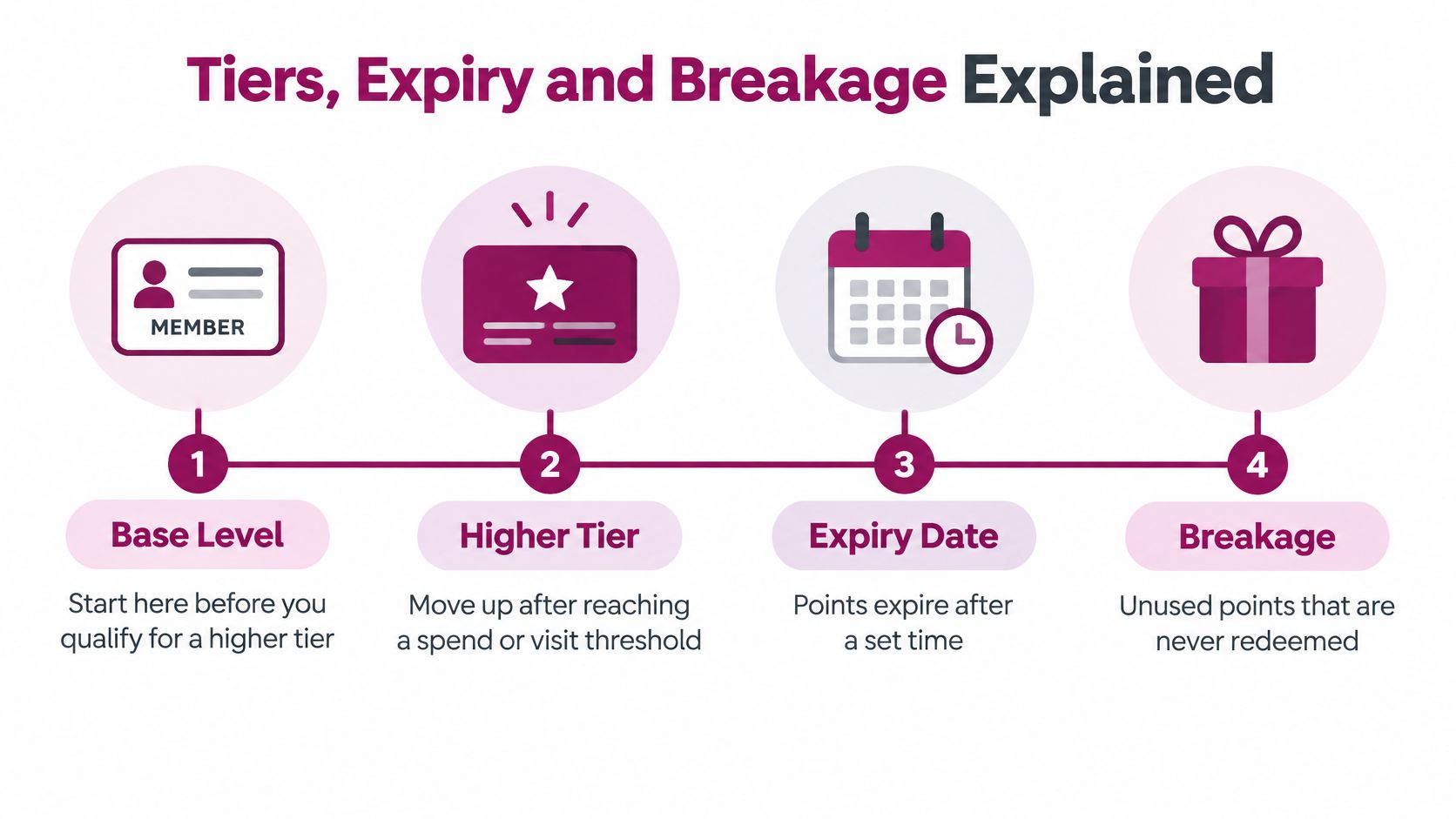
Breakage is the share of points that are never redeemed. It lowers the business's liability, because the reward is never claimed. That is why a program can feel generous and still be affordable. Breakage is not a strategy to rely on, though. A customer who loses points to a deadline she never saw does not feel rewarded. She feels tricked.
The expiry checklist
| Expiry model | What triggers it | Customer experience | Merchant risk |
|---|---|---|---|
| Fixed date | All points expire on one set date | Clear deadline, easy to plan around | Members forget and feel cheated |
| Inactivity | Points expire after a set period with no visit | Feels fair when reminders are sent | Needs accurate visit tracking and notices |
| Account closure | Points end when the member leaves | Clear rule if disclosed | Can look punitive; check local rules |
| No expiry | Points stay until redeemed | Highest trust | Liability grows and breakage falls |
The legal question is narrower than most customers assume. A 2025 legal analysis of the Chipotle litigation reported that rewards points may lawfully expire when they are earned through activity, are not prepaid, and lack a stated dollar value, provided the terms are clearly disclosed, as detailed in this analysis of the rewards points ruling. The same analysis notes that Quebec and Ontario restrict certain forms of time-based expiry, while U.S. gift-card protections generally exclude loyalty, award, and promotional cards when their loyalty purpose and expiration terms are disclosed. Consumer preference runs the other way: 40.7% of global loyalty-program members said they want points not to expire, and 49% of U.S. consumers expressed the same preference.
The practical gap is not “how long do points last?” It is “what event triggers expiration, how is inactivity measured, and what notice does the customer receive?” Name the trigger, define the inactivity window, and state the notice. Then send reminders at 60 days before expiry, again at 14 days, and on the expiry date. Where the terms allow it, a visit should reset the clock, and the pass should say so. If you're designing a higher level, VIP status needs its own rules for earning, expiry and what happens if the member drops back down.
Disclosure rule: The expiry date belongs on the pass, not only in the terms. A deadline a customer can see is a deadline she can act on.
What Customers Give Up for Points
Enrollment is not free. A customer hands over a name, a phone number and a purchase history, and sometimes a birthday or a location, in return for points. The signup screen is an exchange, and most customers never see the price side of it.
A legal analysis of loyalty program rights cites PwC's 2025 customer-experience survey, which found that 53% of consumers considered sharing personal information worthwhile when it made interactions smoother. That is conditional acceptance, not unlimited permission. Customers will trade data for a smoother experience. They will not trade it for a program that feels like surveillance with a free coffee attached.
Essential versus optional data
- Essential: an identifier such as a phone number, plus the transaction history needed to track a balance.
- Optional: precise location, birthday, demographic profiling, and cross-site tracking.
The essential set is enough to run the loop. The optional set may improve marketing, but it raises the trust cost. A customer should be able to answer three questions from the signup screen:
- What is collected?
- Is it sold or shared?
- How do I delete my data or opt out, and what happens to my points if I do?
That third question is where merchants get caught. If opting out erases the points, say so at signup, not after the customer has spent six months earning them. Wallet passes reduce app friction, but they can also make collection less visible because the customer adds a card and moves on. The signup screen has to state the purpose and the retention period in plain language, not in a paragraph of legal text.
One-sentence test: Could a customer explain the deal in one sentence? “I give you my phone number and purchase history, you track my points, and you don't sell my data.” If nobody can say that, the exchange is not clear enough.
Points Problems and How to Fix Them
Most small-business points programs fail in one of four ways. Each failure has a cause, a single change, and one measure that proves the change worked.
The reward sits too far away. A member earns 5 points a visit and the first reward costs 300. The cause is a threshold set for margin, not for behavior. Lower the first reward to 50 to 100 points and add a welcome bonus so the first visit produces visible progress. Measure the redemption rate among members who joined in the last 30 days.
Balances look wrong. A customer says she had 90 points and now sees 70. The cause is usually a refund, a pending sale or a manual edit with no note. Show the balance and the last few transactions on the pass, and use the ledger rules for every adjustment. Measure the number of balance disputes per month.
The program costs too much. A percentage-off reward applies to large baskets and the cost grows faster than the visits. Cap the reward or set a minimum spend. Measure cost per reward against the margin on the extra visit.
Expiry feels like a trap. The customer forgot the deadline because the only notice was in the terms. Send the reminders and reset the clock on a visit where the terms allow it. Measure the share of points redeemed before expiry.
What to avoid is shorter:
- Silent rule changes: A points program is a promise. Changing the earning rate without notice teaches customers that the balance is not reliable.
- Unclear exclusions: If promotional items, gift cards or discounted goods don't earn points, say so on the sign and at the counter.
- Points that cannot be used on promotional items: A member who saves for months and then finds the reward excluded from the item she wants will not save again.
Fix one thing at a time: Change the reward threshold, then watch redemption for 30 days. Changing the rule, the reward and the expiry date in the same week tells you nothing about which change worked.
Confirm Your Points Rules Before Launch
The launch checklist is deliberately short. If you cannot fit the rules on one page, the customer cannot fit them in her head.
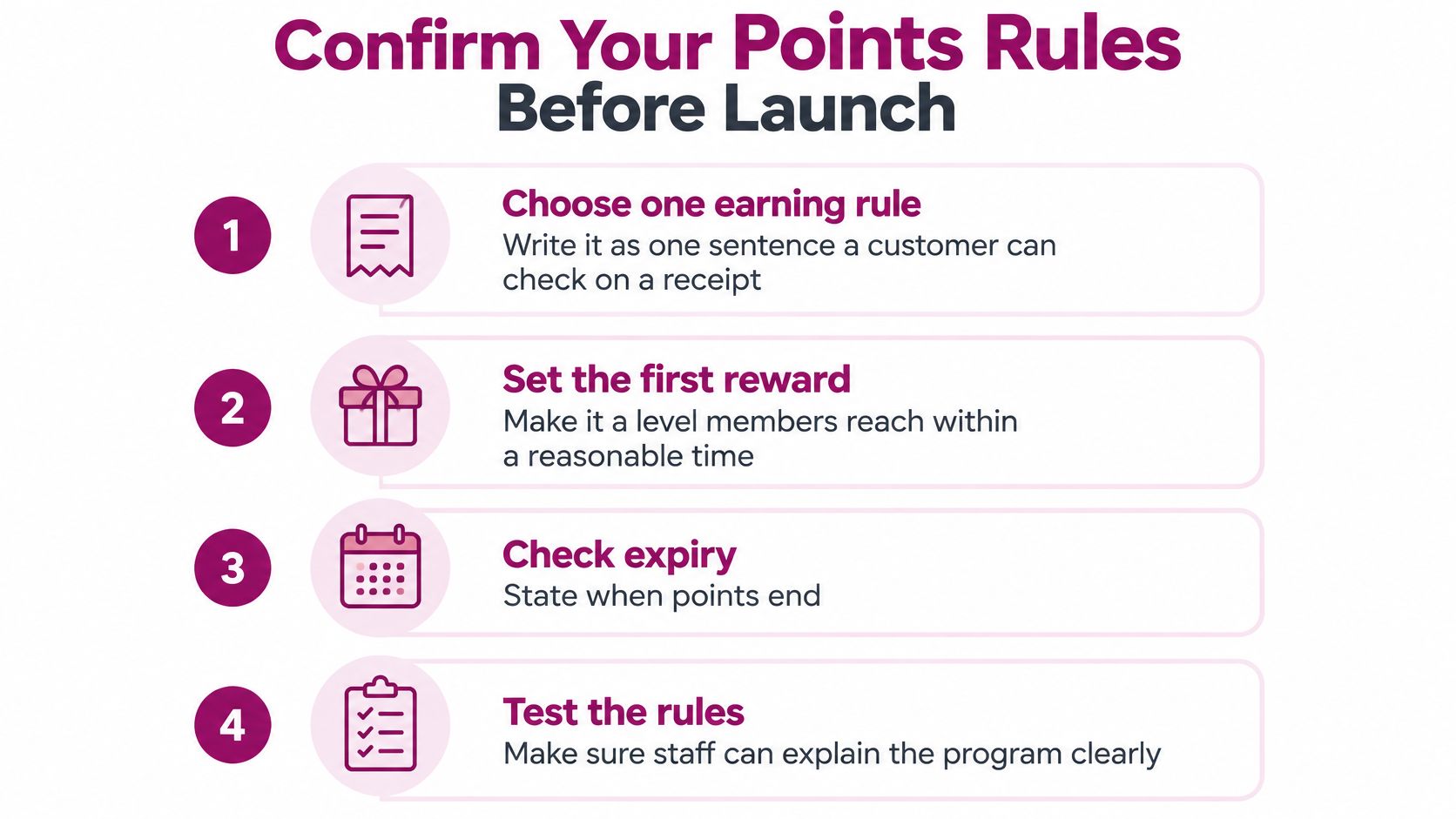
The one-page rule sheet
- Choose one earning rule and write it as one sentence a customer can check on a receipt.
- Set the first reward at a level members reach within two to three visits.
- Pick a fixed or variable exchange rate and state it in dollars or in reward terms.
- Decide the expiry model and the reminder schedule, then put the date on the pass.
- Publish exclusions, the maximum points per visit, and the data you collect.
- Schedule a 30-day review of redemption rate and cost per reward.
The loyalty rewards program guide is a useful cross-check for the reward side of that sheet. The rules come first, though. A tool cannot fix a reward that costs more than the visit it produces.
If you run a cafe, salon, restaurant or retail shop and want a digital program, Loyal Customer runs a points program or a digital stamp card from a phone, with no hardware and no app for customers, and the wallet card updates by itself after every visit. That is a software decision. The rules on the page are the business decision, and they are the part that determines whether the program pays for itself.
Write the rules on one page before choosing any tool. If the page has a rule you cannot explain in one sentence, remove it or rewrite it.
Loyal Customer gives cafes, salons, restaurants and shops a phone-run points program or digital stamp card, with branded passes in Apple Wallet and Google Wallet that update after each visit. Customers join through your link, verify by phone and add the card without downloading an app. If you're ready to turn the rules you just wrote into a working program, visit Loyal Customer and set up your card.