In 2024, U.S. consumers held an average of 19 loyalty-program memberships per person, but only 9.3 were active. For a café, salon, or small shop, a wallet-native stamp or points card on a phone usually beats a feature-rich free plan that charges for SMS, caps members, or turns into a paid subscription when the trial ends.
You're likely comparing options between customers, while the counter is busy and the paper punch card keeps getting forgotten. The question isn't just which tool costs nothing today. It's whether customers can join without hassle, whether you can keep rewards accurate during a rush, and whether the plan stays affordable when people use it.
| What to compare | What a good fit looks like | What to test |
|---|---|---|
| Customer enrollment | A quick QR scan or wallet pass, with no unnecessary app install | How many steps a customer must complete at the counter |
| Daily use | Stamps or points are easy to add and redeem from a phone | Whether staff can handle a normal transaction without switching tools |
| Balance updates | The customer's card reflects a change reliably | Whether updates happen automatically or require a rescan |
| Total cost | No surprise charges for messages, extra members, or essential features | What happens when the trial ends or a cap is reached |
| Data and exit | You collect only what you need and can export records | Whether customer data and balances can move with you |
Table of Contents
- The Decision Behind Choosing Free Loyalty Software
- What Free Loyalty Plans Usually Include
- Wallet-Native Passes Versus Standalone Loyalty Apps
- Mobile-First Admin and How It Changes Daily Work
- The Hidden Cost of Free Loyalty Software
- Matching Free Software to Merchant Use Cases
- How to Pick the Right Free Loyalty Software in 2026
The Decision Behind Choosing Free Loyalty Software
A customer is ready to pay, the queue is growing, and someone asks to redeem a reward. That is when a free loyalty plan proves its value, or creates extra work. For a café, salon, or small shop, choose software your team can run during a busy shift, not just one that looks good on a pricing page.
Start with enrollment friction. Every extra sign-up step at the counter can cost you a member. If customers must download an app, create a password, verify an email, and learn a new interface just to collect a stamp, many will skip the program. A QR code that opens a wallet-native card or simple web card can reduce that burden. The right choice depends on what your customers will use and what your staff can support.
Three tests that matter more than the headline price
First, test the customer's path. Scan the QR code yourself. Can a customer join without installing an app or completing a long form? Then test earning and redeeming a reward. Cafés, bakeries, salons, and convenience retailers rely on repeat visits, so a card that takes too long to use adds friction instead of giving customers a reason to return.
Second, calculate the operating cost. Include setup, staff time correcting balances, message fees, and paid features needed for everyday use. Check what happens when a trial ends or a free plan reaches its limits. A free tool can cost more than a paid one if staff have to maintain customer records by hand or customers need extra steps to use it.
Third, verify that balances stay current. Add points or a stamp, then check what the customer sees. Change a reward rule and confirm existing cards update correctly. Test this during a normal transaction, not just in the setup screen. Your team should be able to run the program consistently without turning each purchase into an admin task.
Compare wallet-native passes with web cards as well as standalone apps. A wallet pass may avoid an app download, while a web card may be easier to set up. Neither saves money if updates are unreliable or customer data takes too much effort to collect and manage.
Practical rule: If staff can't explain the card in one breath and apply a reward without disrupting checkout, simplify the program before launch.
What Free Loyalty Plans Usually Include
Free tiers tend to cover the basic reward mechanic, then draw a line around scale, branding, or communication. Some are ongoing free plans; others are free trials that start charging after a set period. Treat those as different products. A trial is useful for testing, but it isn't a long-term zero-cost plan.
The simplest free tools often let a merchant set a stamp or points rule, issue a digital card, and manage basic activity from a phone or browser. That may be enough for a single-location business with one clear reward, such as earning stamps toward a free drink. The limits matter when you want several reward types, custom branding, automated messages, or more than one location.
| Capability | Common free limit | Typical paid difference |
|---|---|---|
| Reward rules | One basic stamp or points structure | More reward types, tiers, or campaign rules |
| Customer volume | A cap on active members, or unclear limits | Higher or uncapped usage, depending on the plan |
| Card branding | Standard templates or vendor branding | Custom logo, colors, and card design |
| Messages | No campaigns or a small allowance | More email or SMS features, sometimes with usage charges |
| Reporting | Basic totals and limited customer information | Deeper reports, segmentation, or export options |
| POS and locations | No integration or support for one site | POS connections and multi-location management |
Read the pricing page past the word “free”
Before signing up, find out what happens when a customer cap is reached. Does the card stop accepting new members, does the account upgrade automatically, or must you move the whole program? Check whether branded cards, exports, and balance updates are included, rather than assuming they come with the free tier.
Also look for usage-based fees. A free subscription can still carry messaging charges, and SMS is especially easy to overlook when a plan advertises automated reminders. One comparison estimates SMS carrier charges of roughly $40–$100 per month for active programs, and estimates migration costs of $5,000–$15,000 after outgrowing a free plan. These figures depend on the vendor and implementation, so use them as prompts to ask questions, not as a quote for your business (the comparison of free loyalty software costs).
Finally, identify the end date. A trial that becomes paid isn't the same as an ongoing free plan, even if both say “free” on the first screen.
Wallet-Native Passes Versus Standalone Loyalty Apps
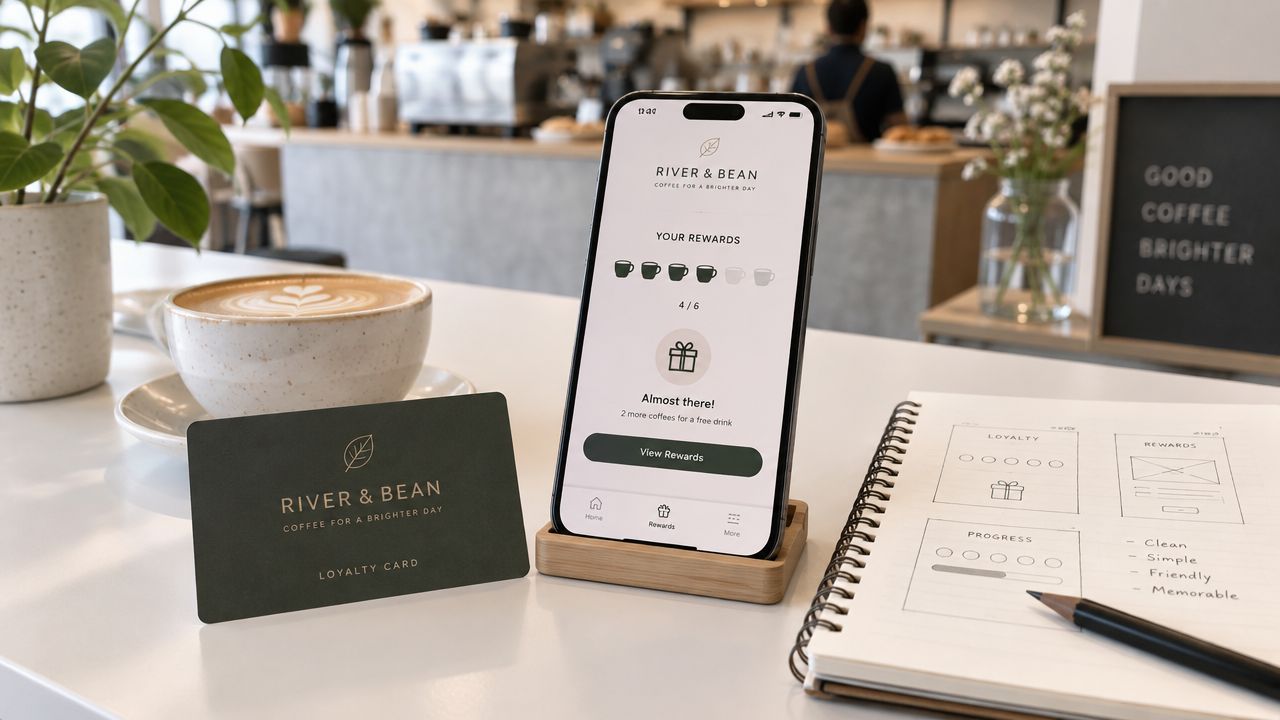
The delivery method often matters more than the list of features. A wallet-native pass sits in Apple Wallet or Google Wallet, tools customers may already use. A standalone app asks them to install another app, create or use an account, and remember where the loyalty card lives. A web card opens in a browser and avoids the install, but may not behave like an updatable native pass.
Digital wallets reached approximately 4.3 billion users worldwide in 2024, about 53% of the global population. Forecasts project roughly 5.8 billion users by 2029, while the estimated value of global digital-wallet transactions in 2024 was about £7.6 trillion, or $10 trillion. Those figures put wallets in the category of mainstream infrastructure, not a novelty feature (Finder's digital-wallet statistics).
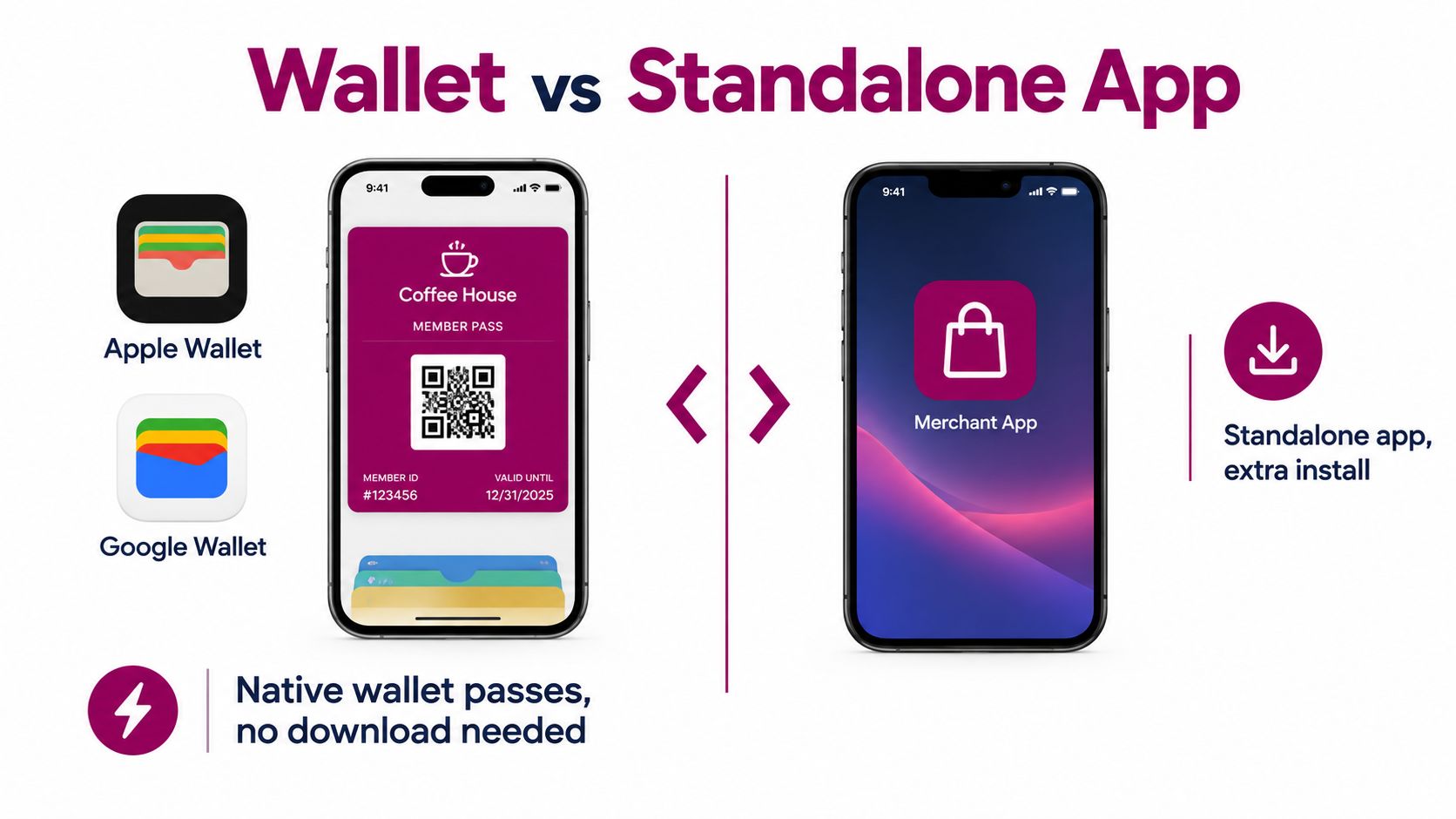
Check what “wallet compatible” actually means
For Google Wallet, a loyalty card can be issued through a REST API or Android SDK, and distributed through channels such as web, email, or SMS. Google distinguishes a shared pass template, or Class, from individual customer passes, or Objects. That structure can support consistent branding across cards while retaining customer-specific records. When comparing providers, ask whether the plan includes real pass creation and updates, dynamic balance fields, customer identifiers, and a way to export or migrate records. Google documents a quota of 20 Wallet API requests per second, a ceiling small merchants are unlikely to hit but larger deployments should test (Google Wallet's loyalty-card documentation).
Apple Wallet has a separate update workflow. An updatable pass relies on a web service and authentication token: the device registers the pass, the provider's server signals that information has changed, and the device requests the updated pass. Ask the vendor who maintains that service and test whether a balance change appears reliably after a purchase, pass reinstall, or device change (Apple's guide to updating Wallet passes).
A static QR card can work for a simple stamp program if the customer or staff rescans it as needed. It's a weaker fit for a points balance customers expect to see updated after every transaction. For a fuller comparison of the trade-offs, see this guide to digital wallets versus mobile wallets.
Mobile-First Admin and How It Changes Daily Work
A mobile-first loyalty tool lets the owner manage routine tasks from the same phone they use to communicate with customers and run the shop. That can remove the need to open a desktop dashboard just to add a stamp or redeem a reward. It doesn't remove the need for clear staff habits, but it makes a simple program easier to operate from the counter.

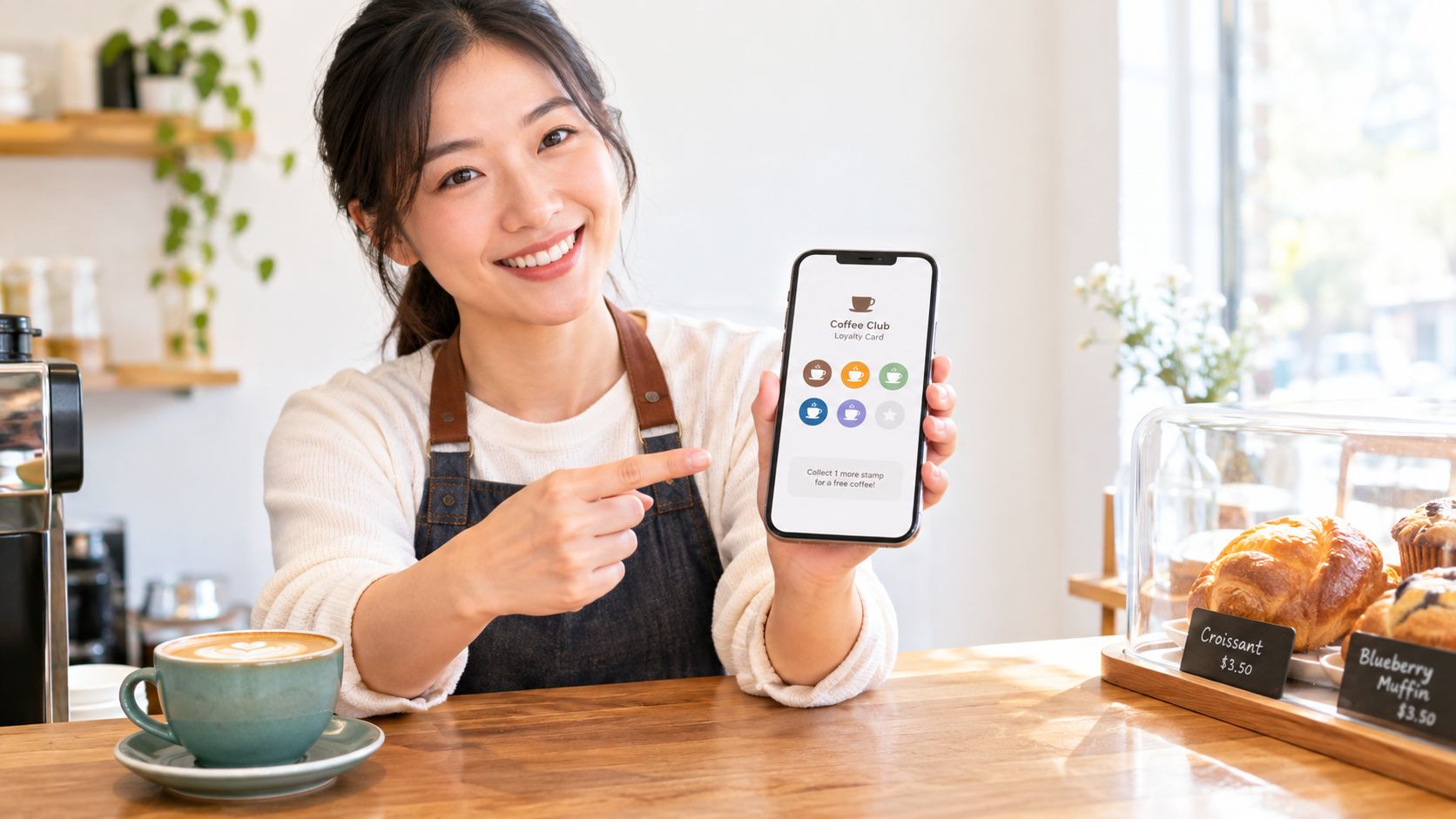
Take a busy café shift. A customer presents a digital card, the barista checks the visit and adds a stamp from a phone, and the customer sees the updated card. When the customer has earned the reward, the barista marks it as redeemed and follows the same process for the next person. That's manageable when the rules are plain and the program doesn't force staff to reconcile balances across different screens.
Where phone-based admin works, and where it strains
This approach suits a single location, a small team, and a predictable reward mechanic. A stamp card for coffees or bakery purchases needs little explanation. A salon might use points earned on services, but the owner still needs to make the earning and redemption rules easy for staff to apply consistently.
Mobile-first administration becomes less comfortable when you need detailed performance reports, complex customer segments, or shared control across locations. It can also become a bottleneck if a free plan requires one person to approve every adjustment. Before launch, have someone other than the owner add a stamp and process a redemption. If they need a long tutorial, the workflow isn't ready for a rush.
A phone-based tool should also make the customer-facing result clear. Show staff what the card looks like, where the balance appears, and what happens when a reward is redeemed. Then test the workflow in the context of the wider loyalty program software setup, especially if your checkout or customer records already live in another system.
The useful dividing line is operational complexity. A phone can replace a desktop for routine loyalty tasks, but it can't compensate for unclear rules, duplicate records, or a program that needs constant manual attention.
Here's a short demonstration of the kind of phone-based loyalty workflow to look for:
The Hidden Cost of Free Loyalty Software
A café can run a free loyalty card and still pay for it in staff time, message fees, or a messy exit. Judge the plan by its total cost of ownership, not its subscription price. If staff must correct balances by hand or you cannot export customer data, “free” may cost more than a paid option.
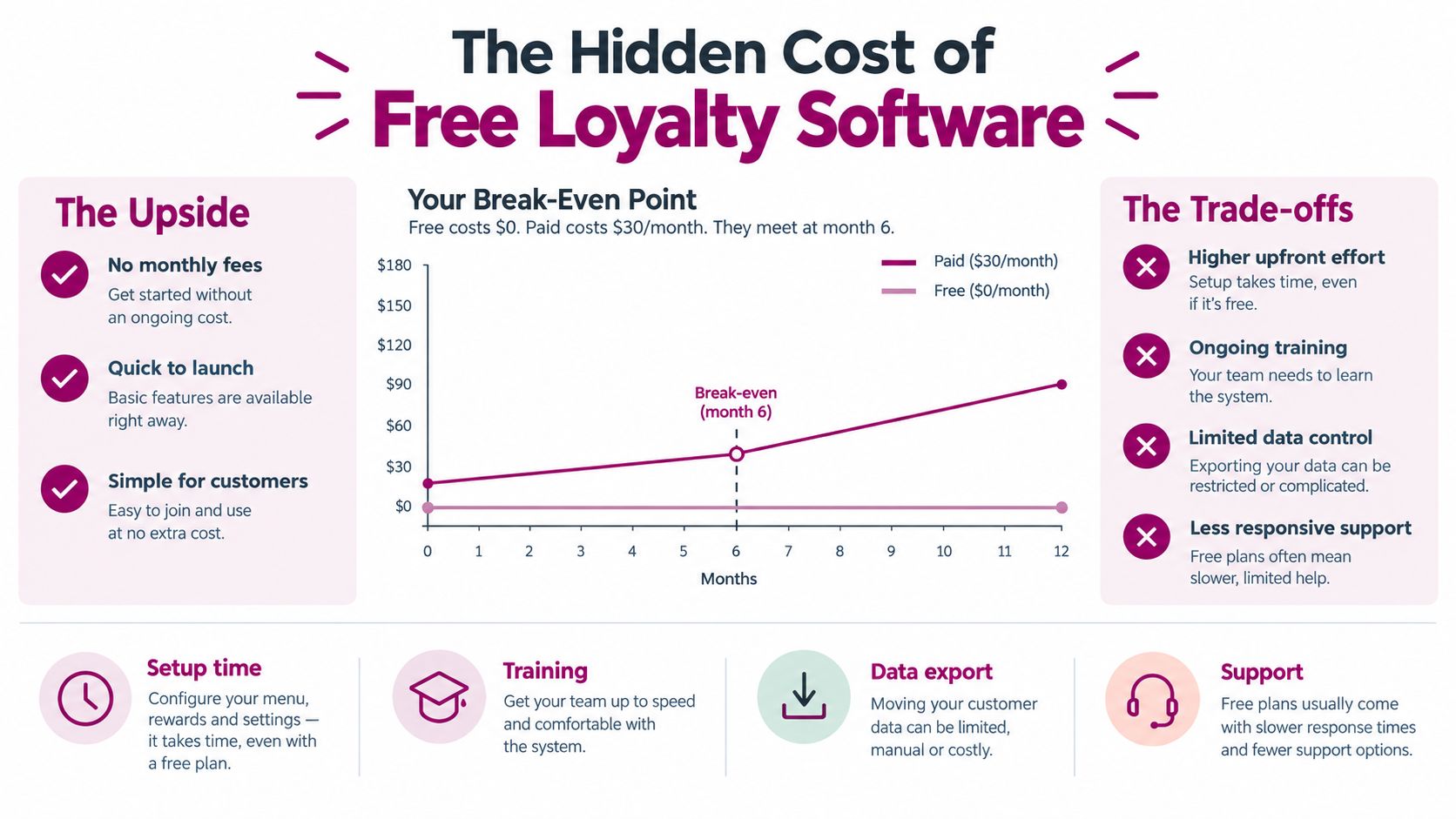
The infographic's line chart is illustrative, not a price benchmark. It shows a paid plan starting at $30 per month and crossing a flat $0 free line at month six. That crossing point is not a forecast for your business. Your break-even depends on the plan's charges and the staff time, messaging, and migration work it creates.
Work out the break-even point
Build a monthly worksheet for your café or salon. Record active customers, reward transactions, messages, and staff hours spent managing the program. Then include the costs a subscription price leaves out:
- Messages: Check whether SMS is included, capped, or billed separately.
- Staff time: Estimate time spent correcting balances, finding customers, and explaining a confusing sign-up.
- Setup and training: Count the hours needed to configure rules and teach the team.
- Data portability: Confirm that customer records and reward balances can be exported in a useful format.
- Migration: Ask what happens when you reach a cap or need a feature the free plan lacks.
Use a loyalty program ROI calculator to compare those costs with the subscription fees before committing. A free tier is a good deal only if you can leave without losing your customer list, reward balances, or setup time.
Privacy also belongs in the calculation. Ask what information the card needs, whether the program can run without unnecessary profile details, and how customers can request deletion. Keep reward administration separate from promotional messaging. Signing up for a loyalty program does not mean a customer has agreed to marketing texts. A discussion of declining U.S. comfort with sharing personal data through loyalty programs makes a practical case for collecting only what you need (the discussion of loyalty-program data privacy).
Test the workflow, export your information, and confirm you can stop without a complicated migration. If the vendor will not explain how to leave, count that as a cost.
Matching Free Software to Merchant Use Cases
Choose the reward mechanic that fits how customers buy from you. A tool with a long feature list won't help if it adds friction to the moment customers are most likely to join.
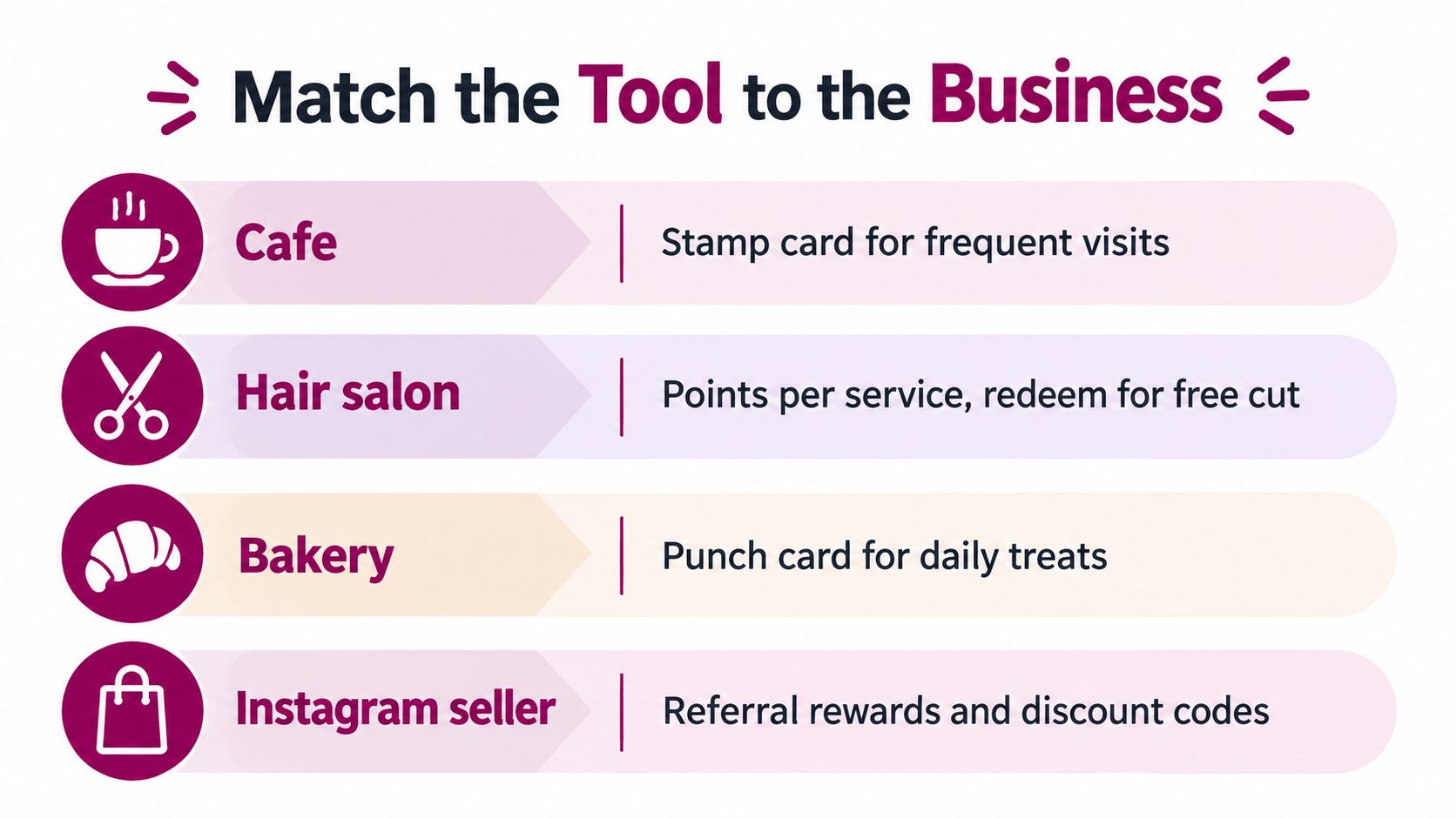
Match the card to the business
Café or coffee shop: A digital stamp card is usually the cleanest starting point. Customers understand the mechanic, and staff can apply stamps quickly. The key trade-off is whether the card updates reliably without forcing customers to install a merchant app.
Hair or beauty salon: Consider points if customers buy different services at different prices or if you want rewards tied to spend rather than visits. Don't add tiers just because a software plan offers them. A complicated rule that staff explain differently can create more work than value.
Bakery: A simple punch-card structure fits repeat purchases such as a regular pastry or loaf. Keep the reward easy to understand and avoid collecting personal details that aren't necessary to administer it.
Instagram or WhatsApp seller: Start with a lightweight card or referral offer that customers can access from a link or QR code. Make sure you can track redemptions consistently, especially if customers order through direct messages rather than a POS.
Takeaway: If you want to avoid recurring SMS costs, prioritize a card customers can access without relying on text-message campaigns. Wallet passes can suit customers who use them, while a web card offers another app-free route. Neither option removes the need to explain how earning and redemption work.
For each business, the best free tool is the one that handles the common transaction cleanly. If your reward has to be explained at length, simplify the offer before changing platforms.
How to Pick the Right Free Loyalty Software in 2026
A café can sign up for a free loyalty tool, train staff, and print signs, only to find that customer records are hard to export or key features require a paid plan. Check the full operating cost before committing. For independent cafés, salons, and micro-retailers, a phone-first program with a wallet-native pass can work well if updates are reliable and leaving the service is straightforward. Regional wallet adoption varies, so check your own customer mix rather than assuming everyone wants a wallet pass.
Test the platforms your customers use. Ask iPhone users to check Apple Wallet updates and Android users to create a Google Wallet pass and confirm balance changes. If you already use a POS, compare its loyalty option with a separate card tool before adding another workflow.
Run these checks before you commit
- Enroll real customers. Invite a small group to join through your planned method. Notice where they hesitate and whether staff need to help.
- Change a reward rule. Update a stamp or points setting, then confirm what existing customers see on their cards.
- Test the end of the trial. Check when billing starts, which features disappear, whether passes still work, and how to export records.
- Check the privacy basics. Find out what information is required, how consent works, and how deletion requests are handled.
- Price the operating work. Include message fees, staff time, integration requirements, and likely migration effort alongside the subscription price.
Add up the hidden costs. Staff time spent reconciling transactions, paid integrations, and customer data you cannot export can make a free tier more expensive than a paid alternative. Skip it if the core workflow depends on a paid integration or you cannot leave with the records you need.
Loyal Customer provides phone-managed points and stamp-card programs, plus Apple Wallet and Google Wallet loyalty cards, and offers a free trial to test setup and fit. Use the trial to test enrollment, rule changes, and data export before committing.
Start with a small group of regulars before printing signs or training the full team. Visit Loyal Customer to explore phone-based points and stamp cards, wallet-ready passes, and a free trial for testing your setup.