
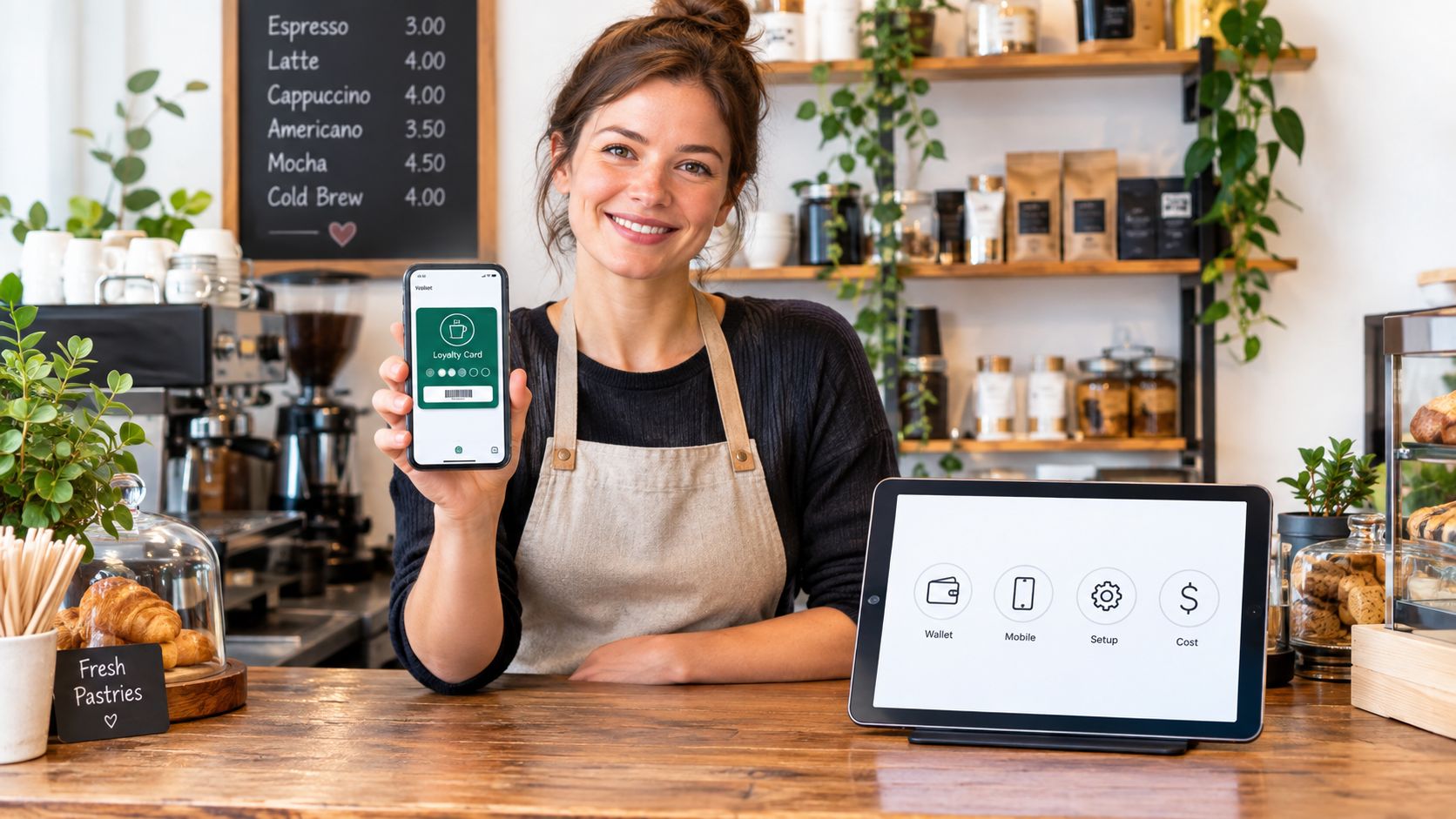
You're standing behind the counter during a rush when a regular asks whether you still use paper punch cards. You find a stack in a drawer, discover the stamps have run out, and promise to “sort it out later.” That moment captures the loyalty problem for many small businesses. The owner wants more repeat visits, but the program can't create extra admin, require a new checkout system, or force customers to download another app.
The right loyalty program software should make repeat purchasing easier to recognize and easier to reward. For an SMB, the practical comparison comes down to wallet pass support, mobile administration, setup effort, and pricing. The strongest option isn't the one with the longest enterprise feature list. It's the one your staff can run during a busy shift and your customers can use without friction.
Table of Contents
- What Loyalty Program Software Actually Does for Small Businesses
- Points, Stamps, and Wallet Passes Explained Simply
- The Four Criteria That Matter When Comparing Tools
- How Loyal Customer Stacks Up Against Common Alternatives
- Matching Software Profiles to Real SMB Scenarios
- Launching a Program Without Slowing Down Your Week
- Which Loyalty Program Software Should You Pick
What Loyalty Program Software Actually Does for Small Businesses
A small business usually faces three choices: keep a paper punch card, add a loyalty feature to an existing POS, or choose standalone loyalty program software. The decision becomes clearer when you judge every option against four operating realities: does it support a useful wallet pass, can you manage it from a phone, can you launch it without technical help, and is the pricing predictable?
The commercial purpose is simple. You want existing walk-ins to return more often, not replace all your marketing with another complicated system. Antavo's 2026 Global Customer Loyalty Report describes loyalty and CRM as a major marketing investment, with program owners allocating 51.5% of their marketing budget to CRM and loyalty on average. The same report says 89.4% believe loyalty creates value they wouldn't otherwise receive, while organizations measuring performance report positive ROI at a rate of 9 out of 10, with average positive ROI at 5.3x in 2026.
That doesn't mean every stamp card will produce the same result. It means loyalty has moved beyond a novelty feature. For a cafe, salon, bakery, or independent shop, repeat purchases can be a more practical revenue lever than constantly finding new customers through paid advertising.
The operating layer you're buying
Loyalty program software normally manages five core jobs:
- Customer identity: It records who joined and connects activity to that customer.
- Reward rules: It defines how customers earn points, stamps, perks, or discounts.
- Issuance: It gives the customer a digital card, account, or reward credential.
- Redemption tracking: It records when a reward is used and helps prevent duplicate claims.
- Basic reporting: It shows balances, earned rewards, redemptions, and member activity.
That's the useful core. It isn't automatically a full CRM, marketing automation platform, customer data platform, or paid-acquisition engine. If you need complex email segmentation, abandoned-cart campaigns, or detailed customer journeys, you may need integrations or separate tools.
Practical rule: If the owner can't issue a reward, check a balance, and correct a mistake from a phone, the software is adding work instead of removing it.
The SMB constraint test
Assume you're running the floor, covering staff breaks, answering suppliers, and closing the shop. A platform that needs a laptop for every change, a consultant for launch, a POS replacement, or a customer-data import fails the basic SMB test unless it solves a problem you have.
Start with the smallest useful workflow. Choose one action that earns a reward, one reward customers understand, and one way to identify the customer. Then check whether the software handles those jobs cleanly. A simpler system that staff use consistently will beat an advanced system that sits untouched behind a desktop login.
Points, Stamps, and Wallet Passes Explained Simply
Points, stamps, and wallet passes solve different problems. Don't choose based on which label sounds more modern. Choose the mechanic that matches how customers buy from you and how easily staff can explain it at checkout.
Points work like a small rewards currency. A customer spends or completes an action, earns points, and redeems them at a defined threshold. Points suit businesses with varied prices, such as an independent retailer selling low- and high-value products, because the rules can reflect spending rather than visits. The drawback is mental overhead. Customers need to understand their balance, earning rate, and redemption value, and staff need to answer questions accurately.
Stamps are easier to grasp. “Buy ten drinks, get one reward” takes seconds to explain and fits frequent, similar purchases. Stamps are a strong choice for cafes, bakeries, and straightforward service offers. They're less flexible when your prices vary widely or when you want to reward different behaviors.
What wallet-native loyalty means
A wallet pass places the loyalty card inside Apple Wallet or Google Wallet, where the customer already keeps tickets, payment credentials, and other passes. A proper pass can display a live balance, tier, reward status, expiration date, or customer identifier, then receive updates in place. It isn't merely a static QR code saved inside a wallet app.
The digital loyalty card guide explains the customer-facing benefit clearly. A wallet pass removes the separate-app download and gives the customer a persistent mobile reference for the program.
A useful way to think about it is this: a wallet pass is a notification-capable loyalty card. When the business updates the pass, the customer can see the new status without opening an email or remembering a dedicated app. Depending on the implementation, the pass may also surface a reminder when the customer is near the business.
The important technical distinction
Wallet support varies sharply between vendors. One platform may place a barcode in a pass and stop there. Another may operate a full pass lifecycle, including issuance, installation, updates, and removal events.
That distinction matters because the pass should remain useful after enrollment. If customers can't see their current balance, staff can't update it reliably, or the pass never changes after redemption, the wallet becomes storage rather than an active loyalty channel. For small businesses, wallet depth is the primary technical differentiator, not the presence of a wallet logo on a feature page.
The Four Criteria That Matter When Comparing Tools
Feature pages make loyalty software look interchangeable. For a small operator, it isn't. The right platform must fit the way the owner works, the way customers return, and the limits of the existing checkout setup.
The first criterion is wallet pass support. Good implementation covers both Apple and Google Wallet, updates balances or reward states, and supports timely notifications. A pass that only stores a barcode is better than paper in some cases, but it doesn't deliver the full value of a mobile-first loyalty experience.
The second is mobile administration. The owner should be able to add a customer, issue a stamp, check a balance, redeem a reward, and adjust a basic rule from a phone. That matters when the owner is serving customers, moving between appointments, or selling at a market instead of sitting at a desk.
The third is ease of setup. A small team shouldn't need a developer, a POS migration, or a complicated customer-data import to test a basic program. Built-in templates, clear reward fields, and a short enrollment flow matter more than a long list of advanced integrations.
The fourth is pricing. Look for a predictable monthly fee, gentle scaling as enrollment grows, and clear treatment of redemptions, messages, locations, and staff accounts. Don't accept a low entry price until you understand what triggers additional charges.
A practical comparison framework
| Criterion | What good looks like | Common SMB failure mode |
|---|---|---|
| Wallet pass support | Apple and Google Wallet passes with live updates and useful customer fields | A static barcode that customers forget |
| Mobile administration | Staff can issue, redeem, correct, and review activity from a phone | Desktop-only management during a busy shift |
| Ease of setup | A basic program launches without developers, POS replacement, or complex imports | Weeks of configuration before the first customer joins |
| Pricing | Predictable billing with clear limits and no hidden redemption pressure | Costs rise unexpectedly as usage grows |
The scale of the opportunity makes these criteria worth taking seriously. Capital One Shopping's 2026 loyalty program statistics says 90% of consumers belong to at least one loyalty program. It estimates that American consumers held 1.56 billion active loyalty memberships in 2025, with an average of 11.4 active accounts per consumer, or 20.3 memberships when inactive accounts are included.
That creates a warning as much as an opportunity. The same report says only 56.2% of members actively use their membership. Enrollment is easy to collect. Active use is what your software must support. Clear balances, quick redemption, and a pass customers can find on their phone are more valuable than another decorative tier setting.
How Loyal Customer Stacks Up Against Common Alternatives
The main comparison isn't “which platform has the most features?” It's “which platform fits the operating model?” Square Loyalty and similar POS-native products can automatically capture visits when the merchant already uses the matching checkout system. Smile.io is more natural for Shopify stores that want points, referrals, and VIP tiers. Yotpo is aimed at ecommerce teams that want loyalty connected with a wider marketing and customer-data stack.
Loyal Customer supports points programs and digital stamp cards, with Apple Wallet and Google Wallet cards and mobile-first administration. That profile is different from a POS-paired tool. The owner can operate a basic loyalty workflow from a phone without making a POS integration the center of the decision.
| Software | Wallet Pass Support | Mobile Admin | Ease of Setup | SMB Pricing |
|---|---|---|---|---|
| Loyal Customer | Apple and Google Wallet passes with digital points or stamps | Phone-based administration for core loyalty tasks | Standalone setup suited to lightweight launches | Free trial available, confirm ongoing limits before purchase |
| Square Loyalty | Strongest when used inside the Square ecosystem, with wallet depth requiring verification | Convenient for Square operators, but tied to the broader POS workflow | Straightforward for existing Square merchants | Confirm plan, message, and usage costs |
| Smile.io | Primarily points, VIP, and referral functionality for ecommerce | Better suited to store administration than phone-only counter work | Fastest for compatible Shopify stores | Check plan limits and feature tiers |
| Yotpo | Wallet capabilities require specific product and integration review | Built for ecommerce and marketing teams | More involved when multiple systems are connected | Request a full quote and integration cost |
The real trade-off: POS-paired tools can win on automatic transaction capture, while standalone wallet-first tools can win when you don't want a POS change or a customer app download.
Square Loyalty is a sensible option when your business already runs on Square and automatic transaction capture matters more than wallet-pass depth. The convenience comes from staying inside one ecosystem. The downside is dependence on that ecosystem, which can make loyalty and POS a single future decision.
Smile.io makes more sense for a Shopify retailer that wants points, VIP tiers, referrals, and online-store behavior in one place. It's less compelling for a single-location cafe or salon where the owner needs quick phone-based redemption and a wallet pass rather than a customer account area.
Yotpo fits a more integrated ecommerce operation. It can be powerful when loyalty must connect with reviews, customer data, and marketing activity, but that sophistication can become overhead for a merchant without a dedicated ecommerce operator.
Before selecting any platform, compare the workflow against the guidance in this rewards program software overview. The key question is whether the software's strongest feature matches your daily bottleneck. Automatic capture is valuable if the checkout supports it. It's irrelevant if you sell through markets, Instagram, WhatsApp, or a counter where staff need a phone-based process.
Matching Software Profiles to Real SMB Scenarios
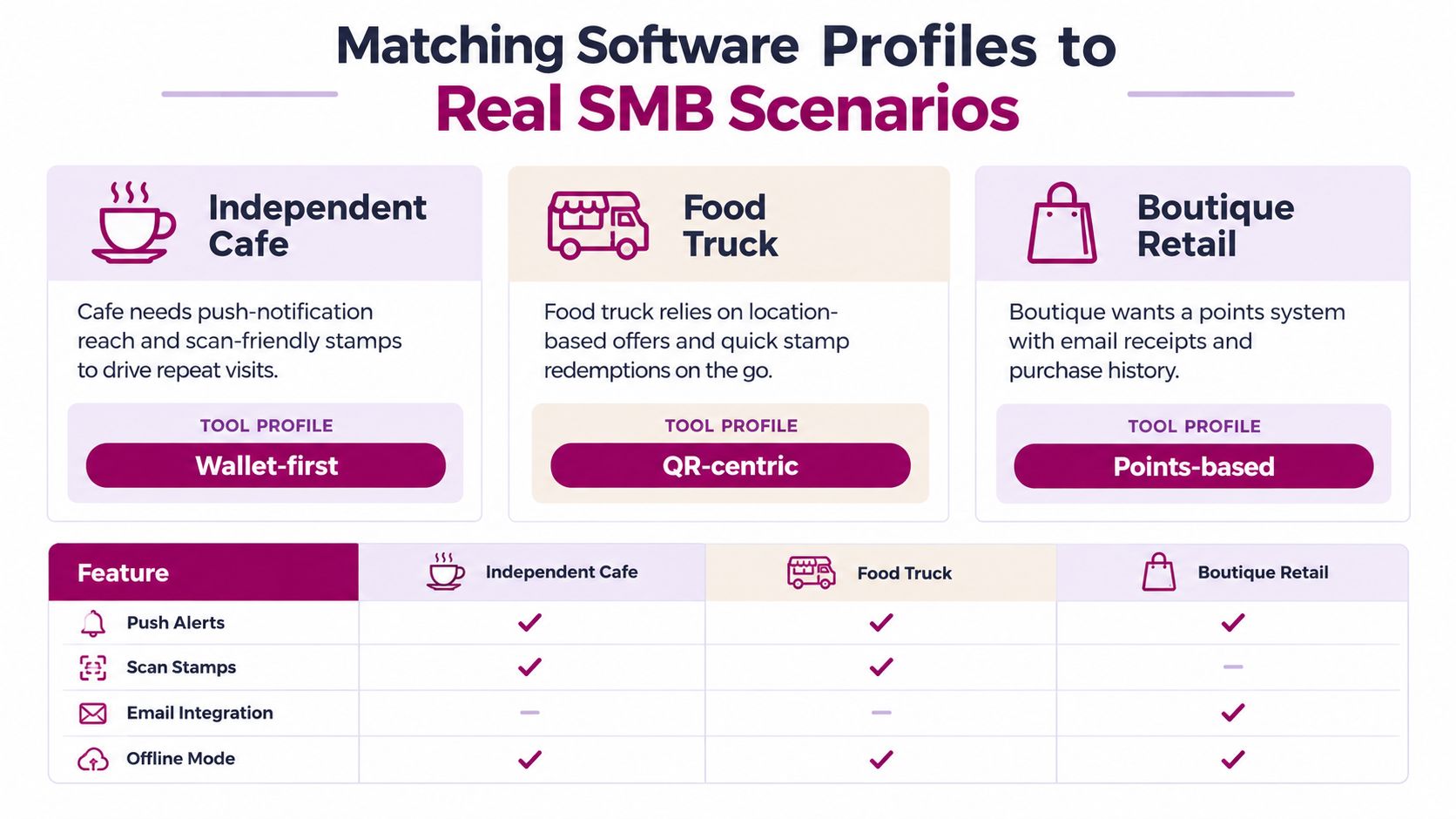
A cafe, a food truck, and a boutique may all describe themselves as small businesses, but their loyalty workflows are not the same. The cafe needs speed at the counter. The food truck needs location-aware communication and quick redemption. The boutique may need a points model that reflects different product prices and purchase histories.
The independent cafe
A cafe benefits from a wallet-first profile with scan-friendly stamps. Customers already carry their phones, staff can validate a visit quickly, and a balance or reward reminder can remain visible after the customer leaves. The program should require minimal explanation: join, collect a stamp, redeem the reward.
Avoid a points structure that makes a customer calculate whether a latte, pastry, or larger order earns the better return. Unless your menu and margins demand that flexibility, stamps will be easier for both staff and regulars.
The food truck
A food truck has a different problem. The location changes, queues move quickly, and the business may not have a permanent checkout environment. A QR-centric or wallet-first workflow can work well if enrollment and redemption are fast enough to avoid slowing the line.
The owner should test the process in direct sunlight, with weak connectivity, and while serving several customers. If a reward requires multiple screens or a staff member to search through a complicated dashboard, the program will fail at the exact moment it needs to work.
The boutique or micro-merchant
A boutique selling varied products should consider points when purchase value differs meaningfully between transactions. A micro-merchant selling through pop-ups, farmers markets, Instagram, or WhatsApp needs a standalone system that doesn't assume a compatible POS or ecommerce platform.
That constraint eliminates many tools bolted tightly onto Shopify or a specific checkout system. The right profile lets the seller identify the customer, record the purchase or reward, and manage the program from a phone. The customer should receive a persistent digital credential rather than a paper card that disappears between events.
Launching a Program Without Slowing Down Your Week
You don't need a perfect loyalty strategy before you launch. You need a small workflow that staff can execute consistently, customers can understand immediately, and the owner can adjust after seeing real usage.
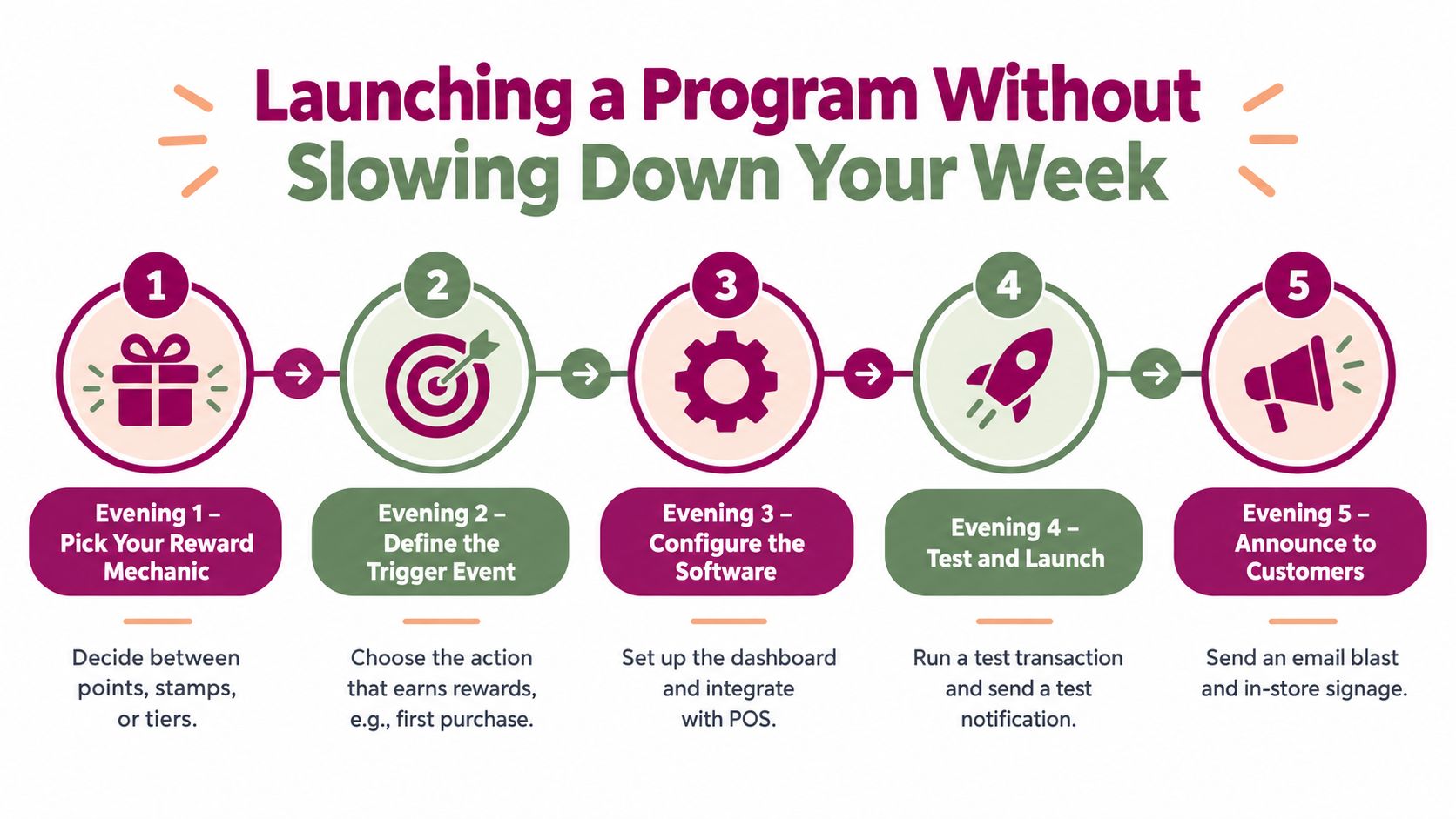
Evening one, choose the mechanic
Pick points or stamps based on the purchase pattern, not personal preference. Use stamps when customers buy a similar item or service repeatedly. Use points when prices vary, you want to reward spending, or you expect the program to expand into tiers later.
Define one trigger event. A completed purchase is usually easier to manage than a vague action such as “engage with the brand.” Write the rule in one sentence that a new staff member could repeat without interpretation.
Evening two, write the customer promise
Decide what the customer receives and when. Keep the reward visible, financially sustainable, and easy to redeem. A reward that sounds generous but rarely triggers creates disappointment, while an expensive reward can damage margins every time the program succeeds.
Write the enrollment pitch as a short sentence. For example: “Join our digital card and collect a stamp each time you buy.” Don't make staff explain tiers, exclusions, and expiration rules during a queue unless those details matter.
Evening three, configure the pass
Use built-in pass fields rather than commissioning a custom build. Add the business name, logo, reward status, customer identifier, and any details staff need to verify. Test the pass on both Apple Wallet and Google Wallet before announcing it.
The digital loyalty cards for business guide can help you think through the customer-facing card rather than treating setup as an internal dashboard exercise.
Evening four, test with real customers
Run the entire flow with two customers who will give honest feedback. Ask them to join, install the pass, earn a reward, find the balance later, and redeem it. Watch where they hesitate. Don't explain every step while testing, because staff won't be standing beside every future customer.
Evening five, launch and observe
Give staff one script and one correction procedure. Put the enrollment prompt where customers can see it, then review the first week's scans, balances, and redemptions. Adjust unclear wording before changing the entire reward structure. Momentum matters more than visual polish.
Which Loyalty Program Software Should You Pick
Don't rank loyalty tools in the abstract. Choose by operating profile.
For a phone-only owner who wants wallet-pass depth, Apple and Google coverage, and a standalone workflow, Loyal Customer is the strongest fit among the profiles discussed here. Its stated product scope includes points programs, digital stamp cards, wallet-ready loyalty cards, and phone-based administration, with a free trial for evaluation.
For a Shopify store that needs points, VIP tiers, and referral mechanics, Smile.io is the more natural choice. It belongs inside an ecommerce workflow where customer accounts, online orders, and referral activity already matter. For an ecommerce brand that prioritizes broader integrations and marketing connections, LoyaltyLion deserves consideration, but its value depends on whether the business can use that additional operational complexity.
| SMB Profile | Recommended Software | Why It Fits | Watch Out For |
|---|---|---|---|
| Single-location cafe or bakery | Loyal Customer | Wallet-ready stamps and phone-based operation suit fast counter service | Confirm the redemption workflow before launch |
| Salon or appointment-led service business | Loyal Customer | Mobile administration works between appointments and supports repeat-service rewards | Make the reward timing realistic for longer visit gaps |
| Shopify ecommerce store | Smile.io | Points, VIP tiers, and referrals align with online-store behavior | Check whether wallet support is deep enough for your needs |
| Integration-heavy ecommerce brand | LoyaltyLion | More appropriate when loyalty must connect with a broader marketing stack | Complexity and integration work can exceed SMB capacity |
Where programs backfire
A loyalty program fails economically when the reward is too expensive, too difficult to trigger, or too difficult to redeem. It also fails when the business uses discounts to compensate for a weak customer experience. The Wharton Baker Retailing Center paper on the boomerang effect of loyalty programs is a useful reminder that loyalty can magnify frustration when service problems occur.
Measure more than enrollments. Industry guidance from Rivo's loyalty program statistics analysis identifies a healthy redemption-rate target above 50%, says redeeming members spend 3.1x more than non-redeeming members, and reports that top-performing programs can lift annual revenue by 15% to 25% through better redemption design. The same source notes that only 19% of surveyed retailers cited ROI as a key success metric, which suggests many merchants still track activity without proving incremental value.
Your minimum dashboard should answer four questions:
- Redemption rate: Are customers using the reward or abandoning it?
- Incremental revenue per member: Do members buy more often or spend more than comparable non-members?
- Cost per incremental transaction: Does the reward cost less than the additional gross profit it helps create?
- Earned versus burned liability: Are outstanding rewards accumulating faster than customers redeem them?
Check these metrics before adding AI, tiers, gamification, or more campaigns. A simple program with a clear wallet pass, fast staff workflow, and sustainable reward economics is usually the safer starting point for a small business.
If you want a phone-managed points or stamp program with Apple Wallet and Google Wallet support, explore what Loyal Customer offers for cafes, salons, independent retailers, and other consumer-facing businesses. Start with one reward, test the customer journey in a real shift, and use the trial to confirm that the pass and admin workflow fit your operation before committing.



