The strongest loyalty card isn't the one with the most features. It's the one that matches the customer behavior you want to reinforce.
That matters more than ever because loyalty is already a normal part of buying behavior. A 2025 industry synthesis reported that 92% of consumers are enrolled in at least one loyalty program, almost 50% belong to more than five programs, and consumers average 17.4 total memberships with 8.8 active memberships. In other words, customers don't need to be convinced that loyalty programs exist. They need a reason to care about yours.
For small businesses, most loyalty card ideas fail for a simple reason. The mechanic doesn't fit the business model. A café with repeat daily traffic usually needs a different reward structure than a salon with longer gaps between visits. A bakery trying to increase add-ons needs something different from a micro-merchant trying to turn happy customers into referrals.
The useful question isn't “Should we launch a loyalty card?” It's “Which behavior are we trying to change?” That could mean more repeat visits, higher average spend, better use of slow hours, more referrals, broader product discovery, or stronger community engagement.
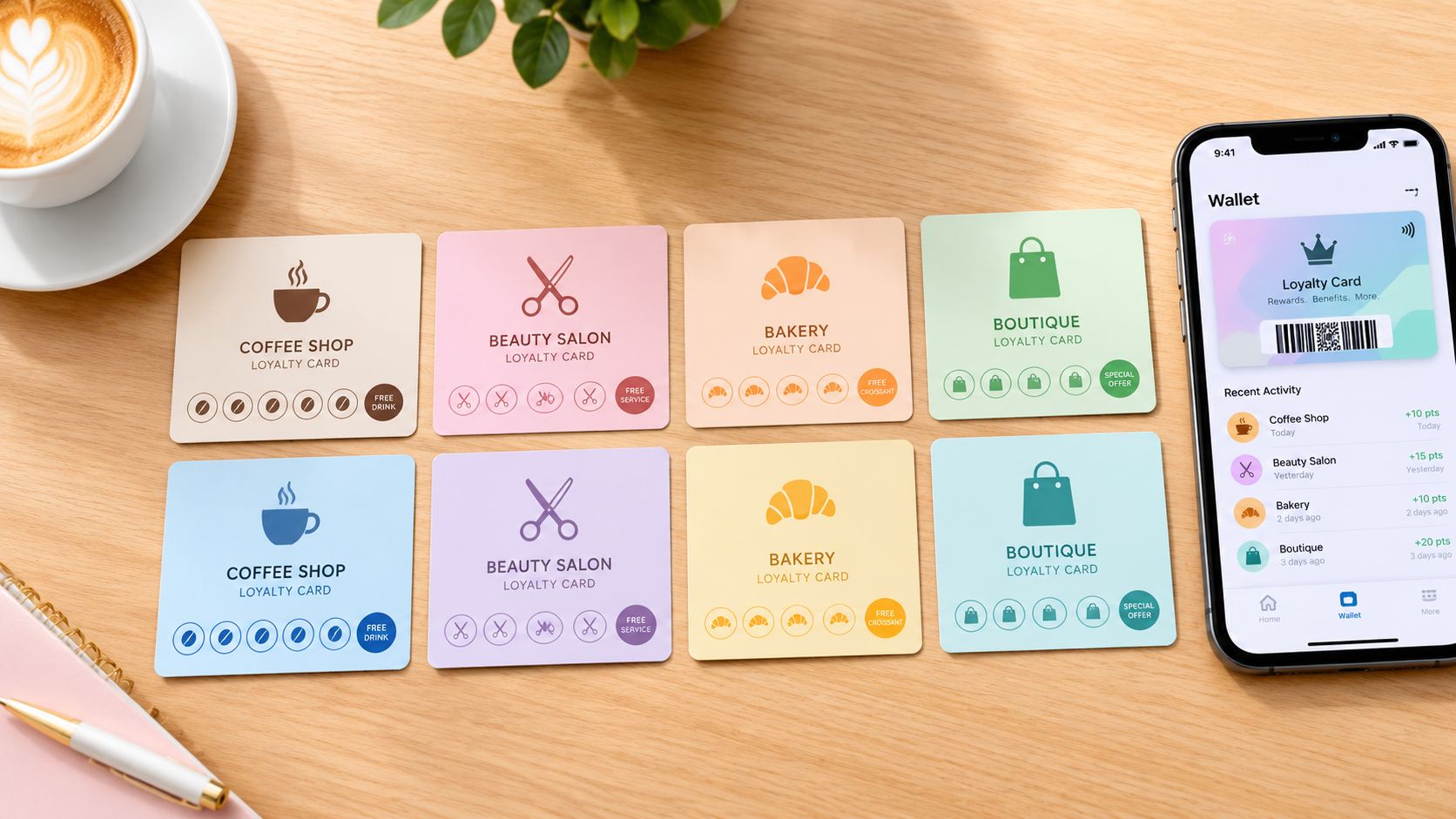
Digital delivery also changes the practical side. Customers increasingly want loyalty to be easy to access, not hidden in another app or lost in a wallet. Loyal Customer supports both digital stamps and points, with Apple Wallet and Google Wallet cards managed from a phone. That makes these loyalty card ideas easier to run in the environments small merchants work in.
Table of Contents
- 1. Digital Punch Card
- 2. Points-Based Loyalty Program
- 3. Tiered Membership Levels
- 4. Digital Referral Rewards Program
- 5. Seasonal and Time-Based Bonus Programs
- 6. Product-Specific and Category Bonus Programs
- 7. Experiential and Exclusive Access Rewards
- 8. Social Media Integration and Gamification
- 8 Loyalty Card Ideas Comparison
- Choose the Reward Structure You Can Run Consistently
1. Digital Punch Card
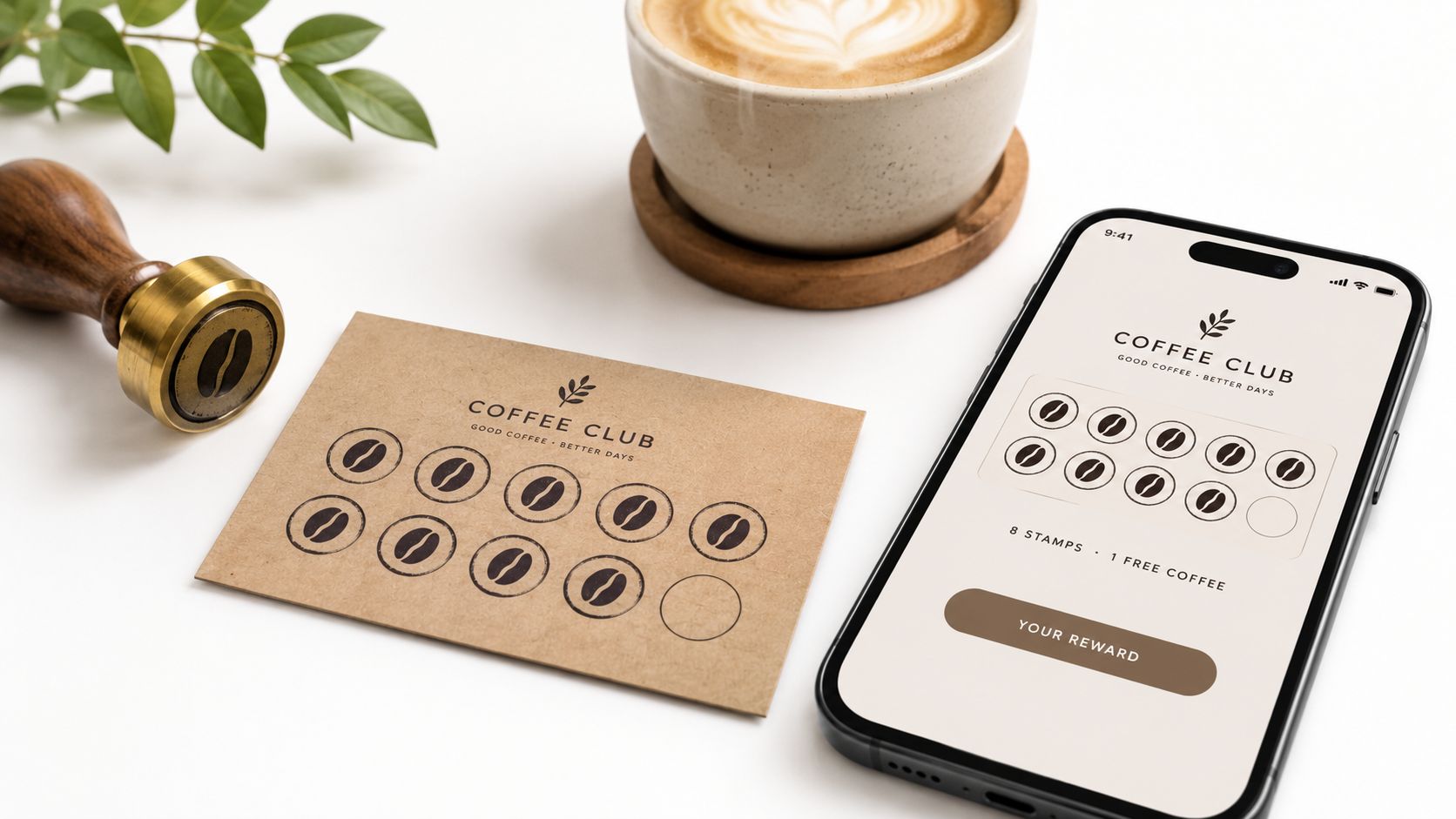
A digital punch card is still the best loyalty format for many small businesses.
If customers buy often and the transaction pattern is simple, stamps usually beat points. Cafés, tea shops, bakeries, barber shops, nail salons, car washes, and fitness studios all fit this model. The customer understands the reward instantly, staff can explain it in one sentence, and the progress feels visible.
Why stamps work in everyday retail
A stamp card works because it removes math. Customers don't need to translate points into future value. They just see progress toward a free coffee, pastry, class, or service. That clarity matters when the visit is quick and the checkout interaction is short.
This is also where digital beats paper. Paper cards get bent, forgotten, or lost. A wallet pass stays on the customer's phone and can be updated without printing new cards. If you want a deeper walkthrough, this guide to digital punch cards for small businesses covers the setup basics.
Practical rule: Use stamps when the visit itself is the habit you want to build.
A neighborhood coffee shop might offer a free drink after a set number of purchases. A bakery could reward repeat visits with a free pastry. A salon can adapt the same logic for blow-dries or beard trims. A yoga or Pilates studio can apply stamps to class attendance when the goal is routine.
Where merchants get this wrong
The common mistake is setting the reward too far away. If the finish line feels distant, customers stop caring. Another mistake is attaching stamps to every possible action. Once the card needs explaining, it loses the simplicity that makes it effective.
Use visual progress on the card itself. Keep the redemption obvious. If your traffic changes by time of day, add occasional bonus stamps during slower periods instead of rebuilding the whole program.
Best fit:
- Cafés and coffee shops: Frequent repeat visits with similar ticket sizes
- Bakeries and tea shops: Simple reward logic tied to habit purchases
- Salons and barbers: Easy repeat-cycle services
- Studios and gyms: Visit-based attendance rewards
2. Points-Based Loyalty Program
Points work better when spend varies.
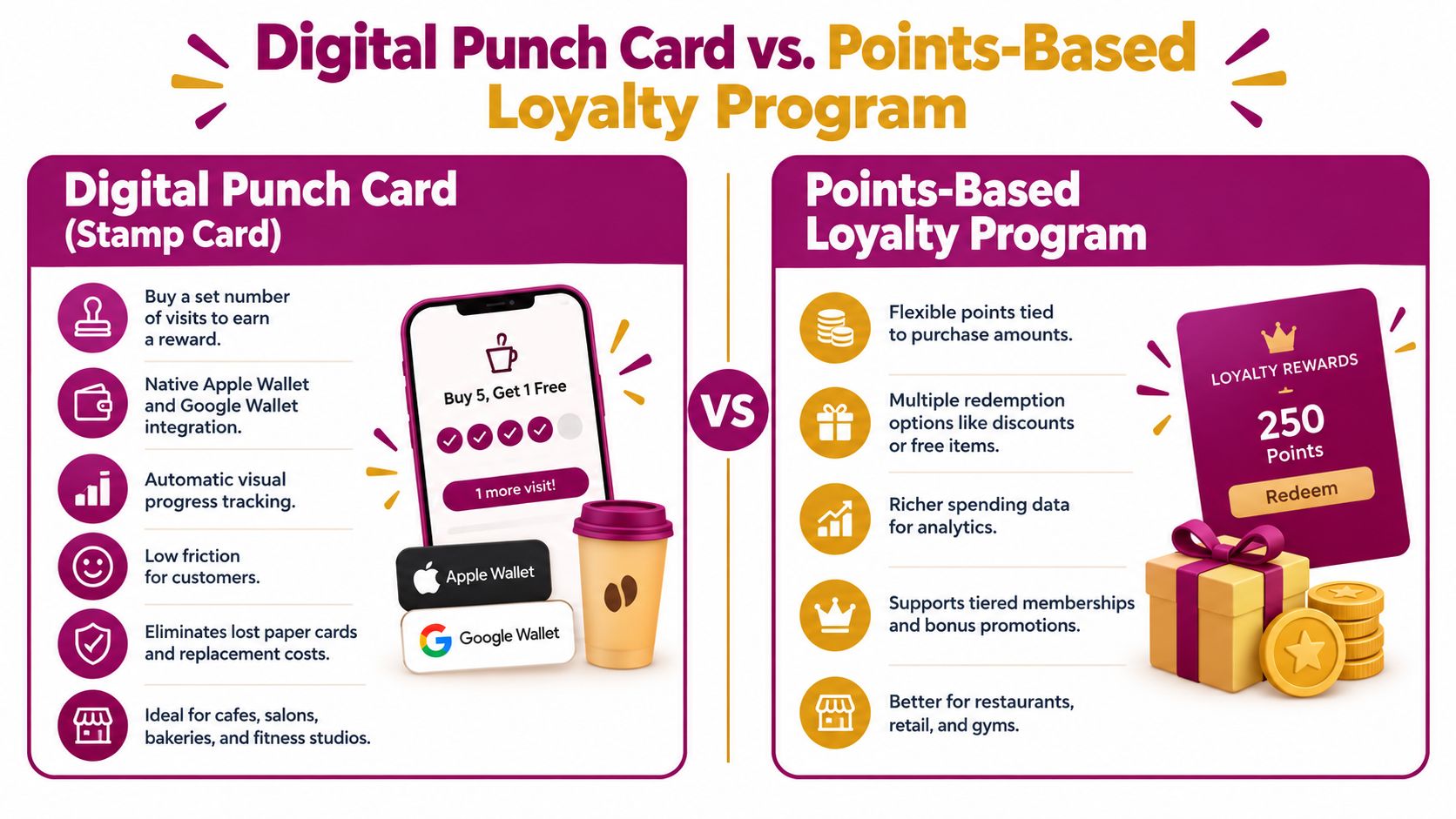
If one customer buys a basic coffee and another buys coffee, beans, retail mugs, and lunch, a punch card can under-reward your best customer. Points solve that. They let you recognize order size, product mix, and premium purchases without building multiple separate stamp cards.
Here's a helpful visual before getting into the trade-off:
When points outperform stamps
Points are strongest when the business has variable basket sizes or multiple categories. Think independent retail, restaurants with add-ons, salons with retail shelves, gyms with premium services, or grocery-style specialty shops. In those settings, the reward system should encourage customers to spend more, not just visit again.
There's also a practical consumer preference behind digital points delivery. Recent wallet research found that 43% prefer managing points balances or rewards via a digital loyalty card rather than downloading a brand app, 32% say digital cards make loyalty profiles more convenient and accessible, and 82% of people who have a brand's loyalty program on a digital card have used it to make a purchase. For a small merchant, that means visibility matters as much as reward design.
A salon is a good example. A haircut customer who adds treatment, styling product, and a future booking should earn more than a customer who buys one core service. A points model reflects that naturally.
Keep the economics understandable
Points programs fail when the customer can't tell whether they're making progress. Avoid clever math. Show the balance clearly and make the first reward feel reachable.
For setup ideas, this overview of a points-based loyalty program for small businesses is a useful starting point.
Use points if you need to reward:
- Higher spend: Better for mixed baskets than flat visit counting
- Category variety: Useful when customers buy across products and services
- Upsells and add-ons: Encourages upgrades without changing the base offer
- Flexible redemptions: Lets you offer discounts, products, or perks
Best fit:
- Independent retail: Customers spend different amounts each visit
- Salons with retail products: Services plus product sales
- Restaurants and takeaways: Meals, drinks, add-ons, and premium items
- Gyms and studios: Membership, private sessions, or premium classes
3. Tiered Membership Levels
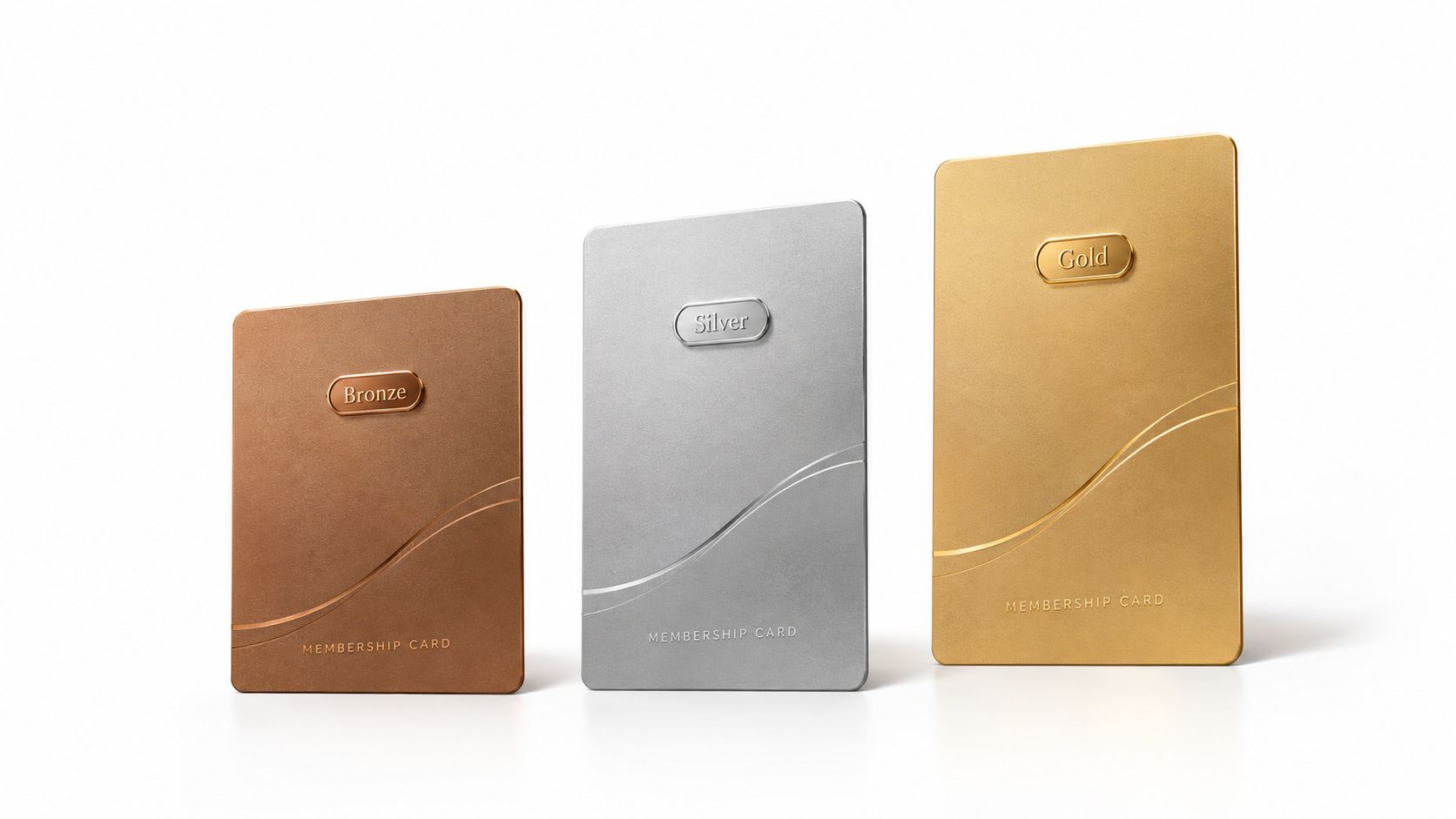
Tiers only work when better customers can see a reason to consolidate more of their spending with you.
If a café sells mostly the same morning coffee to the same crowd, a tier model usually creates admin without changing behavior. If a salon has a core group who rebook on schedule, add color or treatment upgrades, and buy take-home products, tiers can increase frequency and basket size because status feels earned and useful.
Use tiers where customer behavior already splits into clear bands
The practical test is simple. Can you already identify a top group that buys more often, spends more per visit, or uses more than one category? If yes, a tier structure gives that group a reason to stay loyal and gives mid-range customers a target.
A bakery is a good example. Walk-in pastry buyers do not need silver and gold status. A bakery that also handles celebration cakes, catering trays, and holiday pre-orders can justify tiers because customer value differs sharply. The top tier might get priority ordering windows or a reserved seasonal menu preview. That perk matters more than a small discount.
The same applies to salons and boutique fitness. A base tier can cover routine visits. A higher tier can reward clients who maintain recurring appointments, buy retail products, or book premium services. For a studio, that might mean early access to limited workshops or guest passes after a consistent attendance streak.
Keep the path visible and the perks operationally easy
Customers should understand how to move up in one sentence. Spend £300 in 90 days. Book six services in four months. Buy across two categories each month. Clear thresholds outperform vague status systems.
Benefits also need to be cheap to deliver and easy for staff to explain. Early booking access, a free add-on once per quarter, faster custom-order pickup, or occasional bonus multipliers usually work better than broad ongoing discounts. Discounts cut margin every time. Access perks feel valuable without training customers to wait for a price break.
Do not build tiers just to appear advanced. Build them when status changes behavior.
The main risk
Small merchants usually set the bar too high or the rewards too low.
If the jump from one tier to the next feels unrealistic, customers ignore it. If the reward is forgettable, staff stop mentioning it. That is why tiered programs fit businesses with appointment cycles, premium upgrades, or uneven customer value better than simple everyday transactions.
Best fit:
- Salons and spas: Best when regulars combine repeat bookings, upgrades, and retail purchases
- Boutique fitness studios: Strong fit for members who buy class packs, workshops, and premium sessions
- Bakeries with custom orders: Useful when occasional high-value cake or catering customers need a reason to return
- Specialty retail and food shops: Works when perks can focus on access, pre-orders, or member-only products instead of blanket discounts
4. Digital Referral Rewards Program
Referral rewards are loyalty for acquisition.
This is one of the most practical loyalty card ideas for micro-merchants, especially those who sell through Instagram, WhatsApp, or local community networks. If your customers already talk about you, give that behavior a structure.
Reward advocacy, not just purchases
A referral program works when the offer is easy to explain and easy to share. Existing customers get a clear benefit for bringing in someone new, and the new customer gets a welcome reason to try you. That could be bonus points, extra stamps, or a one-time perk tied to a first purchase.
This model fits salons, beauticians, personal trainers, bakers doing custom orders, and local cafés with strong neighborhood word of mouth. It's especially useful when repeat traffic is steady but new customer flow is inconsistent.
If you need ideas for the mechanics, these customer referral program examples for small businesses show the common structures.
A practical version looks like this:
- Salon example: A regular client refers a friend who books a first appointment. Both receive a loyalty bonus.
- Bakery example: A customer shares a code for custom cake orders. The referrer gets a future reward after the new order is completed.
- Fitness example: A studio member brings in a friend for a paid class pack and gets bonus credit.
Keep it narrow enough to track
Referral programs break when the merchant can't confirm who referred whom. They also fail when the reward is so generous that it overwhelms margin. Start with one clear trigger. Usually that means “reward after the referred customer completes a first purchase.”
Because many customers still prefer mobile loyalty access, digital passes make referrals easier to connect to an existing profile instead of relying on paper notes or staff memory. The cleaner the process, the more likely staff will use it.
Best fit:
- Micro-merchants on social channels: Natural fit for direct sharing
- Salons and beauty businesses: Strong trust-based referrals
- Fitness studios: Community-driven trial behavior
- Neighborhood cafés and bakeries: Local word of mouth already exists
5. Seasonal and Time-Based Bonus Programs
Seasonal and time-based bonuses solve a scheduling problem fast.
Use them when demand is uneven, not when the base loyalty offer is weak. A café with a dead 2 to 4 p.m. window can offer an extra stamp on weekday afternoon orders. A salon with gaps every Tuesday can attach a bonus to midweek bookings. A bakery can reward holiday preorders placed before the last-minute rush, which helps production planning as much as sales.
The format matters less than the problem you are trying to fix. Stamps work well for cafés that need a simple traffic push staff can explain in one sentence. Points fit salons or service businesses that already track customer profiles and want more flexible rules, such as birthday-month bonuses or extra credit for off-peak appointments. For bakeries and other preorder-heavy shops, a limited-time bonus usually works best when tied to pickup day, order deadline, or seasonal bundle.
As noted earlier, loyalty members use their programs often enough for timed offers to influence buying habits. The practical takeaway is simple. Customers already pay attention to loyalty. Give them a reason to visit at the time you need demand.
Match the bonus to the operating reality
A good bonus window does one job.
For cafés, that usually means shifting volume into slower hours without discounting every drink all day. For salons, it often means pulling clients back into a rebooking rhythm after busy weekends or around slower seasons. For bakeries, it means getting orders earlier so production is easier to forecast and waste stays lower.
A practical setup looks like this:
- Café: Extra stamp for purchases between 2 and 4 p.m. on weekdays
- Salon: Bonus points for Tuesday and Wednesday appointments, or a birthday-month add-on reward
- Bakery: Double credit on holiday preorders placed by a set date, or a bonus for weekday pickup
- Micro-retail or service shop: Short bonus periods tied to slow days, end-of-month gaps, or local events
Keep it temporary and easy to explain
Timed bonuses lose value when they never stop. If every week has a special, customers learn to delay purchases and your standard reward starts to feel irrelevant.
Run a bonus for a clear window, measure whether it changed behavior, then decide whether to repeat it. If the offer fills seats, smooths staffing, or brings preorder volume forward, keep it in the calendar. If it only gives rewards to customers who would have purchased anyway, cut it.
Best fit:
- Cafés: Off-peak traffic and repeat visit timing
- Salons and spas: Midweek booking gaps, birthdays, and rebooking cycles
- Bakeries: Seasonal preorders, pickup scheduling, and holiday demand
- Micro-merchants: Any business with predictable slow periods and limited promo budget
6. Product-Specific and Category Bonus Programs
Use category bonuses when the goal is to change what customers buy, not just how often they return.
That distinction matters for small operators. A stamp card gets a café customer back in the door. A category bonus can move that same customer from drip coffee to a higher-margin latte and pastry pair. For a salon, it can turn a haircut-only client into someone who books a toner or takes home retail care. For a bakery, it can shift demand from low-ticket daily bread to celebration cakes, seasonal boxes, or preorder bundles that are easier to plan around.
The reward should point at one behavior.
A café might offer double credit on signature drinks for two weeks after a menu launch. A salon can add bonus points for gloss treatments or for any appointment that includes one recommended retail product. A bakery can give extra punches on pie preorders or on bundled coffee-and-pastry purchases during slower weekdays. Micro-merchants benefit most when they have one underbought category with decent margin and a clear reason to promote it.
This works best when the featured item is already easy to understand. Customers rarely respond well to rewards tied to confusing package logic or products staff have to explain from scratch at the register.
Keep the list short and rotate with intent. Two or three featured categories is usually enough. More than that, and the program starts to feel like a promo board instead of a loyalty system.
A practical way to choose categories:
- Pick items with better margin than your default seller
- Pick add-ons that fit the main purchase naturally
- Pick products you want customers to try more than once
- Avoid rewarding categories you would have sold anyway at full demand
For example, a salon should usually bonus blow-dry add-ons, treatment upgrades, or home-care products that support the service result. It should not throw rewards at every service line at once. A bakery can get better results from one clear push, such as bonus credit on celebration cake orders, than from rewarding five unrelated items across the case.
The trade-off is simple. Narrow targeting gives you better margin control, but it asks for staff discipline and clean signage. If the team cannot explain the offer in one sentence, simplify it.
Best fit:
- Cafés: Premium drinks, pairings, and new menu items
- Salons: Add-on services and retail aftercare
- Bakeries: Celebration orders, seasonal boxes, and bundles
- Micro-merchants: One underperforming category that deserves repeat demand, not a blanket discount
7. Experiential and Exclusive Access Rewards
Exclusive access can protect margin better than another discount, but only if customers already care about the people, product, or routine behind the purchase.
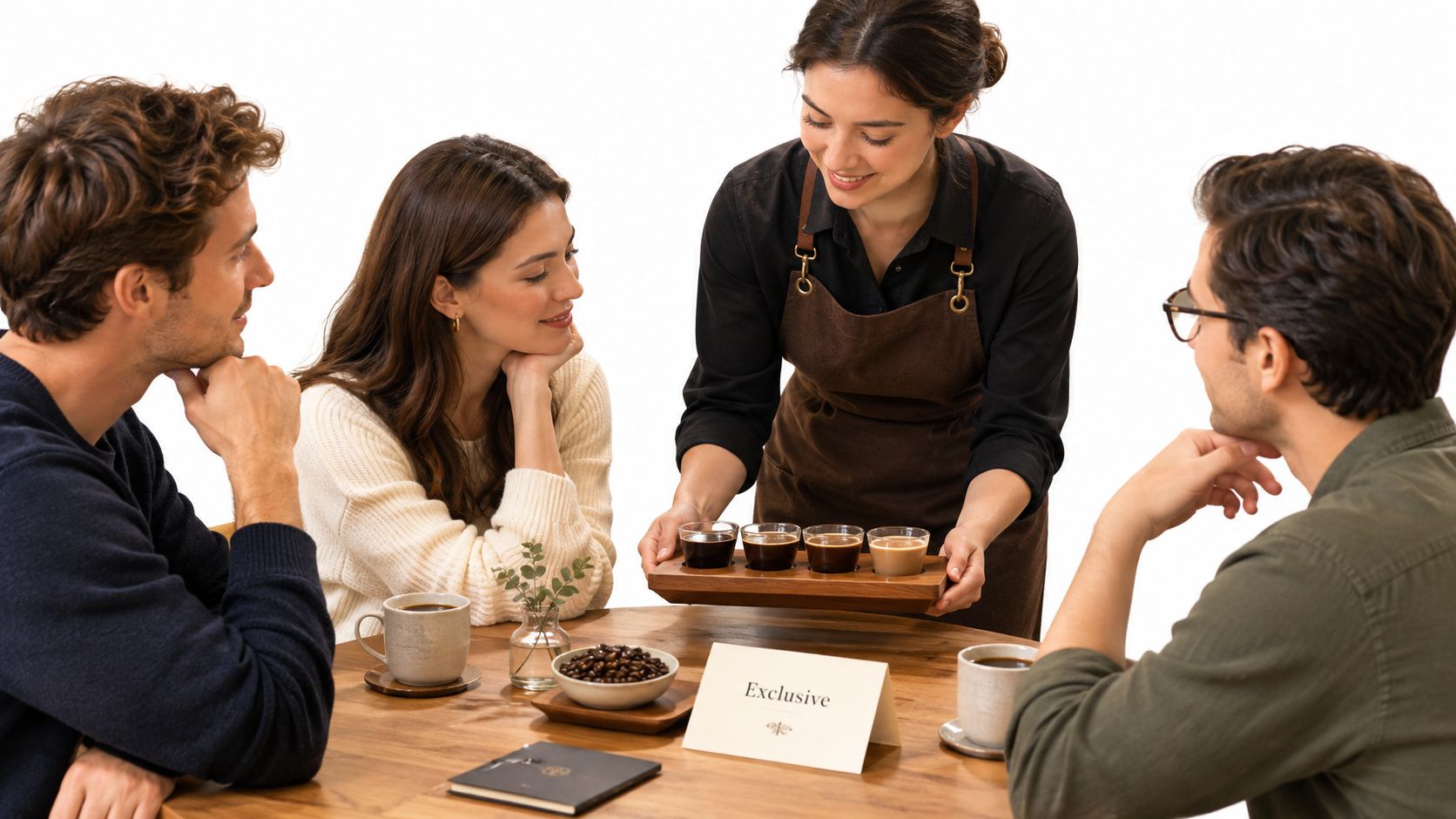
Use this reward type as a layer on top of a simple loyalty system, not as the whole program. In practice, customers usually join to get something concrete. A stamp, points balance, or visit reward gives them that baseline. Access rewards then give your regulars a reason to stay engaged without cutting price every time.
The operating test is simple. Ask whether your business can offer something customers cannot get from the shelf, the booking page, or a generic promo code.
A café can do this well with a small after-hours tasting for regulars who already buy single-origin coffee or seasonal drinks. The cost stays controlled because the event uses existing stock, the guest list is limited, and the reward feels personal. This works best for specialty cafés with staff who can talk confidently about the product.
A salon gets stronger results from priority booking, early access to new service packages, or a member consultation night than from trying to host a broad event. Clients value time and personal attention more than novelty alone. The trade-off is calendar pressure. If the team is already stretched on weekends, offer first access to off-peak appointments or add a short upgrade consultation to an existing visit instead of creating a separate event.
For bakeries, early preorder windows usually outperform general "VIP experiences." Customers want first choice on holiday boxes, celebration cakes, and limited bakes before they sell out. That is easier to run than a large in-store event, and it ties directly to buying behavior. The margin benefit is real because you collect demand earlier and plan production with less waste.
Micro-merchants should be selective here. A maker, florist, or small beauty retailer can offer preview access to a limited drop, a short customer workshop, or first pick from a new batch. A convenience-led business with little brand attachment should skip this format and keep the loyalty offer transactional. Exclusive access only works when the customer sees a reason to care.
One rule matters more than creativity. The reward has to connect tightly to the business. Random partner perks, generic giveaways, and unrelated event invites usually get polite interest and weak repeat behavior.
Best fit by business type:
- Specialty cafés: Tastings, first access to new roasts, small member events
- Salons: Priority booking, launch previews, consultation-based VIP access
- Bakeries: Early preorder windows, seasonal preview lists, limited-release pickups
- Micro-merchants: Small-batch previews, private shopping windows, product education sessions
8. Social Media Integration and Gamification
Social media rewards work only when they follow a sale, a visit, or a rebooking. If the customer has to do extra work that does not connect to buying behavior, the program turns into unpaid admin for both sides.
The merchants who get results here usually keep the trigger narrow. A bakery can give one bonus stamp when a customer tags a preorder pickup story after collecting a paid holiday box. A salon can add points when an existing client refers a friend through Instagram DM and that friend completes a first appointment. A café can run a 5-visit challenge during a slow month, then give a bonus on the fifth check-in only if the visits are tied to real purchases.
That setup matters because cafés, salons, bakeries, and micro-merchants do not have spare time to review vague social activity all day. The reward rule has to be easy to verify from the phone at the counter or from the booking system.
Here's a useful example of the kind of challenge-driven engagement merchants often borrow from:
A good rule is simple. Keep the game layer smaller than the loyalty program underneath it.
For a café, that usually means stamps first, social bonus second. For a salon, it often means service points or rebooking rewards first, referral or posting bonuses second. For a bakery, it means preorder and pickup behavior stays central, while social activity gets a small extra reward that helps spread limited releases without replacing the purchase habit.
Phone access still matters here. Research from Capital One Shopping's loyalty program statistics roundup notes strong customer preference for digital loyalty access over physical cards, so any challenge should be easy to join and redeem on a phone.
Use this format by operating reality, not trend appeal:
- Cafés: Best for photo-friendly drinks, limited drops, or slow-day visit challenges. Keep rewards tied to paid visits.
- Salons: Best for referral tracking, rebooking nudges, and before-and-after content with client consent. Do not reward posting alone. Reward completed appointments.
- Bakeries: Best for preorder pickups, seasonal launches, and sold-out items people already like to share. One verified bonus stamp is usually enough.
- Micro-merchants: Best for maker drops, review prompts, and customer content that supports a small but engaged audience. Skip it if customers buy for convenience rather than identity.
If you need a quick filter, ask one question: would this reward still make sense without Instagram? If the answer is no, the mechanic is probably too fragile to run consistently.
8 Loyalty Card Ideas Comparison
| Program | Implementation Complexity 🔄 | Resource Requirements ⚡ | Expected Outcomes 📊 | Ideal Use Cases | Key Advantages ⭐ | Quick Tip 💡 |
|---|---|---|---|---|---|---|
| Digital Punch Card (Stamp Card) | 🔄 Low, simple visit-count logic, wallet pass integration | ⚡ Minimal, wallet integration and admin phone controls | 📊 Steady increase in repeat visits; predictable redemptions | Cafes, salons, bakeries, fitness studios | ⭐ Familiar to customers; low friction; eliminates paper waste | 💡 Set thresholds from CLV; use clear visual progress |
| Points-Based Loyalty Program | 🔄 Medium, points engine with conversion rules | ⚡ Moderate, POS/CRM integration, analytics, marketing | 📊 Encourages higher spend; yields rich behavioral data | Restaurants, retail, gyms, multi-category stores | ⭐ Flexible redemptions; drives higher-value purchases; supports tiers | 💡 Show estimated time-to-reward; offer bonus promotions |
| Tiered Membership Levels | 🔄 High, multi-tier rules, status handling, renewals | ⚡ High, advanced CRM, data analytics, personalized comms | 📊 Increases lifetime value and frequency via status motivation | Cafes, restaurants, salons, gyms, retail boutiques | ⭐ Creates exclusivity and retention; enables targeted marketing | 💡 Calibrate tiers to be achievable within 3–6 months |
| Digital Referral Rewards Program | 🔄 Medium, referral codes/tracking and attribution | ⚡ Moderate, tracking, fraud controls, sharing UX | 📊 Low-cost acquisition, viral growth potential, higher LTV | Cafes, gyms, micro-merchants, services | ⭐ Leverages word-of-mouth; converts pre-validated customers | 💡 Make rewards equal to CAC; keep referral flows simple |
| Seasonal & Time-Based Bonus Programs | 🔄 Low–Medium, time rules and promo scheduling | ⚡ Low, admin updates, notifications, short campaigns | 📊 Smooths demand, drives off-peak traffic, creates urgency | Cafes, restaurants, gyms, bakeries, salons | ⭐ Flexible and fast to deploy; boosts short-term visits | 💡 Align bonuses to customer behavior and announce early |
| Product-Specific & Category Bonus Programs | 🔄 Medium–High, SKU/category-level rules and tracking | ⚡ Moderate, POS/category integration, regular updates | 📊 Increases AOV and shifts sales toward higher-margin items | Cafes, retail, salons, grocery stores, bakeries | ⭐ Targets product mix; enables upsells and margin control | 💡 Start with 2–3 bonus categories and rotate monthly |
| Experiential & Exclusive Access Rewards | 🔄 High, event logistics and personalized access control | ⚡ High, staff/time, event costs, guest management | 📊 Strong emotional loyalty and word-of-mouth; harder to quantify | Salons, premium cafes, boutique retail, fitness studios | ⭐ High perceived value; differentiates brand; builds community | 💡 Start small (8–15 people) and collect feedback to refine |
| Social Media Integration & Gamification | 🔄 Medium, badges, leaderboards, share tracking | ⚡ Moderate, social integration, content moderation, rewards | 📊 Boosts brand visibility and engagement; generates UGC | Cafes, gyms, retail, micro-merchants targeting younger demo | ⭐ Drives organic reach; taps intrinsic motivation; low-cost mechanics | 💡 Keep challenges simple and provide clear bonus point values |
Choose the Reward Structure You Can Run Consistently
The best loyalty card ideas aren't interchangeable. They solve different operating problems.
Use digital stamps when purchases are frequent, predictable, and easy to count. Cafés, bakeries, barber shops, and studios often benefit from that simplicity. Use points when spend varies and you want to reward basket size, upgrades, or cross-category buying. That usually fits salons with product shelves, independent retail, restaurants, and mixed-service businesses better.
Use tiers when a small group of customers is meaningfully more valuable than everyone else. Use experiential rewards when the brand relationship is strong enough that access feels special. Use referrals when customer advocacy already drives growth. Use seasonal bonuses when you need to smooth demand across hours, days, or seasons. Use category bonuses when you want customers to buy more of the right things, not just more of anything. Use gamification only if you can keep it active and easy to understand.
The operating discipline matters as much as the idea. Loyalty programs have become a real budget category, not a side project. In the 2025 Global Customer Loyalty Report, 83.0% of program owners who measured ROI said their loyalty program produced a positive return, those programs generated 5.2 times more revenue than they cost on average, and companies allocated 31.4% of total marketing budgets to customer loyalty and CRM. That doesn't mean every program succeeds automatically. It means the businesses that treat loyalty as an operating system tend to take it seriously.
Start with one mechanic. Define the reward threshold before you launch. Make sure the margin works. Train staff to explain the program in one sentence at checkout. Watch where customers get confused, where they redeem, and where interest drops off.
For most small businesses, that first version should be boring in a good way. Clear reward. Clear progress. Clear redemption. Once customers understand it, then you can layer in time-based bonuses, category boosts, referrals, or member experiences.
If you want a practical place to test either model, Loyal Customer is one option that lets merchants run a points program or digital stamp card from a phone and issue wallet-ready cards for Apple Wallet and Google Wallet. That's a sensible way to trial a simple program before expanding it.
If you want to test these loyalty card ideas without printing cards or pushing customers into another app, Loyal Customer gives you a way to run digital stamp cards or points programs from your phone. You can create wallet-ready loyalty cards for Apple Wallet and Google Wallet, try a straightforward setup, and see which reward structure fits your business before adding more complexity.