You're serving the morning queue, someone asks whether you have a loyalty card, and the answer is still no. You'd like regulars to earn a reward, but you haven't got a connected till, a software specialist or spare time to manage another system.
You can start a digital stamp card free of subscription charges through a trial or an eligible entry-level tool. The important question is whether you can run it profitably from the phone beside your till. Staff time, promised rewards, corrections and customer support still need an owner.
Table of Contents
- Free Routes to Start a Digital Stamp Card
- Sample Reward Rules and What They Really Cost
- Six Steps to Launch and Safeguard Your Free Stamp Card
- Wallet Passes and Fallbacks for Customers Without One
- Launch a Four-Week Test Before You Print Anything
Free Routes to Start a Digital Stamp Card
Say you run a café with no POS integration and nobody available to manage software. Your minimum requirement isn't a dashboard. It's a way to identify the customer, record a qualifying purchase, and redeem a reward without holding up the queue.
That's a reasonable place to start. Recent U.S. research from SumUp found that 73.2% of micro and small businesses had no formal loyalty program, with the leading barrier being the belief that their customer base was too small to justify one.
Free removes the subscription, not the work. You'll still explain the offer, train whoever covers the till, investigate missing stamps and supply rewards customers have earned. Choose the route with the least administration you can reliably control.
Free routes compared
These are routes to evaluate, not promises that every provider includes the same features.
| Route | What costs nothing | Limit to check | Best fit |
|---|---|---|---|
| Free trial of a loyalty platform | Card setup and a basic test program during the trial | Confirm the trial end date, renewal charge and access to records after cancellation | Testing before committing |
| Wallet pass from a free-entry tool | Apple Wallet or Google Wallet pass issue, when included | Require a live demonstration of phone-based stamp updates without extra hardware | Cafés and salons with steady repeat visits |
| Phone-first admin | Stamping and redemption from a phone, when included in the free allowance | Check individual staff access and what happens when the connection drops | Micro-merchants selling via Instagram or WhatsApp |
| Paper punch card | No software subscription. Printing and the stamp still cost money | Lost cards, no built-in customer records and manual tallying | Very low volume or a short test |
A free pass designer isn't necessarily a working loyalty system. Before committing, check whether the free allowance includes ongoing balance updates, redemption and customer recovery, not just an attractive card.
For a broader assessment, use this guide to a free loyalty program for small businesses alongside a hands-on checkout test. Ask what happens when you exceed the allowance, rather than assuming you can continue unchanged.
Practical rule: If stamping from your own phone interrupts taking payment or handing over the order, simplify the process before launch.
Rehearse during a simulated rush. A route that needs you to search an inbox, switch accounts or ask the customer to repeat registration won't survive a busy Saturday.
Sample Reward Rules and What They Really Cost
Choose the reward from your margin, not from a competitor's card. A free drink and a discount on a colour appointment create different obligations, even when both look modest on a screen.
Set a reward-cost ceiling you can afford and choose a threshold that fits the customer's normal return cycle. A café customer may make progress frequently; a salon customer shouldn't need extra appointments just to make the card feel achievable.
Sample reward rules and their approximate cost
The thresholds below are hypothetical starting rules, not industry benchmarks. Fill in your own selling prices and fulfilment costs before using them.
| Business | Threshold | Reward | Approximate cost to you | Reward share of qualifying spend |
|---|---|---|---|---|
| Coffee shop | Ten paid drinks | Free drink | Ingredients, cup and any extra labour | Fulfilment cost divided by spend on the qualifying drinks |
| Hair salon | Five paid visits | Discount on the next visit | Discount amount plus any additional service cost | Discount amount divided by qualifying visit spend |
| Bakery | Eight qualifying purchases | Free pastry | Production or replacement cost of the eligible pastry | Pastry cost divided by qualifying purchase spend |
| Takeaway | Six paid orders | Free side | Ingredients, packaging and preparation | Side cost divided by qualifying order spend |
| Gym studio | Ten paid classes | Free class | Additional servicing cost, plus displaced revenue if the class would sell out | Class reward cost divided by qualifying class spend |
For the coffee-shop example, multiply the average eligible drink price by the required paid purchases. Then divide the free drink's fulfilment cost by that qualifying spend to calculate the reward-cost share. Keep retail reward value separate from your cost of providing it.
A salon discount needs more care. A blanket reduction can remove substantial margin from a premium service that uses expensive products or scarce appointment time. Specify eligible services, exclusions and whether the reward can be combined with another promotion.
For a gym, an unused place in a quiet class isn't economically equivalent to a place in a fully booked session. Write a clear booking restriction if the reward only works during off-peak capacity, rather than surprising customers at redemption.
A reward is affordable only when you can honour it under the conditions you advertised.
Check the monthly commitment
Calculate monthly reward cost as redemptions multiplied by fulfilment cost per reward. Divide that total by monthly sales to monitor reward cost as a share of revenue, then add staff administration, software charges and support time separately.
Use a loyalty-program ROI calculator to compare those costs with the gross profit from additional purchases. Reward spending alone isn't a break-even calculation: customers who would have returned anyway also collect stamps.
Write your own row before issuing any card. If the economics don't work, adjust the offer before customers start earning a promise you can't comfortably keep.
Six Steps to Launch and Safeguard Your Free Stamp Card
A workable launch needs both a customer routine and a control routine. Staff should know what earns a stamp, while the owner should be able to explain why each stamp exists.
Wallet familiarity helps, but it doesn't prove your offer will work. Fiserv's 2025 Gift Card Gauge reported that 90% of consumers used a digital wallet in 2025; your checkout still needs to turn that familiarity into a completed enrolment and a correctly recorded purchase.
Use this sequence as the launch checklist.
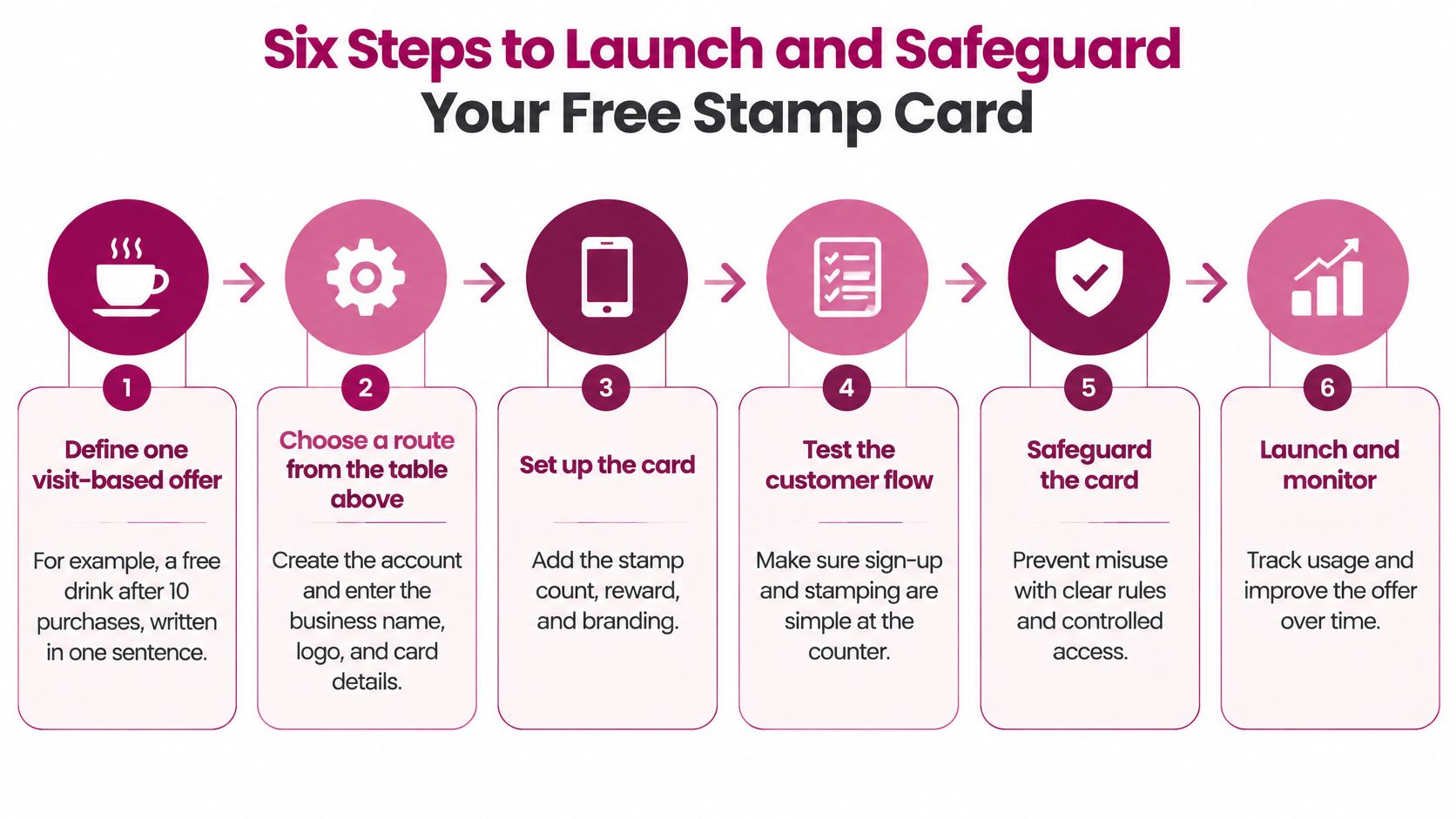
Build and rehearse the counter routine
Define a single visit-based offer. Write the earning condition and reward in a sentence, then document exceptions for staff. Decide whether a qualifying checkout earns a stamp regardless of basket size. The common slip is letting different employees invent different rules.
Choose the route and create the account. Enter the business name, logo, colours and reward text using the phone you'll operate. Check staff access before spending time on design. An account that works only on the owner's device leaves everyone else dependent on them.
Set up the customer card. Make the stamp target, current progress and reward readable in Apple Wallet or Google Wallet. Issue a test pass at the counter and explain the offer while the recipient watches. Don't assume a successful scan means the customer has saved the pass.
Rehearse payment and stamping together. Confirm payment first, identify the correct card, issue the stamp and check the updated balance. If the connection fails, use a documented pending-correction process. Repeatedly tapping the stamp button without checking the result risks duplicate credit.
Test failure and recovery cases. Attempt a duplicate stamp, correct a missed purchase, redeem a completed card and recover access after a lost phone. Include a refund: decide whether the related stamp must be reversed and who can authorise it. Don't launch until a staff member can complete these flows without coaching.
Launch with a named owner. Give someone responsibility for checking exceptions, answering customer questions and reviewing activity. Keep ordinary stamping separate from manual balance adjustments. Leaving everyone able to edit balances makes mistakes harder to investigate.
Safeguards to require before the trial ends
Loyalty records can connect customers with purchasing behaviour. Privacy research published in Computer Communications identifies unlinkability and protection against connecting loyalty points to specific transactions as important design challenges.
Ask the provider to demonstrate the controls rather than relying on a security badge.
- Minimum customer data: Collect only the fields needed to issue, retrieve or manage the card. Keep marketing permission separate from reward administration.
- Named staff access: Give employees individual credentials, enable multifactor authentication where available and test access removal when someone leaves.
- Validated stamp events: Require server validation and an audit record containing the customer identifier, merchant, timestamp and transaction reference.
- Duplicate protection: Confirm that retrying the same transaction can't create another stamp. Ask specifically about idempotency, meaning safe handling of repeated requests.
- Restricted corrections: Reserve adjustments for an authorised manager and require a reason. Preserve the original event rather than overwriting history.
- Recovery and security: Check encryption, pass revocation, device-loss handling, retention settings and the provider's incident-response process.
Reconcile stamps against qualifying transactions each day and review corrections weekly. A rising correction rate or an unusual burst from a staff account deserves investigation before you expand the program.
For a small team, an uneditable event history is more useful than a polished dashboard that can't explain a disputed balance.
Wallet Passes and Fallbacks for Customers Without One
A wallet pass removes a separate app download, but it doesn't remove every access problem. Older phones, shared devices, restrictive settings and nonstandard Android wallets can still prevent customers from adding or displaying a card.
In ACI Worldwide's Mobile Wallet Trend Report, 63% of surveyed consumers wanted unified rewards and loyalty management across brands. That preference supports a convenient journey, not a requirement that every customer use the same technology.
Fallback journeys for customers without a wallet pass
| Journey | Data collected | Main risk |
|---|---|---|
| Phone-number lookup | Phone number only | Shared numbers and privacy questions |
| Printed card with reference number | Reference number, no personal data | Lost cards |
| Staff-held record matched by name | First name and visit date | Name mismatches and unverified identity |
| Nonstandard Android wallet | Pass identifier only, unless recovery details are needed | Pass may fail to add |
| No mobile wallet | Reference number | Lost cards and manual tallying |
For compatible iPhones and Android devices, demonstrate saving and reopening the pass. Check legibility and barcode placement using an Apple Wallet pass design guide, then test the actual Google Wallet journey separately.
Phone lookup suits a customer who wants staff assistance, but possession of a number isn't always proof of identity. Staff shouldn't read purchase history aloud or transfer rewards merely because someone knows the account's contact details.
A printed reference avoids collecting contact information, although recovery becomes harder when the customer loses it. A first-name record can help during initial enrolment, but don't use a name alone to authorise a valuable redemption or account transfer.
Keep the account consistent
Explain whether a phone number is required, how long inactive records remain, and how customers can request deletion or reward transfer. Document what evidence staff need for recovery without collecting extra identity documents by default.
Set the fallback before launch: when someone can't scan, record the qualifying purchase against their existing account that day. Don't issue a new card to get past a scanning problem.
Launch a Four-Week Test Before You Print Anything
The useful promotion moment is at payment, when the customer can join and see their purchase recorded. Social posts can introduce the offer, but they can't replace a clear explanation at the till.
Make the offer visible where staff can help customers act on it.
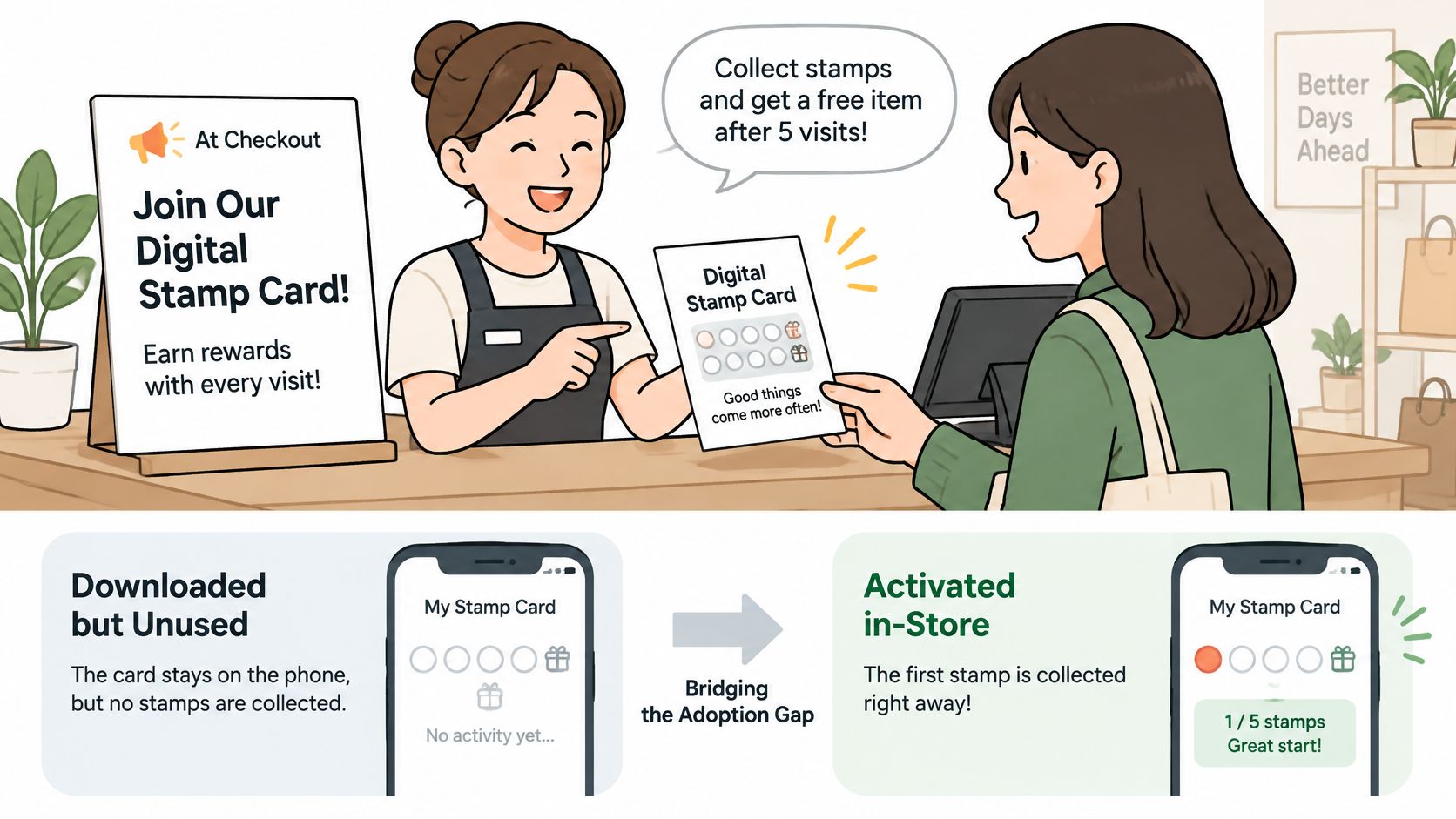
Deloitte's 2024 Consumer Loyalty Survey found that approximately 75% of Generation Z and millennial consumers consider a high-quality digital experience essential to a loyalty program. Treat the first save and stamp as part of service, not as homework for the customer.
- Say the offer aloud: State what earns progress and what the customer receives.
- Display a small till sign: Show the reward and the route to joining, without competing messages.
- Complete the first qualifying stamp immediately: Help the customer save the card and confirm that their paid purchase appears.
Decide what would justify continuing
Run a four-week pilot against a comparable baseline, keeping store hours and other offers unchanged wherever possible. Record unique enrolled customers, time to first repeat visit, card completion, redemption and gross margin after reward cost.
Set your enrolment target, acceptable administration burden and reward-cost ceiling before launch. Keep collecting completion results after the pilot if your customers' normal visit cycle is longer than the test; an unfinished salon card isn't automatically a failed offer.
Use the video alongside your staff rehearsal, then judge the checkout on your own devices.
Continue only if customers return, staff can operate the routine and the additional gross profit covers the work. Write your go-or-stop thresholds on paper, assign the review to a named person and start week one on Monday.
Loyal Customer offers phone-managed digital stamp cards and points programs, with Apple Wallet and Google Wallet cards and free trial access. Visit Loyal Customer to test your chosen reward, rehearse stamping and redemption, and check the current trial terms before committing.