A rewards card is worth it only if you pay the full statement balance every month and redeem what you earn, because carried interest usually cancels out a 1%–3% cash-back return. Even then, the rewards must beat the card's fees and the return available from a comparable no-fee card.
The important distinction is between rewards advertised and value collected. A points balance isn't a saving until you use it, and a premium benefit isn't valuable just because an issuer assigns it a price.
For businesses, there's another side to the calculation: merchants help finance card rewards through payment fees. A business choosing a payment card and a business launching its own loyalty program therefore need different tests.
Table of Contents
- Who Comes Out Ahead With a Rewards Card
- How Rewards Cards Earn and Who Pays for Them
- The Break-Even Test and Realized Value
- Why Interest and Fees Can Erase the Rewards
- When a Digital Loyalty Card Is Worth It for Your Business
- Decide Whether to Apply or Launch a Loyalty Card
Who Comes Out Ahead With a Rewards Card
A rewards card makes financial sense when you clear the statement balance, earn enough on planned spending to cover its costs, and can redeem the rewards without changing your habits. Your repayment behavior matters more than whether the card looks generous.
Verdict by situation
| Situation | Likely verdict | Deciding factor |
|---|---|---|
| Pays statement balance in full, spends steadily in bonus categories | Worth it | Redeemed rewards exceed the annual fee and the no-fee alternative |
| Pays in full, spends lightly on a premium card | Usually not worth it | Annual fee is higher than rewards earned |
| Carries a balance from month to month | Not worth it | Interest charges exceed rewards |
| Uses the card for essentials they cannot otherwise pay for | Not worth it until debt is cleared | Revolving balance |
| Infrequent traveler chasing travel points | Worth it only with usable redemptions | Redemption value and transfer rules |
| Small business paying suppliers in full each month | Often worth it | Redeemed rewards minus fees |
The table separates payment convenience from financial value. Someone who needs credit to cover groceries may need a borrowing solution, but that doesn't make rewards a good reason to choose an expensive card.
Likewise, a business can put substantial purchasing through a card without coming out ahead. Supplier surcharges, annual fees, and rewards that nobody redeems can absorb the benefit.
Choose the card for the spending and repayment habits you already have, not the habits you'd need to develop to justify it.
Match the reward to your routine
Cash back suits someone who wants a straightforward reduction in spending costs. Travel points require a realistic use: a trip you expect to take, an available redemption, and rules you're willing to manage.
Premium cards deserve particular scrutiny when spending is light. A long benefits list doesn't compensate for benefits you wouldn't otherwise buy or use.
These verdicts are starting points rather than approval recommendations. The decisive comparison is between the card's additional usable value and its additional cost, measured against an alternative you could realistically keep.
How Rewards Cards Earn and Who Pays for Them
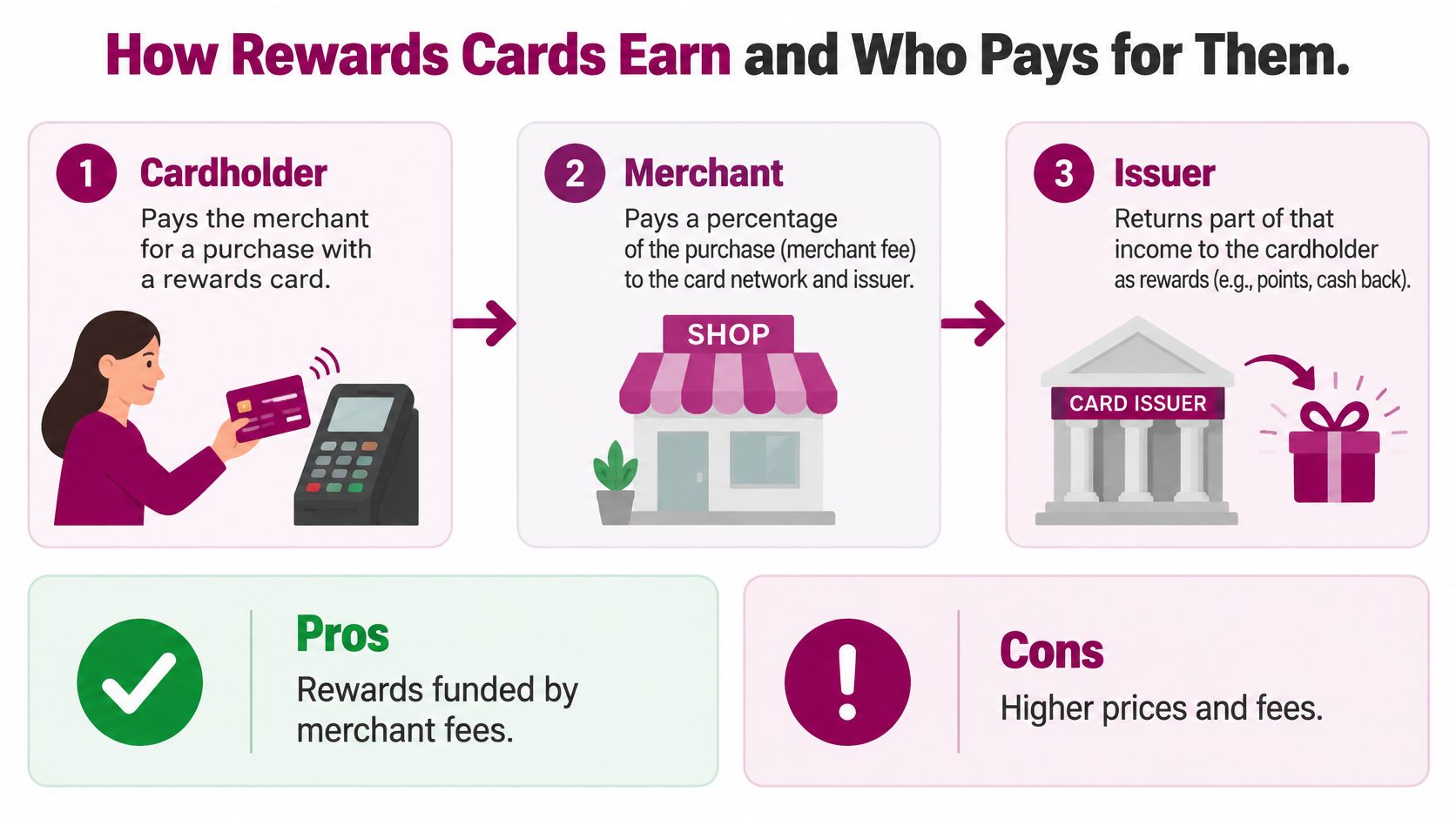
Rewards begin with an ordinary purchase. The customer pays the merchant by card, the merchant pays acceptance charges, and the issuer uses part of its revenue to support cash back, points, or miles.
The payment chain helps explain why rewards aren't free money.
Who receives the value
The Consumer Financial Protection Bureau's consumer credit-card market report found that consumers who paid their balances in full accounted for 6% of interest and fees but earned 73% of rewards, while revolving cardholders paid 94% of interest and fees and received 27% of rewards.
That distribution changes the question from “How much can I earn?” to “Which group am I likely to join?” A generous earning schedule doesn't protect a borrower from financing costs.
The funding reality: Issuers fund rewards from their business revenue, including merchant fees and the interest and fees cardholders pay.
For shoppers, the appeal is understandable. Rewards can reduce the cost of purchases they already intended to make, while eligible cards may offer travel benefits or purchase protection. Those features must be checked against the actual card terms, not assumed from the rewards label.
The merchant's side
Businesses assess card acceptance differently from shoppers choosing a card. They need to weigh customer payment preferences and checkout convenience against transaction costs.
- Customer benefits: Cash back, usable travel benefits, and rewards on ordinary purchases.
- Customer costs: Annual fees, borrowing charges, and redemption rules that require attention.
- Business benefits: Customers can use their preferred payment method without the merchant operating a credit account for them.
- Business costs: Acceptance fees reduce the amount the merchant retains from each sale.
Merchant loyalty points are a separate arrangement from bank-issued rewards. Understanding how loyalty points work helps distinguish a store's promise of a future benefit from an issuer's payment incentive.
Your position in this flow matters. A full-paying cardholder may collect value, a revolving borrower may finance more than they collect, and a merchant must account for acceptance costs before judging a sale's profitability.
The Break-Even Test and Realized Value
The right comparison isn't a rewards card versus receiving nothing. It's the paid card versus your best realistic no-fee alternative.
The Kansas City Fed's analysis of payment-card rewards provides the economic context for this comparison: rewards are primarily financed through merchant fees, which merchants may pass to consumers through higher retail prices. That means a private benefit for a cardholder isn't necessarily a saving for consumers collectively, and cash customers may share the cost without collecting the reward.
Calculate the additional return
Use this formula:
Required spending = incremental annual fee ÷ incremental reward rate
In a hypothetical comparison, a card with a $95 annual fee earns 3% in the relevant category, while a comparable no-fee card earns 1%. The additional return is 2%, so the break-even calculation is $95 ÷ 0.02 = $4,750 of eligible annual spending.
The calculation compares only the extra reward. Counting the paid card's entire return would give it credit for rewards you could have earned without paying an annual fee.
This visual summarizes the inputs to collect before comparing offers.
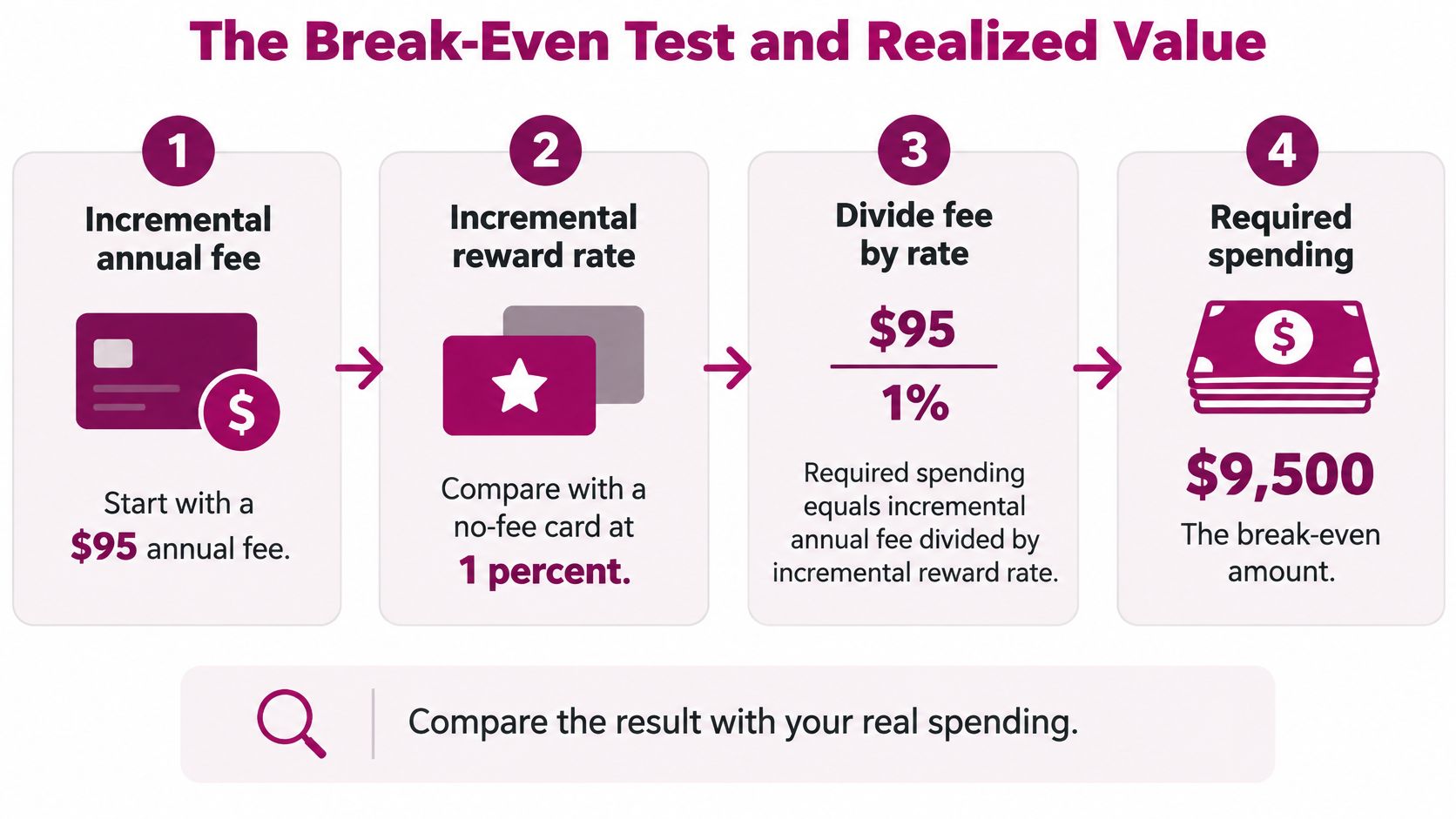
Use your statements rather than a spending target:
- Find the fee difference. Include the annual cost that changes when you choose the paid card.
- Subtract the alternative's earning rate. Compare equivalent categories and redemption methods.
- Divide the fee by the additional rate. Express the rate as a decimal.
- Check actual eligible spending. Keep purchases you would've made anyway; exclude purchases created by the incentive.
- Adjust for restrictions. Reduce the assumed return when caps, exclusions, or uncertain point values limit what you'll collect.
Break-even annual spending by fee and reward rate
These are hypothetical fee-and-rate scenarios, calculated with the formula above. The fee column assumes the comparison card has no annual fee.
| Annual fee | Incremental reward rate | Annual spending to break even |
|---|---|---|
| $0 | Any positive rate | None needed |
| $95 | 1% | $9,500 |
| $95 | 2% | $4,750 |
| $95 | 3% | $3,166.67 |
| $250 | 2% | $12,500 |
| $250 | 3% | $8,333.33 |
| $550 | 2% | $27,500 |
Reaching the threshold only recovers the fee. It doesn't establish that managing the paid card is worth your time, and it doesn't allow for borrowing costs.
Measure what you actually collect
Realized annual value = rewards redeemed + benefits used − annual fees − interest − other charges.
Don't subtract unused points again if you've already excluded them from redeemed rewards. That would count the same missing value twice.
Keep a running record covering a full year of statements. Log eligible spending by category, each redemption's date and cash-equivalent value, and benefits used instead of purchases you otherwise would've made.
For travel, value the redemption against a reasonable alternative you'd buy. An expensive itinerary you never would've purchased isn't automatically worth its advertised cash price to you.
In the 2024 J.D. Power U.S. Credit Card Satisfaction Study, 58% of U.S. cardholders primarily used cash-back cards, compared with 31% using points-or-miles cards. Those preferences don't prove cash back is always better, but simplicity is a legitimate selection criterion.
The accompanying video offers another format for considering the comparison.
Business owners evaluating their own program can use a loyalty-program ROI calculator to organize reward costs and expected returns. Keep that calculation separate from choosing a bank card: a customer reward is a business expense, while card rewards are a potential purchasing benefit.
Why Interest and Fees Can Erase the Rewards
A worked rewards-card comparison illustrates the financing risk: at 20% APR, carrying an average $2,000 balance for a year generates roughly $400 in interest before compounding, while 2% back on $24,000 of annual spending produces $480 in rewards.
That leaves little room for an annual fee or other charges. Also, it isn't a promise about your account: actual interest depends on the balance, timing, and terms.
Borrowing changes the decision
For a closer explanation of daily balances, grace periods, and payment timing, Toya AI's guide to how credit card interest works is useful alongside your card agreement. Check purchase interest, cash-advance terms, and late-payment charges separately rather than assuming the headline APR describes every cost.
Bankrate's assessment of rewards cards cites findings that 72% of Americans were pursuing credit-card rewards while in debt. That finding doesn't mean every participant was borrowing on the rewards card, but it highlights why rewards shouldn't be evaluated independently of household debt.
A reward is a discount on a purchase, not a source of money for repaying that purchase.
If you sometimes carry a balance, compare lower-rate products or balance-transfer options before optimizing rewards. Include transfer fees and the rate after any promotional period in that comparison.
Unredeemed rewards create another loss
Even avoiding interest doesn't guarantee that you collect the advertised return. A 2025 CardRates compilation of consumer survey findings reported that 69% of rewards-card holders had unused cash back, points, or miles, while 23% said they failed to redeem available rewards during the previous year.
An unused balance isn't necessarily forfeited, but it isn't realized value yet. Expiration, minimum thresholds, complicated transfers, and changing redemption rates can prevent collection.
- Resolve expensive debt first. Don't add purchases merely to earn rewards while reducing another balance.
- Check collection rules. Record redemption minimums and expiry conditions before assigning value.
- Consider bonuses last. A temporary incentive shouldn't determine a long-term borrowing decision.
When a Digital Loyalty Card Is Worth It for Your Business
A bank rewards card encourages customers to choose a payment method. A merchant loyalty card encourages customers to return to a particular business.
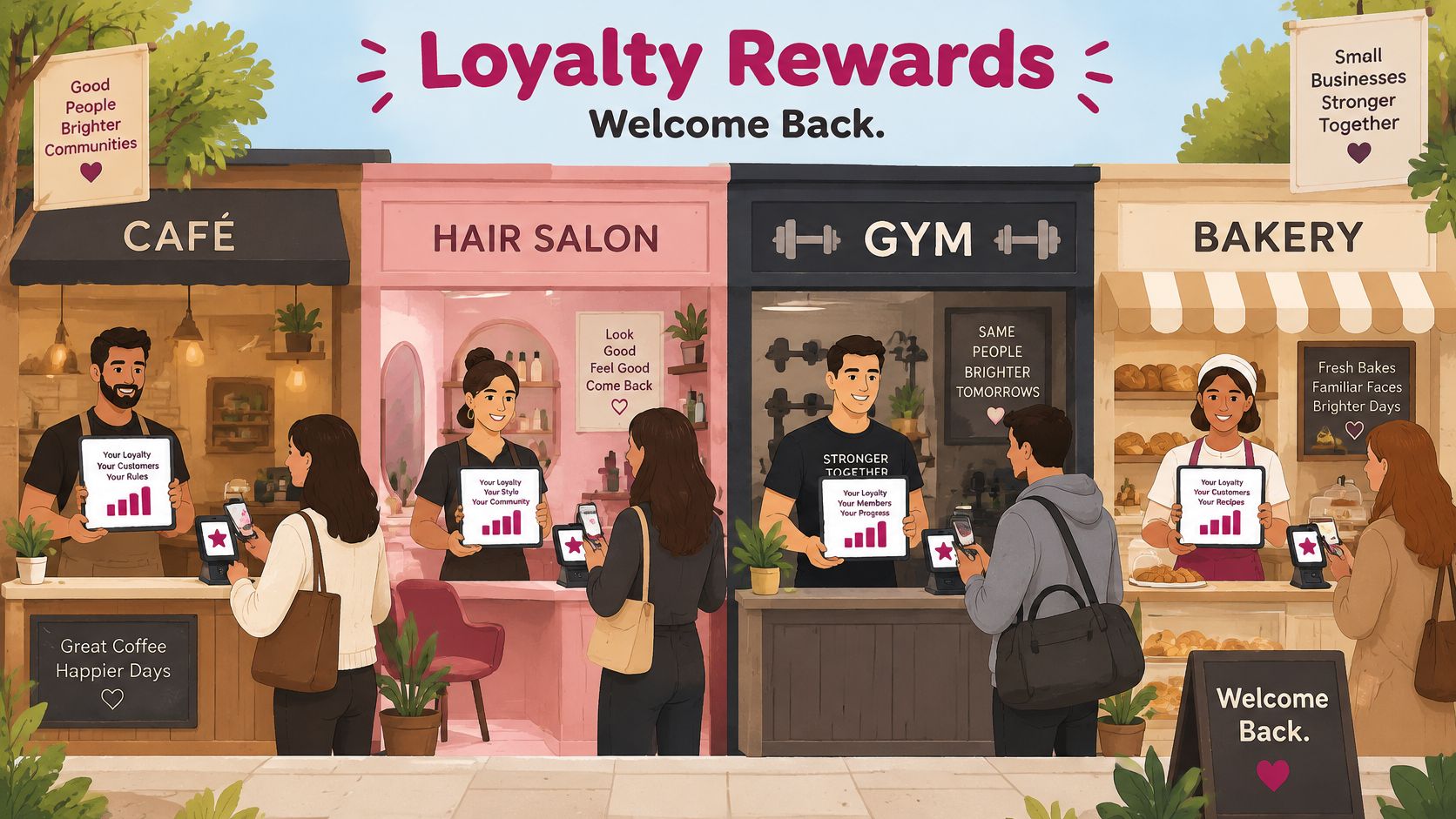
That distinction gives cafes, salons, bakeries, retailers, and gyms a different decision to make. Their program can reward repeat visits without requiring customers to use a particular credit card, although ordinary payment-acceptance fees still apply when customers pay by card.
The business types below illustrate where a visit-based or spending-based reward can fit.
Choose stamps or points by transaction pattern
| Business pattern | Better starting model | Reason |
|---|---|---|
| Cafe selling similar everyday orders | Stamp card | A qualifying checkout is easy to recognize |
| Salon with a consistent repeat service | Stamp card | Visits are a useful measure of repeat custom |
| Bakery rewarding routine visits | Stamp card | Customers can understand progress quickly |
| Restaurant with different-sized tabs | Points program | Rewards can scale with spending |
| Retailer with varied basket values | Points program | Larger purchases can earn proportionately more |
| Gym selling different services | Points or a carefully defined visit reward | The earning rule must match the behavior being encouraged |
A stamp model treats a qualifying checkout as the earning event. A points model can distinguish between customers making small and large purchases.
Neither model guarantees profitable repeat business. A reward that attracts discount-only visits or subsidizes purchases customers would've made anyway can reduce margin without changing behavior.
Make participation easy without ignoring cost
A digital loyalty card avoids the need to carry a paper punch card. Wallet-based passes also let customers participate without downloading a separate loyalty app.
Loyal Customer is one option among several: we support stamp and points programs with cards in Apple Wallet and Google Wallet, and the card updates automatically after points or stamps are added or redeemed. Customers can see available rewards in their wallet.
Before launching, define the qualifying purchase, the reward, and how staff will handle redemption. Estimate the reward's actual fulfillment cost, including staff time, rather than judging it only by its menu price.
- Protect the margin: Choose a reward the business can afford when customers redeem it.
- Track changed behavior: Look for additional profitable visits, not just program sign-ups.
- Budget communication: If opt-in reminders are part of the plan, compare messaging costs, including options such as YipSMS Inc.’s affordable small business texting.
A digital card earns its place when repeat visits are the goal, customers understand the offer, and the reward cost fits the business's economics.
Decide Whether to Apply or Launch a Loyalty Card
For an individual, the answer to “Are rewards cards worth it?” should come from statements and redemption records, not an issuer's headline offer. For a business, the answer should come from contribution margin and the customer behavior the program is designed to encourage.
Use this checklist to distinguish a payment-card decision from a loyalty-program decision.
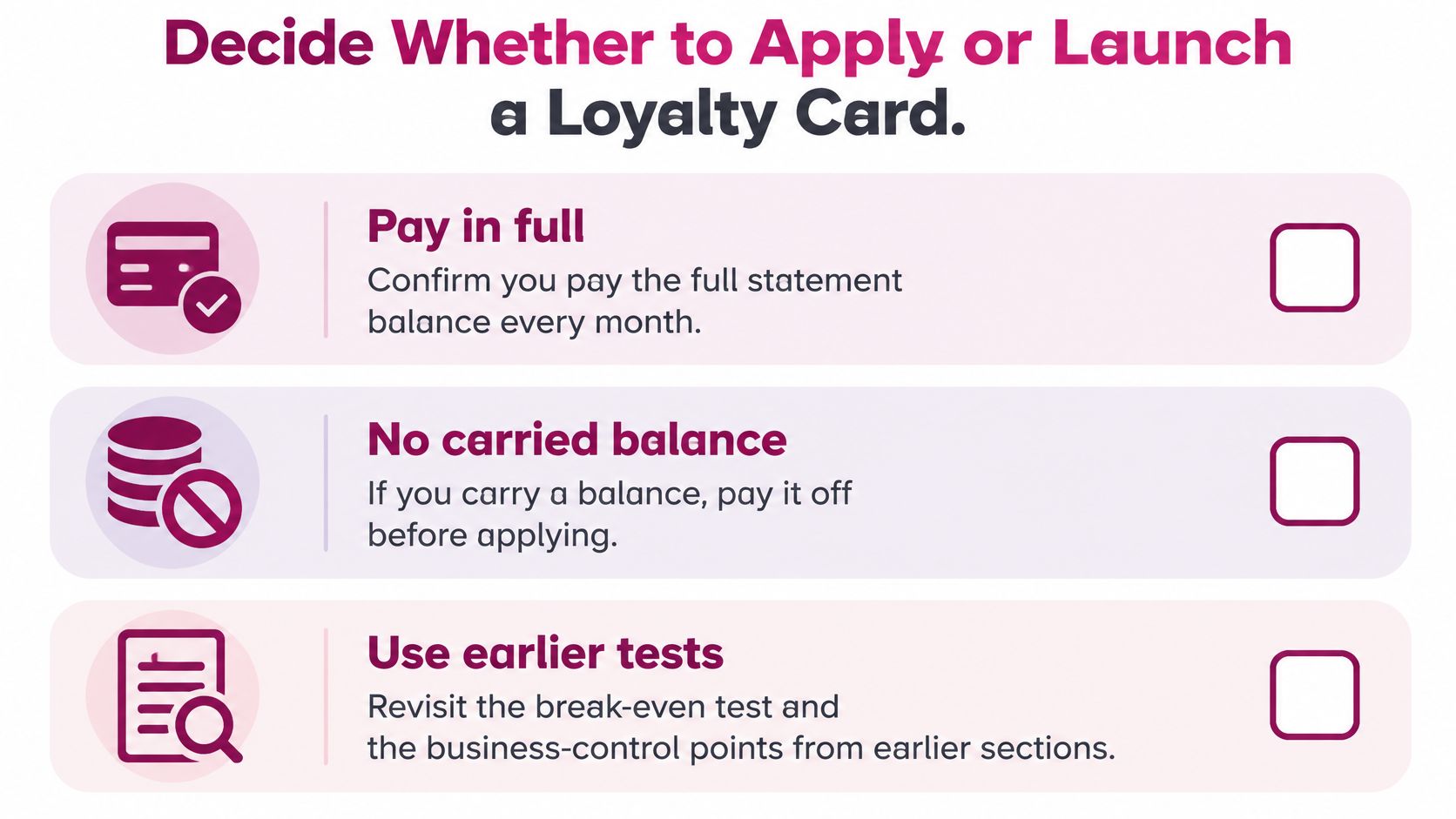
Before applying for a rewards credit card
- Confirm full repayment: If you're carrying expensive debt, make reducing it the priority.
- Use actual spending: Run the incremental break-even calculation against your existing category purchases.
- Verify redemption: Check minimums, transfer conditions, and expiry rules before treating points as cash.
- Keep the alternative visible: Choose the paid card only when its usable additional benefits justify its additional costs.
Don't interpret a narrowly positive estimate as a requirement to apply. Keeping a simpler no-fee card is reasonable when the expected advantage is small or depends on benefits you might not use.
Before launching a business loyalty card
Choose stamps when qualifying visits are broadly comparable and points when spending varies meaningfully. Write a reward rule that staff can explain at checkout, then test whether the reward leaves enough margin.
Setup speed isn't evidence of profitability, but it can make testing easier. Our guided onboarding recommends a stamp card or points program, and businesses can build their card in a few minutes.
Keep payment acceptance and customer retention in separate budgets. A loyalty program doesn't remove card-processing costs, and receiving bank rewards doesn't prove a customer-retention program is working.
This week, cardholders should calculate realized value from their statements, while business owners should cost a specific reward and test its checkout workflow before launching.
Loyal Customer lets businesses run points programs or digital stamp cards from a phone, with loyalty passes for Apple Wallet and Google Wallet. If your reward fits your margins and gives customers a clear reason to return, visit Loyal Customer to build and test your program.