You know the number without looking it up. Roughly half the people who sat in your chair this week won't sit in it again. They liked the cut, they said they'd be back, and then a busy Tuesday happened and the shop two streets closer got the next one.
The regulars carry the rest. They come back every five or six weeks, they ask for you by name, and they're the reason the rent clears in February. A loyalty program for barber shops is worth building because it works on both groups at once, but only when three things run as one system: the stamp at checkout, the card sitting in the client's phone, and the reminder that lands the week his cut starts looking soft.
The pressure is real. U.S. barber shops generated approximately $2.25 billion in revenue in 2024, up from $1.06 billion in 2020, according to the American Salon roundup of barbershop industry data. More shops, more chairs, more alternatives for a client who is already half-decided to drift.
Table of Contents
- Stamps or Points for Your First Program
- Setting Earning and Redemption Rules That Protect Margin
- How to Build and Issue the Wallet Card
- How to Record Visits at Checkout
- Re-engaging Clients on Their Haircut Cycle
- Measuring the Pilot and Launching This Week
Stamps or Points for Your First Program
For a barber shop launching its first program, the answer is stamps. One completed visit earns one stamp, so a twenty-minute beard trim and a full cut both move the card by one. That matches how a barber shop sells: the same cut, at a similar price, on a repeatable clock.
Points run on different logic. They accrue per dollar or by spend tier, which suits a shop where a client spends $25 one visit and $80 the next because he added a hot towel shave and a tin of pomade. That flexibility costs you arithmetic at the chair: every reward needs a rate, a cap and a definition of what counts, as this comparison of stamp and points models for small businesses sets out.
Three things make stamps the better first launch. There's nothing to calculate while the client is reaching for his card. The card explains itself in one sentence. And your first six weeks go into building the habit instead of recalibrating rules.
The verdict: a shop that sells one cut at one price on a fixed clock should count visits, not dollars.
The early-engagement numbers point the same way. A 2026 loyalty benchmark covering small independent merchants, including barbers and salons, found 78.9% of stamp-card holders scanned at least once, against 68.5% of points-card holders, and 20.5% of stamp-card holders reached three or more visits, against 11.4% on points.
| Criterion | Stamp card | Points program |
|---|---|---|
| Reward trigger | Each completed visit | Spend, per dollar or by spend tier |
| Best fit | Uniform cuts on one service menu | Variable tickets with add-ons |
| Setup effort | One threshold and one reward | Points rate, tiers, cap and welcome bonus |
| Client understanding | Immediate, no calculation | Needs explaining at checkout |
| Early engagement in 2026 benchmark | 78.9% scanned at least once | 68.5% scanned at least once |
| Three or more visits in 2026 benchmark | 20.5% of holders | 11.4% of holders |
| Flexibility later | One threshold | Supports tiers and varied rewards |
Pick once. A business runs a single program and can't switch the model after launch, so choose the one that fits the menu in front of you today. The Loyal Customer app sets a stamp program up from your phone in minutes if you want to see the shape of it before committing. If you want the longer argument, points versus stamps compared works through where each earns its keep.
Setting Earning and Redemption Rules That Protect Margin
The usual advice stops at "give a stamp per cut and a free haircut at ten." That isn't a program. It's a discount with a delay on it, paid to the client who was coming back anyway.
The gap worth closing is the second visit. Platform data on U.S. barbershops shows nearly 48% of tracked clients had only one appointment between May 2025 and April 2026, while returning clients accounted for 44.63% of visits; a 2025 survey of 2,000 U.S. men reported alongside it found 57% go to a specific person for haircuts, all compiled in SigmaDax's barbershop industry statistics. Half your client list is a one-visit list, and the other half already has a favourite barber.
The four rules I'd write down before launch
- Stamp completed appointments only. Not bookings, not deposits, not no-shows. If a stamp can be earned without a chair being paid for, the card stops being a record of revenue and becomes a giveaway.
- Set the threshold against the actual cycle. On a five to six week rhythm, a five-stamp card pays out inside about six months. A ten-stamp card takes the best part of a year, and clients abandon a card they can't see the end of.
- Name the reward in one concrete service. A hot towel shave, a beard line-up, a scalp treatment. Percentage off every visit trains clients to wait for the discount instead of booking the cut.
- Allow one reward at a time, and print that on the card. Otherwise a client walks in with three stacked rewards and you've paid for one visit.
Where the margin leaks is the habitual client. He books every five weeks and will clear any threshold you set, so paying him a reward for behaviour he already has costs you money and changes nothing. Pay bonus credit for rebooking inside the normal cycle instead, and leave the main reward for the client who'd otherwise disappear after one cut.
The chair question needs an answer before launch day. Since most men follow a specific barber, decide now whether a client who switches chairs keeps his stamps. I'd keep the card with the client, not the chair, because a stamp balance that resets when a barber moves shops punishes the customer for something he had no say in.
How to Build and Issue the Wallet Card
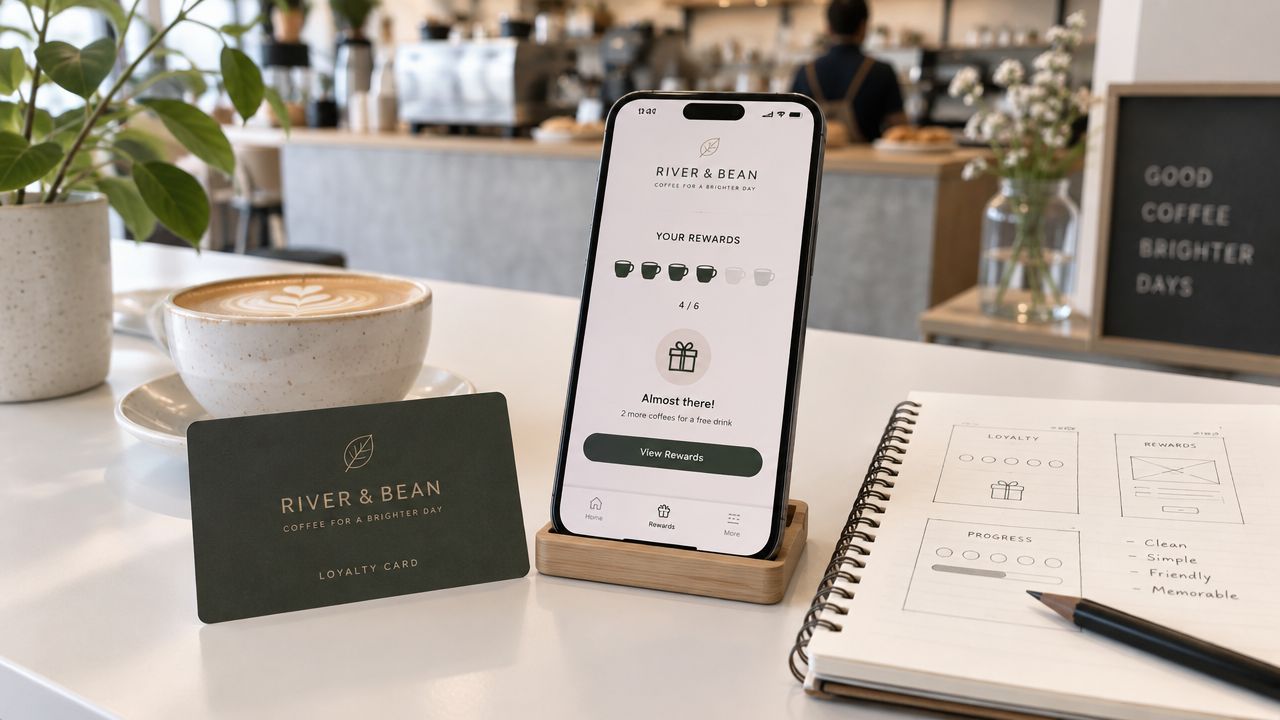
Paper punch cards fail at the same two points every time. The client leaves one in a jacket that goes to the dry cleaner, and when he asks how many stamps he has, nobody behind the chair can tell him. A wallet pass fixes both. It lives on the phone the client already carries, and the current count sits on the pass for him to check between visits.
The build itself takes a few minutes. Spend the time you save on the reward wording.
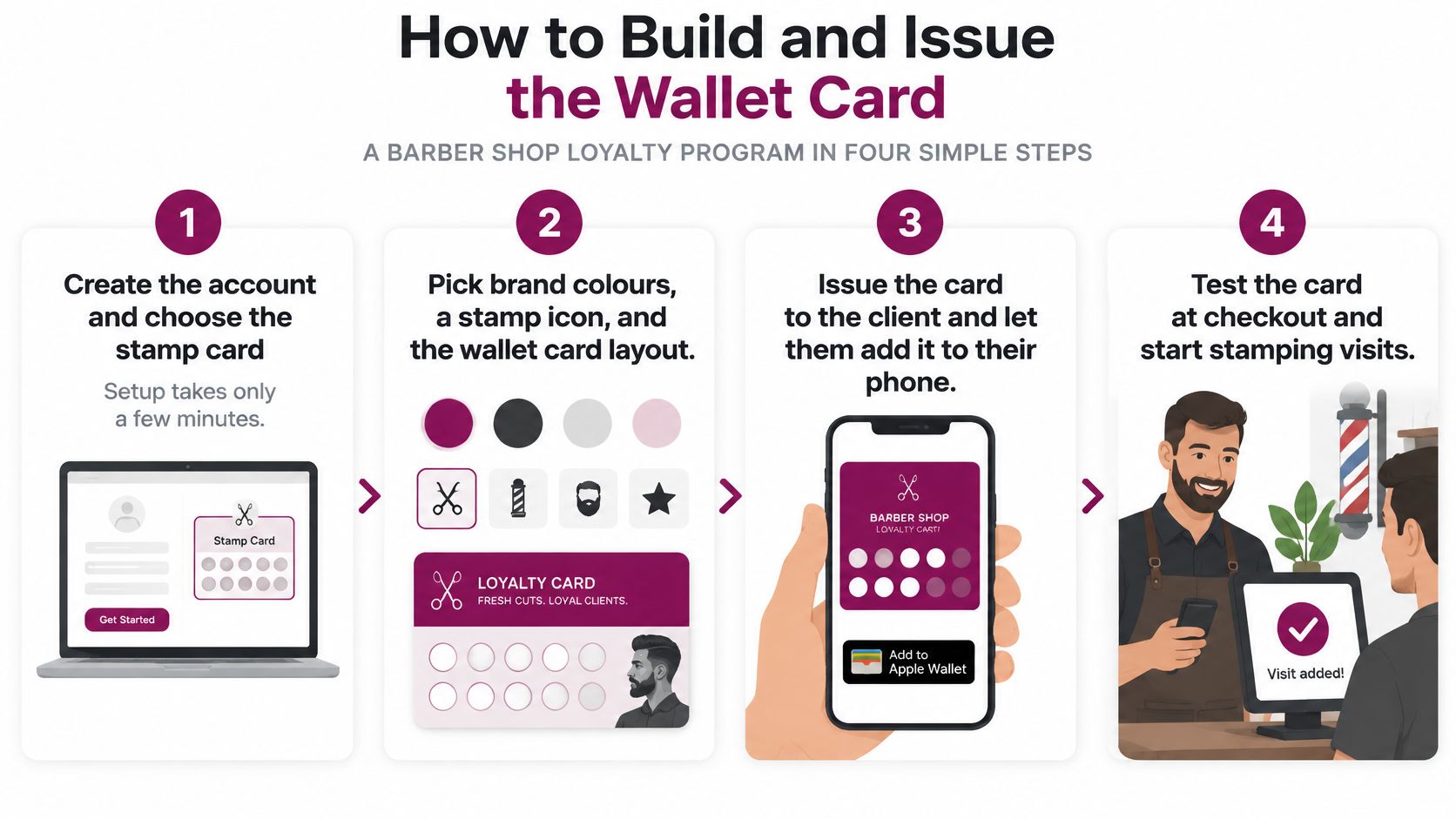
- Create the account and choose the stamp card. Each shop runs a single program, and the type cannot be changed after launch, so stamps versus points gets settled here, on this screen. Have your stamp total and reward sentence written on paper before you open the app, because those two decisions are the only slow part. Everything after that is clicking.
- Pick colours and a stamp icon. Scissors, a razor or a comb, in colours that match the shop front rather than the app's defaults. The client sees this card every time he opens his wallet, parked next to his bank cards, so it promotes the shop between cuts.
- Set the stamp total and write the reward plainly. "Fifth cut free" reads better on a small screen than "complimentary service voucher." Check it on a phone, not a laptop.
- Publish, then put the join link everywhere. Your program lives at a unique public link, a branded page where clients join without downloading anything. Get that link's QR code on the mirror card, into the booking confirmation text, onto the card machine and the front door. A client can't join a program he never sees.
- Know exactly what the client does. He opens your link, verifies his phone number with a one-time code, and adds the card straight to Apple Wallet or Google Wallet. No app, no password to forget, and the card updates itself after every visit.
- Test the join on two phones before a client touches it. One iPhone, one Android. Join as yourself, add a stamp, and confirm the count updates on both. Anything broken at this stage costs nothing to fix.
If the pass layout itself is new ground, how to create Apple Wallet passes covers the design details. Then run the three-point check before you print anything: the shop name is spelled right, the reward text is readable at arm's length, and the stamp count on screen matches what you would have written on paper. Build the card in the Loyal Customer app from your phone. The sign-up count on day one means little; the number that matters is how many of those cards come back through the door on the next cycle.
How to Record Visits at Checkout
The whole program gets decided in about thirty seconds, between the mirror and the card machine. If that window feels clumsy, barbers stop doing it, and a program nobody runs is a poster on the wall.
The moment is worth designing for.
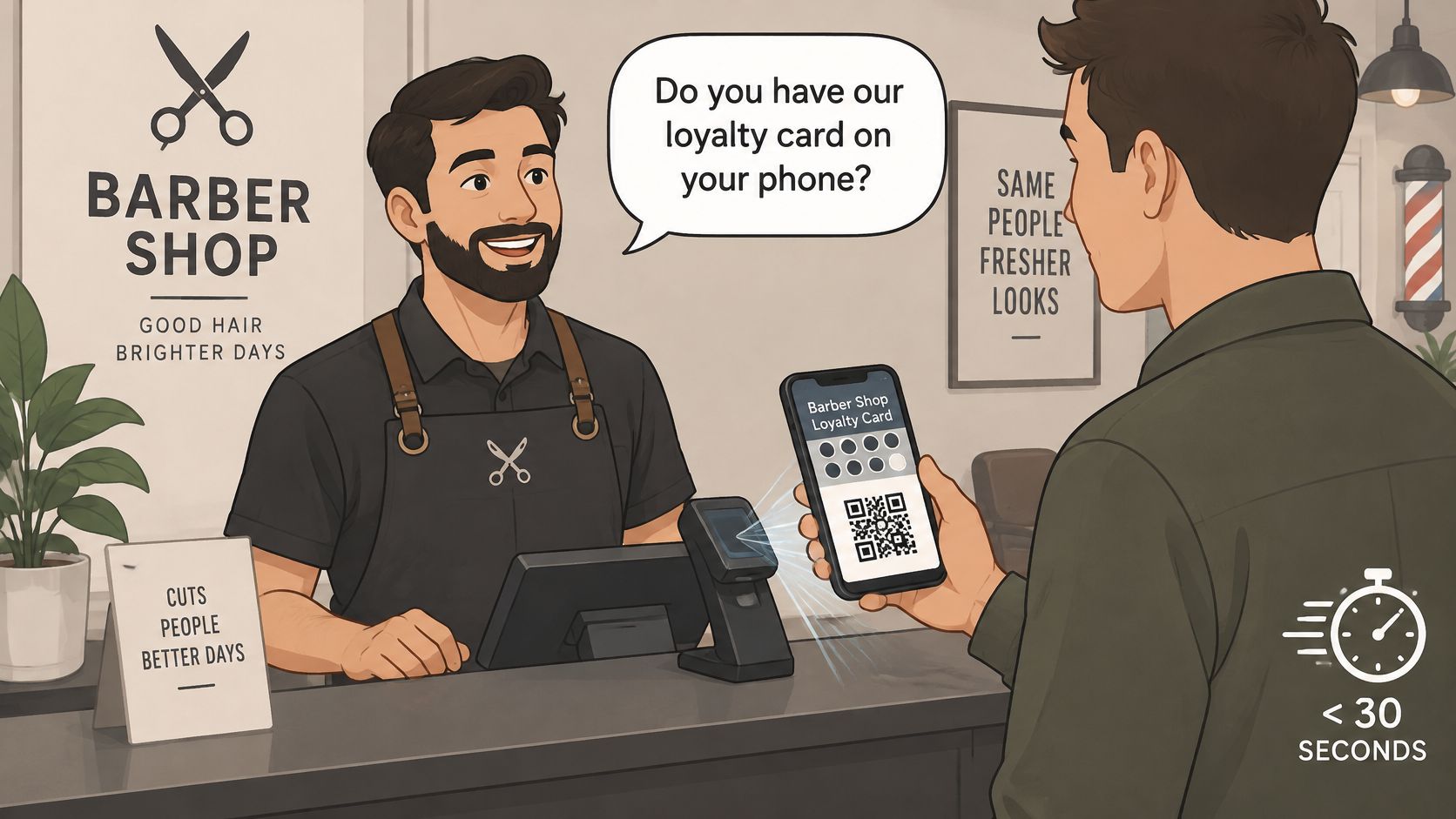
The question that starts it, every single time: "Do you have our loyalty card on your phone?"
The routine, in order
- Ask before payment. Once the card machine is out, the conversation is about money, and the loyalty ask gets skipped.
- Scan the QR code on the wallet pass. The code identifies the member, and the same scan is where you add a stamp, update points or record a redemption.
- Check the name matches the face. This is the step people skip, and it's how stamps land on the wrong account.
- Tap the stamp once payment clears, then turn the screen. Let him see the new count. It takes two seconds and it's the only marketing the program gets.
- Say the next reward in one sentence. "Two more and the beard trim's on us." One sentence, no sales voice.
The two fallbacks worth training
No card yet gets handled while he's still in the chair. He opens your shop's unique link on his own phone, and the card is in his wallet before you've finished with the card machine. The first stamp lands that same visit, which matters, because a client who leaves with zero stamps rarely comes back to claim them.
A dead phone is the other case. A client who can't show a code can't be scanned, so note the visit on the day sheet and square it when his pass is back on screen. What never works is stamping from memory the next morning, because a missed stamp is the fastest way to lose someone who was counting.
Set one house rule and hold everyone to it: the stamp goes in after payment, never before the haircut is finished. Duplicates mostly take care of themselves, since clients join on their own phones through your link rather than being keyed in at a counter.
Say the benefit out loud, in one sentence, at the chair. Plenty of clients have never kept anything in their phone's wallet except a boarding pass, so the explanation has to come from the barber. The card updates itself after every visit, which is the part worth telling: nothing for them to do. The count on his screen is the scoreboard he watches.
Re-engaging Clients on Their Haircut Cycle
A monthly blast goes out when the calendar says so. A reminder on day 38 goes out when the client has started noticing his own hair in the gym mirror. Only one of those gets a booking.
| Days since last visit | Trigger | Action | Stop when |
|---|---|---|---|
| 0 | Enrolment at checkout | Card issued with first stamp | Never, this is the start |
| 35 to 42 | No visit yet | One wallet-pass reminder naming the usual barber | Client books or visits |
| 49 to 55 | No booking yet | Small bonus stamp or targeted message | Client books or redeems |
| After redemption | Reward used | Reset card, no extra offers | Next cycle begins |
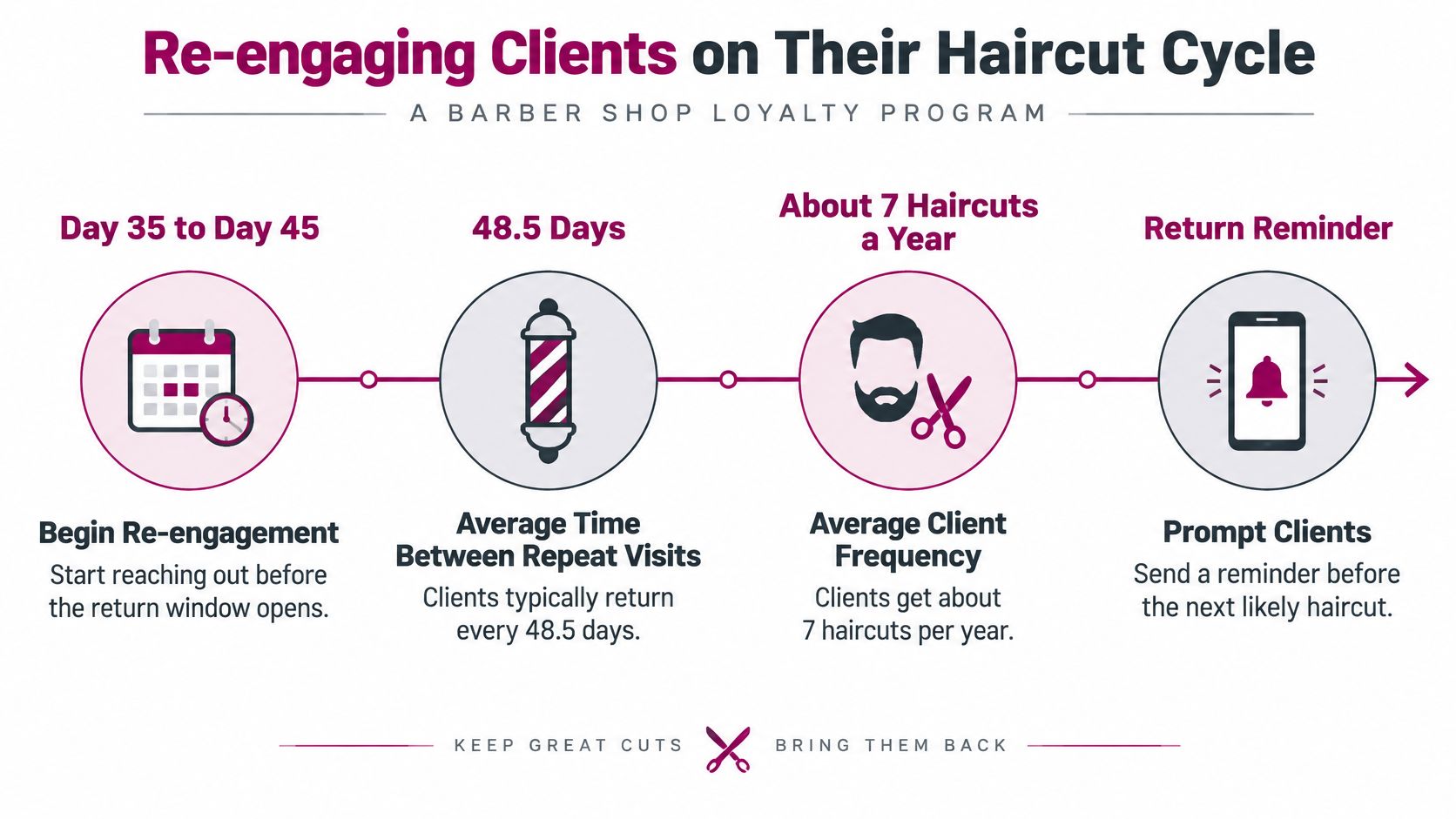
The timing isn't guessed. SQUIRE's benchmark puts the average interval between repeat barbershop clients at 48.5 days, with the average client receiving roughly seven haircuts a year, per SQUIRE's barbershop trends and insights report. That report's wallet research also found only 33% of surveyed consumers had used wallets for non-payment functions such as loyalty-card storage, and only 19% had noticed retailers running such programs.
Why the windows sit where they do
The first window opens before the average return date, not after it. A reminder that arrives on day 40 reaches a client who is already thinking about a cut; the same message on day 70 reads as a shop chasing business. Name the barber in the message, because most men follow a person rather than a premises, and "your usual barber has a Thursday slot" gets a reply where "20% off this week" gets scrolled past.
Name the barber, not the discount.
The second window is the salvage attempt. Somewhere around day 49 to 55, if there's no booking, one small bonus stamp or a direct message is defensible. Stacking both, plus a third message the week after, is how a shop trains clients to wait.
Segment before you send anything: last visit date, usual barber, service type, and whether the client books ahead or walks in. Then apply stop rules hard. Once a client books or redeems, all incentives come off, and the cycle restarts from his next completed visit. Log the messages you suppress, because the suppressed ones are the evidence that your reminder worked rather than your discount.
Measuring the Pilot and Launching This Week
Enrolment is not a result. It's a form submission. A shop with 90 card holders and the same number of second visits as before has bought nothing but a QR code.
| Metric | How to calculate | What to watch |
|---|---|---|
| Second-visit conversion | New clients who book a second visit divided by new clients | Should rise above the pre-launch baseline |
| Median days to next appointment | Middle value of the gap between visits | Compare with the 48.5-day average gap |
| 90-day active-client rate | Enrolled clients with a visit in the last 90 days divided by enrolled clients | Compare reward group with comparison group |
| 180-day repeat rate | Clients with a return visit within 180 days divided by clients acquired | Main long-term check |
| Reward cost per incremental visit | Rewards issued divided by visits above baseline | Should stay below the margin on a visit |
| No-show rate | Missed bookings divided by total bookings | Watch for a rise after reminders |
Build the baseline first, using six to twelve months of visit history, and hold back a comparable group of clients from the reward where you can. That comparison group is what tells you whether the program moved anyone or just recorded people who were already loyal.
Judge repeat visits before you judge ticket size. A 2020 field study of more than 5,500 customers at men's hair salons found a 29% increase in customer lifetime value from a simple $5-per-$100 reward, and more than 80% of that improvement came from higher retention rather than larger individual purchases, per Washington University in St. Louis's write-up of the research. The same body of work notes that loyalty programs reliably improve behavioural loyalty while attitudinal loyalty is harder to shift, so expect visits to change before anyone tells you they love the card.
The judgement call: if second-visit conversion hasn't moved by day 90, the reward is aimed at the wrong behaviour, not priced a few percent too low.
Set the review date before launch, not after. Call the pilot a success only if second-visit conversion climbs and the reward cost per extra visit stays under the margin that visit earns. Run those two numbers through the loyalty program ROI calculator so the answer isn't an argument between you and the barber who likes giving things away.
Then do the launch this week rather than next quarter. Choose stamps. Write the earning rule and the reward on one line. Put the join link on every mirror. Do a test scan on your own phone. Start the 90-day clock on the day the first real card goes live, and count second visits, not sign-ups.
Loyal Customer puts a branded digital stamp card in your client's Apple Wallet or Google Wallet, built from your phone in minutes, with QR scanning at the counter and no app for customers to install. Everything in this guide, from the five-stamp threshold to the day-35 reminder, runs on one card your barbers can operate in a single tap. Start the 7-day free trial when you're ready to launch and set up your first program at Loyal Customer.