A restaurant operator choosing a dining rewards app usually isn't comparing features in a vacuum. You're deciding whether to add a lightweight wallet-based program, extend the POS you already use, or bring in an enterprise engagement suite that can coordinate loyalty, ordering, messaging, and customer data.
The right choice depends on your existing operating ecosystem, number of locations, customer enrollment experience, loyalty mechanics, analytics requirements, pricing visibility, implementation burden, and the complexity your staff can support. A cafe with one counter and a short checkout interaction has different needs from a multi-unit brand managing kiosks, online ordering, subscriptions, and segmented campaigns.
Customer expectations also make the decision more important. The National Restaurant Association reports that 52% of customers already participate in restaurant, coffee shop, snack place, or deli loyalty programs, and that members belong to 3.6 programs on average. Smartphone-based participation is particularly relevant, with 60% of current users preferring apps over physical cards.
The ten options below are assessed from an operator's perspective. Each one is considered for the merchant it suits, how customers enroll, how it connects with ordering and POS workflows, what implementation demands it creates, how clearly it exposes pricing, and where its limitations become important.
Table of Contents
- 1. Loyal Customer
- 2. Paytronix
- 3. PAR Punchh
- 4. Thanx
- 5. Toast Loyalty
- 6. Square Loyalty
- 7. SpotOn Loyalty
- 8. Incentivio
- 9. Appfront
- 10. Fivestars by SumUp
- Top 10 Dining Rewards Apps Comparison
- Match the Platform to the Restaurant's Next Stage
1. Loyal Customer
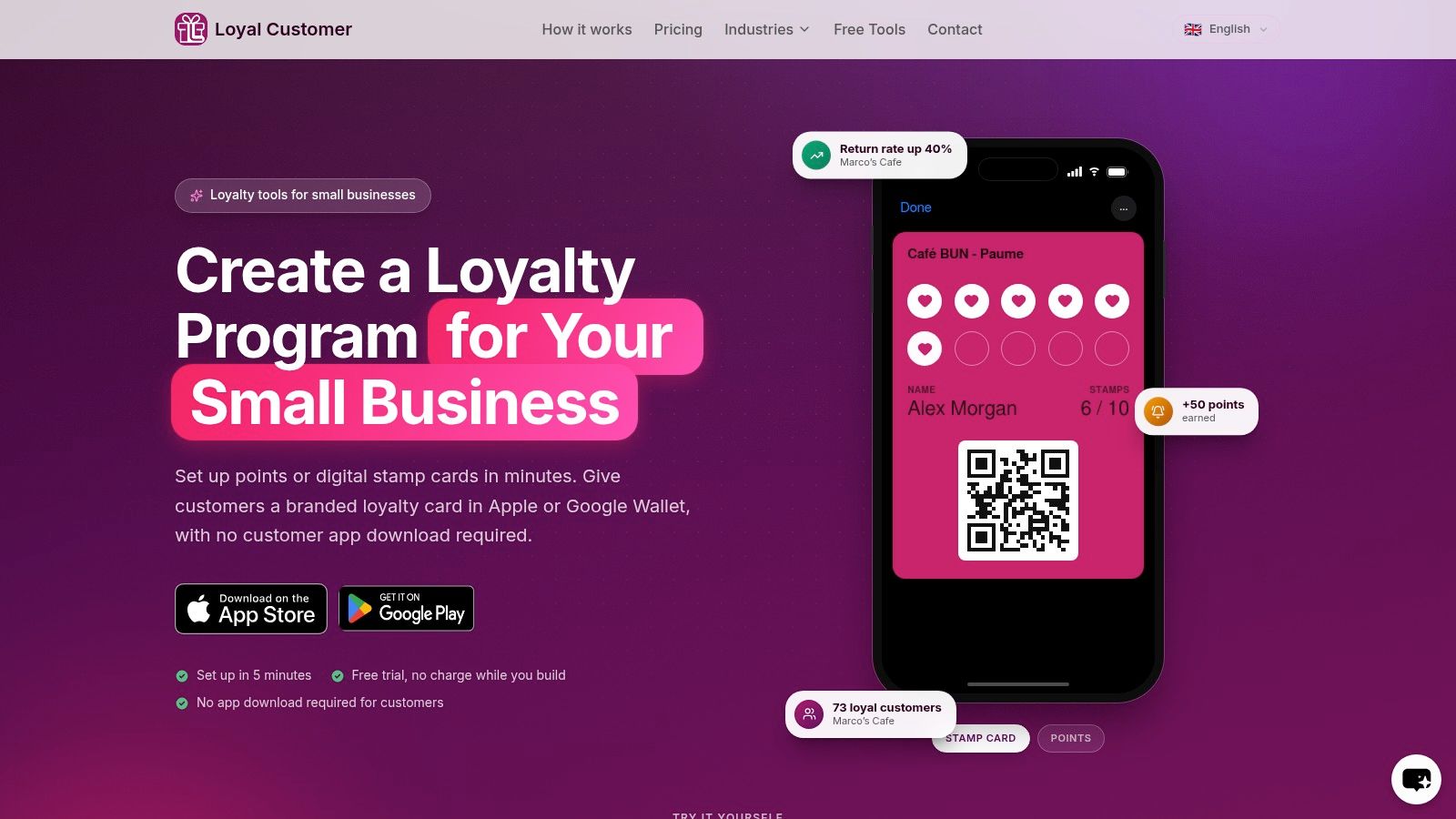
Loyal Customer is the clearest fit for a small restaurant, cafe, bakery, takeaway, or other consumer-facing business that wants to launch quickly without asking customers to install another app. It lets an operator create either a points program for spend-based rewards or a digital stamp card for visit-based incentives, then issue the loyalty pass through Apple Wallet or Google Wallet.
That wallet-native approach addresses a practical problem. Customers often forget paper cards, and many won't download a dedicated app just to collect rewards from one local business. A pass that lives in the phone's existing wallet is easier to present at checkout and easier for a small team to explain.
Why the operating model matters
Loyal Customer is managed from a phone, with guided setup, QR-code distribution, and OTP customer verification. That makes it practical for an owner who doesn't want to configure a desktop system, purchase dedicated equipment, or wait for a lengthy POS integration before testing a program.
The two program models cover common restaurant use cases. A coffee shop might use stamps to reward repeat visits, while a takeaway might award points per purchase and let customers redeem them for discounts or free dishes. Reward settings can include per-dollar earning, custom tiers, and fixed-completion rewards.
The pricing is unusually visible for a small-business tool. The listed plan costs $12 per month or $120 per year, includes up to 100 customer slots, Apple and Google Wallet integration, a branded onboarding page, QR-code checkout flow, email support, and a free trial, as shown on the Loyal Customer platform page. The standard customer limit is the main constraint. A growing restaurant may need a custom plan or a more powerful system once its audience, locations, or reporting requirements expand.
The restaurant mobile-app adoption overview describes traditional loyalty programs as reaching 5% to 12% adoption, while wallet-pass programs can reach 65% to 75% adoption. Those figures don't guarantee a result for any individual restaurant, but they clarify why a wallet-first dining rewards app can be a sensible starting point when enrollment friction is the main obstacle.
Practical rule: Choose Loyal Customer when the immediate problem is replacing paper cards and getting a simple points or stamp workflow live, not building a complex enterprise CRM.
The platform also promotes return rates of up to 40%, a product claim available through its own site, rather than an independent benchmark. Operators should validate that claim with their own baseline, redemption rules, and repeat-visit reporting. For a micro-merchant, its strongest advantages are low setup effort, transparent entry pricing, phone-based administration, and no required customer app download. Its likely limitations are equally clear: advanced analytics, deep POS connectivity, multi-location controls, and complex campaign orchestration may require a custom arrangement or another vendor.
2. Paytronix
Paytronix is built for restaurant and convenience-store operators that need more than a digital punch card. Its suite combines configurable loyalty, stored value and gift programs, online ordering, catering, messaging, and customer engagement in one environment.
The platform supports points, tiers, visit-based rewards, and banked or redeemable wallets. Loyalty can also be connected to online ordering and catering, allowing operators to track earning and redemption across more than the physical counter. That matters for brands whose customers move between in-store purchases, web orders, and larger group orders.
Its strength is breadth. A multi-unit operator can use one vendor for loyalty, offers, ordering, stored value, and messaging instead of stitching together several systems and reconciling customer records between them. Migration and integration capabilities are also important for an established brand replacing a legacy program.
Paytronix includes personalization templates and benchmarks, giving larger teams more room to create targeted engagement instead of relying only on blanket discounts. Operators should still define their reward economics before turning on advanced features. A flexible points system can become expensive or confusing if earning rules, exclusions, expiration policies, and redemption thresholds aren't documented clearly for staff and guests.
Pricing is quote-based, so smaller operators can't compare it directly with a transparent SMB subscription before speaking with sales. Implementation also involves more planning than a wallet-first tool. Data migration, ordering connections, staff permissions, campaign governance, and reporting definitions all need ownership.
For context, the restaurant rewards program guide can help operators distinguish between simple visit incentives and broader restaurant loyalty systems. Paytronix is best suited to the latter. It makes sense when the business needs ordering connectivity, stored value, segmentation, and enterprise-grade coordination. For one independent cafe, the same breadth may create unnecessary cost and operational overhead.
3. PAR Punchh
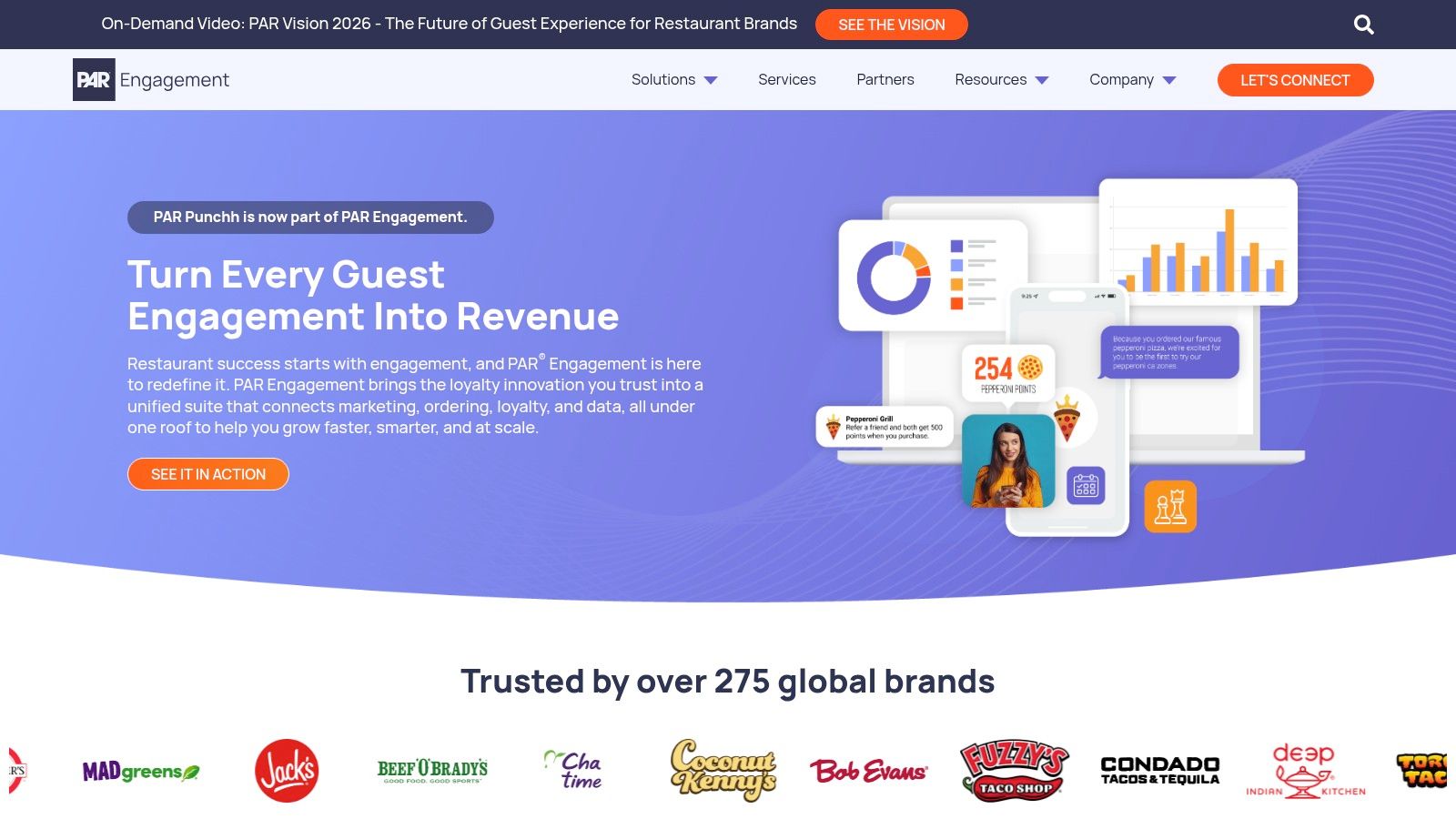
PAR Punchh, now presented as PAR Engagement, targets large restaurant brands that need loyalty to work across a complex guest journey. Customers may interact through the restaurant website, mobile app, kiosk, online ordering, or physical location, and the platform is designed to coordinate those channels.
Its feature set includes omnichannel loyalty, advanced segmentation, machine-learning capabilities, and membership or subscription modules. That makes it relevant to brands experimenting with paid benefits, recurring guest programs, or personalized offers based on customer behavior.
The operator benefit is control at scale. A large brand can set rules centrally, connect loyalty to multiple ordering environments, and give an enterprise team the documentation and integrations needed to manage a consistent program. Security, privacy, uptime, and release management matter more as the number of stores, transactions, and internal stakeholders increases.
That same scale makes PAR Punchh a poor match for a small business seeking a quick launch. A neighborhood restaurant usually doesn't need advanced segmentation, subscription logic, or a broad integration program to test whether customers will return for a reward. It needs a clear offer, a fast enrollment method, and a staff workflow that doesn't slow service.
Pricing is custom and quote-based. Prospective buyers should ask for more than a feature demonstration. Request an implementation timeline, integration responsibilities, migration assumptions, support model, data-export terms, and a clear explanation of which modules are included in the proposed package.
PAR Punchh deserves consideration when enterprise integration and long-term extensibility outweigh simplicity. It isn't the tool to choose merely because it has a long feature list. The operator must have the team, systems, and customer volume to use those capabilities without turning loyalty into another disconnected technology project.
4. Thanx
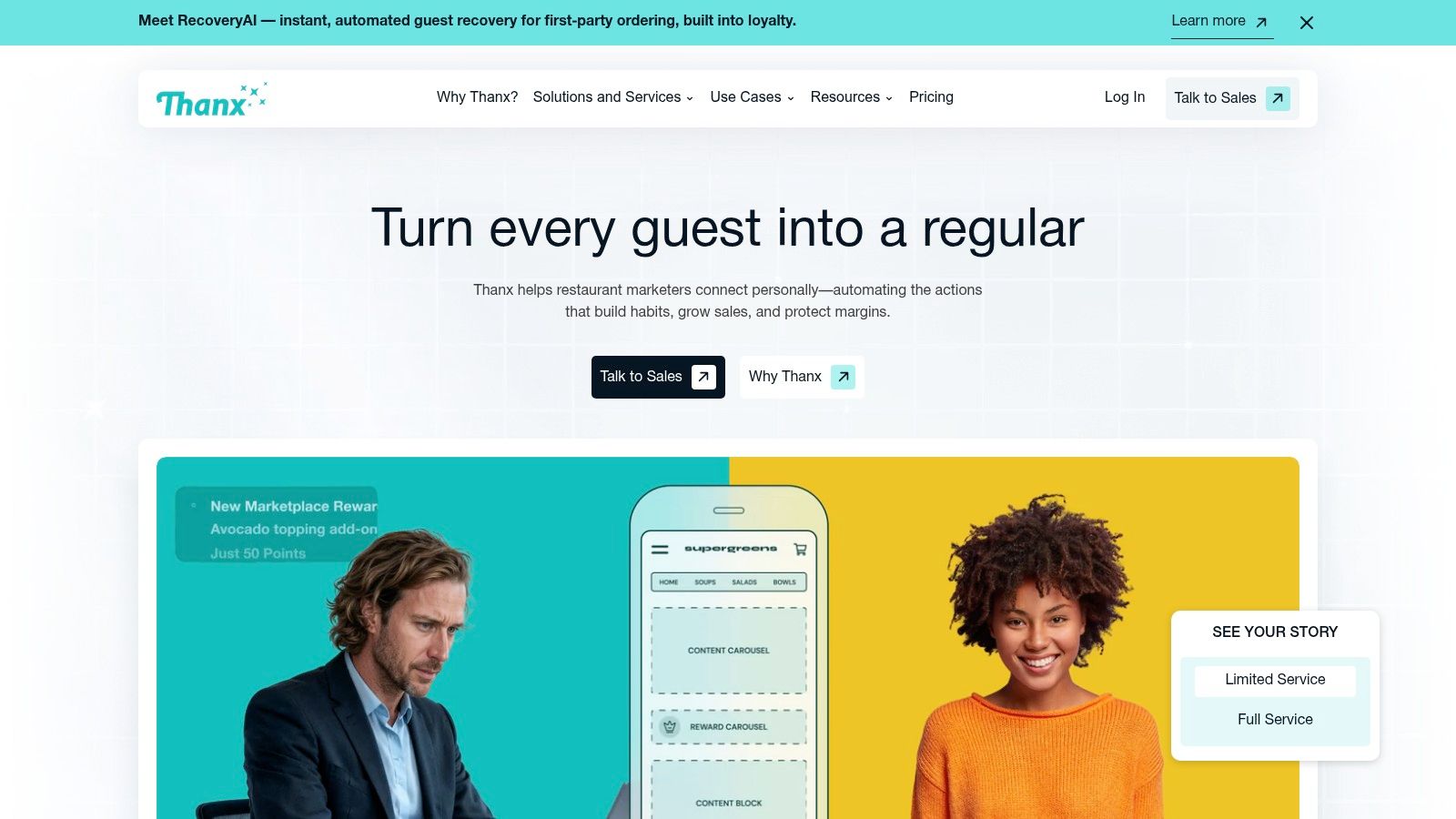
Thanx takes a different route from app-first loyalty. It emphasizes app-optional enrollment, first-party sales growth, habit-building rewards, and customer engagement without requiring every guest to download a native application.
Customers can join through QR codes, text, or the web, while the operator can still provide a branded experience. That flexibility is useful for restaurants where the loyalty moment happens quickly at the counter or drive-through. A customer who won't install an app may still respond to a simple text-based or web enrollment flow.
Thanx supports loyalty models that aren't limited to constant percentage-off promotions. Operators can design rewards intended to build habits while protecting margin, such as visit-based benefits, non-discount incentives, or offers tied to desired behaviors. That requires disciplined measurement. A reward that increases visits but trains customers to wait for discounts may not be attractive once food, labor, and offer costs are included.
The platform is also known for CRM and migration support. That makes it relevant to mid-market and enterprise brands moving away from a legacy loyalty provider. Migration is rarely just a data-transfer exercise. The operator must preserve useful customer identity, explain changes to guests, retest earning and redemption, and avoid sending duplicate or mistimed communications during the transition.
Thanx doesn't publish standard pricing, so buyers should expect a sales-led evaluation. Its typical target is a multi-unit restaurant rather than a single independent operator. The product is strongest when the brand needs guest reach without a mandatory native app, migration assistance, and analytics centered on frequency and margin protection.
For a small cafe, the main question is whether those capabilities justify the added implementation and commercial process. If the answer is no, a wallet pass or POS-native loyalty add-on may be easier to operate consistently.
5. Toast Loyalty
Toast Loyalty is the natural shortlist option for restaurants already running Toast POS. Instead of adding a separate loyalty database and trying to connect it to checkout, the operator can use Toast's existing environment for enrollment and redemption across POS, online ordering, kiosks, Mobile Order & Pay, receipts, and the Local by Toast app.
That ecosystem connection is the product's main advantage. Staff can enroll guests during a normal transaction, and the restaurant can expose loyalty at multiple digital touchpoints. Customers don't have to encounter a separate process every time they order through a different Toast channel.
Operators can configure points and multiple rewards, with POS enforcement helping apply the rules consistently. Centralized setup and operator guidance are useful for restaurants that want a controlled program rather than ad hoc discounts created at each location.
Toast Loyalty isn't a neutral add-on that works equally well with every restaurant stack. It makes the most sense if Toast already handles the core transaction and ordering workflows. If the restaurant changes POS later, portability and data migration should be part of the buying discussion. A loyalty program can become difficult to move when customer identity, order history, rewards, and messaging all depend on one ecosystem.
Pricing is an add-on subscription within Toast and varies by plan, so the operator needs a full quote rather than assuming loyalty is included in the existing POS relationship. Ask which channels are covered, whether enrollment and redemption work consistently across locations, and what staff permissions are available.
For an independent restaurant comparing a POS-native tool with a standalone dining rewards app, the choice usually comes down to integration versus channel independence. Toast wins on operational continuity for Toast users. A wallet-first tool may be more suitable when the business wants a lighter program with fewer dependencies.
A lightweight alternative is described on Loyal Customer's restaurant loyalty page, particularly for operators who want points or stamps without requiring a full restaurant technology stack.
6. Square Loyalty
Square Loyalty is designed for sellers already using Square POS or Square Online. It focuses on a straightforward launch, with enrollment available at the POS, Terminal, Register, or online, followed by automatic SMS status pages for guests.
That approach suits cafes, quick-service restaurants, bakeries, and small chains that want loyalty attached to the payment workflow they already know. Customers can participate with cash or card transactions, and operators can configure rewards based on items, percentage discounts, or cash discounts.
Expiration controls and multiple reward options give operators more flexibility than a single generic punch card. They also create more responsibility. Before launch, define whether rewards can be combined, which menu items qualify, how refunds affect balances, and what happens when a customer has multiple eligible rewards.
Square's developer APIs are useful for businesses that need a custom loyalty flow or a connection to another system. Most smaller operators won't need that flexibility immediately, but it can matter for a brand with a custom website, ordering interface, or marketing workflow.
The main limitation is ecosystem dependence. Square Loyalty offers the strongest value when Square already manages payments, POS, or online ordering. Advanced capabilities may sit behind different Square plan tiers, so the relevant cost is the complete Square setup rather than the loyalty line item alone.
Square is a practical choice for an operator who values quick setup, familiar staff workflows, SMS enrollment, and payment integration. It isn't necessarily the best answer for a business that wants wallet-native passes, a highly specialized restaurant CRM, or a platform independent of its payment provider.
A good pilot should test the entire customer path, from sign-up at checkout to balance messaging and reward redemption. If staff need to explain too many rules, simplify the program before expanding its reach.
7. SpotOn Loyalty
SpotOn Loyalty is part of a broader restaurant platform that can include POS, online ordering, reservations, waitlist management, marketing, and a branded guest app. Its strongest case is therefore not loyalty in isolation. It's the consolidation of several restaurant workflows around one customer record.
Operators can configure visit-based or spend-based earning, with redemption available in-store and online. Loyalty data can feed marketing automations and performance dashboards, allowing the restaurant to connect a reward event with subsequent communications or ordering behavior.
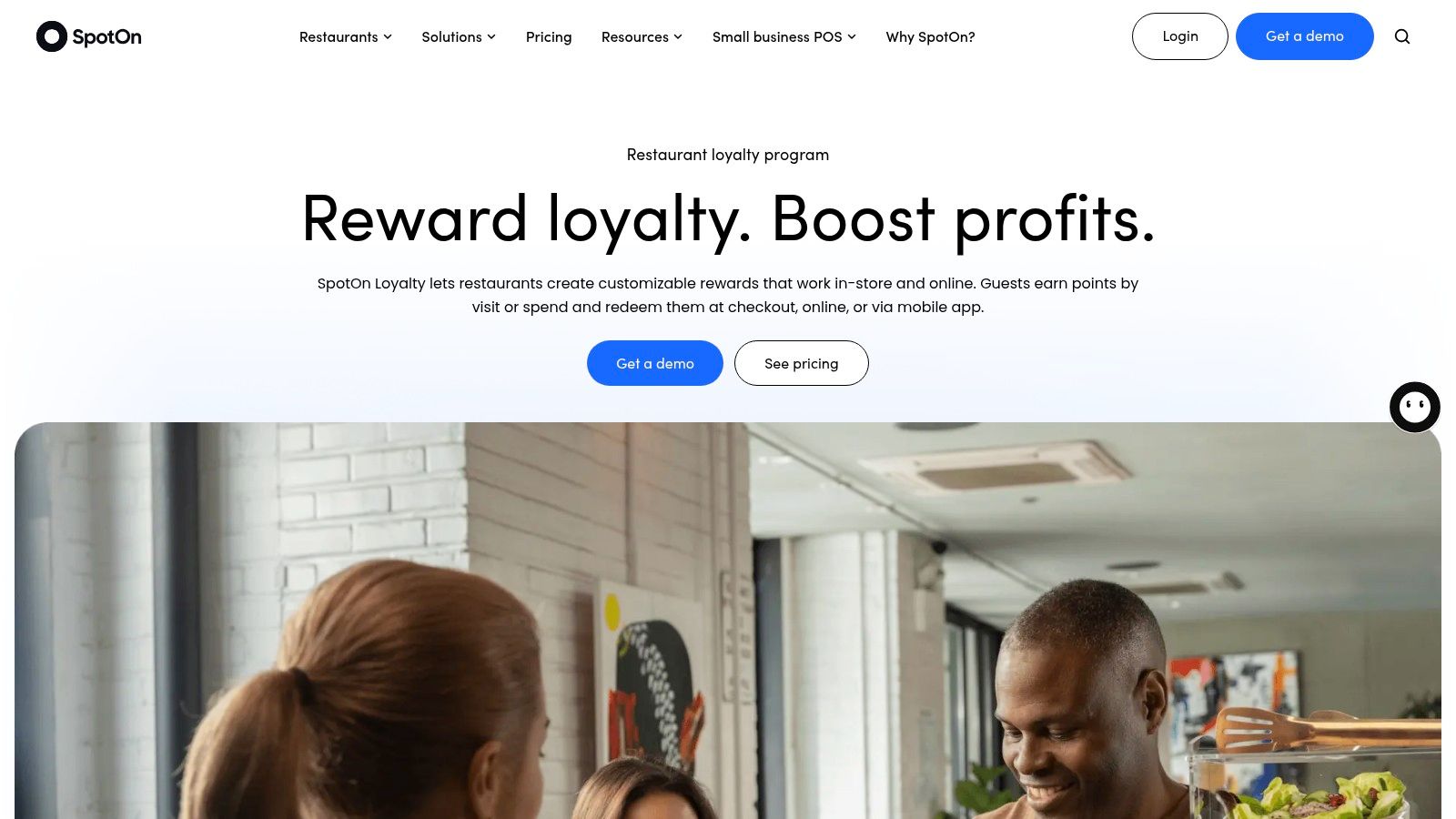
The branded ordering app is important for businesses that want loyalty and ordering in the same guest experience. Depending on the package, the app may be bundled without a separate charge, but operators should confirm the commercial terms rather than relying on a general product description.
SpotOn can reduce vendor sprawl. One provider may be easier for staff to learn and for management to support than separate systems for reservations, ordering, loyalty, and campaigns. The trade-off is that the restaurant becomes more dependent on SpotOn's product scope, packaging, and data model.
Pricing and packaging evolve and are typically quote-based. A buyer should ask for an itemized proposal covering POS, ordering, reservations, branded app access, loyalty, messaging, analytics, onboarding, and support. Otherwise, the apparent simplicity of one platform can hide the cost of adopting several modules.
SpotOn is most compelling for an operator ready to standardize on its wider restaurant ecosystem. If the restaurant only needs a basic repeat-visit reward, its broader platform may be more than the team needs. If the goal is to unify ordering, guest profiles, marketing automation, and rewards, the integrated approach deserves a closer look.
8. Incentivio
Incentivio combines a white-label app and online ordering with loyalty, CRM, email and SMS communication, and analytics. It is positioned for fast-casual and multi-unit restaurant brands that want to manage customer engagement through branded digital channels rather than a disconnected loyalty tool.
The platform supports points, tiers, and targeted offers, with earning and redemption across branded app and web ordering. Loyalty milestones can also trigger marketing automation, giving operators a way to communicate based on customer activity instead of sending the same promotion to everyone.
Its POS integrations are a significant part of the evaluation. When transaction data, ordering, loyalty, and customer communication share a reliable connection, the restaurant has a better chance of presenting accurate balances and applying rewards consistently. If the connection is incomplete, employees may need manual workarounds that undermine the program.
Incentivio's value depends on adopting its channels. A restaurant that only wants a wallet pass or a small digital stamp program may not use enough of the platform to justify implementation. A multi-unit brand with a branded ordering strategy has a stronger reason to consider it.
Pricing is custom and quote-based. Ask about POS certification, supported ordering channels, migration, app ownership, campaign controls, data export, and the process for changing reward rules after launch. The operator should also confirm which analytics are available to store managers, not only to a central marketing team.
Incentivio fits a restaurant that wants loyalty, ordering, CRM, and targeted communication in one coordinated stack. It's less suitable when simplicity and pricing transparency matter more than a broad first-party digital experience.
9. Appfront
Appfront brings together first-party ordering, loyalty, CRM, AI-assisted segmentation, and a no-code mobile app builder. Its core proposition is centralization. Instead of treating the dining rewards app as a separate feature, Appfront connects customer, transaction, ordering, and loyalty data around a branded digital channel.
Operators can configure points, tiers, cashback-style rewards, and perks, with accrual and redemption across supported channels. The no-code builder can speed up branding and app deployment for a restaurant that wants more control over its ordering experience without commissioning a custom application from scratch.
The CRM layer supports segmentation and automations, while AI-assisted tools can help coordinate retention campaigns across channels. Those capabilities are useful only when the restaurant has clean customer data and a clear communication policy. More automation doesn't fix weak identity matching, unclear reward economics, or an ordering journey that customers don't want to use.
Appfront is best when the operator is prepared to make it a primary digital channel. The restaurant needs to promote its branded app or web ordering, keep menus and offers current, and train staff to direct guests into the experience. A business that wants loyalty without changing how customers order may not capture the platform's full value.
Pricing is custom and requires contact with sales. During evaluation, ask whether the proposed package includes the app builder, ordering, CRM, loyalty, analytics, integrations, onboarding, and ongoing support. Also clarify how the restaurant can export customer and transaction data if its technology strategy changes.
Appfront is a strong consideration for digital-first restaurant brands seeking branded ordering and coordinated personalization. It's a less natural choice for a small operator whose main need is a simple pass or stamp card that customers can use without installing another application.
10. Fivestars by SumUp
Fivestars, now associated with SumUp, takes an SMB-oriented approach to loyalty and marketing. It combines turnkey rewards with text-to-join enrollment, automated campaigns, merchant reporting, and a consumer discovery network through the Fivestars app.
That discovery component distinguishes it from a pure app-less loyalty tool. A cafe, quick-service restaurant, or local retailer may gain a way to reach consumers beyond its own existing customer list, while the merchant dashboard tracks sign-ups, redemptions, and campaign performance.
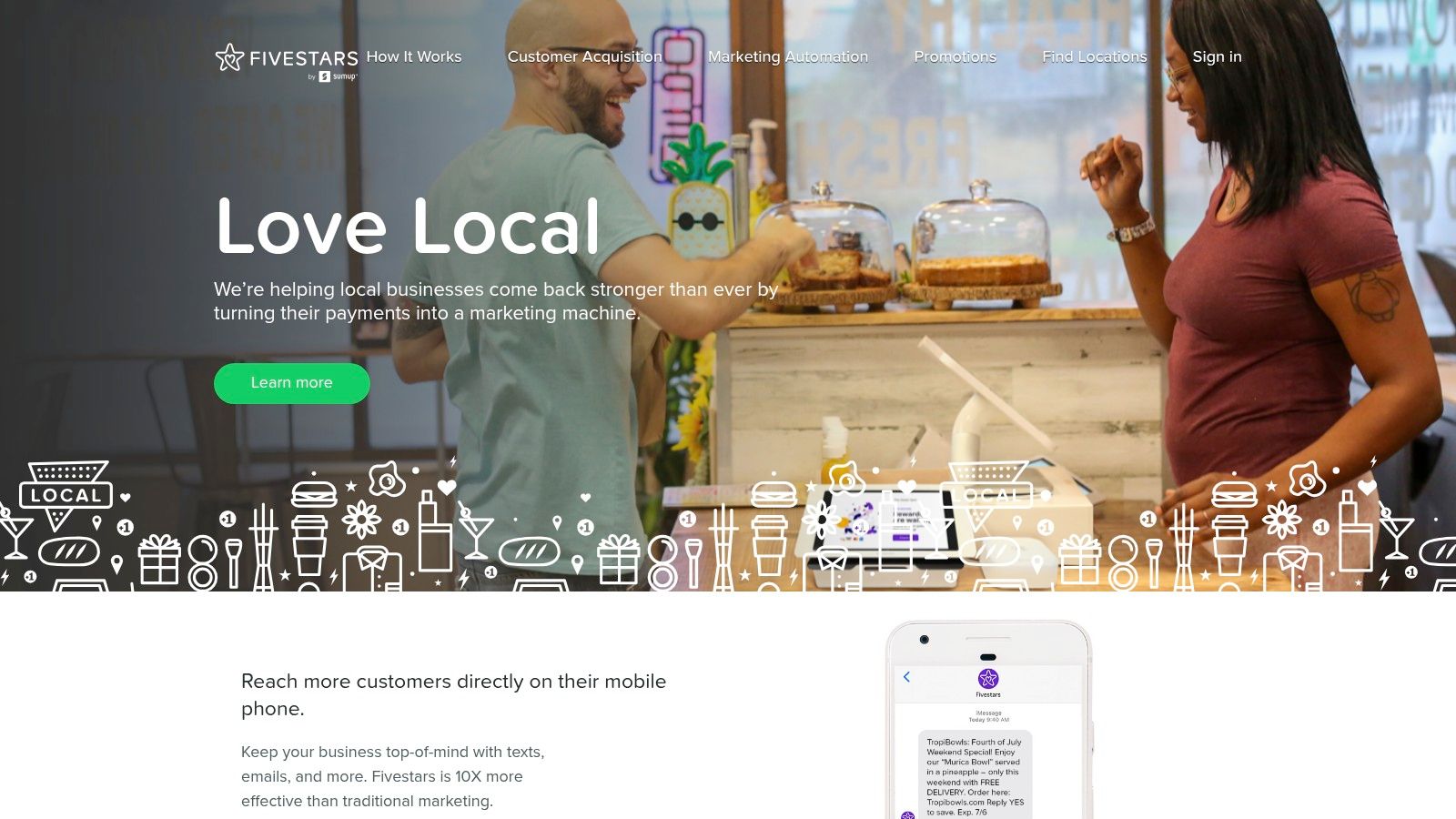
Text-to-join can reduce the work required at the counter. Staff can invite a guest to enroll without explaining a long setup process, and autopilot campaigns can keep communication active after the initial sign-up. The operator still needs to control message frequency and offer quality. Automated outreach that feels repetitive or low-value can lead customers to ignore future messages.
Fivestars integrates with SumUp payments and supports cross-channel communication. That makes it more attractive to an independent business already using SumUp or looking for a packaged loyalty and marketing solution. Pricing is flexible and requires a sales conversation, so operators should request a clear breakdown of subscription, messaging, payment, campaign, and onboarding costs.
The consumer-app focus may not suit a brand that specifically wants a wallet-native, app-less model. Some operators will value the discovery network, while others will prefer a loyalty credential that belongs entirely to their own brand and customer experience.
For a local business comparing a consumer network with a standalone wallet pass, this guide to digital punch cards explains the operational difference between a familiar visit-based reward and a broader marketing platform. Fivestars is most appropriate when customer acquisition and automated messaging matter alongside repeat visits.
Top 10 Dining Rewards Apps Comparison
| Solution | Core features | ★ UX & quality | 💰 Price / value | 👥 Target audience | ✨ Unique selling point |
|---|---|---|---|---|---|
| 🏆 Loyal Customer | Points & digital stamp cards, Apple/Google Wallet passes, phone-based admin, QR/OTP onboarding | ★★★★☆ mobile-first, wallet-native | 💰 $12/mo or $120/yr (up to 100 customers); free trial | 👥 Micro & small consumer-facing businesses (cafes, salons, bakeries, gyms) | ✨ Wallet-native passes + fast phone setup; low friction launch |
| Paytronix | Configurable loyalty, online ordering, stored value, messaging | ★★★★★ enterprise-grade | 💰 Quote-based (enterprise) | 👥 Multi‑unit & enterprise restaurants / c‑stores | ✨ Deep customization + integrated ordering & messaging |
| PAR Punchh (PAR Engagement) | Omnichannel loyalty, ML segmentation, memberships, enterprise integrations | ★★★★★ built for scale & security | 💰 Custom pricing / quote | 👥 Large restaurant brands & enterprises | ✨ ML-powered segmentation & membership modules |
| Thanx | App‑optional joins (QR/text/web), CRM, habit-forming rewards, analytics | ★★★★★ strong guest reach without forcing an app | 💰 Not public / quote | 👥 Mid‑market & enterprise restaurants | ✨ App‑less enrollment + migration support from legacy vendors |
| Toast Loyalty | POS-integrated loyalty, multi‑reward programs, checkout sign-up | ★★★★☆ seamless if on Toast POS | 💰 Add‑on subscription within Toast (varies) | 👥 Restaurants already using Toast POS | ✨ Native POS enforcement & multiple guest touchpoints |
| Square Loyalty | POS/Terminal enroll, SMS status pages, multi‑reward options, APIs | ★★★★☆ quick to launch for Square users | 💰 Add‑on (best value if on Square); tiered features | 👥 Cafes, QSRs, small chains using Square | ✨ Fast launch + SMS enrollment & developer APIs |
| SpotOn Loyalty | Visit/spend earning, in‑store & online redemption, marketing automations | ★★★★☆ cohesive ecosystem for operators | 💰 Quote-based; better value with SpotOn bundle | 👥 Operators standardizing on SpotOn (restaurants) | ✨ Branded ordering app + built-in marketing automations |
| Incentivio | Points/tiers, white‑label app & ordering, CRM, analytics, POS integrations | ★★★★☆ strong multi‑unit support | 💰 Quote-based / custom | 👥 Fast‑casual & multi‑unit brands | ✨ White‑label app + certified POS integrations & journey analytics |
| Appfront | Flexible loyalty, centralized CRM, AI segmentation, no‑code app builder | ★★★★☆ AI-assisted personalization & fast branding | 💰 Custom pricing (contact sales) | 👥 Brands wanting first‑party app + CRM | ✨ No‑code app builder + AI for retention orchestration |
| Fivestars (by SumUp) | Turnkey loyalty, text‑to‑join, merchant dashboard, consumer discovery app | ★★★★☆ SMB‑friendly with large local reach | 💰 Flexible packages; contact sales | 👥 SMBs, local cafes, QSRs & retailers | ✨ Consumer discovery network via the Fivestars app for local reach |
Match the Platform to the Restaurant's Next Stage
The best dining rewards app is the one your team can operate consistently and your customers can understand at checkout. A loyalty engine won't compensate for a confusing enrollment process, unreliable reward balances, or staff who have to leave the POS workflow to verify every redemption.
Start with the merchant model. A small cafe, bakery, takeaway, salon, or independent shop usually needs a program that can launch quickly, work on common phones, and avoid adding another app to the customer's device. For that operator, a wallet-first tool such as Loyal Customer is a sensible starting point. It supports points and digital stamps, runs through Apple Wallet and Google Wallet, and offers a clearly listed entry plan with a free trial.
A wallet-native model also responds to a broader shift in customer behavior. A mobile wallet loyalty report says 64% of 18-to-34-year-olds prefer storing loyalty cards on smartphones, while a DACH survey cited in the same research found that 43.2% of respondents named always having their smartphone with them as the main reason for switching to a digital loyalty card. Those figures support testing wallet delivery when the business wants less enrollment friction, though they don't remove the need for a clear reward.
If the restaurant already runs Toast or Square, start with the native option. Toast Loyalty makes the most operational sense for a Toast restaurant that wants loyalty across POS, ordering, kiosks, and Mobile Order & Pay. Square Loyalty is similarly practical for a Square operator seeking SMS enrollment and reward configuration inside the existing payments environment. The trade-off is portability. A restaurant that later changes its POS should understand how customer identities, balances, and historical data will move.
Choose SpotOn, Incentivio, or Appfront when loyalty is only one part of a larger digital transformation. These platforms become more valuable when the restaurant wants ordering, CRM, marketing automation, branded apps, and customer analytics to work together. They also demand more commitment. The operator needs a channel strategy, a data owner, implementation time, and people responsible for campaign governance.
For larger multi-unit brands, Paytronix, PAR Punchh, or Thanx may justify a sales-led implementation. Their strengths include deeper configuration, enterprise integrations, migration support, segmentation, omnichannel engagement, and broader ordering or messaging capabilities. They're not automatically better for every restaurant. Their quote-based pricing and implementation burden need to be weighed against the revenue, operational, and reporting problems they are intended to solve.
The business case should focus on repeat behavior, not registration totals alone. An operator ROI guide from Paytronix reports average program ROI between 4.8x and 5.3x, members visiting 20% more frequently, and spending 38% more per visit than non-members. It also reports that loyalty members account for 39% of U.S. restaurant visits, approximately double the level cited for 2019, and that 67% of restaurants have launched loyalty programs. These are industry-level figures, not a forecast for your restaurant. Use them as context, then measure your own incremental visits, average order value, redemption cost, and margin.
Personalization deserves similar caution. A restaurant loyalty software comparison guide says behavioral triggers and predictive churn models can produce redemption rates up to 35% higher than traditional segmentation. It also reports that more than half of consumers prefer managing no more than five loyalty accounts, and that nearly 70% say loyalty programs help them manage costs, while one-third use them more often because of economic pressure. The practical implication is simple. Your program must earn a place in the customer's routine by offering clear value without creating another low-value account or an endless stream of promotions.
Before signing, check these points:
- POS and ordering compatibility: Confirm where customers can enroll, earn, and redeem, and test refunds, split payments, online orders, kiosks, and multiple locations.
- Reward economics: Set the earning rate, reward threshold, exclusions, expiration, stacking rules, and margin guardrails before launch.
- Enrollment method: Compare wallet pass, SMS, QR code, web, and native app flows. Count the steps from invitation to usable loyalty credential.
- Staff workflow: Make sure employees can identify a member and apply a reward without slowing service or relying on an undocumented workaround.
- Customer limits: Check whether the plan caps members, locations, transactions, campaigns, or stored data.
- Analytics needs: Define the reports required for repeat visits, redemption, customer frequency, average order value, and campaign profitability.
- Data ownership: Ask who owns customer records, how data can be exported, and what happens if the restaurant changes vendors.
- Pricing structure: Separate subscription, onboarding, messaging, integrations, payment, app, and support charges.
- Rollout testing: Pilot the program with staff and a small customer group, verify every reward path, and adjust the offer before promoting it widely.
The choice should follow the restaurant's next stage, not the most impressive demo. A single-location operator often wins with less software and faster adoption. A growing brand may need integrated ordering and CRM. An enterprise may need migration support, segmentation, and governance. Match the platform to the systems, staff, and customer behavior you can support today, while keeping a realistic path for tomorrow's requirements.
Loyal Customer gives cafes, restaurants, takeaways, and other small operators a phone-managed points program or digital stamp card with Apple Wallet and Google Wallet passes, without requiring a customer app download. Start with the free trial to test enrollment and redemption, then visit Loyal Customer to see whether its lightweight dining rewards app fits your next loyalty launch.