It's 8:15, the line is three deep, and the guest at the register is digging through a bag for a paper punch card that's probably at home. Your barista offers a new card, the guest sighs about the six stamps already earned, and the queue stalls over a free drink that was supposed to build goodwill. This is the true test for any coffee shop loyalty app. It doesn't fail in a feature list. It fails at the counter, during a rush, when staff and guests need something fast.
Build your program around that moment. Choose a format a new hire can explain in one sentence, a reward guests can reach, and a pass they don't have to hunt for. Then measure whether it creates extra visits, not just extra discounts.
Table of Contents
- Digital Stamps or Points for Your Café
- Design Principles for a Café Loyalty Card
- Setting the Reward Threshold That Brings Guests Back
- Why Wallet Passes Beat Paper Cards and Standalone Apps
- Customer Loyalty and Staff Recognition Use Cases
- KPIs to Track Whether Your Loyalty App Pays Off
- How to Launch Your Coffee Shop Loyalty App
- Start Your Coffee Shop Loyalty App Today
Digital Stamps or Points for Your Café
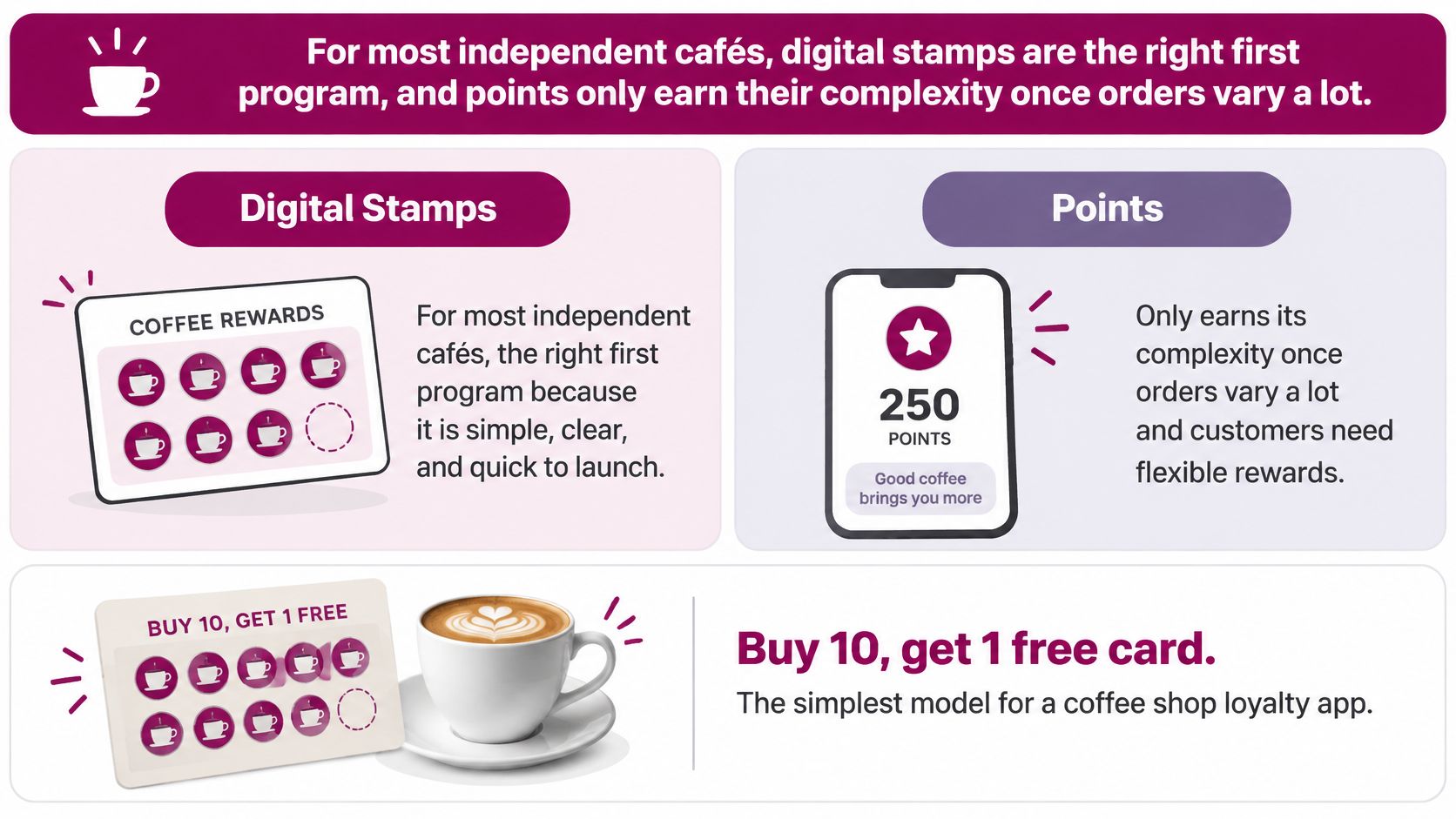
For most independent cafés, I recommend digital stamps as the first program. Points only earn their complexity once orders vary a lot. A stamp card rewards the behavior you want most in coffee, another visit, and it asks almost nothing of staff or guests during a rush.
Start with buy 10, get 1 free. One stamp per paid coffee, the eleventh drink free. According to independent loyalty guidance from joe.coffee, the eleventh coffee free after ten paid coffees creates an effective reward of approximately 9.1% of the eleven-coffee sequence, and eight to ten purchases for a free coffee is the standard range. Guests grasp that math instantly because they already know how a punch card works. There's no exchange rate to teach and no balance to convert at the till.
Digital stamps and points compared for a coffee shop
| Criterion | Digital stamps | Points |
|---|---|---|
| Best fit | Single drinks bought often | Varied tickets and spend-based rewards |
| Earning rule | One stamp per checkout | Points per spend or per item |
| Typical reward | Free drink after 10 stamps | Points redeemed for a drink or item |
| Staff work at checkout | One tap to add a stamp | Calculate and check the balance |
| Customer understanding | Immediate, everyone knows a stamp card | Needs a short explanation |
My rule of thumb is simple. Stamps are easy to track, and a frequent guest gets a timely reward without waiting to decode a points balance. You can set a target of 3 to 10 stamps, choose a stamp icon such as a star, coffee, gift, check or heart, and give one stamp per checkout with a reward when the card is full. That same setup works beyond cafés too, for restaurants, hair salons, retail stores, bakeries, gyms, spas, grocery stores, and Instagram and WhatsApp sellers, but coffee suits it best because the purchase itself repeats so naturally.
When points actually win
Points win when a single ticket regularly mixes price points. Say one guest buys a drip coffee, another buys a latte, a pastry and a bag of beans. A stamp treats both visits as equal, while points per spend reward the second guest fairly and let you push specific categories, like beans on a slow retail week. Points also work if you want several reward levels instead of one free drink.
That flexibility costs you at the counter. Staff have to check balances, guests ask what their points are worth, and someone will want to split a redemption mid-line. Don't pay that cost unless varied tickets are your norm.
Counter test: If your barista can't state the earning rule while pulling a shot, the program is too complicated for a rush.
Choose with three questions. How often do guests return? Frequent, drink-led visits point to stamps. How varied is a typical order? Wide ticket variation points to points. How much time can checkout absorb? If the answer is almost none, stamps win again. Most small cafés land on stamps, and that isn't settling. It's matching the tool to the queue.
Design Principles for a Café Loyalty Card
Design choices get tested at 8 a.m., when six guests are waiting and one is holding up a phone. Four rules hold under that pressure.
1. One earning rule, stated in one breath. One stamp per paid coffee is a rule a barista can recite mid-pour. If it takes a second sentence to explain, simplify it before launch.
2. A reward guests can reach. A card that takes months to fill loses people before it changes a single habit. Reachable depends on visit frequency, so set the distance around your real regulars.
3. The balance on the pass itself. A Federal Reserve Bank of Boston analysis of 2016 mobile-payments data found that only 13% of consumers used mobile wallets for in-store purchases, and it examined whether loyalty rewards could drive wallet adoption. The design lesson holds: a guest who sees their stamp count at the moment they pay has a reason to keep the pass installed. The barrier has since moved. In the Fiserv Gift Card Gauge 2025 survey, 90% of consumers used a digital wallet in 2025, while 53% of nonusers had never set one up, so setup friction is now what your design has to clear. A clean layout matters here, which makes Apple Wallet pass design basics worth reviewing before launch.
4. Measurement from day one. Record each purchase with its date and amount so recency, frequency and spend are calculable later. A wallet pass is an adoption tool, and adoption is measurable: count how many guests add the card, then compare their return rate against nonmembers.
Setting the Reward Threshold That Brings Guests Back
Set the threshold against the calendar, not your gut. A reward reachable within two to four weeks completes far more often than one that takes months. In a study of 23,296 stamps across 1,013 small businesses, 11.4% of cards whose reward was reachable within two to four weeks were completed, compared with 4.0% for cards taking eight to 16 weeks and only 0.8% for cards requiring 32 or more weeks.
Ten stamps isn't right or wrong on its own. It's right for the guest who reaches it quickly and wrong for the guest who needs a season. Match the card to the visit pattern you serve.
Time to reward by visit pattern
| Visit pattern | Time to 10 stamps | Recommended card |
|---|---|---|
| Most workdays | About 2 weeks | 10 stamps |
| Three times a week | About 3 to 4 weeks | 10 stamps |
| Once a week | About 10 weeks | 5 stamps |
| Twice a month | About 5 months | Milestone reward instead of a stamp card |
A workday regular hits ten stamps in about two weeks, so the full card creates momentum without feeling distant. A three-times-a-week guest still finishes in three to four weeks, which sits inside the range where completion holds up. A weekly guest needs about ten weeks for ten stamps, so cut that card to five. A twice-a-month guest won't finish either version soon enough to care, so give that group a milestone reward or a win-back offer instead. If you want more structures to test, browse stamp card ideas for different visit patterns and pick one you can run cleanly.
You can set the target anywhere from 3 to 10 stamps, with one stamp per checkout and the reward redeemed at checkout when the card is full. Before you lock it in, check the cost of the free drink, coffee, milk, cup and labor, against the margin from the visits the card needs to create. The reward doesn't have to be the cheapest drink on the menu, but it can't cost more than the extra visits return.
Then run this test. Count how many issued cards reach the reward within four weeks. If that number stays low, your threshold is too high for your visit pattern, no matter how standard ten sounds. Lower the target and measure again.
A generous reward nobody reaches is not generous. It is invisible.
Why Wallet Passes Beat Paper Cards and Standalone Apps
The forgotten card is the whole problem. A guest reaches the register, pats two pockets, and admits the punch card is in another jacket. Staff issue a replacement to keep the line moving, and the stamps on the original card are effectively gone. Most guests forget paper cards at some point, and every reissue tells them their progress doesn't really count.
As Voqado's punch card design guide puts it, paper punch cards create a practical checkout problem because customers may forget or lose them, forcing staff to issue replacement cards and potentially losing the existing progress record. Digital wallet passes fix that specific failure by keeping the credential on the phone, and they reduce adoption friction compared with a separate app download.
Three delivery methods at the counter
Paper cards cost little and need no setup, but they're anonymous, easy to lose and easy to fake. You get no record of who your regulars are. A standalone app gives you rich data and ordering options, but every guest has to find it, download it, create an account and remember a password, all for a neighborhood café they may visit twice a month. Most won't bother, and I don't blame them.
A wallet pass sits in Apple Wallet or Google Wallet, which guests already have. With Loyal Customer, for example, a guest visits your unique link, verifies their phone with a one-time code, and adds the card directly to Apple or Google Wallet, with no app to install. We run the stamp card or points program from a phone, with no hardware and no app for customers. At the counter, staff scan the card or search by name and add the stamp in one tap, and the pass updates itself after every visit so the guest sees new progress right away.
Where wallet passes fall short
Be honest about the limits. A guest with an older phone, a dead battery or no wallet set up needs a fallback, so keep phone-number or name lookup as the backup and train staff to use it without sighing. A pass also doesn't create engagement by itself. If the reward isn't visible on the pass and the threshold feels far away, the pass becomes another forgotten card, just a digital one.
There's also a discovery gap. Guests don't browse their wallet the way they open apps, so your counter signage and your barista's one-line ask do the reminding. The pass reduces friction, it doesn't replace the invitation.
My rule is this. Choose the method a guest can use at the counter without help, while holding a coffee, with three people behind them. For an independent café, that's a wallet pass with a lookup fallback.
Customer Loyalty and Staff Recognition Use Cases
A coffee shop program can serve two groups, and most guidance only covers one. Guests come first, for good reason. In 2024, 96% of restaurant, coffee-shop, snack-place, and deli loyalty-program participants said membership was a good way to get more value for their money, according to the National Restaurant Association. Guests already believe in the exchange. Your job is aiming it at the right behavior.
Guest use cases worth running
- Second-visit push: Give a new guest a clear reason to return soon, while the first visit is still fresh and a habit hasn't formed yet.
- Win-back offer: Target regulars who've gone quiet with a small, time-bound reason to come back before they've settled into another café's routine.
- Milestone reward: Recognize high-frequency guests at a visit count that matters, so your best customers feel known rather than just enrolled.
- Spend-based reward: Use points where tickets vary, so the guest adding beans and pastries earns faster than the guest buying a single drip.
Don't send the same offer to all four groups. Segment guests by recency, frequency and monetary value, calculating recency as days since the last purchase, frequency as visits in a fixed window such as 30 days, and monetary value as average spend. A frequent low-spend guest fits a visit-based stamp reward, while an occasional high-spender may respond better to a points bonus tied to a second visit within seven days. Research on takeaway-food customers in a Springer chapter on RFM analysis combined RFM with k-means clustering to group customers and develop retention campaigns, and that modeling approach transfers well to a café list once you have clean transaction records.
Staff recognition without mixing the books
The same points logic works for staff. Award points for behavior you want repeated, training a new barista, a clean close, covering a shift at short notice, or a menu suggestion that sells. Let staff redeem for a shift swap, a free drink or first pick of a holiday slot.
Ledger rule: Keep staff points in a separate ledger. Never mix employee balances into your customer list, or your guest numbers stop meaning anything.
A guest loyalty tool is built for customers, so treat staff recognition as a parallel system with its own rules, not a side balance on the café card. Launch the guest program first. Add staff points only once the guest card runs cleanly at the counter, because debugging two behaviors at once teaches you nothing about either.
KPIs to Track Whether Your Loyalty App Pays Off
A stack of new wallet passes on day one feels like a win. It is not one yet. The figure that matters is whether members visit more than they would have without the program, because a card can collect installs while discounting visits that were coming anyway. Contribution margin and retention are the numbers to report to yourself, even when enrollment and redemption counts look better on a dashboard.
Six loyalty KPIs and how to calculate them
| KPI | Formula | Read-out |
|---|---|---|
| Pass issuance to first redemption | Cards redeemed within 30 days divided by cards issued | Shows whether guests reach the reward |
| Active members per 30 days | Members with a visit in the last 30 days divided by enrolled members | Shows whether the program is in use |
| Incremental visits | Member visits minus control-group visits per guest | Shows whether the reward changes behaviour |
| Average ticket | Member spend per visit compared with non-member spend | Shows whether members spend more when they come |
| Reward cost | Reward value divided by incremental revenue | Shows whether the reward pays for itself |
| Reward-day visit share | Share of member visits that happen only on offer days | Shows discount dependency |
Two of these get decided at the counter, not in a report. Pass issuance to first redemption tells you whether the join flow during a rush turns a queue into returning guests. Reward-day visit share tells you whether the program earns its keep or just reschedules visits you already had.
Now the caveat every operator should keep in view. Circana data reported in 2025 and discussed in Deloitte's loyalty research found that restaurant loyalty members made 22% more visits per year than nonmembers, while Deloitte's survey of 5,564 U.S. loyalty members found that 72% were more likely to spend with a preferred brand and 56% increased spending because of a program. Those figures describe who joins more than what the program causes. Frequent customers enroll first, so part of that uplift arrives with them.
The fix is a baseline. Keep a control group of guests who get no special offer, or run a reward push on set weekdays only, then compare visits and average ticket against it. If member visits cluster on offer days and drop elsewhere, the program is buying timing rather than loyalty, and the answer is a higher threshold or a different reward, not more promotion.
Before launch, run your numbers through our free Loyalty Program ROI Calculator so the reward cost target is set before the first stamp goes out. Then review the table every four weeks. Our customer list shows every guest in one place, with points balance or stamp progress, full transaction history and last visit, so the 30-day activity and redemption checks can be made from one view.
Judge the program on one question each month. Did members make profitable, incremental visits after reward cost? If yes, scale it. If visits rose but margin fell, fix the threshold or the reward before you enroll another guest.
How to Launch Your Coffee Shop Loyalty App
You can finish this in a week if you resist adding mechanics. The visual below condenses the launch into its three core moves, and the numbered steps after it give you the working detail.
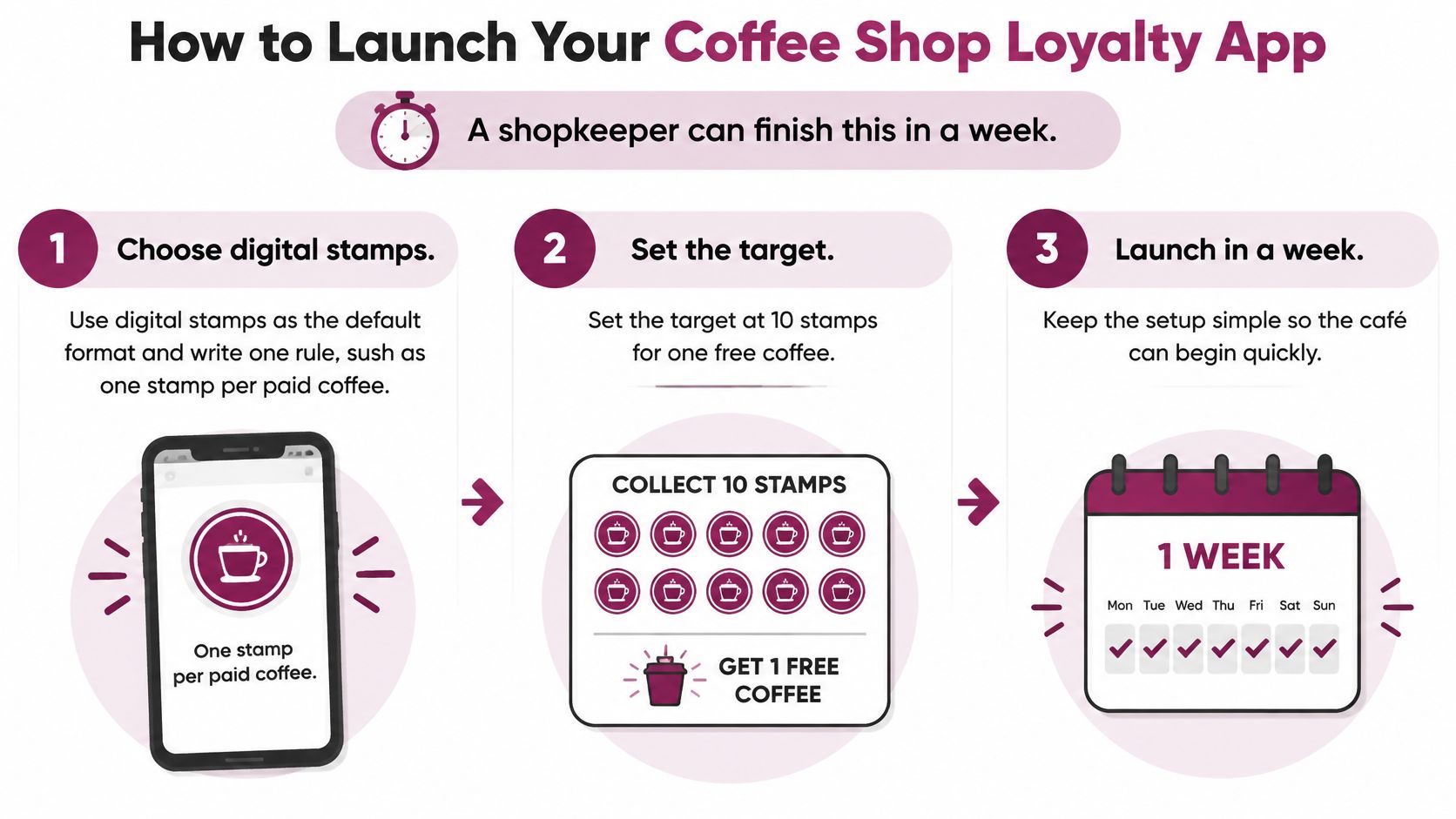
- Choose digital stamps and write one rule. One stamp per paid coffee is enough. A single rule is what makes the one-tap counter routine possible.
- Set the target and one reward. Use 10 stamps for frequent guests or five for weekly guests, with a free drink as the reward. The common slip is setting the target against your best regular instead of your typical guest.
- Build the card and preview the pass. You can build the card in a few minutes, choosing the stamp icon and reward text, then preview how the Apple Wallet or Google Wallet pass will look before anyone joins.
- Put the link where guests already wait. Each business gets a unique public link to a branded web page where customers download their card without an app. Place that link and a QR code at the register and the pickup counter, not by the door where nobody stops.
- Brief staff on the routine. Scan the card or search by name, add the stamp, redeem at checkout. Skipping this briefing is the slip that sends staff back to paper cards out of habit during the first busy morning.
- Start the free trial. The 7-day free trial starts when the program is launched, and the plan can be cancelled at any time, so launch when staff are briefed rather than burning trial days on setup.
- Review the first two weeks. Check pass issuance and first redemption each week with the KPI table open, then keep or adjust the threshold based on what guests did.
If you want to see the setup flow before you brief staff, this short walkthrough shows the card and checkout steps end to end.
A working launch on day 14 doesn't mean hundreds of members. It means cards issued every day, at least a first redemption or clear progress toward one, and staff running the scan, stamp and redeem routine without prompting. If the routine holds during a rush, the program has a foundation. If it doesn't, fix the counter step before you touch the reward.
Start Your Coffee Shop Loyalty App Today
The decision is straightforward. Launch digital stamps with a buy 10, get 1 free card, delivered as an Apple Wallet or Google Wallet pass, and review your KPIs at four weeks. Change that default in one case only, a shop with varied tickets where a latte, a pastry and a bag of beans regularly share one order. That shop should start with points.
Loyal Customer is built for this setup. One plan covers up to 100 customer slots, with a custom onboarding page, branded digital loyalty card design, a choice of points program or stamp cards, unlimited offers, discounts and stamp rewards, Apple and Google Wallet integration, QR code scanning at checkout, and email support. Before you launch, use our free Loyalty Program ROI Calculator to estimate reward cost against your margin, and make counter signage with the free Branded QR Code Generator. Our free tools also include a Google Review Link & QR Maker, a Punch Card Template Builder, and a Nail Salon Service Menu & Price List Maker.
The 7-day free trial can be cancelled at any time. Use the first two weeks of data to decide whether ten stamps stays or drops to five. Start the trial this week, brief your staff on the one-tap routine, and open the KPI table on day 14.
Start your coffee shop loyalty app with a buy 10, get 1 free digital stamp card that lives in Apple Wallet and Google Wallet, so guests join from your counter link without downloading another app and staff add stamps in one tap during the rush. Loyal Customer lets you build that card in minutes, test it on a 7-day free trial, and check pass issuance, redemptions and last visits from one customer list. Visit us this week, launch with ten stamps, and let your day-14 numbers decide whether the threshold stays or drops to five.