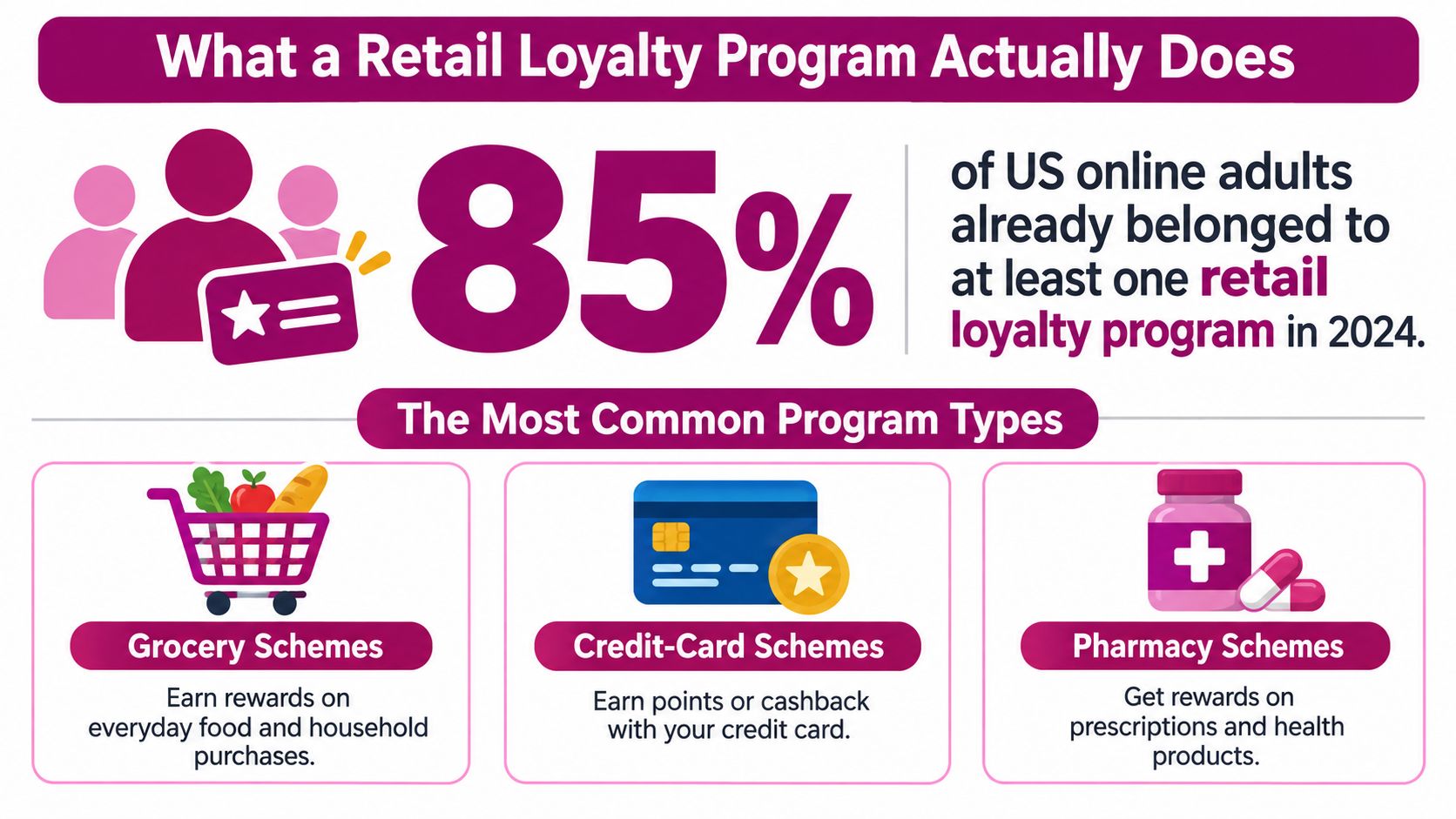
85% of US online adults already belonged to at least one retail loyalty program in 2024, according to Forrester's Consumer Benchmark Survey. Another sign-up form isn't much of an advantage. The useful question is whether your reward gives customers a reason to return, and whether you still make money when they do.
Table of Contents
- What a Retail Loyalty Program Actually Does
- Points Versus Stamps for Retail Merchants
- Loyalty Examples Across Retail Formats
- How to Set Up a Program Customers Will Use
- Judge Loyalty by Active Use and Margin
- Choose Points or Stamps and Launch
What a Retail Loyalty Program Actually Does
Think of a loyalty program as a punch clock for goodwill. Customers can see that their purchases count toward something, rather than hoping the store remembers them. Points track spending; stamps track qualifying visits or purchases.
Say a bakery has dependable morning regulars but loses occasional customers to the cafe next door. A visible reward can influence that choice when both shops are convenient. It won't rescue stale pastries, slow service, or an unfriendly counter, but it can give a satisfied shopper another reason to choose the bakery.
The membership picture makes the starting point clear.
Make the next visit worth choosing
High-frequency retailers have frequent opportunities to influence the next purchase. Grocery stores, cafes, pharmacies, and convenience shops serve customers whose needs recur, so a useful reward can enter an existing routine. The merchant doesn't have to manufacture a new reason to buy the underlying product.
The reward still needs to be understandable. In its 2024 survey of more than 9,800 consumers across the United States, United Kingdom, India, and Brazil, Deloitte found that 86% rated financial rewards, simplicity, and ease of use as important or very important.
Practical rule: A cashier should be able to explain what customers earn and how they redeem it before finishing the transaction.
That means showing progress, stating exclusions plainly, and making redemption part of checkout rather than a separate administrative task. A customer who has to search through messages to discover what a reward means hasn't received a convenient benefit.
Separate recognition from behavior change
A reward can thank a regular without generating an additional purchase. That may serve a relationship objective, but it's different from growing profitable visits.
For a customer loyalty program in the retail industry, the commercial job is specific: encourage a return, a larger qualifying basket, or a worthwhile category purchase. Choose the model around that behavior, make participation easy, and judge the result after paying for the reward.
Points Versus Stamps for Retail Merchants
| Criterion | Points program | Stamp card |
|---|---|---|
| Earn rule | Points per dollar or by spend tier | One stamp per visit or qualifying purchase |
| Reward shape | Free item, fixed discount, or percent off at a point threshold | Free item or set reward after a stamp count |
| Basket fairness | Larger baskets earn more | Large and small qualifying baskets get the same stamp |
| Customer effort | Balance and threshold to track | Visible progress, no conversion math |
| Best retail fit | Grocery, convenience, multi-category, and variable tickets | Cafe, bakery, sandwich shop, or salon with similar visits |
| Fraud and loss | Server-held digital balances resist paper-card forgery, but staff access still needs controls | Paper cards can be lost, over-stamped, or copied |
| Flexibility | Category bonuses and caps are practical | Tiers and variable offers are awkward |
| Main risk | Outstanding points create a reward obligation and can train discounting | Under-rewards the biggest spenders |
Stamps keep the promise visible
A stamp answers a straightforward question: how much closer am I to my reward? Customers don't need to convert a balance into spending power. Staff can explain the arrangement while handing over a coffee or booking the next appointment.
That makes stamps a sensible starting point when transactions look alike and the objective is visit frequency. Define a qualifying purchase carefully, though. Otherwise, shoppers may split a basket into separate transactions, or staff may disagree about whether a small add-on earns another mark.
Paper introduces its own controls problem. A familiar customer may receive an extra stamp as a favor, while another employee replaces a supposedly lost card without checking anything. Digital records remove the physical copying problem, but managers still need clear rules for adjustments and reversals.
The limitation is basket fairness. A customer buying for a group may contribute far more gross margin than someone buying a snack, yet receive identical progress. If those bigger orders matter to your business, a visit-only rule can feel ungenerous.
Points recognize spending but need boundaries
Points make more sense when the till sees a wide spread of basket values. They let the merchant recognize spending without pretending every transaction is equivalent. They can also support a targeted category incentive rather than a storewide price cut.
The trade-off is explanation. Customers need to understand both how points accumulate and what they buy. A large-looking balance isn't useful if the reward remains remote or its value is unclear.
Before launch, specify whether points apply before or after discounts, which products qualify, and what happens after a return. Decide whether customers earn points on the part of a purchase paid with a reward. Leaving those decisions to individual cashiers creates inconsistent treatment and avoidable leakage.
A clever earn rule isn't an advantage if staff have to explain it again at every visit.
Don't choose points because a future tier ladder sounds impressive. Choose them because the transactions you already process justify spend-based earning. Likewise, don't choose stamps merely because the card looks familiar.
Program migration deserves attention before customers accumulate balances. For our service, each business runs one program, and its type can't change after launch. Match the dominant transaction now rather than planning around a hypothetical expansion.
Similar tickets and a frequency goal: start with stamps.
Mixed basket sizes or category incentives: start with points.
Loyalty Examples Across Retail Formats
The right reward can look different at neighboring stores because customers buy differently in each one. These store scenarios show why the earning unit matters.
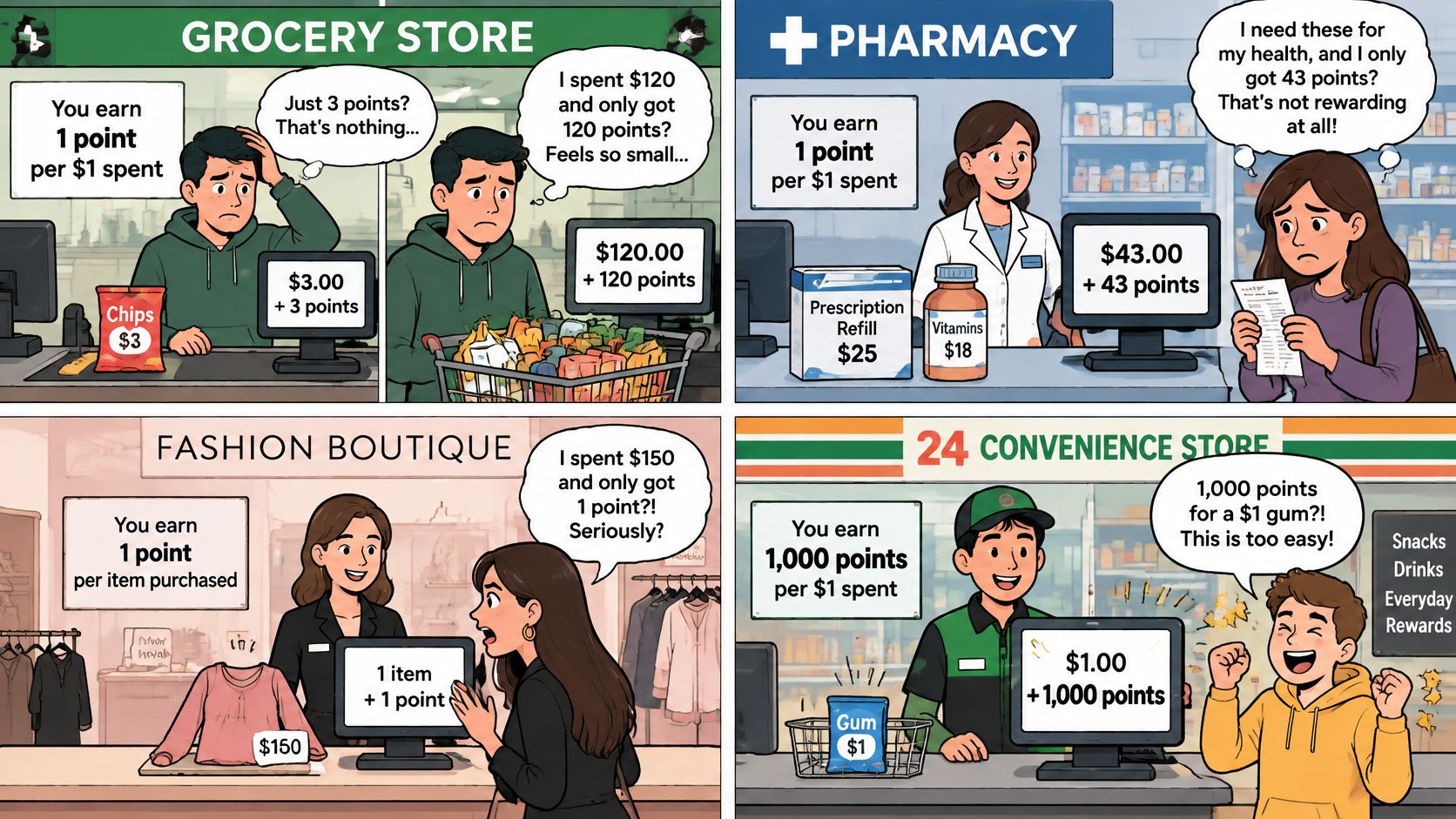
Grocery and convenience
A shopper grabbing a snack shouldn't necessarily earn the same reward progress as a household filling a trolley. Spend-based points acknowledge the difference without requiring the cashier to make a judgment.
A category bonus might encourage shoppers to buy household goods they usually purchase elsewhere. The mistake is applying a blanket incentive to staples those customers already buy from you, then calling the discounted sales growth.
There's commercial potential in relevant offers, but scope matters: McKinsey reports that personalization at scale typically produces a 1–2% lift in total sales for grocery companies. That's not a forecast for an independent shop's new reward card.
Cafes and bakeries
For a cafe with similar drink orders, stamps make progress easy to recognize. A customer approaching the reward may choose your counter rather than a competitor's.
The exception is the large order. A catering customer who receives the same progress as an individual coffee buyer may reasonably feel overlooked. Decide whether those purchases fit the core program before promising that every transaction earns identically.
Use the video below as a prompt for reviewing the customer-facing experience, then test the actual checkout motion with staff.
Salons and spas
A visit-based reward can suit a salon with consistent appointments. An add-on treatment may be easier to fund than a deep discount on the entire service, provided the appointment has room for the extra work.
Don't treat staff time as free. A reward that extends an already full appointment book can displace a paid service, even when its product cost looks low.
Independent apparel and gift shops
Points can recognize the difference between a small accessory purchase and a full outfit. Returns need particular attention: reverse the related earning so customers don't keep rewards from merchandise they no longer own.
Avoid copying a large retailer's coalition benefits or elaborate status system without its economics. Browse examples of stores with rewards programs for ideas, but fund your offer from your own margin. Match the earning unit to the typical basket, then review actual activity before adding complexity.
How to Set Up a Program Customers Will Use
Keep the launch small enough that staff can operate it consistently. The purpose of the initial setup is to establish a clear exchange, not to activate every available promotion.
Build the operating rule
Pick the model before issuing cards. Use the store's transaction pattern, not its branding, to make the choice. Treat the selection as fixed once customers start earning, and write down how refunds and mistaken entries will be handled.
Tie earning to an observable purchase. For stamps, define what qualifies and whether separate purchases during the same visit count separately. For points, specify the eligible spend and rounding rule. Keep a welcome bonus modest, and set a maximum balance where the system supports it.
Cost the reward before designing the card. Include product cost, packaging, extra labor, and any displaced paid sale. Expected reward cost per incremental visit must remain below the contribution that visit adds. Don't cost a free product solely at its shelf price, but don't ignore the sale it might replace either.
Make the card easy to carry. A pass in Apple Wallet or Google Wallet avoids asking customers to install another shopping app. Check that its wording remains readable on a phone screen, especially the earning condition and reward entitlement.
This setup path keeps the customer experience separate from unnecessary technical work.
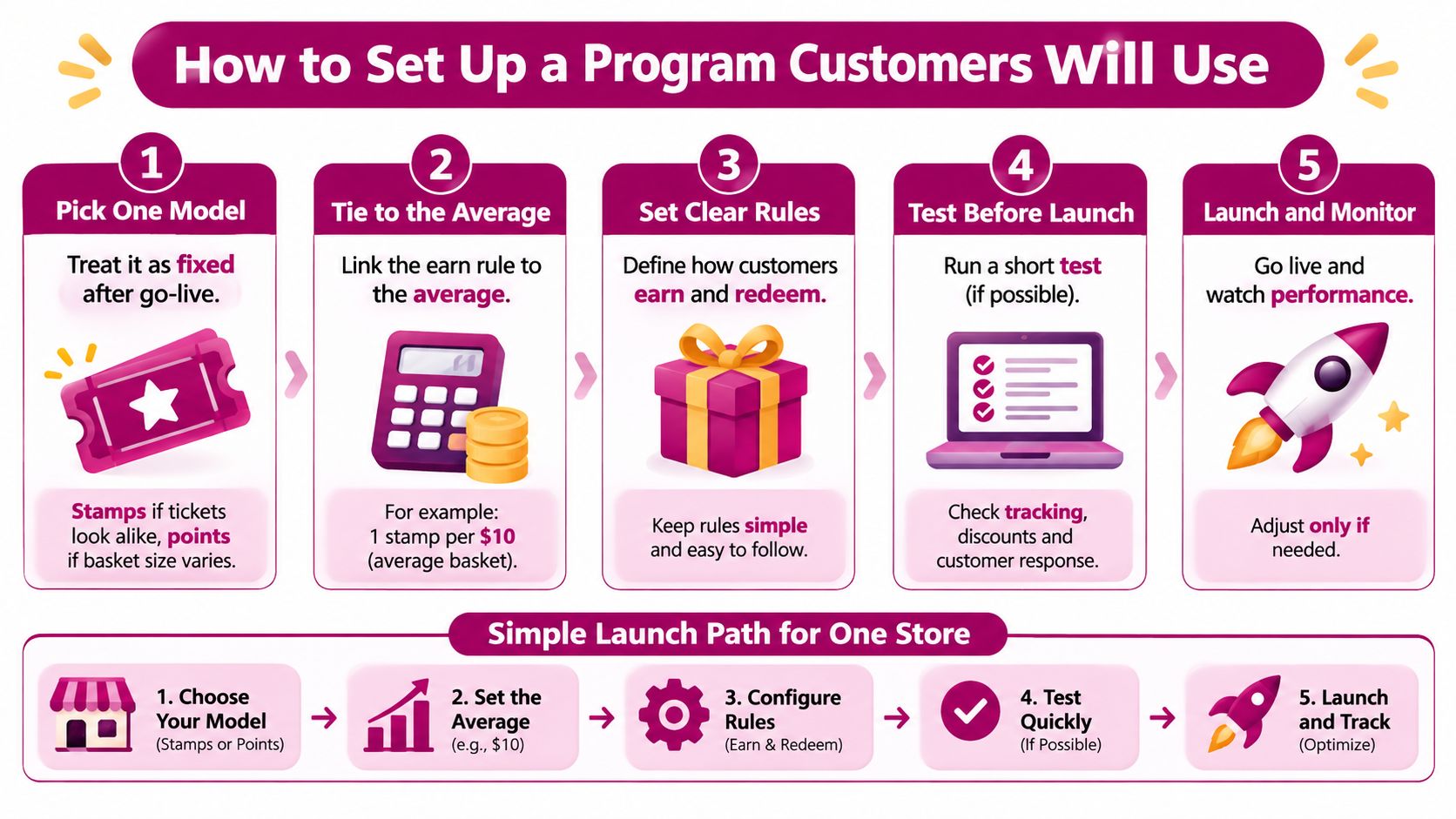
Put the rule into daily use
Place enrollment where customers can act. Put a counter QR code beside a short explanation of the benefit. The public sign-up page should match that promise, rather than introducing a long list of unexpected requirements after the scan.
Rehearse checkout and redemption. Have staff practice adding progress, redeeming a reward, and correcting an error while taking payment. A basic phone-operated workflow doesn't need POS integration, but it does need a designated staff responsibility so transactions aren't missed.
Explain the data exchange clearly. Tell customers what you store, why you need it, and whether you'll use it for marketing or personalization. A consumer privacy survey reported through Business Wire found that 53% of privacy-aware consumers were comfortable with personalization, compared with 19% of privacy-unaware consumers. Ask only for information needed to administer the reward, separate optional marketing consent, and provide a clear way to opt out.
Trial the basic rule before adding offers. Keep the earning and redemption conditions stable while you establish a baseline. Record staff problems, customer questions, and reward costs alongside purchasing activity. Use the loyalty program launch playbook to turn those tasks into a repeatable counter routine.
A non-personalized stamp card can deliver understandable value without a detailed customer profile. Purchase-based segmentation needs transaction history; individualized recommendations need more information and explanation. Choose the least intrusive approach that can achieve the intended behavior, and monitor consent withdrawals as well as purchases.
Judge Loyalty by Active Use and Margin
US consumers held an average of 19 loyalty-program memberships in 2024, but only 9.3 were active on average, according to Deloitte's loyalty reporting. A large enrollment total can hide a program that customers rarely use. Count activity within the store's normal purchase cycle, not everyone who has ever joined.
From the shopper's side, useful loyalty feels ordinary: a benefit they understand, progress they can check, and redemption that doesn't interrupt the purchase. From the merchant's side, that pleasant experience still needs to produce a worthwhile result.
Find the subsidized regular
Consider a customer who already buys lunch from you whenever they work nearby. They join, keep buying at the same frequency, and redeem a free meal. You've recognized their custom, but you haven't yet demonstrated an additional visit.
That's the subsidized-regular problem. Higher spending among members doesn't solve it because committed shoppers may be more inclined to enroll in the first place.
Deloitte's research on reshaping customer loyalty surveyed 5,564 US loyalty-program members, reflecting substantial attention to how customers value these schemes. Consumer interest, however, isn't evidence that a particular store's reward pays for itself.
Margin test: Credit the program only with behavior it plausibly changed, while charging it for every reward it funds.
Compare customers with similar purchasing patterns before enrollment. Track how their behavior changes afterward, and compare that change with a similar group that didn't receive the intervention. For bonus campaigns, randomly hold back the bonus from a comparable eligible group where practical, while honoring everyone's published base benefits.
Read the till results together
Use a spreadsheet if that's what the store can maintain reliably. Keep dates, a consistent customer identifier, purchase value, reward usage, and an estimated margin contribution. Mark holidays, closures, and major promotions so a seasonal surge doesn't get mistaken for a loyalty effect.
| KPI | What to compare | Warning sign |
|---|---|---|
| Active member rate | Members with a visit in the store's normal cycle versus all enrolled | High enrollment with few active members |
| Visit frequency | Enrolled versus similar non-enrolled customers, or before versus after joining | No change after the program starts |
| Average order value | Member baskets versus comparable non-member baskets | Baskets fall once discounts apply |
| Redemption rate | Rewards claimed versus rewards earned | Near zero may mean irrelevance; very high redemption needs a margin check |
| Gross margin after reward | Incremental margin minus reward cost | Reward cost exceeds the contribution from extra visits |
| Breakage | Earned rewards never redeemed | Treating unclaimed rewards as proof of success |
| Reward liability | Outstanding points or unfinished stamp cards | Balances grow without a funded redemption plan |
| Dormant share | Members with no visit beyond the store's normal cycle | Celebrating sign-ups while regulars go quiet |
Redemption alone isn't a verdict. Low redemption may mean the threshold is too remote, while high redemption may mean customers understand a good offer. Read either result alongside frequency and margin.
Outstanding rewards also need attention. Don't rely on breakage, meaning earned rewards that customers never redeem, to rescue a weak offer. Track the operational obligation and get accounting advice on its formal treatment.
Target behavior without building a dossier
Start with useful groups such as recent shoppers, frequent shoppers, and customers overdue for a return. McKinsey's loyalty guidance supports behavior-based segmentation and testing incremental outcomes rather than crediting every redemption as growth. You don't need an elaborate personality profile to identify a missed buying cycle.
Watch for customers moving purchases between channels rather than adding spending, or waiting for bonuses before buying. Include software and administrative costs when assessing the overall return. The loyalty program ROI calculator can help organize assumptions, but actual transactions must replace those assumptions after launch.
Keep stamps when simple progress produces profitable return visits. Keep points when spend-sensitive earning improves basket contribution or category purchasing. Neither model deserves to survive merely because customers have accumulated balances.
Choose Points or Stamps and Launch
Choose stamps when similar-value transactions make an additional visit the useful outcome.
Choose points when basket differences or category purchasing justify spend-based earning.
Make that decision before inviting customers. Don't launch competing rules at the counter or expect staff to decide which arrangement suits each shopper. Consistency matters more than offering every possible reward.
Give the counter team a usable promise
Write the reward in a sentence the cashier can say naturally. Identify the qualifying purchase, the reward, and any important exclusion. If the sentence becomes a speech, simplify the offer.
Prepare the sign-up prompt, rehearse the scan-and-redeem motion, and assign responsibility for resolving mistakes. Invite a manageable group of regulars to participate while staff learn the routine. Ask those customers to explain the reward back in their own words, because polite agreement doesn't prove understanding.
Launch a rule the store can honor during its busiest shift, not just during a quiet demonstration.
Decide what would justify keeping it
Set the review around the store's purchasing cycle. Check the active-member rate and the contribution remaining after reward cost, then investigate whether returning members changed their behavior.
If activity hasn't improved, diagnose the obstacle before rewriting the slogan. Customers may not understand the threshold, staff may forget to record purchases, or the reward may cost too much for the behavior it generates. Change the offer deliberately and preserve existing earned entitlements.
Loyal Customer supports a phone-operated digital points program or stamp card, with Apple Wallet and Google Wallet cards, no extra hardware, and no customer app. That removes setup work, but it doesn't remove the need to prove the economics.
Keep the program only when the additional customer behavior justifies its cost and operating effort.
Loyal Customer offers digital points and stamp cards that merchants manage from a phone, so you can test a retail reward without installing a POS integration or asking shoppers to download another app. Visit Loyal Customer to prepare your wallet-ready card and start the 7-day free trial when you're ready to launch. Bring a costed reward and a clear measurement plan, then let repeat purchasing decide whether to keep it.