
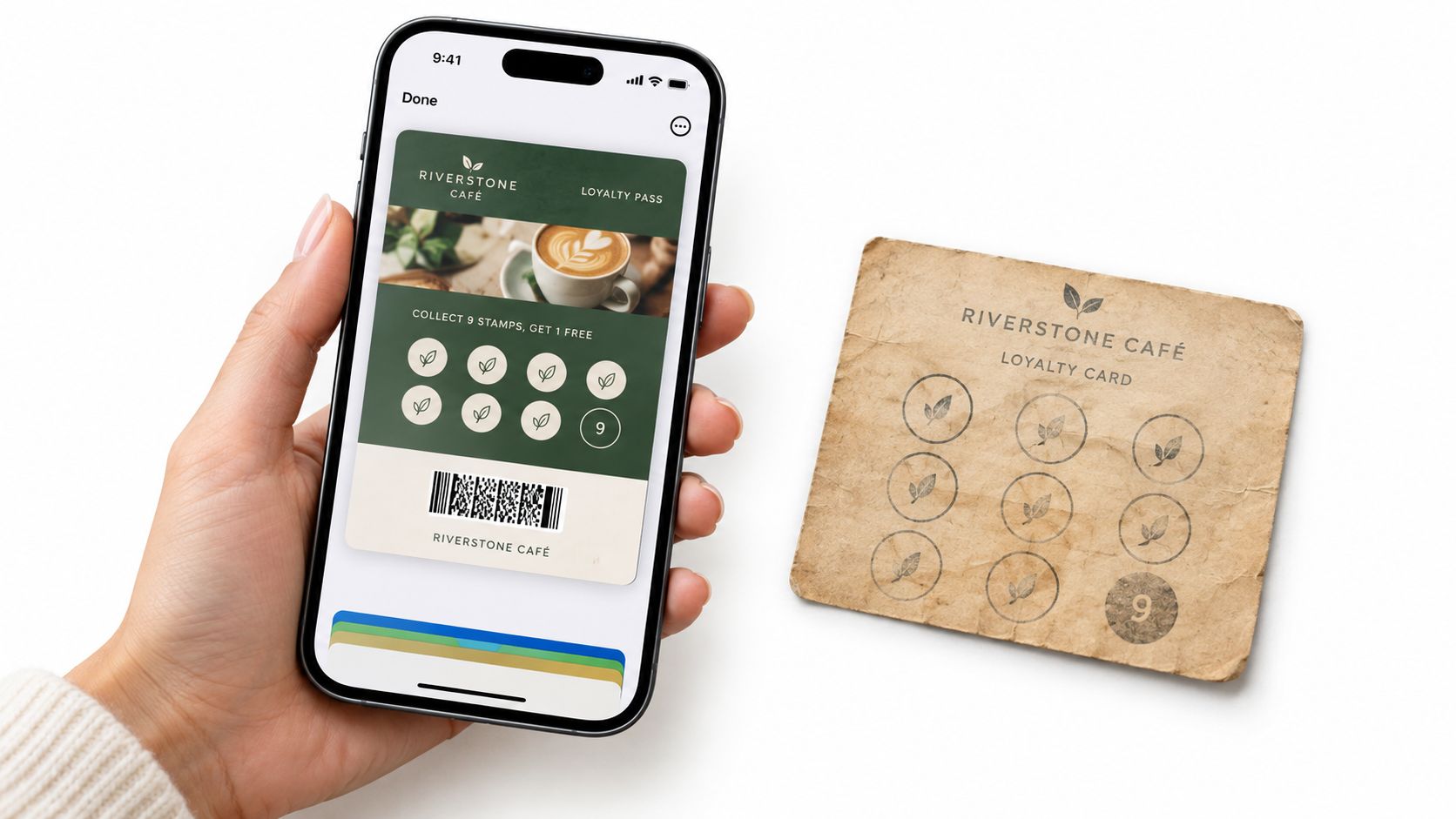
You've seen it happen. A regular asks for their coffee punch card, then realizes it's still on the kitchen counter, or worse, already lost in a bag they haven't used in weeks. The purchase still happens, but the next visit gets less likely because the reminder disappeared with the card.
That's where loyalty program digital changes the conversation. For a café, salon, or small shop, the main question isn't whether loyalty sounds modern. It's whether the program is easy to hand out, easy to remember, and easy to use when a customer is standing at the counter.
Practical rule: if the loyalty mechanic is simple, the delivery should be simple too.
If you run a small consumer business, this guide will help you sort out the basics, compare paper, app-based, and wallet-native options, and decide whether points or stamps fit your shop better. It also keeps the focus on the core problem behind most loyalty programs: getting people to use them.
Table of Contents
- Introduction to Digital Loyalty for Everyday Businesses
- How a Digital Loyalty Program Actually Works
- Physical Cards Versus Digital Passes at a Glance
- Wallet Native Versus App Based Loyalty Compared
- Why Enrollment Is Easy but Activation Is the Real Challenge
- Real World Examples for Cafes Salons and Small Retail
- Choosing Your Approach and Getting Started Quickly
Introduction to Digital Loyalty for Everyday Businesses
A paper card works until it doesn't. It gets bent, forgotten, washed, or left in a wallet pocket nobody checks, and the customer who meant to come back next week walks out without a reminder of the reward.
Digital loyalty keeps the card on the phone instead of in a drawer. That matters because the loyalty management market was valued at $15.19 billion in 2025, is projected to reach $17.38 billion in 2026 and $51.65 billion by 2034, with a 14.6% CAGR across that forecast period, which shows how far this category has moved beyond a niche tactic into mainstream software investment. Antavo's loyalty statistics also place loyalty in the wider world of points, stamps, wallet passes, and CRM-linked engagement, not just one-off promotions.
What changes for the customer and the merchant
For customers, the win is obvious. The pass lives where they already look, on their phone. For merchants, the change is less about technology and more about flow, because a loyalty card that's easy to issue is easier to keep consistent on busy days.
That's why the format matters as much as the reward. If you can decide between points or stamps, and between a wallet pass or an app, you can choose the lightest setup that still fits your checkout routine.
How a Digital Loyalty Program Actually Works
Think of a paper coffee punch card, but the card lives inside a phone wallet. The customer signs up once, the merchant issues the pass from a smartphone, and each visit adds a stamp or points balance that the system keeps track of for both sides.
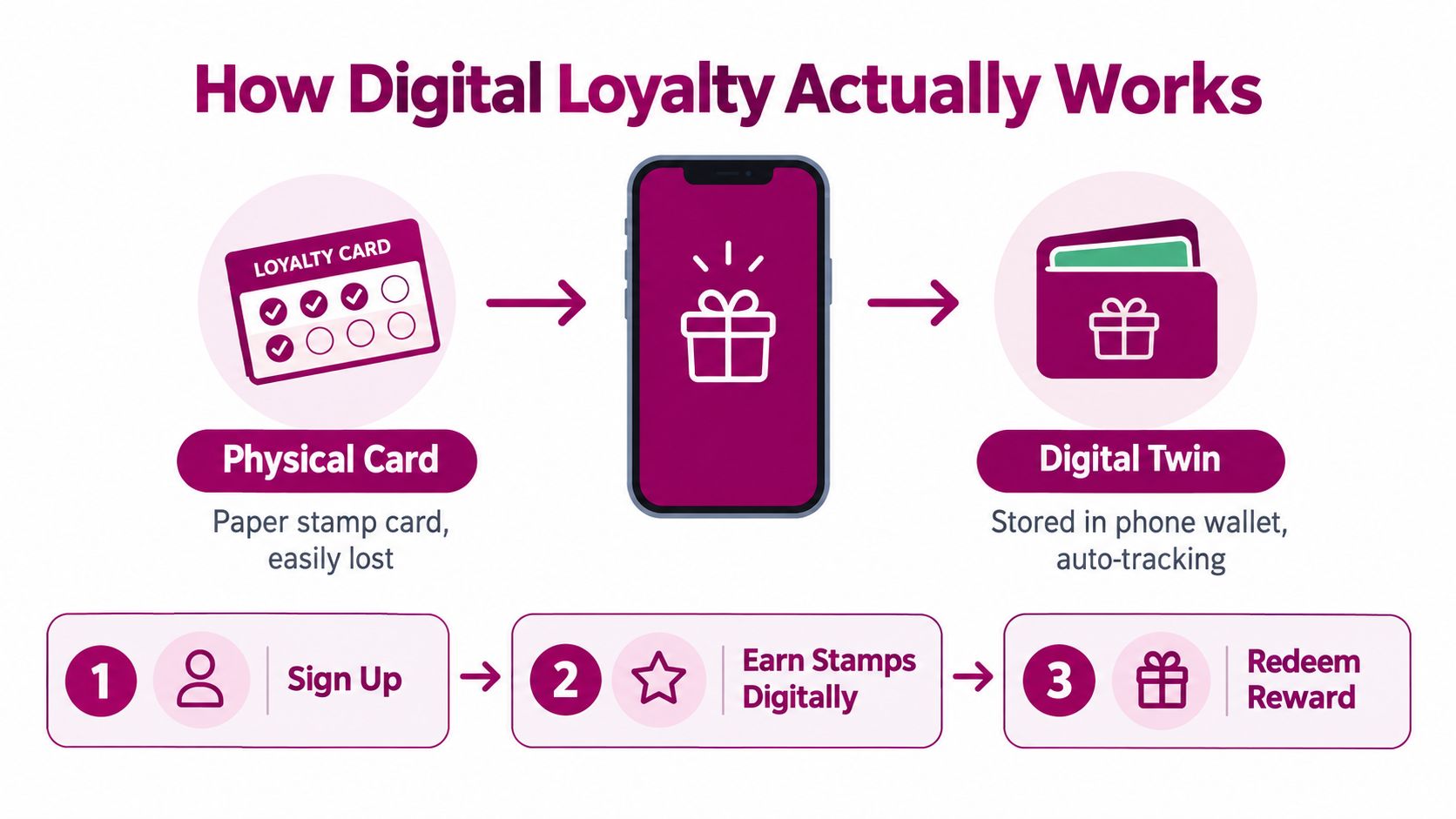
The simplest version is visit-based. A café can use a stamp card for every latte or sandwich, while a salon might prefer points for varied ticket sizes and service bundles. The customer adds the pass to Apple Wallet or Google Wallet, then shows it at checkout, and the merchant updates the reward from a phone instead of counting paper marks by hand.
You can see the setup flow in a basic walkthrough like this how-it-works guide. The important part is that the customer doesn't need to remember a separate card, and the merchant doesn't need a desk full of printed stock.
A good digital loyalty setup should feel like handing out a regular card, only without the printing, reprinting, or “I forgot it at home” moment.
The wallet stays useful because it's always on the device. That makes it a practical home for repeat-visit rewards, especially when the business wants a lightweight system that doesn't depend on a terminal or a complicated checkout flow.
Physical Cards Versus Digital Passes at a Glance
Paper still has one advantage, it's familiar. But familiarity doesn't help much when cards go missing, rewards get miscounted, or the stack on the counter runs out at the wrong time.
Digital passes reduce that daily mess. They're easier to issue, easier to update, and easier for customers to carry, which matters in a market where Americans had an estimated 1.56 billion active loyalty program memberships in 2025 and the average consumer held 11.4 active loyalty accounts, rising to 20.3 memberships when inactive accounts are included. Capital One Shopping's loyalty program statistics shows how crowded that attention space already is, so convenience becomes a real advantage.
For a quick side-by-side view, use this digital vs paper loyalty comparison.
| Criteria | Paper Punch Card | Digital Wallet Pass |
|---|---|---|
| Distribution | Must be printed and handed out | Issued from a phone |
| Replacement | Needs reprinting if lost | Lives on the customer's device |
| Memory | Easy to forget at home | Easy to find at checkout |
| Updates | Manual tallying and hand edits | Balance updates happen digitally |
| Day-to-day use | Depends on the physical card being present | Built for repeat access on a phone |
The trade-off is straightforward. Paper is cheap to start, but digital is easier to keep in circulation once your customers begin coming back regularly.
Wallet Native Versus App Based Loyalty Compared
A lot of small merchants get stuck here. A standalone app sounds complete, but it asks for a download, an account, and a reason for the customer to keep another icon on their phone. A wallet-native pass uses the tools already built into the device, so the customer can add it faster and return to it more often.
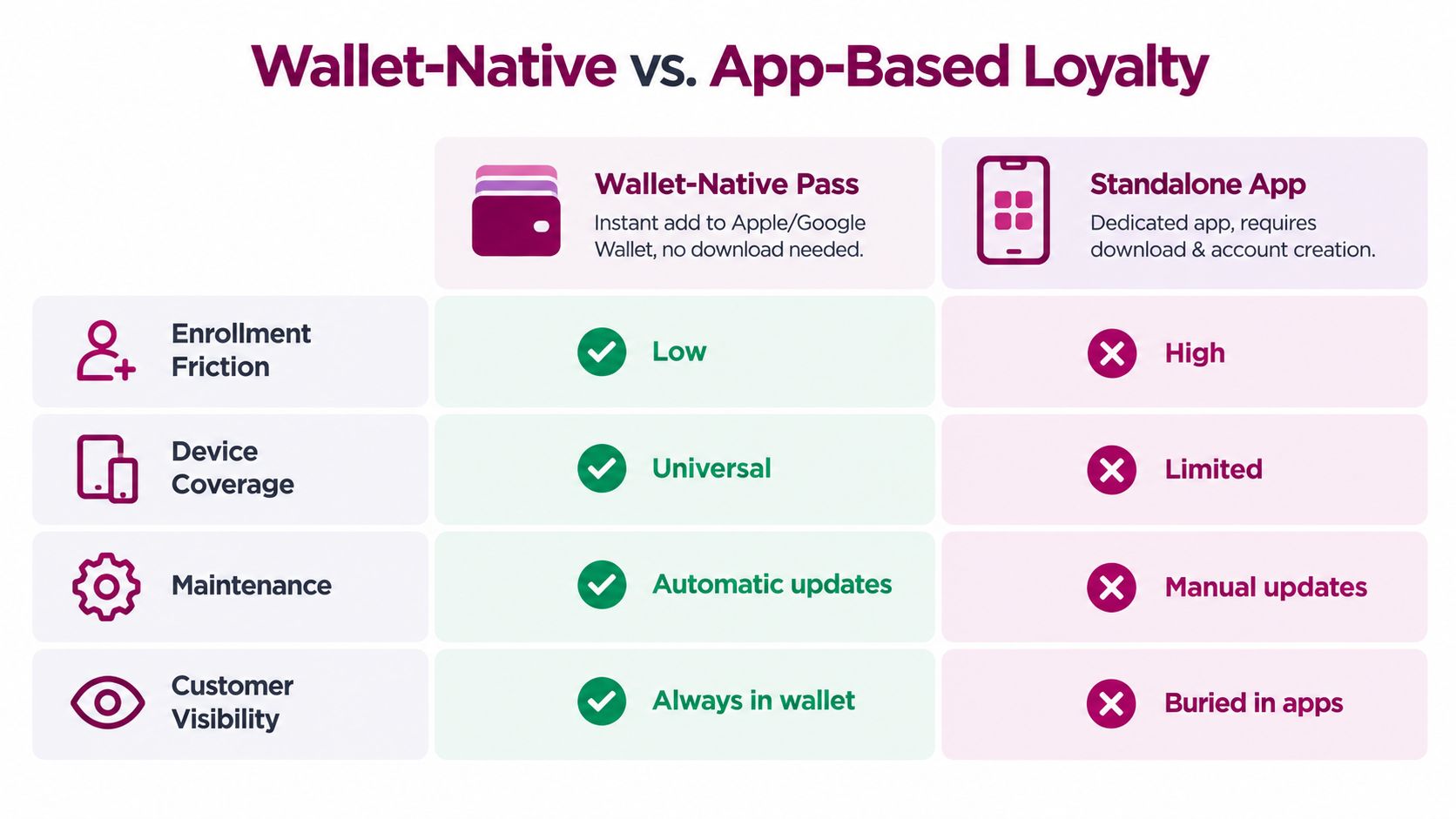
One independent industry report says wallet-pass enrollment averaged 3.1x higher than equivalent app-based programs in comparable retail deployments, and it links the lift to removing app-install and signup friction. Dataintelo's wallet-native loyalty report points to the core issue, people often don't want one more app for one more brand.
Why wallet-native usually fits small merchants better
Wallet-native loyalty also lines up with how people already use their phones. An independent mobile-wallet marketing study found that 69% of respondents were more likely to use a loyalty card if it was on their phone, with stronger interest among Millennials at 82% and higher-income households at 78%. The mobile wallet marketing study suggests that visibility and ease of access matter more than a fancy app feature set.
For a café, salon, or local retailer, that usually means less setup weight. The customer adds a pass, the merchant updates it from a phone, and the program stays close to the checkout moment instead of being buried in an app folder.
Good fit rule: choose the format customers can open fastest on a busy day, not the one that looks most advanced in a demo.
Why Enrollment Is Easy but Activation Is the Real Challenge
Getting a pass onto a phone is only half the job. The harder part is getting it used after the customer has already saved it, because digital wallets can turn into clutter just as easily as paper cards can disappear in a wallet.
A useful clue is how crowded the average customer's digital space already is. Consumers juggle multiple programs, and many of them prefer managing balances through a digital card instead of downloading another app. That means the problem isn't “can they enroll,” it's “will they remember to pull it up when they're standing in line.”
The trigger problem
Wallet-native passes help because they stay visible in the native wallet interface, where push updates and reminders can catch attention at the right moment. That's especially relevant for repeat-visit businesses, where the best nudge is often a simple reward reminder or a visible balance, not a long marketing message.
One independent industry source also says 82% of consumers who already have a brand's loyalty program on a digital card have used it to make a purchase, which points to a clear pattern, once the pass is in active use, behavior changes. 360 Magazine's digital wallet loyalty coverage frames the issue well, the gap is often after enrollment, not before it.
Merchants also miss this. Independent coverage says only 19% of consumers noticed retailers using mobile-wallet-based offers and loyalty, even though 85% said they'd welcome benefits beyond payments and 22% said digitalizing paper items was a top mobile-wallet priority. Brandmovers' mobile wallet loyalty article makes the point clearly, the format can work, but it still needs communication.
What merchants should do differently
- Use simple reminders: A visible wallet pass is more useful when you follow up with nearby offers or redemption prompts.
- Tie the pass to a repeat behavior: Weekly coffee, haircut refresh, or grocery top-up all work better than vague brand points.
- Avoid passive setup: If you issue the pass and never mention it again, it can sit unused.
The best wallet loyalty programs don't just exist. They get surfaced at the right time.
Real World Examples for Cafes Salons and Small Retail
A coffee shop usually needs speed. A 10-stamp digital card fits when the purchase pattern is repeatable and easy to explain, so the barista can issue the pass from a phone and the customer can tap back to it without extra thought. It suits a busy morning line better than a long rewards pitch.
A salon often has more variable spend, so points usually make more sense than stamps. One client buys a trim, another adds color, and another books a treatment, so a points balance can handle different ticket sizes without forcing every visit into the same shape.
For an independent grocery or specialty shop, wallet passes help cover iOS and Android without building a separate app. Customers add the pass to the wallet already on their device, then use it for repeat visits, seasonal deals, or simple reward tracking. The key question is not just format, it is whether the pass stays visible enough to bring people back.
If you want a merchant-side option that supports points, digital stamps, and wallet-ready cards from a phone, Loyal Customer fits that basic workflow. The platform matters less than the daily habit it creates, the customer sees the pass, the merchant updates it, and the reward stays tied to the visit.
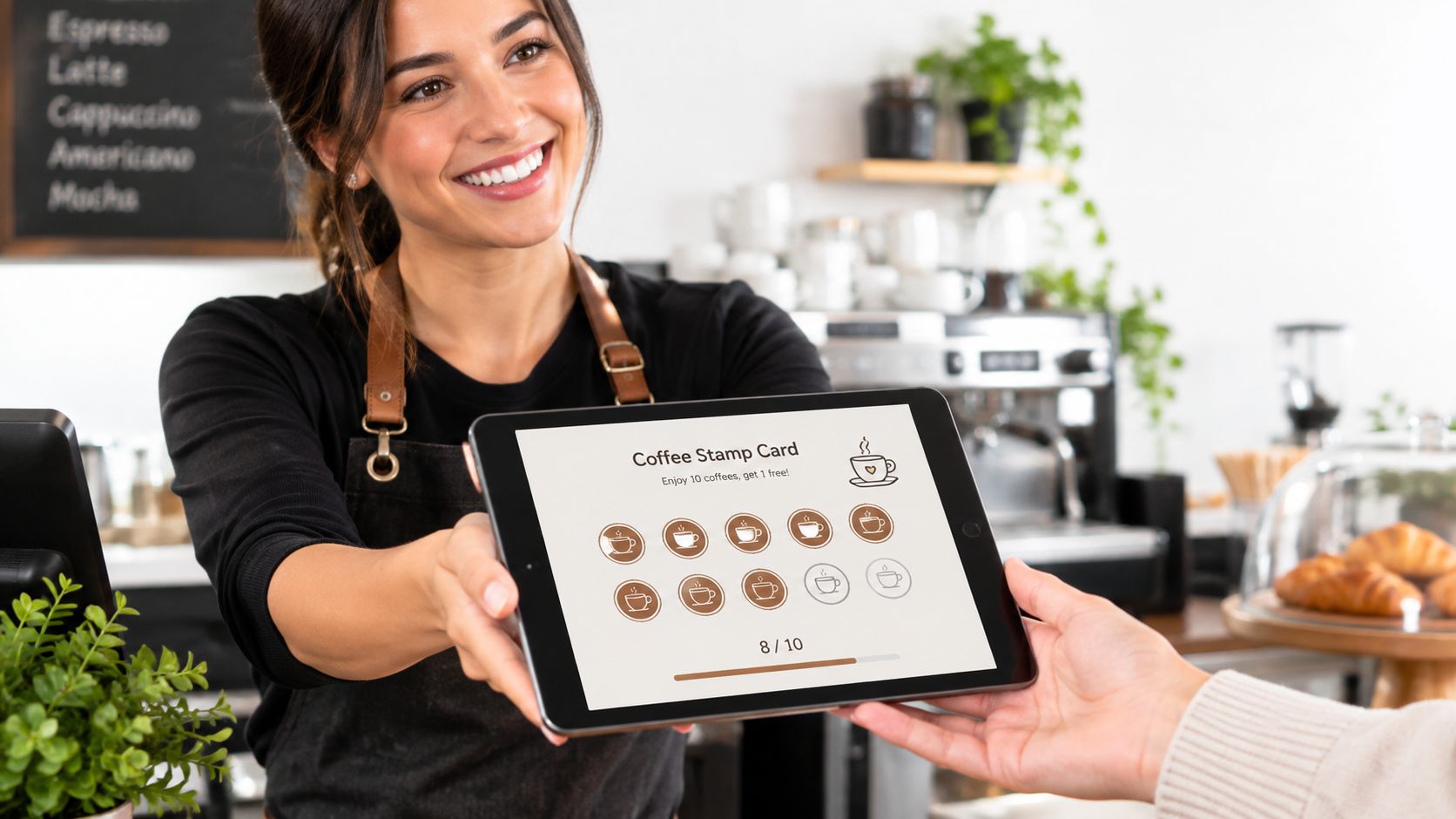
The strongest small-business examples stay simple on purpose. When the reward is obvious and the pass is easy to reach, the program feels less like software and more like a habit.
Choosing Your Approach and Getting Started Quickly
If your business sells the same thing over and over, start with stamps. If order value changes a lot, points are usually the cleaner fit. If your priority is fewer clicks for customers, choose wallet-native before you choose anything app-heavy, because lower friction usually beats extra features in a small shop.
A quick setup guide can help you move from idea to test faster, and a getting-started guide is useful if you want to see the setup flow before committing. A free trial also gives you room to check whether the pass looks right on a phone and whether your team can run it from the counter without extra training.
The right loyalty choice is the one your regulars will use. Keep the system small, keep the pass visible, and make the reward easy to claim.
If you want a simple way to run points or stamp cards from a phone, Loyal Customer gives small businesses a practical way to issue wallet-ready loyalty passes without a heavy setup. Visit Loyal Customer to see how a digital loyalty program can fit the way your shop already works.



